




Key Takeaways
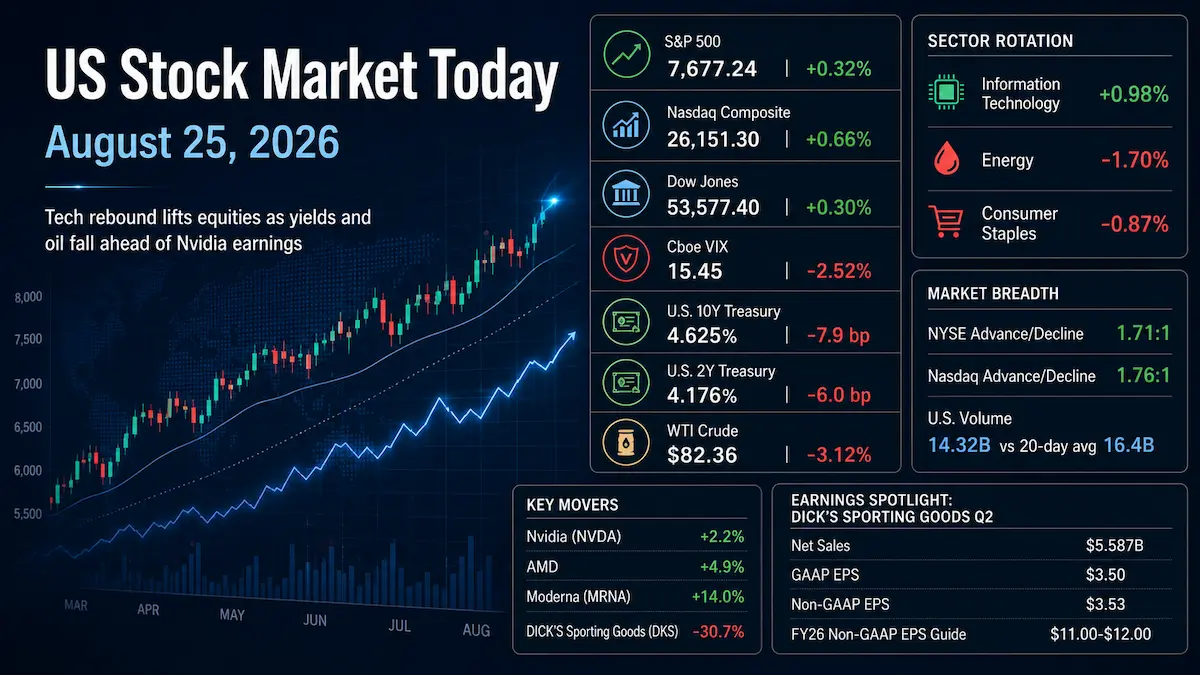
- The S&P 500 rose 0.32% to 7,677.28, the Nasdaq Composite gained 0.66% to 26,151.30, and the Dow advanced 0.30% to 53,577.40. The Russell 2000 added 0.50% to 3,010.02, showing that the rebound extended beyond mega-cap technology even though growth leadership remained decisive.
- Information Technology led the S&P 500 sectors with a 0.98% gain, while Energy fell 1.70%, the weakest sector, as crude oil prices retreated sharply. Consumer Staples declined 0.87%, reinforcing the session’s selective rather than indiscriminate risk-on character.
- Market breadth was positive: advancing issues outnumbered decliners by 1.71-to-1 on the NYSE and 1.76-to-1 on Nasdaq. However, U.S. exchange volume was 14.32 billion shares versus a 20-day average of 16.4 billion, arguing against treating the rebound as a high-conviction breakout.
- Cboe VIX fell 0.40 point, or 2.52%, to 15.45. The 10-year Treasury yield dropped about 7.9 basis points to 4.625% and the 2-year yield fell about 6.0 basis points to 4.176%, easing discount-rate pressure on long-duration equities.
- U.S. consumer confidence slipped to 89.4 in August from 90.2 in July, with the Expectations Index falling to 68.2 even as the Present Situation Index improved to 121.2. The split kept the growth outlook nuanced rather than delivering a clean macro risk-on signal.
1. Market Capital Flows and Sector Rotation
Tuesday’s close was best characterized as a selective duration-led rebound rather than a broad cyclical surge. The Nasdaq Composite outperformed with a 0.66% gain, while the S&P 500 rose 0.32% and the Dow added 0.30%. Small caps also participated, with the Russell 2000 up 0.50%, suggesting that lower yields provided some relief to rate-sensitive risk assets beyond the largest technology names. Within the S&P 500, Information Technology was the strongest sector at +0.98%, followed by Communication Services at +0.46% and Materials at +0.35%. Energy was the clear laggard at -1.70%, followed by Consumer Staples at -0.87%, Industrials at -0.30% and Consumer Discretionary at -0.27%. Financials rose 0.17%, Health Care gained 0.33%, Real Estate added 0.10%, and Utilities advanced 0.21%. Growth leadership was therefore clearer than value leadership: technology and communication services benefited from lower yields, while value and cyclical sectors were mixed rather than uniformly weak or strong. Defensive sectors were also mixed, with Staples falling while Health Care and Utilities gained.
Breadth was constructive but not euphoric. Advancers led decliners by 1.71-to-1 on the NYSE and 1.76-to-1 on Nasdaq, while the S&P 500 registered 11 new 52-week highs against four new lows. Still, total U.S. exchange volume of 14.32 billion shares was below the 16.4 billion 20-day average. That combination points to a reasonably broad rebound with lighter-than-normal participation, not the kind of volume confirmation that would by itself validate a durable change in trend.
Institutional Flow Insight: The price action is consistent with tactical re-risking toward duration-sensitive growth as Treasury yields and crude oil declined, rather than evidence of a wholesale increase in institutional risk budgets. Lower long-end yields mechanically reduce the discount-rate headwind for high-multiple technology, while the oil decline reduced near-term inflation and term-premium pressure but simultaneously weakened the earnings beta of energy producers. The resilience of small caps and positive breadth argues that the move was not purely a handful of mega-cap stocks, yet below-average volume and weakness in several cyclical and defensive groups suggest investors were still selective. Ahead of major inflation data, NVIDIA earnings and the Federal Reserve’s Jackson Hole communication, maintaining flexibility likely remained more valuable than chasing a single factor regime.
2. Decoding the Biggest Market Movers
DICK’S Sporting Goods (DKS)
DICK’S Sporting Goods plunged 30.7% at the close after the company materially reduced its 2026 outlook as weakness in the acquired Foot Locker business offset continued strength in the core DICK’S operation. The company’s second-quarter release reported consolidated net sales of $5.587 billion, up 53.2% year over year because the current period includes Foot Locker. GAAP operating margin fell to 7.9% from 12.4%, and non-GAAP operating margin declined to 8.1% from 13.0%. GAAP diluted EPS was $3.50 versus $4.71 a year earlier, while non-GAAP diluted EPS was $3.53 versus $4.38.
The more important business signal was the divergence between the two operating platforms. DICK’S Business comparable sales rose 4.9%, while Foot Locker pro forma comparable sales declined 3.6%. Management said parts of the athletic footwear and apparel marketplace became increasingly promotional, with Foot Locker more exposed to legacy footwear silhouettes and dependent on launch and retro products. The company maintained its DICK’S Business full-year comparable-sales outlook at +2.5% to +4.0% but cut Foot Locker’s pro forma comparable-sales outlook to -2.0% to 0.0%, from the prior +1.5% to +3.0% range. Consolidated 2026 net-sales guidance was reduced to $21.9 billion-$22.2 billion from $22.1 billion-$22.4 billion, while non-GAAP EPS guidance fell to $11.00-$12.00 from $13.50-$14.50. GAAP EPS is now expected at $10.94-$11.94, with GAAP operating income of $1.45 billion-$1.55 billion and non-GAAP operating income of $1.46 billion-$1.56 billion.
The read-through is more specific than a blanket collapse in U.S. sports demand. Core DICK’S comps remained positive, while the pressure was concentrated in Foot Locker’s product mix, inventory exposure and a more promotional legacy sneaker environment. Even so, the magnitude of the guidance reset raises the required risk premium for athletic retail integration stories and can pressure valuation assumptions across footwear brands and retailers with heavy wholesale or legacy-silhouette exposure. Nike shares also weakened during the session, underscoring the sector-level sensitivity to DICK’S commentary.
NVIDIA (NVDA)
NVIDIA rose 2.2% as investors rebuilt exposure ahead of the company’s fiscal second-quarter 2027 results scheduled for Wednesday, August 26, after the U.S. close. The move helped lift the Philadelphia Semiconductor Index by 1.4%; Micron gained 2.5% and Advanced Micro Devices rose 4.9%. NVIDIA’s advance was not triggered by a new operating announcement during Tuesday’s regular session, so it is better interpreted as pre-earnings positioning amplified by lower Treasury yields after a period of pressure on growth stocks. Because NVIDIA is a major index weight and a bellwether for AI infrastructure spending, the company’s report has implications beyond one stock: revenue trajectory, margins, demand visibility and hyperscaler capital-spending signals can affect semiconductor valuations, data-center suppliers and the broader market’s willingness to pay premium multiples for AI-linked growth.
3. Macro Indicators and Market Outlook
The Cboe VIX finished at 15.45, down 0.40 point or 2.52%. That decline was directionally consistent with gains in equities and falling Treasury yields, indicating that near-term demand for S&P 500 volatility protection eased. The move was modest rather than a collapse in hedging demand, which is appropriate given the concentration of event risk immediately ahead: inflation data, NVIDIA earnings and the Federal Reserve’s Jackson Hole communication could all reprice index-level volatility quickly.
Rates provided a meaningful tailwind. The 10-year Treasury yield fell about 7.9 basis points to 4.625%, while the 2-year yield declined about 6.0 basis points to 4.176%. With the long end falling slightly more, the 2s10s curve experienced a modest bull flattening while remaining positively sloped by roughly 45 basis points. The move reflected several forces rather than a single monetary-policy conclusion: softer forward-looking consumer confidence, a sharp drop in oil prices and continued assessment of expanded Treasury buybacks all helped ease pressure on bonds. A one-day yield decline should not be treated as confirmation of a future Fed cut or as a reversal of inflation risk; the next inflation and policy signals remain capable of moving both front-end expectations and the term premium.
Oil had unusually clear explanatory power for equity rotation. WTI crude settled 3.12% lower at $82.36 a barrel and Brent fell 3.89% to $88.58. Lower crude prices reduced an immediate source of inflation anxiety and helped duration-sensitive equities, while directly weighing on the Energy sector’s earnings sensitivity. The U.S. dollar was little changed on the day, so it was less important than rates and oil in explaining the session’s cross-sector behavior.
Upcoming Economic Data & Catalysts:
- Personal Income and Outlays, July 2026 (Release date: August 26, 2026): The Bureau of Economic Analysis will release income, spending and the PCE price indexes at 8:30 a.m. EDT. Investors will focus on whether inflation and consumption data alter the balance between persistent price pressure and slowing household demand, with direct implications for Treasury yields and equity valuation multiples.
- Federal Reserve Chair Kevin Warsh — Jackson Hole Keynote Remarks (Release date: August 28, 2026): The Federal Reserve calendar lists the chair’s keynote for 10:00 a.m. EDT. Markets will watch how the Fed frames inflation persistence, growth resilience, financial conditions and the reaction function; the most important cross-asset risk is a material repricing of the expected policy path or longer-run term premium.
Market Insights:
The August 25 advance was broader than a pure mega-cap squeeze because small caps rose and advance-decline ratios were positive, but the strongest leadership still came from technology and semiconductors. The more useful interpretation is selective risk appetite supported by rate relief, not indiscriminate risk-taking. The trend could reverse if Treasury yields resume their climb, market breadth weakens while cap-weighted indexes remain elevated, earnings guidance deteriorates, oil rebounds sharply enough to revive inflation concerns, or VIX breaks higher as event risk is repriced. Valuation remains especially relevant for growth stocks where execution is already embedded in expectations.
Trading & Investment Strategy:
Risk management should take precedence over chasing a one-day rebound ahead of concentrated catalysts. Investors can use staggered entries rather than full-size deployment, keep single-stock exposure proportional to event risk, and distinguish companies with visible earnings power from stocks benefiting mainly from falling discount rates. Technology leadership can remain attractive while yields are contained, but position sizing should reflect elevated sensitivity to NVIDIA results and macro data. In consumer discretionary, favor balance-sheet strength, differentiated demand and cleaner inventory rather than assuming all retailers will share the same demand profile. In energy, a sharp oil move can overwhelm company-specific fundamentals in the short run. Predefined loss limits, portfolio diversification and avoiding late-session momentum chasing remain important when volatility can reprice quickly around scheduled events.
4. Key FAQs About the US Stock Market Today
Why did the US stock market move on August 25, 2026?
U.S. stocks rose as technology rebounded, Treasury yields declined and crude oil prices fell. Lower yields reduced discount-rate pressure on growth equities, while weaker oil eased an immediate inflation concern. Positive market breadth showed participation beyond mega-cap technology, although below-average volume and losses in Energy, Staples, Industrials and Consumer Discretionary kept the session selective. Consumer confidence also weakened modestly, adding a softer growth signal without producing a broad risk-off response.
Which sectors performed best and worst in the US stock market on August 25, 2026?
Information Technology was the best-performing S&P 500 sector, rising 0.98%, while Energy was the worst, falling 1.70%. Technology benefited from lower Treasury yields and pre-NVIDIA earnings positioning. Energy lagged as WTI and Brent crude fell sharply, reducing near-term commodity-price support for producer earnings. Communication Services also gained 0.46%, while Consumer Staples fell 0.87%, showing that the day’s rotation was driven more by rates and commodity sensitivity than by a simple cyclical-versus-defensive split.
What should investors watch after the US stock market close on August 25, 2026?
The immediate focus is the August 26 Personal Income and Outlays report, including PCE inflation, followed by NVIDIA’s fiscal second-quarter results after Wednesday’s close and Fed Chair Kevin Warsh’s Jackson Hole keynote on August 28. Investors should watch whether the 10-year yield holds below the levels that recently pressured growth stocks, whether market breadth remains positive, and whether technology can sustain leadership without a renewed rise in VIX. A reversal in yields, weaker earnings guidance or a renewed oil shock would challenge the session’s constructive setup.
Selected Primary Sources
Disclaimer: This article is intended solely for the exchange of investment ideas and does not constitute investment advice of any kind.