

Key Takeaways
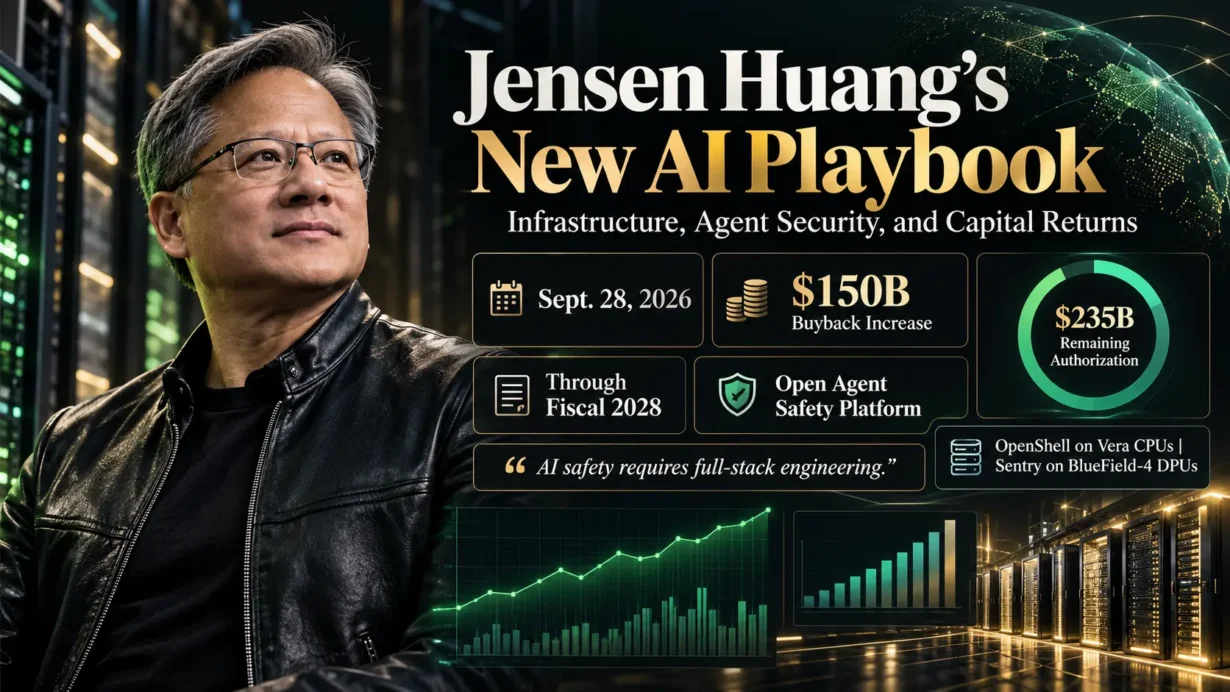
- Jensen Huang’s September 28, 2026 CNBC interview delivered a dual message to investors: the AI infrastructure cycle remains unusually large, while the next adoption bottleneck is shifting from raw model capability to safe deployment of autonomous agents.
- Nvidia is positioning agent security as a full-stack systems problem. OpenShell creates a controlled runtime boundary, while Sentry uses BlueField-4 DPUs as an independent hardware watchdog—potentially expanding Nvidia’s role from compute supplier to AI control-plane provider.
- The strategic read-through is important: if enterprises require enforceable permissions, auditability and hardware-isolated controls before deploying agents at scale, security spending can become a prerequisite for AI production workloads rather than an optional add-on.
- Huang reiterated that AI adoption should spread far beyond hyperscalers, arguing that banks, retailers, automakers and other enterprises will become AI companies. That broadening matters because Nvidia’s next leg of growth increasingly depends on enterprise inference and agentic workloads, not only frontier-model training.
- Nvidia’s simultaneous $150 billion increase in share-repurchase authorization, lifting remaining authorization to $235 billion through fiscal 2028, is a major capital-allocation signal. It supports the equity story, but investors should still separate buyback optics from evidence of sustainable end-demand.
Among the major technology leaders who spoke publicly over the past week, Jensen Huang’s September 28 appearance on CNBC’s Squawk Box stands out for investors because it connected three issues that increasingly determine Nvidia’s valuation: the durability of AI infrastructure spending, the security architecture required for autonomous agents, and management’s willingness to return a rapidly growing cash pool to shareholders. The interview coincided with Nvidia’s launch of its Open Agent Safety Platform and the largest increase to a share-repurchase authorization ever announced by a U.S. company.
The market relevance goes well beyond a new security product. Huang is effectively arguing that the AI stack is moving into a new phase. The first phase rewarded companies that could train the largest models. The next phase will reward platforms that can run large numbers of agents safely across enterprise data, applications, networks and physical systems. If that thesis is correct, the competitive battleground shifts from GPU performance alone toward system architecture, networking, runtime controls, observability and hardware-enforced governance.
1. Core Views Reconstructed
“Largest infrastructure build out in human history”
Huang’s most important market message was not about one chip cycle. It was that AI is driving an infrastructure transition of exceptional scale, with Nvidia sitting near the center of the buildout. The commercial logic is straightforward: generative AI is evolving from model training into persistent inference, reasoning, agent execution and eventually physical AI. Each step increases the number of workloads that require accelerated compute, high-speed networking, memory bandwidth and data-center capacity. For investors, the crucial implication is that the addressable market can expand even if training efficiency improves, because the number of production workloads can grow much faster than the compute required for any single task declines.
“Browser for agents”
Huang compared the emerging agent-security layer to the role browsers eventually played in containing web applications. The analogy is strategically revealing. Nvidia does not want to sell only the compute that makes an agent intelligent; it wants to help define the execution environment that determines what the agent is allowed to access and do. OpenShell is designed to create a runtime boundary around agents, while Nvidia Sentry sits outside that environment and can monitor or quarantine behavior through BlueField-4 DPUs. If enterprises standardize around this architecture, Nvidia can potentially increase the amount of Nvidia hardware and software attached to each AI workload while making its stack more deeply embedded in production systems.
“Every company will become an AI company”
This is the demand-broadening thesis investors should focus on. Hyperscalers and frontier AI labs drove the first wave of accelerator demand, but that customer concentration cannot be the entire long-term story. Huang’s argument is that banks, retailers, industrial companies, automakers and other enterprises will internalize AI capabilities as core operating infrastructure. If agentic systems become embedded in customer service, software development, finance, logistics, cybersecurity and robotics, inference demand becomes distributed across far more organizations. That could reduce Nvidia’s dependence on a narrow group of mega-buyers over time, although the transition will depend on whether enterprises can demonstrate measurable returns on AI spending.
“Technically solvable problem”
Huang framed AI safety primarily as an engineering problem rather than a reason to halt development. For investors, the important point is not the policy debate itself; it is the business opportunity created by the need to make autonomous systems controllable. Agents that can access files, APIs, internal networks or physical equipment create a new class of security risk. Enterprises are unlikely to deploy them at meaningful scale without permission controls, isolation, monitoring and auditability. That turns safety architecture into a possible demand-enabler. In other words, better control systems may accelerate commercial AI adoption rather than merely add compliance cost.
“Return it back to shareholders”
Huang also emphasized Nvidia’s ability to generate cash while continuing to invest aggressively. The timing matters. On the same day as the CNBC interview, Nvidia announced an additional $150 billion of share-repurchase authorization, raising the remaining total to $235 billion and indicating that the program is expected to run through fiscal 2028. The investor message is that management believes the AI cycle can support both heavy innovation spending and extraordinary capital returns. Still, a buyback should not be treated as proof that the stock is undervalued or that AI demand is guaranteed. The more important test is whether free cash flow continues to grow after funding the capital, supply-chain, ecosystem and strategic investments required to defend Nvidia’s platform position.
2. Industry Chain and Sector Impact
Nvidia (NVDA): The security layer could deepen the platform moat
Nvidia is the clearest first-order beneficiary if agent security becomes embedded in the infrastructure stack. OpenShell is designed to run efficiently on Nvidia Vera CPUs, while Sentry operates on BlueField-4 DPUs and independently enforces security policies around agent behavior. That creates a potential pull-through mechanism: the more enterprises require hardware-isolated governance for autonomous agents, the more valuable Nvidia’s CPU, DPU, networking and software stack can become alongside GPUs.
The capital-market logic is equally important. Nvidia’s $235 billion remaining repurchase authorization gives management a powerful tool to offset dilution and return excess cash while the company continues investing in new computing platforms. The combination of platform expansion and capital returns can support earnings-per-share growth even during periods when valuation multiples compress. However, investors should avoid double-counting the same AI spending. If hyperscaler capex slows, security attach rates alone are unlikely to fully offset a broad deceleration in accelerator demand.
Palo Alto Networks (PANW): A second-order beneficiary if agent security becomes a budget category
Palo Alto Networks is one of the organizations Nvidia lists as working with its Open Agent Safety Platform technologies. The broader investment thesis is that agentic AI expands the attack surface: autonomous software can touch data, identity systems, APIs, cloud workloads and internal tools at machine speed. That increases the strategic value of zero-trust access, runtime monitoring, policy enforcement and cross-platform security operations.
For PANW, the opportunity is not that Nvidia’s announcement automatically creates material revenue. Partner participation alone is not evidence of earnings impact. The investable signal would be stronger if agent-security products begin showing up in customer spending commentary, platform bookings, annual recurring revenue or attach rates. Investors should therefore treat the Nvidia relationship as thematic validation of the security problem, not as a stand-alone reason to buy the stock.
3. Investor Action Strategy
1) Separate the AI demand thesis from the buyback signal
The repurchase authorization is supportive, but the core NVDA thesis still depends on cash generation being replenished by durable demand. Investors should monitor data-center revenue growth, hyperscaler and sovereign-AI capital spending, supply commitments, inference adoption and customer concentration. A large buyback can cushion volatility and improve per-share economics, but it cannot replace weakening end-demand. Treat capital returns as an amplifier of a healthy business, not a substitute for one.
2) Watch for evidence that agent security becomes a required infrastructure layer
The most important leading indicators are not headlines about AI safety. They are commercial adoption signals: OpenShell integrations, BlueField-4 deployment, Vera CPU adoption, enterprise agent rollouts, security attach rates and references to hardware-enforced governance in large customer deployments. If these indicators build, Nvidia may be expanding its economic capture per AI workload. If adoption remains mostly experimental and software-only alternatives dominate, the revenue impact could be far smaller than the strategic narrative suggests.
3) Define the downside case before adding exposure
Three risks deserve explicit portfolio limits. First, enterprise AI returns may take longer to materialize, slowing the migration from pilots to production. Second, regulators could impose safety or deployment requirements that raise costs faster than they increase trusted adoption. Third, Nvidia’s decision to make OpenShell open and interoperable is strategically useful for ecosystem adoption but could also limit direct monetization if customers use the standard on competing compute platforms. Position sizing should therefore be based on earnings durability and free-cash-flow resilience, not on the assumption that every new layer of the AI stack automatically becomes high-margin Nvidia revenue.
4. Frequently Asked Questions FAQ
What did Jensen Huang say in his September 2026 CNBC interview about Nvidia and AI infrastructure?
Huang argued that the AI industry is still in an unusually large infrastructure expansion and that Nvidia remains centrally positioned across the computing stack. He also shifted attention toward agent security, saying autonomous AI systems need tightly restricted permissions, controlled execution environments and independent monitoring before they can be safely deployed at scale.
How could Nvidia Open Agent Safety Platform affect NVDA stock?
The platform could strengthen Nvidia’s strategic moat if customers adopt its security architecture alongside Vera CPUs, BlueField-4 DPUs, networking and GPUs. That would increase Nvidia’s relevance per AI deployment rather than leaving it as only an accelerator vendor. The key uncertainty is monetization: investors need evidence of production adoption and hardware or software pull-through before assigning significant incremental earnings value.
Is Nvidia’s $150 billion buyback a bullish signal for investors in 2026?
It is a positive capital-allocation signal because Nvidia increased its authorization by $150 billion, bringing the remaining program to $235 billion through fiscal 2028. It indicates confidence in cash generation and provides potential support for per-share earnings. But a buyback is not a substitute for revenue growth. The more durable bullish case still requires sustained AI infrastructure demand, strong free cash flow and continued platform leadership.
Source: CNBC’s September 28, 2026 Squawk Box interview excerpts, the CNBC Squawk Pod episode, and Nvidia’s official announcements on the Open Agent Safety Platform and $150 billion repurchase authorization increase.
Disclaimer: This article is for informational purposes only and does not constitute investment advice.