




Key Takeaways
- Sam Altman’s August 23, 2026 interview delivered a crucial two-speed message for investors: frontier AI capability is advancing rapidly, but real-world adoption is being slowed by human habits, institutional inertia and an unfinished product experience.
- Altman said scaling compute is already, or is rapidly becoming, one of the most expensive infrastructure projects in history—linking the AI investment cycle directly to chips, fabrication, networking, racks, power systems, data centers, financing and logistics.
- The missing “iPhone moment” suggests the next major value-creation event may come from a superior AI interface or agent experience rather than another incremental model benchmark.
- OpenAI’s stated preference for platform economics—one broad AI interface plus an API—raises the strategic value of horizontal intelligence while increasing competitive pressure on application companies that lack proprietary data, distribution or workflow lock-in.
- For public-market investors, the near-term setup favors infrastructure bottlenecks such as accelerated compute and power-and-cooling capacity, but valuation discipline matters because adoption can lag infrastructure spending and create periods of severe multiple compression.
1. Reconstructing Sam Altman’s Core Investment Message
AI Has the Technology, but It Still Has Not Had Its “iPhone Moment”
Altman’s most consequential product observation is that the industry already possesses many of the technological building blocks for a radically different computing experience, yet users still spend much of their day interacting with computers in familiar, decades-old ways. The commercial implication is significant: model capability and monetizable behavior change are not the same thing. The AI sector may therefore be much further along on the technology S-curve than on the user-interface and workflow S-curve.
For investors, this helps explain why AI infrastructure demand can remain exceptionally strong even while some application-layer revenue curves look less explosive than the most aggressive forecasts. The bottleneck is shifting from “Can the model do it?” toward “Can a product make the new behavior effortless, habitual and economically superior?” The company that solves that interface problem could capture disproportionate distribution power, just as the iPhone reorganized mobile computing around a new user experience rather than merely introducing the first smartphone.
Compute Is Becoming a Historic Infrastructure Buildout, Not Just a Semiconductor Cycle
Altman framed compute expansion as a multi-industry coordination problem involving chips, fabs, racks, power systems, data centers, finance, policy, supply chains and logistics. That framing matters because it moves the AI thesis beyond a conventional semiconductor upcycle. The real investment stack increasingly resembles industrial infrastructure: long lead times, enormous capital commitments, scarce power, specialized cooling, complex financing and high switching costs once a facility architecture is selected.
The deeper message is that the AI capex cycle can remain large even if model economics improve. Lower inference costs do not automatically reduce total spending when falling unit costs unlock more use cases, higher query volumes, longer context, more autonomous agents and larger scientific workloads. Investors should therefore distinguish between cost per unit of intelligence and aggregate demand for intelligence. The former can fall rapidly while the latter expands even faster.
The Economy Has More Inertia Than the AI Industry Expected
Altman acknowledged that he had underestimated how slowly customers, companies and workers change established habits. This is one of the most investable observations in the interview because it challenges the simplistic assumption that better AI capabilities translate immediately into enterprise revenue. Corporate procurement cycles, security reviews, data integration, compliance, employee training and organizational redesign can all delay adoption even when the technology is clearly useful.
That slower absorption rate is not necessarily bearish for the long-term AI thesis. It can make the transition more orderly and extend the duration of the investment cycle. But it does create a timing mismatch: infrastructure suppliers may recognize demand through multi-year buildouts while software vendors must prove that AI features generate durable willingness to pay. In public markets, that mismatch can produce violent rotations between hardware, infrastructure, cloud and application-layer winners.
OpenAI Wants Platform Economics, Not a Collection of Every Possible AI Product
Altman said OpenAI should operate primarily as a platform: a broad direct interface to advanced AI plus an API that allows other businesses to build on top. He also described reallocating scarce compute and talent away from good products when they were less strategically important than general intelligence for knowledge work and science. The business logic is classic platform concentration—own the horizontal intelligence layer, maximize usage across the cost-performance curve and let third parties specialize at the application layer.
For investors, this raises the bar for AI software companies. A thin interface wrapped around a broadly available model is vulnerable to platform compression. Defensibility increasingly requires proprietary data, workflow integration, distribution, regulatory expertise, network effects or measurable domain-specific ROI. The winners should be businesses that use foundation models as an input while owning the customer relationship and the high-value workflow.
AI Capability May Advance Faster Than Society and Corporate Systems Can Absorb It
Altman expects technical capability to continue advancing faster than the economy can fully digest. This creates a powerful but non-linear investment setup. Supply-side capability may move in step changes, while enterprise adoption moves through budgets, governance and operating processes. That gap can create periods when the technology looks dramatically ahead of reported revenue—and other periods when accumulated adoption suddenly converts into explosive utilization.
The practical takeaway is to avoid using a single adoption metric as a verdict on the AI cycle. Investors should track model capability, token economics, data-center capacity, power availability, utilization, enterprise deployment, software pricing and free-cash-flow conversion as separate variables. The AI trade is no longer one trade; it is a chain of interdependent capital cycles with different lead times.
2. Industry Chain and Sector Impact
NVIDIA (NASDAQ: NVDA): The Most Direct Compute Beneficiary—With a Rising Capital-Intensity Caveat
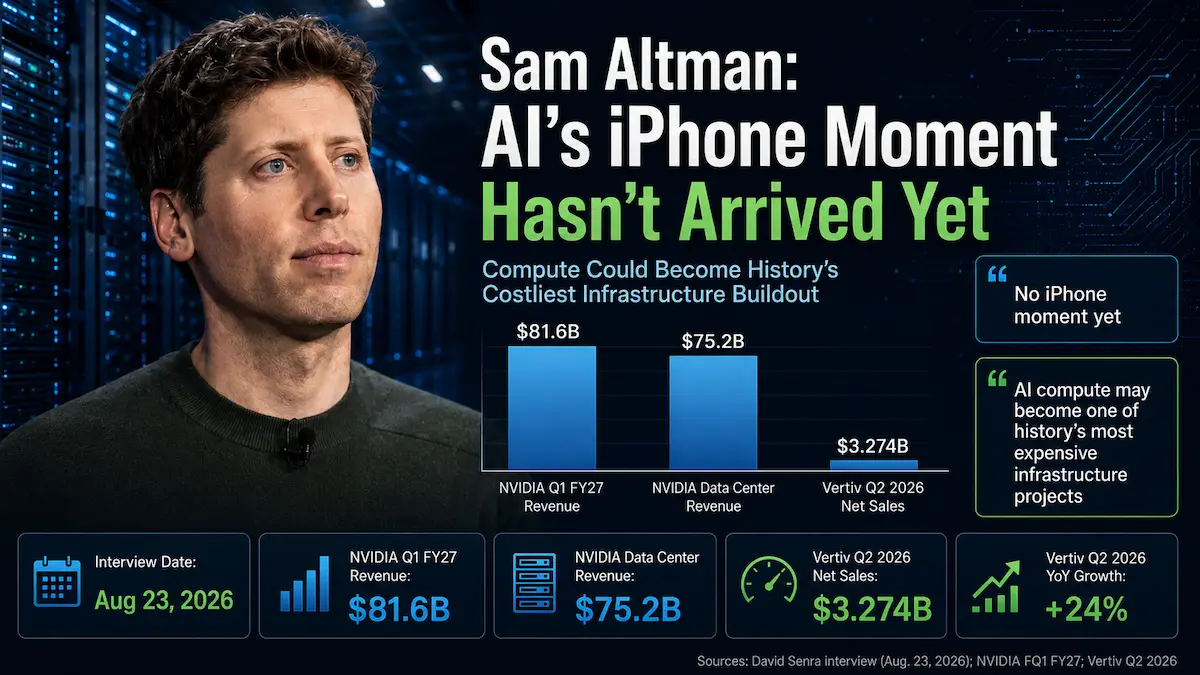
Altman’s description of compute as a massive, system-level infrastructure project maps directly onto NVIDIA’s core economic exposure. NVIDIA is no longer selling only accelerators; its data-center architecture increasingly spans GPUs, CPUs, networking, interconnects and full rack-scale systems. In its fiscal first quarter of 2027, NVIDIA reported $81.6 billion of revenue, including $75.2 billion from Data Center, while legacy reporting showed $60.4 billion of Data Center compute revenue and $14.8 billion of Data Center networking revenue.
The capital-market signal is equally important. NVIDIA recently announced partnerships with major alternative-asset managers and banks designed to mobilize more than $500 billion of third-party capital for AI infrastructure over time. It also disclosed a large Ohio campus arrangement tied to OpenAI demand. These developments reinforce Altman’s point that financing is becoming part of the compute stack itself: AI growth increasingly depends not only on chip supply, but on the ability to fund land, power, buildings and complete systems at unprecedented scale.
The risk is that stronger infrastructure demand does not eliminate competitive or economic pressure. Altman explicitly referenced designing custom chips as part of the compute problem. Custom silicon from hyperscalers and AI labs can pressure portions of the accelerator economics over time, while large financing commitments can increase concerns about customer concentration, ecosystem circularity and return on invested capital. NVDA therefore remains a high-quality expression of the buildout, but the stock should be evaluated against realized utilization and cash economics—not just announced gigawatts.
Vertiv Holdings (NYSE: VRT): A Second-Derivative Bet on Power Density and Thermal Complexity
If Altman is correct that compute scaling is fundamentally constrained by power systems, racks and physical infrastructure, Vertiv is positioned closer to one of the hardest bottlenecks than many traditional “AI software” names. Vertiv provides critical power, thermal management and integrated infrastructure for high-density data centers, where next-generation AI systems are increasing rack power density and accelerating the transition toward liquid cooling.
The operating data already show this infrastructure pull-through. Vertiv reported second-quarter 2026 net sales of $3.274 billion, up 24% year over year, with adjusted operating profit up 51% and adjusted operating margin reaching 22.6%. Management raised full-year guidance and said AI and general-compute demand continued to intensify as deployments became more complex and infrastructure-intensive. That is precisely the physical-world consequence of Altman’s compute thesis.
The investment caveat is duration risk. VRT is a leveraged beneficiary of data-center capex, which means the same operating leverage that can expand earnings in a capacity-constrained market can work in reverse if hyperscaler build schedules slip, power interconnections delay projects or customers digest previously ordered capacity. Investors should treat power and cooling as structural bottlenecks, but not assume a straight-line revenue path.
3. Practical Investor Strategy
Strategy 1: Separate Infrastructure Monetization From Application Adoption
Do not treat slower enterprise adoption as automatic evidence that the AI infrastructure thesis is broken. Long-lead-time data centers, grid connections, networking and cooling systems are funded years before many downstream applications reach mature monetization. A more disciplined framework is to maintain separate scorecards for infrastructure demand and software ROI. For NVDA and VRT, watch committed capacity, backlog quality, utilization and cash conversion. For application software, demand evidence of seat expansion, usage intensity, pricing power and measurable customer productivity.
Strategy 2: Respect Near-Term Event Risk—Especially NVIDIA’s August 26 Earnings
NVIDIA is scheduled to report fiscal second-quarter 2027 results on August 26, 2026, with results expected before its 2 p.m. Pacific conference call. Its prior-quarter outlook called for approximately $91.0 billion of Q2 revenue and roughly 75% non-GAAP gross margin. Because the AI complex is heavily indexed to NVIDIA’s demand signal, investors should avoid confusing a strong secular thesis with a guaranteed positive post-earnings reaction. The critical questions are whether demand remains broad beyond a handful of hyperscalers, whether Rubin-related visibility strengthens, whether networking growth confirms system-level expansion and whether gross margins remain resilient as system complexity rises.
Strategy 3: Build a Thesis-Breaker Checklist Before Adding Exposure
The most useful defense against AI narrative risk is to define what would invalidate the thesis. For the infrastructure trade, monitor hyperscaler capex discipline, project financing conditions, power availability, data-center permitting, utilization rates, custom-silicon substitution and evidence of order pushouts. For the application trade, monitor whether AI features create incremental revenue or merely raise compute costs. If model capability keeps improving but customer willingness to pay stalls, the value pool can migrate upstream toward infrastructure or downstream toward companies with proprietary workflows.
A practical portfolio approach is therefore to scale exposure rather than make a single binary call. Infrastructure leaders can be accumulated when earnings revisions and capacity commitments confirm the thesis, while valuation and event risk should determine position size. The core principle is simple: own the bottleneck, but continuously verify that the bottleneck is converting into economic profit.
4. Frequently Asked Questions
What did Sam Altman say in his August 2026 AI interview? Altman argued that AI technology is advancing rapidly but adoption is slower than many technologists expected because the economy and human behavior have substantial inertia. He also said AI has not yet experienced its true “iPhone moment” and described compute scaling as an infrastructure undertaking of historic cost and complexity.
Is NVIDIA stock a beneficiary of Sam Altman’s compute infrastructure outlook? Strategically, NVIDIA is one of the clearest public-market beneficiaries because Altman’s compute stack requires advanced accelerators, networking and large-scale systems. However, investors still need to account for valuation, customer concentration, custom-silicon competition, financing risk and earnings volatility. A strong structural demand thesis does not guarantee a favorable short-term stock reaction.
Which AI infrastructure stocks could benefit from OpenAI’s compute buildout? NVIDIA offers direct exposure to accelerated compute and networking, while Vertiv offers second-derivative exposure to the power, cooling and physical infrastructure required to operate dense AI systems. The better opportunity at any point in time depends on earnings revisions, order quality, utilization, margins and valuation rather than on thematic exposure alone.
Primary source: David Senra’s August 23, 2026 interview with OpenAI CEO Sam Altman, “Sam Altman on Building OpenAI & Betting on the Impossible.”
Disclaimer: This article is for informational purposes only and does not constitute investment advice.