

Key Takeaways
- Palantir CEO Alex Karp argues that the next phase of enterprise AI will be defined not simply by access to powerful models, but by control over data, models, infrastructure and operational decision-making.
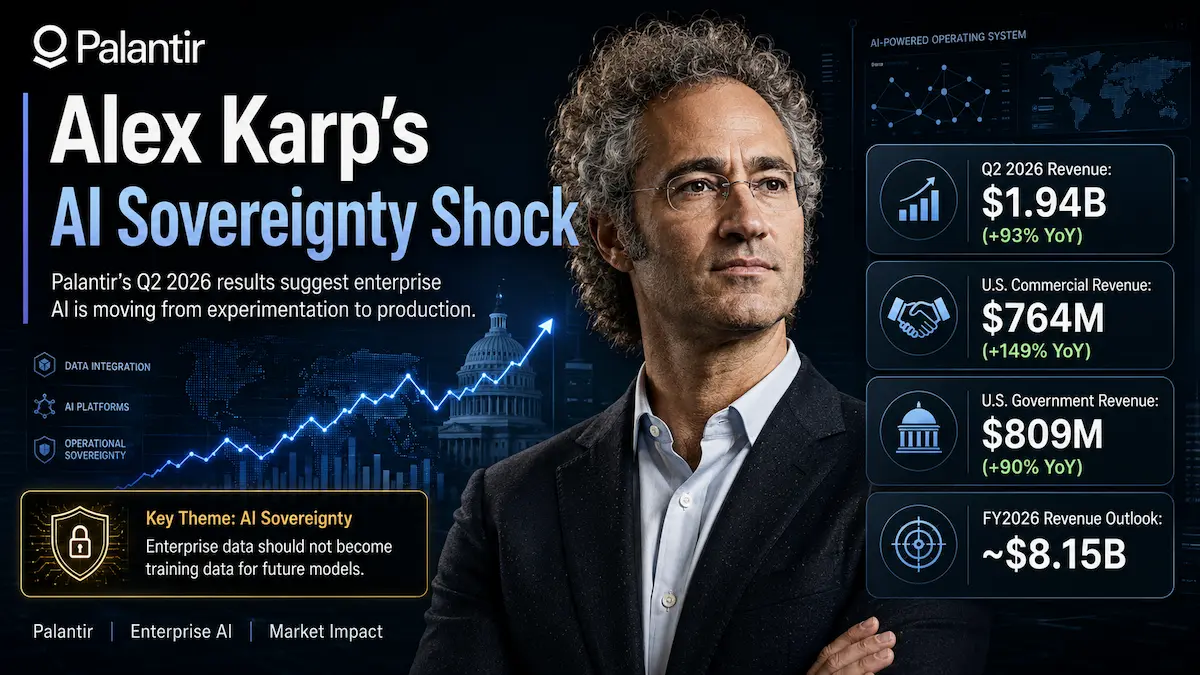
- Palantir’s latest results give that thesis unusually strong financial backing: second-quarter revenue surged 93% year over year, while U.S. commercial revenue jumped 149%.
- Management raised its full-year 2026 revenue outlook to roughly $8.15 billion, signaling that enterprise and government demand for production-grade AI remains exceptionally strong.
- The investment implication is a potential shift in value capture from standalone foundation models toward the infrastructure, governance and application layers that turn AI outputs into measurable operational value.
- Palantir and NVIDIA are strategically positioned around this theme, but Palantir’s powerful post-earnings rerating also raises the cost of any future execution miss.
1. Reconstructing Alex Karp’s Core AI Thesis
“Demand for AI sovereignty has now been unleashed.”
Karp’s most consequential message is that enterprises are entering a new phase of the AI cycle. The first phase was about acquiring access to the strongest possible models. The second is increasingly about determining who controls the intelligence those models create. For banks, defense agencies, manufacturers, healthcare systems and other organizations with proprietary data, the strategic question is no longer simply, “Which model is smartest?” It is, “Who owns the operating environment in which that intelligence is created?”
This distinction matters because enterprise data is not merely an input. Pricing logic, supply-chain relationships, manufacturing processes, customer behavior, proprietary code and institutional decision-making collectively represent corporate competitive advantage. If AI adoption requires surrendering control over that knowledge, the apparent productivity gain may introduce a longer-term strategic liability.
“Their competitive advantage should never become the training data for future models.”
This may be Karp’s most disruptive challenge to the prevailing foundation-model business model. His argument effectively reframes AI data governance from a compliance issue into a capital-allocation issue. Enterprises spending heavily on AI must evaluate not only inference cost and model quality, but also whether their proprietary operational context remains under their control.
That creates a potential premium for architectures that allow companies to route between models, protect sensitive data, audit AI decisions and replace model providers without rebuilding the entire operational stack. In financial terms, the moat may migrate away from the model itself and toward the layer that controls enterprise context, permissions, workflows and deployment.
Palantir’s Growth Suggests AI Is Moving From Experimentation to Production
The most important evidence behind Karp’s thesis is not rhetorical. It is Palantir’s financial acceleration. Second-quarter revenue reached approximately $1.94 billion, rising 93% year over year. U.S. commercial revenue increased 149% to roughly $764 million, while U.S. government revenue climbed 90% to approximately $809 million.
For investors, this matters because enterprise AI has spent several years trapped between impressive demonstrations and uncertain return on investment. Palantir’s accelerating commercial revenue suggests that at least one segment of the market is crossing that gap: customers are paying for AI systems tied directly to operational workflows rather than simply purchasing model access.
The AI Value Chain May Be Moving Beyond “More Tokens Equals More Value”
Karp’s broader criticism of the AI industry is fundamentally economic. Token consumption is a usage metric; it is not automatically a measure of productivity. An enterprise can dramatically increase AI usage without generating proportionate improvements in revenue, margins, inventory turns, labor productivity or mission outcomes.
The next major competition in enterprise AI may therefore revolve around outcome capture. Vendors able to connect models to proprietary data, permissions, business logic and real-world actions could command greater strategic value than vendors selling intelligence as an isolated API. This would mark an important evolution in the AI investment cycle: from model scarcity, to compute scarcity, and eventually toward operational integration.
AI Sovereignty Is Becoming an Infrastructure Decision
The concept extends beyond software. Sovereign AI environments may require private clouds, on-premises deployments, air-gapped systems, specialized networking, accelerated computing and auditable model infrastructure. That means Karp’s thesis potentially expands the opportunity rather than shrinking it: enterprises can still consume advanced models, but they may demand an architecture in which the organization—not the model provider—controls deployment and data governance.
This is particularly relevant for governments, defense organizations, financial institutions and critical infrastructure operators, where the cost of losing control over proprietary information can be significantly greater than the incremental cost of running dedicated AI infrastructure.
2. Industry Chain and Sector Impact
Potential Beneficiary No. 1: Palantir Technologies (NASDAQ: PLTR)
Palantir is the most direct public-market expression of Karp’s AI sovereignty thesis. The company is positioning AIP, Foundry, Apollo and its Ontology architecture as the operational layer between foundation models and mission-critical enterprise workflows.
The significance of 149% U.S. commercial revenue growth is that Palantir is no longer relying solely on its traditional government franchise to support the AI thesis. Corporate demand is scaling rapidly, while management’s higher 2026 revenue guidance indicates that the current momentum is expected to persist.
The risk is valuation sensitivity. When a company is priced for extraordinary execution, extraordinary numbers can become the minimum requirement rather than an upside surprise. Investors therefore need to distinguish between a strengthening business thesis and an automatically attractive entry price.
Potential Beneficiary No. 2: NVIDIA (NASDAQ: NVDA)
NVIDIA represents the infrastructure side of the same investment thesis. Palantir and NVIDIA have already developed a Sovereign AI Operating System reference architecture combining Palantir’s software stack with NVIDIA accelerated computing and AI infrastructure.
If governments and regulated enterprises increasingly demand dedicated, on-premises or sovereign AI environments, the result could create another avenue for GPU, networking and enterprise AI software demand beyond conventional hyperscale cloud deployments. Instead of reducing compute intensity, data sovereignty may fragment AI infrastructure across more organizations and jurisdictions, increasing the number of production environments that require accelerated computing.
The broader implication is that the AI trade does not necessarily have to be framed as software versus semiconductors. Sovereign AI could reinforce a full-stack architecture in which NVIDIA captures the compute layer while Palantir captures the operational and governance layer.
3. Practical Strategy for Investors
Strategy 1: Track Fundamentals, Not the Post-Earnings Headline
A sharp share-price reaction after exceptional earnings can tempt investors to extrapolate immediately. A more disciplined framework is to monitor whether the fundamental acceleration continues. For Palantir, the highest-value indicators are U.S. commercial revenue growth, remaining deal value, operating profitability and the company’s Rule of 40 performance.
If those indicators remain exceptionally strong, valuation can potentially be supported by upward revisions to future cash-flow expectations. If growth begins to decelerate materially while valuation remains elevated, downside sensitivity can increase quickly.
Strategy 2: Watch Whether “AI Sovereignty” Becomes a Budget Category
The most important confirmation of Karp’s thesis will not come from additional speeches. Investors should watch procurement behavior. More sovereign-cloud contracts, private AI deployments, government AI infrastructure programs, air-gapped installations and regulated-industry adoption would indicate that sovereignty is evolving from marketing terminology into a genuine enterprise spending category.
That transition would potentially expand the investable theme beyond Palantir toward accelerated computing, networking, cybersecurity, private-cloud infrastructure and AI governance.
Strategy 3: Separate Technology Winners From Stock-Price Winners
A superior technology thesis does not eliminate valuation risk. Investors considering PLTR or other high-growth AI stocks should define in advance what operational evidence would invalidate the thesis. Revenue growth, contract momentum, margin trajectory and customer adoption should matter more than narrative momentum alone.
For investors who believe in sovereign AI but want to avoid a single-company thesis, another framework is to study multiple layers of the stack—from NVIDIA’s compute infrastructure to Palantir’s operational software—rather than assuming all economic value will concentrate in one company.
4. Frequently Asked Questions About Alex Karp, Palantir and AI Sovereignty
What did Alex Karp say about AI sovereignty in Palantir’s Q2 2026 shareholder letter?
Karp argued that demand for AI sovereignty has been unleashed and emphasized that customers increasingly want control over their operations, data and decisions. His central warning is that a company’s proprietary competitive advantage should not inadvertently become training material for somebody else’s future AI system.
Is Palantir stock a beneficiary of enterprise AI sovereignty spending?
Palantir is one of the clearest publicly traded beneficiaries if enterprises increasingly prioritize controlled, auditable and model-flexible AI deployment. Its 149% year-over-year U.S. commercial revenue growth provides strong evidence of current demand. However, business momentum and stock valuation are separate questions, and a high-expectation stock can remain volatile even when operating results are strong.
How could Palantir and NVIDIA benefit from sovereign AI adoption?
The companies operate at complementary layers of the AI stack. NVIDIA supplies accelerated computing, networking and model infrastructure, while Palantir provides software for connecting AI with enterprise data, permissions and operational workflows. A shift toward private, on-premises and sovereign AI environments could therefore support demand across both infrastructure and enterprise software.
Source: Palantir Q2 2026 Letter to Shareholders — official company source.
Disclaimer: This article is for informational purposes only and does not constitute investment advice.