


Key Takeaways
- MongoDB’s economic engine is now Atlas, its consumption-oriented database-as-a-service platform. Atlas represented 73% of fiscal 2026 revenue and 75% of revenue in the first quarter of fiscal 2027, making workload growth, customer expansion, and application activity more important than traditional software seat counts.
- The company’s most defensible moat is switching costs, not a classic network effect. Once MongoDB is embedded in application data models, query logic, indexes, operational workflows, security policies, and adjacent services such as Search and Vector Search, migration becomes a multi-layer engineering project rather than a simple vendor replacement.
- MongoDB’s platform strategy is designed to reduce customer dependence on any single hyperscaler while increasing dependence on MongoDB as the application data layer. Atlas runs across AWS, Azure, and Google Cloud, while MongoDB increasingly bundles operational data, search, vector retrieval, stream processing, analytics, and AI retrieval into one developer platform.
- AI is a credible growth vector, but the key question is monetization rather than product availability. Voyage AI, native embedding and reranking, Search, Vector Search, persistent agent memory, and the Atlas Managed MCP Server can increase new workload creation and database consumption only if enterprise AI applications move from experimentation into production.
- The principal risks are structural competition from hyperscalers and relational database ecosystems, customer optimization of consumption, gross-margin pressure from third-party cloud infrastructure, and the possibility that AI retrieval becomes commoditized faster than MongoDB can convert it into durable platform spend.
Research status: current through August 17, 2026. MongoDB’s latest reported quarterly financial results are for the first quarter of fiscal 2027, ended April 30, 2026. The company’s second-quarter fiscal 2027 earnings release is scheduled for September 1, 2026, so this analysis does not assume any unreported Q2 financial results.
MongoDB’s corporate history is best understood as a sequence of business-model upgrades rather than a simple database product timeline. The company was incorporated in 2007 as 10Gen, introduced MongoDB Community Server in 2009, launched its first commercial enterprise database offering in 2013, and introduced MongoDB Atlas in 2016. The Atlas launch was the decisive strategic inflection: MongoDB moved from primarily monetizing enterprise software licenses and support toward monetizing the ongoing consumption of a managed cloud data platform.
That shift changed the company’s corporate DNA. MongoDB no longer needs to win only at the procurement layer. It can enter through developers, free usage, or a single application; convert that adoption into Atlas consumption; and then expand inside the enterprise as applications grow, new workloads are added, or adjacent platform services replace standalone tools. The investment case therefore turns less on whether document databases remain fashionable and more on whether MongoDB can become a durable default data layer for modern and AI-driven applications.
1. Business Model Breakdown
How MongoDB Actually Makes Money
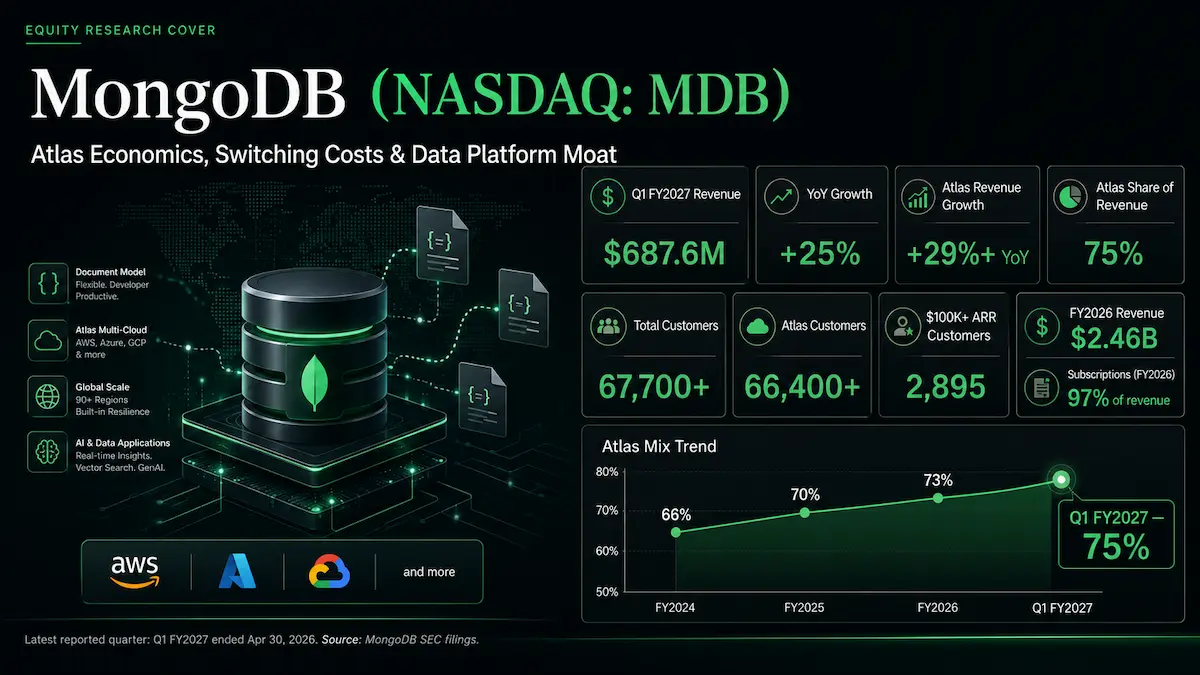
MongoDB is overwhelmingly a subscription software company. In fiscal 2026, total revenue was approximately $2.46 billion, of which 97% came from subscriptions and 3% from services. The subscription business has two primary economic engines: MongoDB Atlas, the managed cloud platform, and MongoDB Enterprise Advanced, the self-managed enterprise offering for cloud, on-premises, and hybrid environments.
Atlas is now the center of gravity. It represented 73% of total revenue in fiscal 2026, up from 70% in fiscal 2025 and 66% in fiscal 2024. In the first quarter of fiscal 2027, Atlas represented 75% of total revenue. Atlas-related revenue was $512.5 million in that quarter versus $395.9 million a year earlier, while total company revenue rose 25% year over year to $687.6 million.
The important economic nuance is that Atlas is substantially usage-driven. Self-service customers are generally billed monthly in arrears based on usage, while sales-led Atlas customers may sign annual contracts, pay upfront, or be invoiced monthly based on consumption. MongoDB has explicitly said it expects a higher portion of Atlas contracts to be billed monthly in arrears without requiring upfront commitments. This creates a model with attractive expansion potential, but it also makes revenue more sensitive to real application activity, workload optimization, macro conditions, and customer architecture decisions than a conventional fixed-seat SaaS model.
The Land-and-Expand Flywheel
The commercial funnel starts far above the enterprise sales organization. MongoDB distributes Community Server at no charge and offers a free Atlas tier to reduce developer friction. As of April 30, 2026, the company said its software had been downloaded from its website more than 750 million times since February 2009. That installed developer familiarity is not revenue by itself, but it lowers product education costs and increases the probability that an engineer introduces MongoDB into a new application before a formal enterprise standardization decision is made.
The monetization loop is straightforward. A developer starts with Community Server or free Atlas. A project reaches production. Usage rises with traffic, data volume, query intensity, geographic expansion, backups, search, streaming, or AI retrieval. The customer then adds workloads, standardizes MongoDB across teams, or upgrades to enterprise-grade security, management, and support. MongoDB’s net ARR expansion rate was 121% as of April 30, 2026, indicating that the existing customer base, in aggregate, continued to spend materially more than one year earlier after accounting for churn and contraction.
The scale of that funnel is now meaningful. MongoDB reported more than 67,700 customers as of April 30, 2026, including more than 66,400 Atlas customers and 2,895 customers with at least $100,000 in annualized recurring revenue. These metrics matter because the company’s economic model improves when small developer-led deployments graduate into larger, mission-critical enterprise workloads.
Why Professional Services Matter Despite Being Low Revenue
Professional services are only about 3% of revenue and are not an attractive standalone profit pool; in fact, services gross margin has often been negative. Their strategic role is different. Consulting and training reduce deployment risk, accelerate time to production, and increase the odds that customers expand subscription usage. MongoDB states that customers purchasing professional services have historically increased subscription usage more quickly than those that do not. Services should therefore be viewed as a retention and expansion enabler rather than a material earnings engine.
The Platform Strategy: Consolidate the Application Data Stack
MongoDB’s strategy has expanded well beyond document storage. The company is attempting to consolidate a growing share of the application data stack into a unified platform: operational database, full-text search, vector search, time-series data, data lifecycle management, application-driven analytics, stream processing, encryption, embeddings, reranking, and agent memory.
The business logic is powerful if execution holds. Every additional native capability can do three things at once: increase the number of workloads addressable by MongoDB, raise consumption per application, and remove a reason for customers to operate a separate point solution. That can increase wallet share while making the architecture harder to unwind. In other words, MongoDB’s platform expansion is not merely feature accumulation; it is an attempt to turn a database purchase into a broader application infrastructure standard.
There is also a strategic asymmetry in MongoDB’s multi-cloud positioning. Atlas is available across AWS, Google Cloud, and Microsoft Azure and can run multi-cloud clusters across providers. That reduces infrastructure-provider lock-in for the customer. At the same time, if an enterprise standardizes application logic, data models, search, vector retrieval, streaming, and operational tooling on MongoDB, the customer can become more dependent on MongoDB itself. The platform therefore competes partly by becoming the portability layer above hyperscale infrastructure.
Unit Economics and the Margin Trade-Off
MongoDB’s business model has software-like gross margins, but Atlas is not a zero-marginal-cost SaaS product. The company pays third-party cloud infrastructure costs to AWS, Azure, and Google Cloud. In fiscal 2026, subscription gross margin was 76%, down from 77% a year earlier, and MongoDB attributed the decline partly to Atlas becoming a larger share of subscription revenue. In the first quarter of fiscal 2027, subscription gross margin was 75% versus 76% a year earlier.
This is a central modeling point. Atlas can improve revenue durability and expand the addressable market, but mix shift toward cloud consumption does not automatically expand gross margin. MongoDB must offset infrastructure costs through scale efficiencies, pricing, workload density, higher-value services, and operating leverage below the gross-profit line. The strongest evidence of improving business quality would therefore be simultaneous Atlas growth, stable or improving subscription gross margin, disciplined sales efficiency, and durable free-cash-flow generation.
2. Deep Dive into Economic Moats
Applying a Buffett-style moat framework requires separating true structural defenses from attractive but replicable business characteristics. MongoDB has scale, growth, a well-known developer brand, and a large user base, but none of those facts alone constitutes a moat. The key question is whether competitors must incur a persistent economic disadvantage to displace MongoDB after it is adopted.
Switching Costs: The Strongest Moat
Switching costs are MongoDB’s most defensible economic moat. A database sits deep inside the application architecture. Once deployed in production, the customer’s dependency extends beyond raw data storage to schemas, document models, query patterns, indexes, drivers, security policies, observability, backup procedures, performance tuning, operational runbooks, service-level expectations, and developer expertise. Migration therefore imposes engineering labor, testing requirements, downtime risk, performance uncertainty, and organizational retraining.
Those costs increase as MongoDB broadens the platform. A customer using only basic document storage has fewer layers to unwind than one using Atlas Search, Vector Search, stream processing, native embeddings, reranking, multi-region clusters, encryption, and agent memory. Platform consolidation can therefore deepen switching costs even if each individual feature is technically substitutable.
The durability of this moat depends on workload criticality. Switching costs are highest for large, always-on operational applications with years of accumulated data and business logic. They are much lower for greenfield projects, small workloads, loosely coupled services, or applications built behind abstraction layers that make database replacement easier. This is why MongoDB’s most valuable customers are not merely those that spend more today, but those that standardize multiple workloads on the platform.
For a competitor to overcome these switching costs, it is not enough to offer a lower database price. The rival must provide a sufficiently superior combination of price, performance, developer productivity, compatibility, cloud economics, migration tooling, and operational confidence to justify a disruptive re-platforming project. That hurdle can be substantial for mission-critical applications.
Intangible Assets: Developer Mindshare and Proprietary Product Control
MongoDB’s second meaningful moat is a combination of developer mindshare and control of its core intellectual property. The company owns the intellectual property behind its offerings and uses a licensing model designed to protect the commercial economics of its platform. That control allows MongoDB to determine which capabilities remain free, which are monetized, and how the roadmap evolves.
Developer familiarity is commercially important because database selection is often influenced early in the application-development cycle. Community Server, the Atlas free tier, MongoDB University, documentation, drivers, integrations, and years of developer usage reduce adoption friction. As of fiscal 2026, MongoDB reported more than 3 million MongoDB University registrations, and by April 2026 it reported more than 750 million software downloads from its website since 2009.
However, this should be classified as a moderate intangible moat rather than an impregnable one. Software features can be copied, open and source-available code can reveal implementation approaches, developers can learn competing databases, and hyperscalers can bundle alternatives into broader cloud relationships. MongoDB itself warns that intellectual-property protection may not prevent competitors from independently developing similar technology. The durable value of developer mindshare therefore comes from repeated preference and lower adoption friction, not from legal exclusivity alone.
Network Effects: Real but Indirect, Not the Core Defense
MongoDB benefits from an ecosystem effect: more developers can lead to more knowledge, integrations, trained employees, consulting expertise, partner support, and organizational comfort. That makes adoption easier for the next customer. But this is not a classic network effect in which each additional customer directly increases the utility of the product for every existing customer.
A bank does not receive a meaningfully better database simply because a retailer also adopts MongoDB. The ecosystem can improve indirectly with scale, but the product’s core utility still comes from technical capabilities, reliability, and developer productivity. Treating MongoDB as a network-effect business would therefore overstate the strength of this moat.
Cost Advantages: Not a Structural Moat
Cost advantage is the weakest of the four traditional moat categories for MongoDB. Atlas depends on third-party cloud infrastructure, and the major cloud providers are simultaneously suppliers, distribution partners, and competitors. Hyperscalers generally possess greater infrastructure scale and can bundle database services into larger cloud contracts.
MongoDB has achieved cost efficiencies as Atlas scales, but its own filings show that higher Atlas mix can pressure subscription gross margin because of hosting costs. That is the opposite of a classic structural cost moat. MongoDB can still generate attractive software economics through product value and operating leverage, but investors should not assume it wins primarily because it can produce database compute more cheaply than hyperscale cloud platforms.
Moat Verdict
The most credible long-term defense is the combination of switching costs and developer-centric intangible assets. The first protects installed production workloads; the second helps MongoDB win new workloads before those switching costs are created. The two reinforce each other: developer adoption seeds applications, and successful applications create operational dependency.
That combination can support durable customer lifetime value and above-average economics, but it is not sufficient by itself to guarantee long-term excess returns. MongoDB must keep its platform technically relevant as relational databases, cloud-native offerings, vector databases, search engines, and AI infrastructure converge. If MongoDB’s platform becomes the default operational data layer for a broad class of modern and AI applications, its moat should deepen. If the market instead fragments into interoperable, easily replaceable services, switching costs could weaken.
3. Business Inflection Points & Future Catalysts
The Defining Strategic Inflection: Atlas in 2016
The most important turning point in MongoDB’s history was the June 2016 launch of Atlas. Before Atlas, MongoDB’s monetization centered much more heavily on enterprise licenses, support, and self-managed deployments. Atlas transformed the company into a cloud consumption platform and aligned revenue more closely with application usage.
The evidence of that strategic transition is visible in the revenue mix. Atlas represented only 1% of fiscal 2017 revenue, according to MongoDB’s 2017 IPO filing. By fiscal 2026 it represented 73%, and by the first quarter of fiscal 2027 it represented 75%. The company effectively used its developer distribution to migrate from a commercial open-source-style model into a global multi-cloud DBaaS model without abandoning self-managed customers.
Atlas also changed the competitive frame. MongoDB no longer competed only against database software vendors. It began competing with the managed database portfolios of AWS, Azure, and Google Cloud while simultaneously using those companies as infrastructure suppliers and go-to-market partners. The resulting strategy is unusually nuanced: cooperate with hyperscalers at the infrastructure and marketplace layers, while competing with their native database services at the application data layer.
Catalyst 1: AI Retrieval Becomes a Monetizable Database Workload
The acquisition of Voyage AI in February 2025 marked MongoDB’s attempt to move higher in the AI data stack. Voyage brought embedding and reranking models that MongoDB is integrating with Atlas Search, Vector Search, automated embeddings, and native reranking. By June 2026, MongoDB had made Search and Vector Search generally available for Enterprise Advanced and Community Edition, while also introducing hybrid search and additional Voyage capabilities. In August 2026, it further announced automated embeddings, an Atlas embedding and reranking API, and a code-focused Voyage model.
The transmission mechanism is not simply “AI spending grows.” The economic pathway is: more AI applications require retrieval from proprietary enterprise data; MongoDB captures those operational datasets; native search, vectors, embeddings, reranking, and agent memory reduce the number of external systems required; production usage drives more database and retrieval consumption; and higher workload density raises Atlas revenue per customer.
Observable indicators include Atlas revenue growth, Atlas as a percentage of total revenue, net ARR expansion, growth in customers above $100,000 of ARR, evidence that AI-native customers graduate from free or small deployments into production-scale workloads, and any future disclosure around Search, Vector Search, Voyage, or agent-memory usage. Investors should be cautious with vendor-reported benchmark claims: MongoDB has cited substantial retrieval-quality improvements from native reranking, but those claims are based on specified benchmarks and should not be treated as independent proof of broad commercial superiority.
The execution risks are significant. Enterprise AI projects may remain experimental longer than expected. Embedding and reranking models may commoditize. Customers may prefer specialist retrieval vendors or hyperscaler-native AI stacks. Relational databases may continue adding competitive vector and AI capabilities. Most importantly, a technically impressive AI feature does not automatically create material database consumption; MongoDB must prove that these capabilities drive production workloads and incremental spend.
Catalyst 2: Agentic Development Expands MongoDB’s Distribution Surface
On August 13, 2026, MongoDB launched the Atlas Managed MCP Server, a hosted connector designed to let coding agents and AI development tools access live MongoDB operational data under Atlas credentials and controls. The company said its existing MCP server was seeing more than 30,000 installs per week before the managed service launch.
The strategic logic is distribution. Historically, MongoDB won developer mindshare through downloads, documentation, free tiers, education, and community adoption. Agentic coding changes the interface through which technology choices are increasingly made. If developers delegate more application creation and maintenance to coding agents, database vendors need to be natively discoverable and easy for those agents to use. MongoDB is attempting to place itself directly inside that workflow.
The transmission mechanism is: lower integration friction leads to more greenfield application trials; agents query, inspect, and modify live operational data; more applications start on Atlas; and successful projects increase consumption. The key observable indicators are customer additions, Atlas customer growth, self-service conversion, MCP usage, developer activity, and whether Atlas growth accelerates relative to broader database spending.
The risk is that agentic development could commoditize database selection rather than strengthen MongoDB. If AI coding tools can easily abstract among multiple databases, switching costs at the application-development layer may fall. Agent-generated applications could also converge on the database ecosystems with the broadest default support, lowest bundled price, or strongest cloud-native integration. MongoDB therefore needs its agentic distribution strategy to create preferred usage, not merely interoperability.
Catalyst 3: Regulated and Hybrid Enterprises Expand the Addressable AI Market
MongoDB’s June 2026 expansion of Search and Vector Search to Enterprise Advanced and Community Edition is strategically important because it extends AI retrieval beyond the public-cloud-only use case. Regulated organizations often have data-residency, sovereignty, security, or architecture constraints that prevent sensitive workloads from moving fully to managed public cloud services.
The transmission mechanism is: MongoDB brings a more consistent search and vector experience to on-premises and private-cloud environments; regulated customers can build AI retrieval on existing infrastructure; MongoDB captures workloads that might otherwise remain outside Atlas; and the company gains a broader path to enterprise standardization across self-managed and managed deployments. The company said more than 20 large banks and financial institutions had been evaluating Search for Enterprise Advanced ahead of the June 2026 release, but that figure is company-reported and should be treated as pipeline evidence rather than booked revenue.
Observable indicators include Enterprise Advanced revenue growth in absolute dollars, large-customer growth, RPO and cRPO trends, federal and regulated-industry customer wins, and cross-sell from Enterprise Advanced into Atlas. MongoDB’s acquisition of Clarity Business Solutions to strengthen its U.S. federal capabilities also fits this vertical-expansion strategy.
The main risk is channel and product-mix complexity. A stronger self-managed product can increase total addressable market but may slow migration to Atlas for some customers. Regulated-industry sales cycles are also long, implementation-heavy, and dependent on security, compliance, procurement, and partner execution. The strategic opportunity is credible, but its financial impact may emerge more slowly than developer-led cloud adoption.
Catalyst 4: Operating Leverage Under a New Leadership Team
Chirantan “CJ” Desai became MongoDB’s president and CEO in November 2025, succeeding Dev Ittycheria after an 11-year operating tenure. MongoDB has since added or elevated leaders across revenue, security, core products, AI and emerging products, and customer success. The leadership architecture suggests a sharper separation between core database execution and emerging AI products, paired with more explicit go-to-market scaling.
The financial transmission mechanism is straightforward: if MongoDB can maintain mid-20s revenue growth while sales and marketing and R&D grow more slowly than revenue over time, operating margin and free cash flow can expand. In Q1 fiscal 2027, total revenue grew 25%, GAAP operating loss narrowed to $24.8 million from $53.6 million, and free cash flow increased to $197.5 million from $105.9 million. These quarterly figures are encouraging but should not be extrapolated mechanically because cash flow and billing patterns can be seasonal.
Observable indicators include GAAP operating margin, stock-based compensation as a percentage of revenue, free-cash-flow margin, sales and marketing efficiency, R&D intensity, Atlas gross-margin behavior, and the relationship between customer additions and sales expense. The principal execution risk is that MongoDB must continue investing heavily in database performance, cloud infrastructure, AI, developer distribution, and enterprise sales while competing against companies with much larger balance sheets and bundled product portfolios.
4. Key FAQs
How does MongoDB make money from its business model?
MongoDB makes almost all of its revenue from subscriptions. Atlas, its managed multi-cloud database platform, is the largest component and is primarily monetized through usage-based consumption. MongoDB Enterprise Advanced generates subscription revenue from self-managed enterprise deployments, while consulting and training account for only a small portion of total revenue. The core economic model is developer-led acquisition followed by workload expansion: as customer applications add users, data, transactions, search, vector retrieval, regions, or new workloads, MongoDB captures additional subscription revenue.
What is MongoDB’s strongest competitive moat versus AWS, Microsoft, Oracle, and other databases?
MongoDB’s strongest moat is switching costs created after the database becomes deeply embedded in production applications. A migration can require changes to data models, application logic, queries, indexes, drivers, security controls, operational processes, testing, and staff expertise. MongoDB’s developer mindshare and proprietary product control strengthen that moat by helping the company win workloads before they become difficult to replace. By contrast, MongoDB does not have a strong classic network effect, and its reliance on third-party cloud infrastructure means cost advantage is not its primary defense.
Is MongoDB Atlas an AI infrastructure company or still mainly a database business?
MongoDB is still fundamentally a database and application data platform company, but it is deliberately embedding AI retrieval capabilities into that core. Vector Search, full-text search, Voyage embeddings and reranking, automated embeddings, agent memory, and the Managed MCP Server are designed to make MongoDB the operational data layer used by AI applications. The commercial test is whether those capabilities create incremental production workloads and higher customer consumption. If AI features remain mostly experimental or are easily substituted by external services, MongoDB’s economics will continue to depend primarily on traditional application database growth.
5. Conclusion
MongoDB’s enterprise gene is best described as developer-led adoption that compounds into infrastructure-level switching costs. The company begins with ease of experimentation, converts adoption into Atlas consumption, and then attempts to expand from a database into a unified application data platform. The crucial strategic achievement was Atlas: it transformed MongoDB from a mostly self-managed commercial database vendor into a cloud consumption business with a globally distributed, multi-cloud platform.
The company’s current AI strategy is consistent with that DNA rather than a departure from it. Voyage AI, Vector Search, hybrid search, automated embeddings, reranking, agent memory, and MCP connectivity are all attempts to keep the database at the center of the application architecture as software development shifts toward AI agents. The strongest version of the strategy is not that MongoDB becomes another AI model vendor; it is that MongoDB becomes the place where operational data, retrieval, memory, and application state converge.
The moat is meaningful but conditional. Switching costs can be substantial for mature production workloads, and developer familiarity gives MongoDB an efficient path into new applications. Yet hyperscalers, established database vendors, relational ecosystems, specialist data platforms, and rapidly evolving AI tooling remain formidable competitors. The long-term business quality will therefore depend on whether MongoDB can continue turning platform breadth into deeper customer standardization, higher consumption, and operating leverage without allowing infrastructure costs, product complexity, or competitive bundling to erode the economics.
Primary Sources
- MongoDB FY2026 Form 10-K — U.S. Securities and Exchange Commission
- MongoDB Q1 FY2027 Form 10-Q — U.S. Securities and Exchange Commission
- MongoDB Q1 FY2027 Financial Results — SEC Exhibit 99.1
- MongoDB 2017 IPO Registration Statement — U.S. Securities and Exchange Commission
- MongoDB Announces Acquisition of Voyage AI — MongoDB Investor Relations
- MongoDB Delivers Accurate AI Retrieval Wherever Enterprise Data Lives — MongoDB Investor Relations
- MongoDB Brings Live Operational Data to the Agentic Coding Stack — MongoDB Investor Relations
- MongoDB Announces Leadership Transition — MongoDB Investor Relations
- MongoDB Investor Relations — Current Earnings Calendar and Company Disclosures
Disclaimer: This article is intended solely for business logic discussion and corporate research purposes, and does not constitute investment advice of any kind.