

Key Takeaways
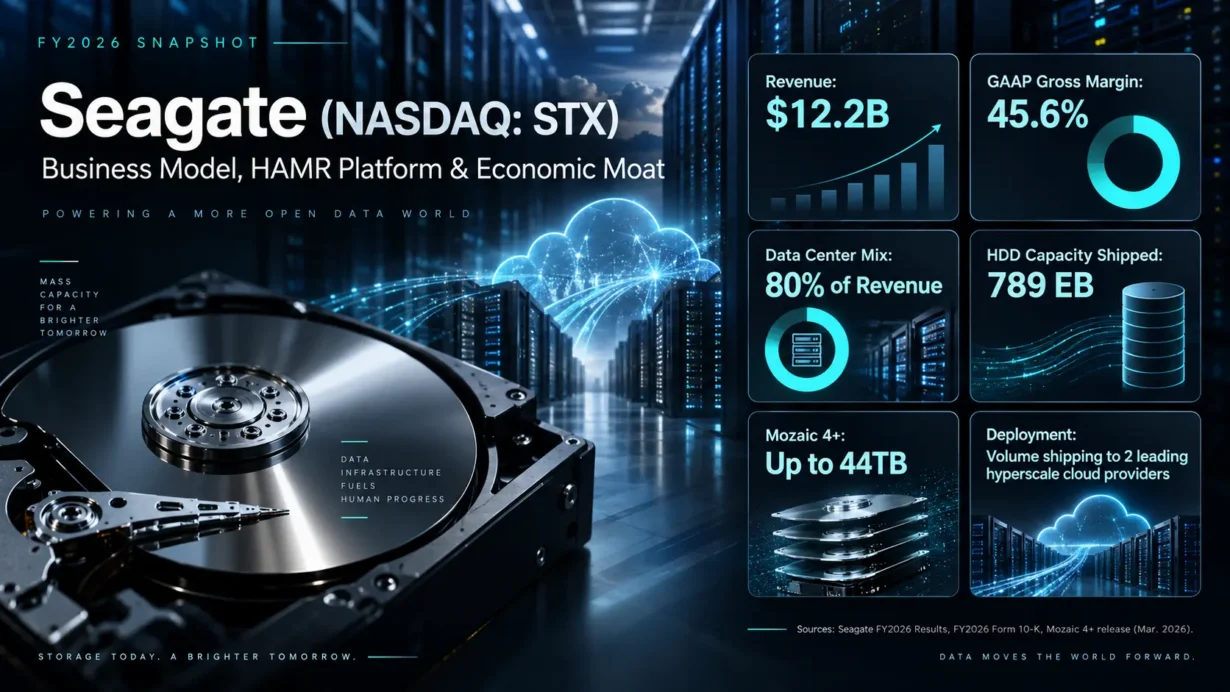
- Seagate’s core monetization engine is not drive-unit growth; it is the sale of ever more exabytes into cloud and enterprise infrastructure at attractive economics per terabyte. In fiscal 2026, Data Center accounted for 80% of revenue and nearline capacity shipments reached 695EB.
- The most defensible moat is a cost advantage created by areal density, reinforced by proprietary HAMR know-how and vertically integrated manufacturing. Mozaic 4+ supports drives up to 44TB and was already qualified and in production with two hyperscale cloud providers by March 2026.
- The platform strategy matters because Seagate can reuse common recording, media, head, firmware and manufacturing technologies across capacity points. Higher density can therefore improve both customer TCO and Seagate’s own component efficiency instead of relying solely on more platters or more drives.
- Fiscal 2026 profitability benefited from a better product mix and pricing discipline as well as technology. The principal risk is that investors mistake a favorable supply-demand regime for a permanent margin structure.
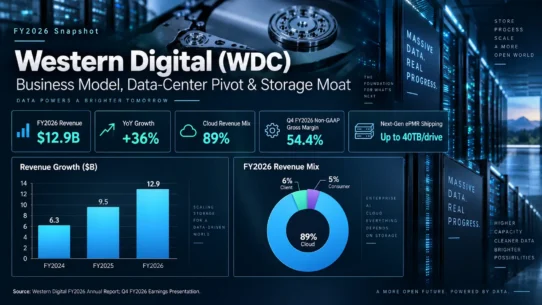
- The moat is real but not absolute. Western Digital has publicly targeted 40TB ePMR volume production in the second half of 2026 and HAMR ramp production in 2027, while Seagate also faces customer concentration, qualification risk, flash substitution at selected workloads and cyclical cloud capital spending.
1. Business Model Breakdown
What Seagate Actually Sells
Seagate primarily monetizes physical storage capacity. It designs and manufactures HDDs, storage systems and related solutions for two principal end markets: Data Center and Edge / Internet of Things. The business is reported as one operating segment, reflecting management’s use of common technology platforms and manufacturing infrastructure across the portfolio.
The economic center of gravity is now Data Center. Fiscal 2026 revenue was 80% Data Center and 20% Edge IoT. By channel, 81% of revenue came from OEMs, 13% from distributors and 6% from retailers. That mix makes Seagate far more exposed to hyperscale procurement cycles, enterprise infrastructure spending and large-volume OEM relationships than to consumer retail demand.
There is no high-margin SaaS engine hidden underneath the model. Seagate’s economics are predominantly product-led: design a higher-capacity drive, qualify it with demanding customers, manufacture it at high yield, and sell large volumes under purchase orders and customer supply arrangements. The company’s advantage must therefore show up in cost per terabyte, reliability, qualification speed, power efficiency, performance and supply continuity rather than in software lock-in or recurring subscription revenue.
The Revenue Equation: Exabytes, Capacity Mix and Price Discipline
A useful way to frame the Seagate business model is as a three-variable equation: exabytes shipped, average economics per terabyte, and manufacturing cost per terabyte. Unit shipments alone are increasingly less informative because a higher-capacity drive can deliver more storage with the same basic enclosure and with fewer system-level resources per petabyte deployed.
Fiscal 2026 illustrates the model. Seagate shipped 789EB of HDD capacity, including 695EB of nearline capacity versus 497EB a year earlier. Revenue increased by approximately $3.1 billion to $12.2 billion, which the company attributed primarily to higher nearline exabyte shipments and favorable pricing actions. Gross margin expanded by roughly 11 percentage points year over year, with Seagate citing pricing and a shift toward higher-capacity products as the primary drivers.
This is the core profit logic: higher-capacity products can raise the value delivered to a data-center operator while improving Seagate’s own cost structure per terabyte. But the margin outcome remains partly cyclical. When industry supply runs ahead of demand, customers gain negotiating leverage and comparable-drive pricing can erode. When supply discipline is tighter and customers need capacity urgently, Seagate can retain more of the economic value created by technology.
Why the Mozaic Platform Is More Than a Product Family
Seagate’s platform strategy is designed to turn recording physics into repeatable commercial leverage. The company states that it uses common technology platforms across HDDs and storage systems to accelerate development, improve manufacturing and supply-chain efficiency, and shorten deployment cycles. Mozaic is the clearest expression of that strategy.
Mozaic combines Seagate’s implementation of heat-assisted magnetic recording with proprietary photonics, magnetic media, read/write head technology, signal processing, firmware and manufacturing processes. The strategic objective is not simply to launch a 44TB drive. It is to establish an architecture that can move from 3TB-plus per disk to 4TB-plus, 5TB-plus and eventually much higher areal densities without forcing the customer to redesign the basic 3.5-inch data-center environment each time.
That compatibility matters commercially. A hyperscaler is not buying an isolated component; it is buying rack density, watts per petabyte, failure behavior, serviceability and predictable supply. If Seagate can raise capacity per drive while preserving the operational characteristics customers already understand, each new density step can become an easier economic upgrade rather than an entirely new infrastructure decision.
How Seagate’s Corporate DNA Evolved
Seagate was founded in 1979 as Shugart Technology and shipped the ST506, an early 5.25-inch hard drive, in 1980. The enduring corporate gene was established early: use advances in recording density to make a new class of computing infrastructure economically viable. The target market has changed—from PCs to enterprise systems to hyperscale cloud—but the underlying capability remains precision storage engineering at mass-production scale.
The strategic evolution became more consequential as client HDDs were displaced by NAND flash in PCs and lower-capacity devices. Rather than defending every legacy HDD use case, Seagate increasingly concentrated its economic model on mass-capacity storage, where HDDs retain a large cost-per-bit advantage and where data-center operators care deeply about rack density, power and total cost of ownership. That transition explains why Data Center now dominates the revenue mix and why areal density, rather than broad device unit share, is the company’s central strategic KPI.
2. Deep Dive into Economic Moats
Intangible Assets: Strong, but Only When Converted Into Manufacturing Yield
Seagate owns a meaningful portfolio of patents, proprietary know-how, process knowledge and trade secrets across photonics, materials science, magnetic media, heads, firmware and manufacturing. On their own, patents do not create a durable moat in an industry populated by sophisticated rivals. The more important intangible asset is the accumulated ability to make extremely complex recording technology reliable at hyperscale volumes.
HAMR illustrates the difference between invention and moat. Heating a microscopic region of magnetic media for a fraction of a second is scientifically impressive, but the economic value emerges only when lasers, plasmonic writers, media, readers, controllers and mechanical systems can be produced with acceptable yields and survive cloud qualification. Seagate’s March 2026 disclosure that Mozaic 4+ drives up to 44TB were already qualified and in production with two leading hyperscalers suggests that its intangible asset is not merely laboratory IP; it includes process integration and production learning.
The 2025 acquisition of Intevac reinforces this capability. Seagate’s fiscal 2026 10-K describes Intevac as a supplier of thin-film processing systems and states that the transaction aligns with its strategy to integrate important components and manufacturing processes. This does not create a monopoly, but it deepens control over manufacturing know-how that can matter when the competitive race depends on nanoscale tolerances and yield learning.
Switching Costs: Moderate, Operational Rather Than Contractual
Seagate does not enjoy the kind of switching costs found in mission-critical enterprise software. Large cloud customers can and do qualify multiple storage vendors. However, switching is not frictionless. Seagate notes that new key customers typically require a lengthy and rigorous qualification process, and hyperscale operators must validate reliability, firmware behavior, performance, power consumption and failure characteristics before deploying a drive family broadly.
That creates operational switching costs and qualification inertia, especially once a product is deployed at exabyte scale. The moat is still limited because sophisticated customers deliberately preserve supplier diversity. Seagate’s customer relationships should therefore be viewed as a retention advantage, not a captive installed base.
Network Effects: Essentially Absent
Seagate does not become structurally more valuable because more customers buy its drives. There is no meaningful two-sided marketplace or user network. Large installed fleets may accelerate field learning and manufacturing feedback, but that is a scale-learning effect, not a classic network effect. Investors should not assign a network-effect moat to the business.
Cost Advantages: The Strongest Moat
The most credible long-duration moat is cost advantage, specifically the ability to deliver more terabytes from a constrained set of materials, components, rack slots and watts. Areal density is the fulcrum. If more bits can be stored on each platter, a drive manufacturer can increase capacity without proportionally increasing heads, disks, motors, enclosures and other components. At the customer level, higher-capacity drives can reduce the number of devices, racks and associated infrastructure needed to store a given amount of data.
Seagate has quantified those benefits in company testing and product materials. For Mozaic 3+ configurations, it has cited lower cost per terabyte and materially lower power consumption per terabyte versus older lower-capacity deployments. Those figures should be treated as vendor estimates rather than independent benchmarks, but the direction of the economics is intuitive and consistent with the physical architecture of higher-density drives.
Vertical integration amplifies the advantage. Seagate designs and manufactures many critical HDD technologies, including read/write heads and magnetic media, and coordinates product design with manufacturing. This can shorten technology transitions, improve yields and reduce dependence on external suppliers for the most differentiated parts of the drive. In a business with high fixed costs, small improvements in yield, component count and throughput can have an outsized impact on gross profit.
The important caveat is that cost advantages must be judged relative to competitors, not in isolation. Western Digital disclosed in February 2026 that its 40TB UltraSMR ePMR drives were in qualification with two hyperscale customers, with volume production planned for the second half of 2026, and that its HAMR ramp was planned for 2027. That means Seagate’s current HAMR lead is commercially meaningful but contestable. The moat is best described as a time-to-scale and cost-curve advantage, not permanent technological exclusivity.
For long-term excess returns, Seagate therefore needs to keep moving the density curve faster than competitors can close the gap. A one-generation lead can support premium economics; a stalled roadmap can quickly turn differentiated hardware back into a commodity.
3. Business Inflection Points & Future Catalysts
The Strategic Inflection Point: HAMR Moved From Research Project to Volume Platform
The most important strategic inflection in modern Seagate history was not the invention of HAMR; it was the transition of HAMR into qualified, volume production. In January 2024, Seagate announced the volume ramp of 30TB-plus Exos drives on Mozaic 3+, marking the moment when years of R&D began to translate into customer deployments and unit economics. By March 2026, the company had advanced to Mozaic 4+, supporting capacities up to 44TB and production deployments with two leading hyperscale cloud providers.
This matters because technology leadership in storage only becomes economically relevant after three gates are cleared: manufacturability, hyperscale qualification and volume yield. Passing those gates turns technical density into revenue mix, cost per terabyte and customer TCO. That is why the Mozaic commercialization cycle is a more consequential corporate turning point than a single product launch.
Catalyst 1: Broader Mozaic 4+ Adoption and the Next Density Step
The first catalyst is expansion of Mozaic 4+ beyond its initial hyperscale customers and continued movement up the areal-density roadmap. The transmission mechanism is straightforward: more qualified customers and higher-capacity points should increase the share of exabytes shipped on the newest platform, improve product mix, reduce component cost per terabyte and strengthen Seagate’s ability to defend price through differentiated customer economics.
Observable indicators include the number of hyperscale qualifications, the percentage of nearline exabytes represented by Mozaic products, average capacity per drive, nearline exabytes shipped, manufacturing yields, gross margin and capital spending required to support the HAMR ramp. Seagate has stated that fiscal 2027 capital expenditures are expected to rise to support HAMR volume while remaining within its 4% to 6% of revenue target range.
The key risks are yield problems, reliability issues, qualification delays and a narrowing competitive lead. Western Digital’s ePMR roadmap can offer customers an alternative path to higher capacity without an immediate HAMR transition, while its planned 2027 HAMR ramp could compress Seagate’s time-to-market advantage. If Seagate must spend materially more capital than planned to sustain yields, the apparent density advantage could produce less free-cash-flow leverage than expected.
Catalyst 2: AI Turns Stored Data Into a More Valuable Production Asset
The second catalyst is not “AI demand” in the generic sense. The relevant mechanism is that AI increases the amount of data worth retaining, reusing and bringing back online. Training corpora, inference logs, multimodal content, synthetic data, model checkpoints and historical business data can all enlarge the persistent data layer beneath expensive compute infrastructure. HDDs participate where capacity economics matter more than microsecond latency.
Seagate’s fiscal 2026 results already show the sensitivity of the model to this infrastructure build-out: Data Center reached 80% of revenue and nearline shipments rose to 695EB. The company’s latest formal guidance, issued July 28, 2026, called for fiscal Q1 2027 revenue of $4.1 billion plus or minus $100 million and non-GAAP diluted EPS of $7.30 plus or minus $0.20. Those numbers are guidance, not realized results, but they indicate the strength of demand embedded in management’s near-term expectations at the start of fiscal 2027.
Observable indicators include hyperscaler capital spending, Seagate Data Center revenue mix, nearline exabyte growth, customer demand commitments, average capacity shipped and commentary on AI-related storage deployments. A useful counter-indicator would be a divergence in which AI compute spending remains strong but nearline exabyte growth slows, suggesting that storage intensity is not scaling as expected.
The failure case is equally important. AI budgets can be reallocated toward accelerators, networking and power infrastructure, leaving storage growth lagging. Data can also be deleted, compressed, tiered or kept on flash where performance is worth the premium. In addition, hyperscalers periodically digest capacity after aggressive build cycles. AI creates a structural data-growth argument, not immunity from procurement cycles.
Catalyst 3: Structural Supply Discipline Converts Technology Into Cash Flow
The third catalyst is a business-model change that is easier to miss than HAMR: Seagate has been trying to run the HDD industry with more demand visibility and tighter supply discipline. The company now works with key customers on longer-term demand forecasts and supply commitments for certain high-capacity nearline products, including cancellation provisions in some circumstances. At its 2025 Investor and Analyst Event, management explicitly described structural improvements in demand visibility, supply discipline, product mix and cost structure.
The transmission mechanism is powerful. If capacity additions are better aligned with real customer demand, Seagate can reduce underutilization, avoid destructive price competition, protect gross margin and convert a higher share of revenue into free cash flow. Fiscal 2026 provided an unusually strong proof point: GAAP gross margin reached 45.6%, Q4 GAAP gross margin reached 52.3%, and full-year free cash flow reached $3.1 billion.
Observable indicators include gross margin, utilization commentary, inventory levels, pricing, customer forecast visibility, free cash flow, capital expenditures and debt reduction. Seagate retired $1.4 billion of debt during fiscal 2026 and completed the redemption or exchange of the remaining 2028 exchangeable notes in September 2026, improving financial flexibility.
The risk is that discipline is easier to maintain when demand is strong. The HDD industry remains concentrated and cyclical, and competitors may choose to defend share aggressively. Seagate itself warns that excess industry capacity can cause price erosion, underutilization and inventory charges. Therefore, the margin framework should be stress-tested against a normal downcycle rather than extrapolated from a peak quarter.
What Could Break the Thesis
Three risks deserve disproportionate attention. First, technology execution: a setback in HAMR yield, field reliability or qualification can erase a density lead quickly. Second, customer concentration: one customer represented approximately 14% of fiscal 2026 revenue, making large procurement shifts meaningful. Third, substitution and competition: SSD economics continue to improve, especially for performance-intensive workloads, while Western Digital and Toshiba remain capable HDD competitors.
The central analytical discipline is to distinguish demand growth from moat durability. A rising storage market can lift every vendor. Seagate earns an excess return only if its technology lets it deliver each incremental exabyte at a structurally better cost or value proposition than alternatives and if industry pricing does not immediately give that value back to customers.
4. Key FAQs
How does Seagate make money from AI and cloud data centers?
Seagate makes money from AI primarily by selling high-capacity HDDs and storage systems that hold the persistent data layer surrounding AI workloads. The company does not monetize AI through model subscriptions or accelerator chips. Its exposure is indirect but economically important: as cloud operators retain more training data, generated content, logs, checkpoints and historical datasets, they need more petabytes and exabytes of cost-efficient storage. Seagate benefits when that demand raises nearline exabyte shipments and shifts the mix toward higher-capacity drives where its areal-density roadmap can improve both customer TCO and Seagate’s own cost per terabyte.
Is Seagate’s HAMR technology a sustainable competitive advantage over Western Digital?
It is a current competitive advantage, but not a permanent monopoly. Seagate has already put HAMR-based Mozaic products into volume production and, as of March 2026, had Mozaic 4+ drives up to 44TB qualified and in production with two hyperscale cloud providers. Western Digital, however, is pursuing both advanced ePMR and HAMR, with 40TB ePMR volume production planned for the second half of 2026 and HAMR ramp production targeted for 2027. The durable advantage will depend on whether Seagate can maintain a lead in areal density, yields, reliability and cost per terabyte across multiple generations rather than simply being first to one capacity point.
Why are HDDs still important when SSD prices keep falling?
Because storage media are optimized for different economic jobs. SSDs are superior for many latency- and IOPS-intensive workloads, while HDDs remain compelling for very large data sets where cost per terabyte, rack density and power per petabyte dominate the decision. Seagate itself acknowledges that enterprise SSDs and nearline HDDs can compete in selected high-performance workloads. The HDD thesis therefore does not require flash to lose. It requires mass-capacity data to grow fast enough that hyperscalers continue to use HDDs as the lowest-cost persistent tier for enormous datasets, with flash deployed where its performance premium creates sufficient value.
5. Conclusion
Seagate’s corporate DNA is unusually consistent across nearly five decades: commercialize advances in magnetic recording density at manufacturing scale. The end market has migrated from personal computers to cloud data centers, but the strategic engine is still the same. The company wins when it stores more bits with fewer physical resources and can translate that engineering advantage into lower cost per terabyte, better power economics and a faster capacity roadmap for customers.
That is why the most important feature of the Seagate business model is not the HDD itself; it is the density platform behind the HDD. Mozaic and HAMR create the possibility of a cost moat because a successful density transition can benefit both sides of the transaction: customers obtain more capacity per rack and potentially lower infrastructure cost per terabyte, while Seagate can reduce component intensity and improve product mix. Vertical integration, manufacturing know-how and hyperscale qualification reinforce that advantage.
The durability of the moat will be determined by execution rather than narrative. Seagate must keep Mozaic yields high, broaden customer qualifications, advance density faster than rivals, maintain supply discipline and avoid allowing higher industry margins to trigger a destructive capacity response. If it can do that, the business can behave less like a commodity component vendor and more like a specialized infrastructure supplier with a favorable cost curve. If competitors close the density gap or industry supply outruns demand, the economics can revert quickly. That tension is the defining feature of the Seagate investment case and the clearest expression of its enterprise gene.
Primary Sources and Further Reading
- U.S. SEC — Seagate Technology Holdings plc FY2026 Form 10-K
- Seagate Investor Relations — Fiscal Fourth Quarter and Fiscal Year 2026 Results
- Seagate Investor Relations — Mozaic 4+ and 44TB Hyperscale Production Announcement
- Seagate Investor Relations — 2025 Investor and Analyst Event Strategy and FY2028 Targets
- Seagate Investor Relations — Mozaic 3+ Volume Ramp Announcement
- Seagate — Our Story
- Western Digital Investor Relations — 2026 Storage Innovation and HAMR Roadmap
- Seagate Investor Relations — September 2026 Completion of Exchangeable Notes Redemption
Disclaimer: This article is intended solely for business logic discussion and corporate research purposes, and does not constitute investment advice of any kind.