



⚡ Key Takeaways
- Atlassian monetizes organizational complexity. Jira, Confluence, Jira Service Management, Loom, Rovo, and its Collections convert recurring workflows, institutional knowledge, service requests, and software-development processes into subscription revenue.
- The company’s most defensible moat is switching cost, not a conventional public network effect. Once Atlassian becomes embedded in workflows, permissions, documentation, automations, integrations, and governance processes, replacing it becomes an organizational transformation rather than a routine software purchase.
- The next value-creation cycle depends on cloud migration, enterprise penetration, Service Collection, and AI-driven bundle expansion. Rovo’s strategic role is less about selling a standalone chatbot and more about increasing the value, seat count, pricing power, and cross-product adoption of the broader Atlassian platform.
1. Business Model Breakdown
Atlassian is best understood not as a collection of project-management tools, but as a subscription platform that monetizes the coordination layer of modern organizations. Its products sit where work is planned, assigned, documented, reviewed, serviced, governed, and increasingly executed by AI agents.
The company began with a developer-centric beachhead through Jira and subsequently expanded into organizational knowledge through Confluence, service management through Jira Service Management, asynchronous communication through Loom, and AI-assisted search and execution through Rovo. Each expansion added another form of high-value enterprise context to the same underlying platform.
Where the Revenue Comes From
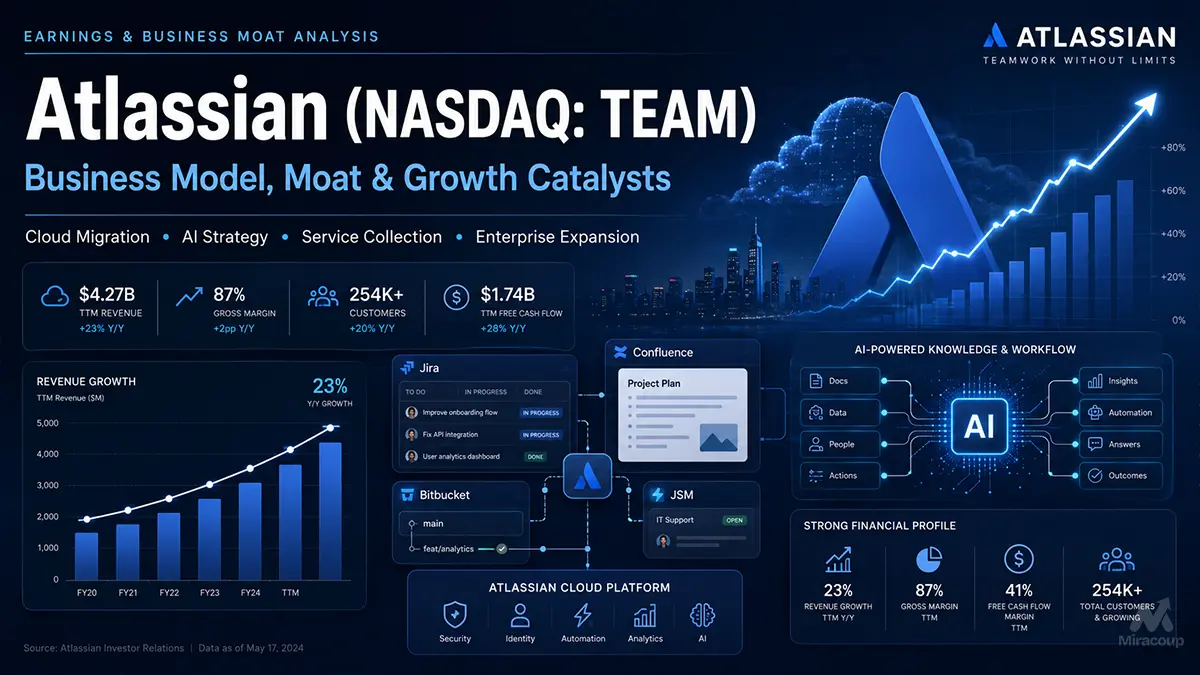
In Atlassian’s latest reported quarter, the three months ended March 31, 2026, the company generated approximately $1.79 billion in revenue, representing 32% year-over-year growth. Subscription revenue accounted for roughly 95% of total revenue, confirming that the economic engine is overwhelmingly recurring rather than transactional.
- Cloud: Approximately $1.13 billion, or 63% of quarterly revenue. Cloud subscriptions are the company’s primary long-term growth vehicle and include products sold individually or through integrated Collections.
- Data Center: Approximately $561 million, or 31% of quarterly revenue. This remains economically important, but its reported growth was temporarily amplified by end-of-life accounting effects and customers pulling purchases forward.
- Marketplace and other revenue: Approximately $94 million, or 5% of quarterly revenue. This includes revenue associated with third-party Marketplace applications and support-related offerings.
The revenue model has five major monetization levers: paid-seat expansion, movement into higher subscription tiers, cross-selling additional applications, adoption of integrated Collections, and periodic price increases. Cloud migration provides an additional lever because cloud customers can access Atlassian’s shared data model, Rovo, centralized administration, analytics, and cross-product experiences more easily than self-managed customers.
The Land-and-Expand Machine
Atlassian’s defining commercial innovation was its product-led distribution model. Instead of depending exclusively on expensive enterprise sales teams, the company historically allowed individual teams to discover, trial, purchase, and deploy its software with limited sales involvement.
This creates a bottom-up adoption pattern:
- A software team begins using Jira.
- Engineering documentation moves into Confluence.
- Operations adopts Jira Service Management.
- Executives require portfolio visibility, governance, analytics, and enterprise controls.
- Additional departments adopt Jira, Loom, Rovo, or an Atlassian Collection.
The initial purchase may be small, but the account expands as more employees, teams, workflows, and data become connected. Atlassian reported that more than 90% of its Q3 FY2026 revenue came from customer accounts that already existed before the quarter began. This is the clearest expression of the model’s underlying logic: customer acquisition opens the door, but installed-base expansion drives the economics.
The company now overlays this self-service engine with a more conventional enterprise-sales organization. Salespeople focus on strategic expansions, complex cloud migrations, multi-year agreements, security requirements, and platform-wide deployments rather than handling every initial transaction.
Why the Economics Can Be Attractive
Atlassian reported an 85% GAAP gross margin in Q3 FY2026. The company can therefore generate substantial incremental gross profit when an existing customer adds seats, upgrades a plan, adopts another application, or purchases a Collection.
Its commercial structure also creates a potential customer-acquisition cost advantage. Product-led adoption, transparent pricing, brand recognition, community referrals, solution partners, and Marketplace applications reduce the company’s dependence on commissioned salespeople at the earliest stages of the customer journey.
However, investors should not confuse high gross margins with effortless profitability. Atlassian continues to invest aggressively in research and development, enterprise sales capacity, cloud infrastructure, AI computing, and acquisitions. The company reported a GAAP operating loss in Q3 FY2026, partly reflecting significant restructuring charges. The long-term earnings thesis therefore requires both sustained subscription growth and credible operating leverage.
2. Deep Dive into Economic Moats
Moat One: Deep, Organization-Level Switching Costs
Atlassian’s most important competitive barrier is the cost of removing it after it becomes embedded in an organization.
A mature Atlassian deployment can contain years of Jira issues, Confluence pages, service-management records, approval policies, custom workflows, automation rules, software-development links, asset data, access controls, compliance evidence, reporting structures, Marketplace applications, and institutional knowledge.
Migrating this environment is not simply a matter of exporting data and purchasing another license. A replacement project may require an organization to redesign workflows, retrain users, rebuild integrations, reproduce governance controls, validate historical records, renegotiate partner relationships, and accept a period of operational disruption.
The switching cost becomes especially powerful when multiple Atlassian products operate together. Replacing a standalone task-management tool may be relatively easy. Replacing a connected system spanning software delivery, documentation, incident response, service requests, asset management, goals, and AI agents is materially harder.
This is why Atlassian’s moat is strongest inside large software, technology, and service-intensive organizations where its products support mission-critical processes. Its competitive position is less secure in lightweight horizontal collaboration use cases, where customers may be able to substitute a bundled productivity suite or a lower-cost point solution.
Moat Two: Proprietary Workflow Context and Ecosystem Density
Atlassian’s emerging differentiation is the Teamwork Graph, a contextual data layer that connects people, teams, goals, knowledge, work items, services, assets, conversations, and code across Atlassian and third-party systems.
This matters because enterprise AI is ultimately constrained by context. Foundation models can be sourced from multiple providers, but a model is only as useful as the proprietary information, permissions, relationships, and workflow history it can securely access.
Atlassian has spent more than two decades positioning its products at the point where organizational work is recorded. Jira captures what teams are doing. Confluence captures what they know. Jira Service Management captures what employees and customers need. Loom captures asynchronous explanations. Integrated developer tools capture how software changes relate to business priorities.
As customers connect more products and workflows, the Teamwork Graph can provide Rovo and other agents with richer context. Better context can produce more relevant search results, more effective automations, and a stronger reason to consolidate additional work on the platform.
This should not be mistaken for a classic cross-customer network effect. One company does not automatically receive dramatically more value because an unrelated company adopts Jira. The compounding effect occurs primarily within each customer environment: more users, data, applications, integrations, and workflows increase the value of that customer’s own Atlassian deployment.
The Atlassian Marketplace reinforces this advantage. Thousands of third-party applications extend product functionality, solve specialized industry requirements, and increase customization. Developers are attracted by Atlassian’s installed base, while customers benefit from a broader selection of extensions. This creates a genuine ecosystem effect, although Atlassian must continue maintaining application quality, security, and developer economics.
Moat Assessment
Atlassian possesses a strong, wide-leaning moat in software-development coordination, enterprise knowledge, and connected service workflows—but it does not hold an unassailable monopoly.
The company benefits from high switching costs, workflow data, ecosystem depth, brand authority among technical teams, and an efficient product-led distribution model. Those advantages become stronger as customers standardize multiple departments on the Atlassian platform.
The moat is nevertheless exposed to several forms of pressure:
- Large software suites can bundle adjacent collaboration capabilities at aggressive prices.
- Specialized competitors may offer deeper functionality within individual categories.
- Repeated price increases can create procurement resistance and encourage consolidation reviews.
- Cloud migration can trigger customer dissatisfaction if security, residency, performance, or customization requirements are not met.
- AI functionality may become commoditized if Atlassian cannot translate proprietary context into measurably better business outcomes.
The investment-grade question is therefore not whether Atlassian has a moat. It does. The more important question is whether the company can extend that moat from technical teams into an enterprise-wide system of work without undermining the simplicity and product quality that created its original advantage.
3. Business Inflection Points & Future Catalysts
The Corporate Gene: Product-Led Expansion into Adjacent Workflows
Atlassian was founded in Sydney in 2002 around a simple but powerful idea: enterprise software could be useful, transparent, affordable, and easy to purchase without a high-friction sales process.
The company’s development history reveals a consistent corporate gene. Atlassian establishes a beachhead in a high-value workflow, earns user loyalty through product quality, and then expands into adjacent forms of work.
Jira established the software-development workflow. Confluence added organizational knowledge. Trello widened the company’s reach among business teams. Incident-management and service-management investments expanded Atlassian into IT operations. Loom added asynchronous video. Rovo, DX, Collections, and the acquisition of The Browser Company extend the platform toward AI execution, engineering intelligence, and a potential AI-native work surface.
This is not merely product accumulation. The strategic objective is to own more of the context surrounding how an organization plans, builds, communicates, supports, and improves its work.
The Defining Strategic Inflection Point
Atlassian’s most consequential strategic pivot is its transition from independently purchased team tools and self-managed deployments into a unified, cloud-based enterprise platform.
The end of Server support was the first major forcing function. Atlassian then announced the planned end-of-life of Data Center through its Atlassian Ascend initiative. New Data Center customer sales ended in March 2026, sales and expansions to most existing customers are scheduled to stop in March 2028, and standard maintenance and support are planned to end in March 2029, subject to limited exceptions.
This transition changes the company’s identity. Atlassian is moving from selling software products that customers operate themselves to managing a continuously updated cloud platform with shared administration, security, analytics, AI, and cross-product data.
The near-term financial pattern may be uneven. Data Center customers can pull purchases forward, accounting treatment can distort reported growth, and the first year of a cloud migration may generate less recognized revenue than a comparable Data Center transaction. Over time, however, cloud deployments give Atlassian greater control over product delivery, AI distribution, platform integration, usage data, pricing architecture, and customer expansion.
Catalyst One: Data Center-to-Cloud Migration
The installed Data Center base represents a multi-year migration pipeline rather than a conventional new-customer opportunity. Successful migrations can move customers onto a platform where Rovo, Collections, analytics, unified administration, and shared data services are easier to deploy.
The critical variables are migration pace, customer retention, cloud seat expansion, cloud gross margin, and the percentage of migrating customers that adopt additional applications. Migration alone is not enough; the economic upside depends on whether Atlassian can increase each customer’s lifetime platform value after the move.
Catalyst Two: Collections as the Primary AI Monetization Layer
Atlassian’s AI strategy is commercially distinctive because Rovo is available to many customers without a separate standalone subscription charge. At first glance, this may appear to weaken direct AI monetization.
In practice, management is using AI as a platform-expansion mechanism. Customers that require more AI capacity, agents, coordinated workflows, and cross-product context are encouraged to adopt Teamwork Collection, Service Collection, premium plans, or broader enterprise deployments.
The monetization sequence is therefore indirect but potentially powerful:
- Include AI broadly enough to stimulate adoption.
- Use Rovo to make Jira, Confluence, Loom, and service-management workflows more valuable.
- Convert higher usage into seat growth, Collection upgrades, cross-selling, and longer contracts.
- Introduce economic limits through AI credits and package differentiation.
Atlassian has reported that customers using Rovo have been growing their annual recurring revenue at approximately twice the rate of customers not using it. This is encouraging, but correlation should not be confused with causation: larger and faster-growing customers may simply be more likely to adopt AI. The stronger proof point will be sustained incremental revenue and retention attributable specifically to AI-driven behavior.
Catalyst Three: Service Collection and Enterprise Service Management
Service Collection may be Atlassian’s most important near-term growth asset outside its traditional software-development franchise.
The business has surpassed $1 billion in annual recurring revenue and was growing by more than 30% year over year as of Q3 FY2026. Atlassian reported more than 65,000 Service Collection customers, with over 60% of instances being used by non-IT functions.
This expands the addressable market from IT support into human resources, legal, finance, marketing, facilities, customer service, and other request-driven departments. These teams frequently operate through fragmented email inboxes, spreadsheets, messaging channels, and manual approval processes. Atlassian can convert those invisible activities into structured workflows that are measurable, automated, and connected to enterprise knowledge.
The strategic advantage is that Jira Service Management does not operate in isolation. It can connect service requests to Jira development work, Confluence documentation, asset records, and Rovo agents. That integration gives Atlassian a credible basis for displacing legacy service-management platforms on usability, total cost, and cross-team coordination.
Catalyst Four: Enterprise Cloud, Governance, and Regulated Workloads
Atlassian’s enterprise opportunity depends on proving that its cloud architecture can satisfy complex security, data-residency, governance, reliability, and isolation requirements.
Offerings such as Atlassian Government Cloud and Atlassian Isolated Cloud are strategically important because they can unlock workloads that previously remained on self-managed infrastructure. Winning these customers would improve contract duration, average revenue per account, and platform standardization, although it also introduces longer sales cycles and higher service expectations.
Atlassian ended Q3 FY2026 with more than 350,000 customers and 55,913 customers generating more than $10,000 in Cloud ARR. Those larger customers represented more than 85% of total Cloud ARR, making enterprise expansion substantially more important to future growth than the headline customer count alone.
Catalyst Five: DX and the AI-Native Work Surface
DX adds engineering-intelligence capabilities that can help customers measure developer productivity, software-delivery performance, and the impact of AI coding tools. This addresses a major enterprise concern: executives are investing heavily in coding agents but often lack reliable evidence that those investments improve throughput, quality, or developer experience.
The Browser Company introduces a more speculative option. A browser optimized for SaaS applications and enterprise knowledge could give Atlassian a new interface through which employees interact with Rovo, organizational context, and work applications.
The upside is strategically meaningful, but investors should treat it as optionality rather than established moat value. Browser markets are difficult to penetrate, integration can consume substantial resources, and the acquisition must prove that it can strengthen Atlassian’s core platform rather than become an expensive side project.
What Could Trigger a Valuation Re-Rating?
A durable valuation re-rating would require evidence that Atlassian is converting its platform and AI narrative into higher-quality financial growth. The most important signals are:
- Cloud revenue growth that remains durable after migration contributions normalize.
- Higher Collection adoption and measurable cross-product expansion.
- Rovo usage translating into incremental ARR, retention, and paid AI capacity.
- Continued share gains in enterprise service management.
- Growth in multi-year contracts and remaining performance obligations.
- Improving free-cash-flow and operating margins without sacrificing product velocity.
- Disciplined stock-based compensation and acquisition integration.
As of July 30, 2026, Atlassian’s fourth-quarter and full-year FY2026 results had not yet been released and were scheduled for August 6, 2026. Investors evaluating the next phase should distinguish sustainable cloud and Collection growth from temporary Data Center end-of-life effects.
4. Key FAQs
How does Atlassian make money from Jira and Confluence?
Atlassian primarily earns recurring subscription fees based on the number of users, product edition, deployment type, contract structure, and applications purchased. Revenue expands when customers add seats, move from free or standard plans to premium or enterprise editions, adopt additional products, purchase integrated Collections, or migrate to Atlassian Cloud. Marketplace applications and premium support provide smaller supplementary revenue streams.
What is Atlassian’s biggest competitive moat?
Its strongest moat is organization-level switching cost. Jira, Confluence, Jira Service Management, integrations, Marketplace applications, workflows, permissions, automations, and historical data can become deeply embedded in daily operations. Replacing the platform requires process redesign, data migration, employee retraining, integration rebuilding, and governance validation. The Teamwork Graph and Atlassian Marketplace strengthen this moat by making a multi-product deployment more contextual, extensible, and difficult to reproduce.
Is Rovo AI a meaningful growth catalyst for TEAM stock?
Rovo can become a meaningful catalyst if it increases seat expansion, Collection adoption, customer retention, AI-credit consumption, and enterprise standardization. Its advantage is access to contextual data across Jira, Confluence, Loom, service management, code, goals, and connected third-party systems. However, AI usage metrics alone are insufficient. The investment case ultimately requires evidence that Rovo produces incremental recurring revenue and durable operating leverage after accounting for model, infrastructure, and development costs.
Selected Primary Sources
- Atlassian — Q3 fiscal 2026 financial results, April 30, 2026
- Atlassian — Q3 fiscal 2026 shareholder letter
- Atlassian — Form 10-Q, quarter ended March 31, 2026
- Atlassian — Ascend and Data Center retirement timetable
Disclaimer: This article is intended solely for business logic discussion and corporate research purposes, and does not constitute investment advice of any kind.