



⚡ Key Takeaways
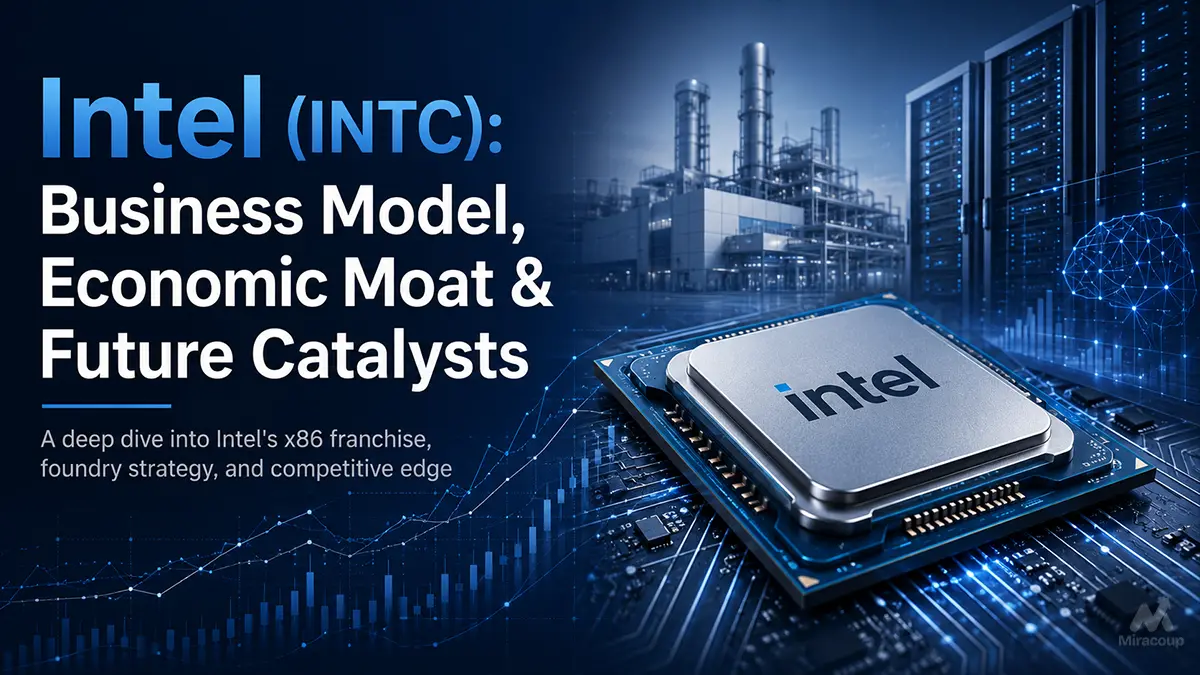
- Intel’s profit engine remains its CPU franchise, not its external foundry business. Client and data-center processors generate the company’s commercial scale and product-level earnings, while Intel Foundry remains a capital-intensive turnaround operation.
- The deepest Intel economic moat is backward compatibility. Decades of x86 software, enterprise validation, developer tooling and operational knowledge create meaningful switching costs—even though AMD, Arm and custom silicon have weakened Intel’s historical platform control.
- Intel Foundry is a potentially strategic asset, but not yet a proven financial moat. Intel 18A execution, advanced packaging and a major external Intel 14A customer could transform the manufacturing network from a cost burden into scarce geopolitical infrastructure.
1. Business Model Breakdown
Intel’s corporate gene can be summarized as platform ownership through vertically integrated engineering. Founded in 1968 as a semiconductor-memory company, Intel subsequently created the 4004 microprocessor and introduced the 8086 architecture in 1978. The architecture’s ability to preserve software compatibility across successive processor generations helped turn x86 into the foundation of the personal-computing ecosystem. The IBM PC design win then converted a processor product into an industry standard.
That history matters because Intel does not simply sell pieces of silicon. It monetizes its position at the center of complex computing platforms. Its processors must work with operating systems, enterprise applications, cloud software, security tools, memory, networking components and equipment from hundreds of hardware partners. The commercial value of an Intel CPU therefore includes not only transistor performance, but also compatibility, validation, availability and the customer’s confidence that critical workloads will run as expected.
The Product Engine: Client Computing and Physical AI
Intel’s Client Computing and Physical AI Group sells processors, platforms and related components primarily to PC manufacturers, distributors and edge-computing partners. Demand is shaped by notebook and desktop replacement cycles, enterprise IT budgets, operating-system transitions, AI-PC adoption and Intel’s ability to secure premium designs from major original equipment manufacturers.
The economic model is driven by the interaction of unit volume and average selling price. Higher-end processors for commercial notebooks, gaming systems, workstations and AI-enabled PCs can lift revenue faster than unit shipments, but only when Intel delivers competitive performance, power efficiency and product availability.
In the second quarter of 2026, the segment generated $8.9 billion of revenue, an increase of 13% year over year. Client processor revenue benefited from a 27% increase in average selling prices, primarily because of a richer mix of premium products, even as unit volume declined by 8%. This illustrates Intel’s preferred earnings formula: defend the installed base while moving customers toward higher-value platforms.
The Higher-Value Engine: Data Center and AI
Intel’s Data Center and AI business sells Xeon server processors, networking products, infrastructure components and purpose-built silicon to cloud providers, enterprises, telecommunications operators, equipment manufacturers and other large computing customers.
Server economics are particularly sensitive to workload performance, power consumption, platform reliability and total cost of ownership. A processor that enables a data center to consolidate servers, reduce electricity consumption or operate existing software without costly migration can command a substantial price premium. This is why Intel’s data-center franchise remains strategically important even as GPUs capture the largest pools of incremental spending for AI training.
In Q2 2026, Data Center and AI revenue reached $6.3 billion, up 59% year over year. Server average selling prices increased 48%, server volume rose 9%, and demand from hyperscale customers strengthened. Revenue from purpose-built silicon also increased, indicating that Intel is gradually broadening its model beyond standardized CPUs toward customer-specific ASICs and infrastructure components.
The underlying opportunity is not to displace every GPU. Intel’s more credible strategy is to monetize the CPU’s continuing role in AI infrastructure: orchestrating data, managing memory, running operating systems, supporting databases, handling security and executing the large body of general-purpose code surrounding accelerated computing.
Intel Foundry: Manufacturing Platform or Internal Cost Center?
Intel Foundry develops semiconductor process technologies, manufactures wafers, provides assembly and testing, offers advanced packaging and supports chip-design enablement. Its long-term ambition is to serve both Intel’s own product groups and external semiconductor customers.
The foundry model has materially different economics from the product business. Semiconductor fabrication requires enormous upfront spending on research, factories and equipment. Profitability depends on high factory utilization, strong manufacturing yields, disciplined capital deployment and enough wafer demand to spread fixed costs across a very large production base.
Intel Foundry reported $5.8 billion of segment revenue in Q2 2026, but approximately $5.5 billion came from transactions with Intel’s own product operations. External revenue was only $293 million and was primarily attributable to Altera becoming an external customer after Intel sold a controlling interest. Intel Foundry also recorded a $2.1 billion operating loss, compared with $4.8 billion of operating income from Intel Products.
This distinction is critical. Intel Foundry’s reported revenue should not be interpreted as evidence that Intel has already built a scaled third-party business comparable with established pure-play foundries. At present, the segment primarily represents the manufacturing cost structure supporting Intel’s own products.
The strategic thesis is that Intel can eventually convert this internal manufacturing base into a commercially neutral platform serving outside customers. Doing so would increase factory utilization, share process-development costs across more wafers and reduce the capital burden carried by the CPU franchise. Until meaningful external customers commit production volumes, however, Intel Foundry remains an option on future economics rather than a demonstrated source of economic rent.
Other Businesses and Portfolio Simplification
Intel also retains exposure to Mobileye and a minority interest in Altera. These businesses provide technology optionality in automotive computing and programmable semiconductors, but they are no longer the center of Intel’s capital-allocation framework. Intel sold 51% of Altera in September 2025 and redirected resources toward its core client, server, manufacturing and custom-silicon priorities.
Intel’s consolidated earnings equation can therefore be expressed as: premium processor pricing multiplied by platform volume, plus external foundry and custom-silicon revenue, minus the immense fixed costs of process development, manufacturing capacity and product engineering.
This creates unusually powerful operating leverage. When product mix, yields and factory utilization improve simultaneously, incremental revenue can produce a disproportionate increase in operating profit. When execution slips, the same fixed-cost structure magnifies losses and forces Intel to absorb depreciation on underutilized or obsolete manufacturing assets.
2. Deep Dive into Economic Moats
Moat One: x86 Switching Costs and Ecosystem Intangibles
Intel’s strongest durable advantage is the accumulated x86 ecosystem. Enterprises have spent decades building applications, operating procedures, cybersecurity policies, virtualization environments, deployment tools and employee expertise around x86 infrastructure. Hardware vendors and software developers also validate their products against established Intel platforms.
This creates switching costs that extend far beyond the purchase price of a processor. Moving an enterprise workload to a different architecture can require software modification, testing, employee retraining, new hardware-management practices and additional operational risk. For mission-critical systems, avoiding disruption may be more valuable than achieving the lowest theoretical chip cost.
Intel’s own filings describe x86 as a platform supporting a deep software ecosystem across client and data-center applications. That installed base remains commercially valuable as AI expands from model training into inference, enterprise agents, robotics and other workloads that must integrate with conventional software environments.
However, this is no longer an exclusive moat. AMD offers compatible x86 processors, allowing customers to switch vendors without abandoning the architecture. Apple, Qualcomm and other Arm-based competitors have demonstrated that strong hardware-software integration can overcome compatibility barriers in selected markets. Hyperscalers are also designing custom chips for specific workloads.
Intel therefore owns a powerful ecosystem position, but not absolute control over that ecosystem. The moat protects relevance and customer access; it does not guarantee technology leadership or pricing power.
Moat Two: Integrated Manufacturing, Advanced Packaging and Strategic Scarcity
Intel’s second potential moat is its ability to combine processor architecture, chip design, process technology, wafer manufacturing and advanced packaging inside one engineering system. This model can enable design and manufacturing teams to optimize products together rather than treating fabrication as a standardized external service.
Intel is also uniquely positioned as the only company conducting both leading-edge logic research and related high-volume manufacturing in the United States. That footprint has strategic value for customers and governments seeking supply-chain resilience, domestic production and reduced geographic concentration.
Intel 18A introduces RibbonFET gate-all-around transistors and PowerVia backside power delivery. By Q2 2026, Intel had launched products manufactured on 18A, entered risk production for the enhanced 18A-P process and begun high-volume production for a subset of its Core Ultra Series 3 processors. Intel stated that 18A-P can provide either 9% higher performance at equivalent power or 18% lower power at equivalent performance compared with the original 18A process.
Advanced packaging may be equally important. As semiconductor designs become more disaggregated, customers increasingly combine CPU, GPU, memory, networking and specialized accelerator dies within a single package. Intel’s EMIB and related packaging technologies give it an opportunity to earn revenue even when every component is not manufactured on an Intel process node.
The analytical caveat is that manufacturing capacity is not automatically a cost advantage. A fab becomes a moat only when its yields, utilization, process competitiveness and customer volumes support attractive returns on capital. Intel Foundry’s continuing operating losses show that the manufacturing network has not yet cleared that financial test.
Buffett Moat Category | Intel Assessment | Business Interpretation |
|---|---|---|
Intangible Assets | Strong | x86 architecture, processor IP, software optimization, enterprise credibility and semiconductor engineering expertise. |
Switching Costs | Strong but Eroding | Software compatibility and platform validation remain valuable, although AMD preserves x86 compatibility and Arm adoption is expanding. |
Network Effects | Moderate | More x86 users attract software support, which reinforces adoption, but this is an ecosystem-scale effect rather than a true two-sided network monopoly. |
Cost Advantage | Unproven | Vertical integration could lower costs at scale, but current foundry losses and capital intensity prevent it from qualifying as an established cost moat. |
Strategic Scarcity | Strong | Leading-edge U.S. manufacturing and advanced packaging have geopolitical and supply-chain value that few competitors can replicate. |
Overall moat assessment: medium, with a credible path toward medium-wide. Intel’s x86 position remains highly defensible, but technological execution must continually replenish the moat. The foundry network could materially deepen Intel’s competitive position, yet it must first prove external demand and acceptable returns on invested capital.
3. Business Inflection Points & Future Catalysts
The Defining Historical Inflection: From Commodity Memory to the x86 Platform
Intel’s most important strategic transformation was its shift away from increasingly commoditized memory products and toward microprocessors. The crucial insight was that the company could capture more durable economics by controlling a computing architecture rather than competing primarily on memory capacity and manufacturing cost.
The 8086 and subsequent IBM PC design win established a cycle of backward compatibility. Each new generation encouraged software developers to remain within the architecture, while the expanding software library made x86 hardware more valuable. This feedback loop created the institutional DNA that still defines Intel: invest aggressively in foundational technology, establish a platform and monetize successive generations through performance upgrades.
The Modern Inflection: IDM 2.0 and the Separation of Product and Foundry Economics
Intel launched its IDM 2.0 strategy in 2021, combining internal manufacturing, selective use of external foundries and a renewed attempt to manufacture chips for third parties. The initiative was designed to restore process competitiveness while converting Intel’s manufacturing network into a broader commercial platform.
The strategy remains economically unfinished. Intel has made its internal product and foundry economics more transparent, simplified the organization, reduced management layers and disposed of non-core assets. Under CEO Lip-Bu Tan, the company has placed greater emphasis on customer commitments, capital discipline and concentrating engineering resources on client CPUs, servers, custom silicon and leading-edge process technologies.
Catalyst One: Intel 18A Yield, Volume and Product Competitiveness
The first catalyst is not simply launching Intel 18A products; it is demonstrating that 18A can support competitive products at economically attractive yields and costs. Panther Lake for client computing and Xeon 6+ for data centers provide Intel with internal production volume, real customer feedback and a way to refine the manufacturing process before pursuing broader external adoption.
If yields improve, Intel can increase available supply, lower unit costs and rebuild gross margin. Successful products would also provide external foundry prospects with evidence that Intel’s process technology works at commercial scale. Conversely, persistent yield or cost problems would leave the foundry network dependent on internal transfers and prevent the manufacturing strategy from generating acceptable returns.
Catalyst Two: A Significant External Intel 14A Customer
The most consequential foundry catalyst is a large external customer committing a meaningful product to Intel 14A. Unlike earlier Intel nodes that were primarily designed around internal products, Intel 14A is being developed from inception with external foundry customers in mind.
Intel stated in its Q2 2026 filing that it had committed to completing Intel 14A development and was making progress toward performance and design milestones for potential major customers. The scale and timing of manufacturing expansion, however, will depend on committed demand from Intel’s own roadmap and external design wins.
An anchor customer would validate Intel’s technology, design tools, service model and long-term roadmap. It would also help spread process-development costs across a larger wafer base. Failure to obtain such a customer would raise questions about the economic viability of maintaining leading-edge nodes beyond Intel 18A-P.
Catalyst Three: Monetizing the CPU’s Role in AI Infrastructure
Intel is unlikely to win the AI cycle by imitating the market leader in training accelerators. Its more differentiated opportunity lies in the expanding infrastructure surrounding AI inference, agents and physical systems.
These workloads require CPUs for orchestration, data processing, storage, networking, security and application logic. They also create demand for custom ASICs, edge processors and packaging capable of integrating multiple types of compute. Intel’s strategic partnership with NVIDIA to develop multiple generations of x86-based client and data-center products could strengthen this position by connecting Intel CPUs more directly with accelerated computing platforms.
The investment case improves if Intel can become the general-purpose compute layer surrounding heterogeneous AI systems rather than treating every AI dollar as a contest between a CPU and a GPU.
Catalyst Four: Operating Leverage and Capital Discipline
Intel’s Q2 2026 revenue increased 25% year over year to $16.1 billion, while its GAAP operating margin improved to 11.1% and research, development and administrative expenses declined. The company also generated $7.0 billion in operating cash flow during the quarter.
The central question is whether this represents durable operating improvement or a favorable period of premium product mix and constrained industry supply. Sustained margin expansion requires continued cost control, improving foundry economics and product competitiveness—not merely higher prices caused by limited availability.
What Could Break the Thesis?
- No major external foundry customer: Without third-party wafer volume, Intel Foundry may remain an internal cost center incapable of earning an attractive return on its asset base.
- Further x86 share erosion: Competitive products from AMD, Arm vendors and hyperscaler-designed silicon could reduce Intel’s scale, weaken pricing power and lower internal fab utilization.
- Execution gaps on 18A or 14A: Process delays, weak yields or unfavorable cost structures would damage both Intel Products and Intel Foundry simultaneously.
- Misallocation of capital: Semiconductor factories require commitments years before demand is visible. Building excess capacity or pursuing uneconomic nodes could consume cash without strengthening the moat.
The core analytical conclusion is that Intel is no longer a conventional semiconductor recovery story. It is attempting to rebuild three interdependent assets at once: product competitiveness, manufacturing credibility and financial discipline. Success in only one area will not be sufficient. Product wins must create wafer volume, manufacturing execution must improve product economics, and external customers must eventually help finance the process roadmap.
4. Key FAQs
How does Intel make money in 2026?
Intel primarily makes money by selling client and server processors, platforms and related semiconductor products. Its Client Computing and Physical AI business serves PCs and edge devices, while its Data Center and AI segment sells Xeon processors, networking products and purpose-built silicon. Intel Foundry manufactures chips for Intel’s product groups and is attempting to build a larger external manufacturing and advanced-packaging business.
Does Intel still have an economic moat against AMD, NVIDIA and Arm-based competitors?
Intel retains a meaningful moat through x86 software compatibility, enterprise switching costs, global customer relationships, processor IP and manufacturing expertise. The moat is narrower than it was during the peak PC era because AMD competes within x86, NVIDIA controls the dominant accelerated-computing ecosystem, and Arm-based processors are gaining adoption. Intel’s moat remains real, but it must be renewed through competitive products rather than defended by legacy market share alone.
Is Intel Foundry a genuine competitive advantage or still a turnaround bet?
Intel Foundry is currently better described as a strategic turnaround bet. Its U.S. manufacturing footprint, Intel 18A process technology and advanced packaging capabilities are scarce assets, but the segment still generates substantial operating losses and receives most of its revenue from Intel’s internal product businesses. It becomes a genuine economic moat only if Intel secures major external customers, raises factory utilization and earns acceptable returns on its manufacturing investments.
Selected Primary Sources
- Intel — Q2 2026 financial results, July 23, 2026
- Intel — Form 10-Q, quarter ended June 27, 2026
- Intel Foundry — process milestones at VLSI 2026
Disclaimer: This article is intended solely for business logic discussion and corporate research purposes, and does not constitute investment advice of any kind.