



⚡ Key Takeaways
- SK hynix monetizes the rising memory intensity of computing. Its earnings are driven by DRAM and NAND sales, but the economic center of gravity has shifted toward premium products such as high-bandwidth memory, high-capacity server DRAM and enterprise SSDs.
- The company’s strongest moat is manufacturing execution rather than conventional semiconductor patents alone. Proprietary packaging know-how, production yields, customer qualification history and dependable volume delivery make leading-edge HBM difficult to replicate at commercial scale.
- SK hynix has evolved from a cyclical commodity supplier into a strategic AI-infrastructure bottleneck. HBM4, HBM4E, custom memory, expanded packaging capacity and Solidigm’s enterprise-storage portfolio could deepen that position over the next several product cycles.
1. Business Model Breakdown
SK hynix is fundamentally a high-volume semiconductor manufacturer. It designs, fabricates, packages and sells memory chips used in AI accelerators, cloud servers, smartphones, personal computers, automobiles and consumer electronics. Unlike a software company, it does not rely on subscriptions or advertising. Its economic engine is the conversion of capital-intensive fabrication capacity into billions of memory bits sold to device manufacturers, chip designers, cloud operators and infrastructure customers.
The revenue equation appears straightforward: bit shipments multiplied by average selling prices. The profit equation is considerably more complex. Operating leverage depends on product mix, manufacturing yield, wafer productivity, fabrication utilization, packaging capacity and the speed at which new process technologies reach stable mass production. Small changes in pricing or factory utilization can therefore create disproportionately large changes in earnings.
In the first quarter of 2026, DRAM represented approximately 77.3% of SK hynix’s revenue, while NAND flash represented roughly 22.0%. Foundry and other activities remained comparatively small. These figures make one point clear: SK hynix is still economically anchored in memory, even as it moves toward more specialized and valuable categories within that market.
DRAM: The Primary Cash-Generation Engine
Traditional DRAM is used as working memory across servers, PCs, mobile devices, graphics systems and other electronics. Historically, much of this market behaved like a commodity business. Suppliers invested heavily in fabrication capacity, and profitability fluctuated according to industry inventory, customer demand and the discipline of the three major producers: SK hynix, Samsung Electronics and Micron Technology.
SK hynix has attempted to improve the quality of this revenue base by moving its production mix toward high-performance products. These include DDR5 server memory, high-capacity memory modules and, most importantly, high-bandwidth memory.
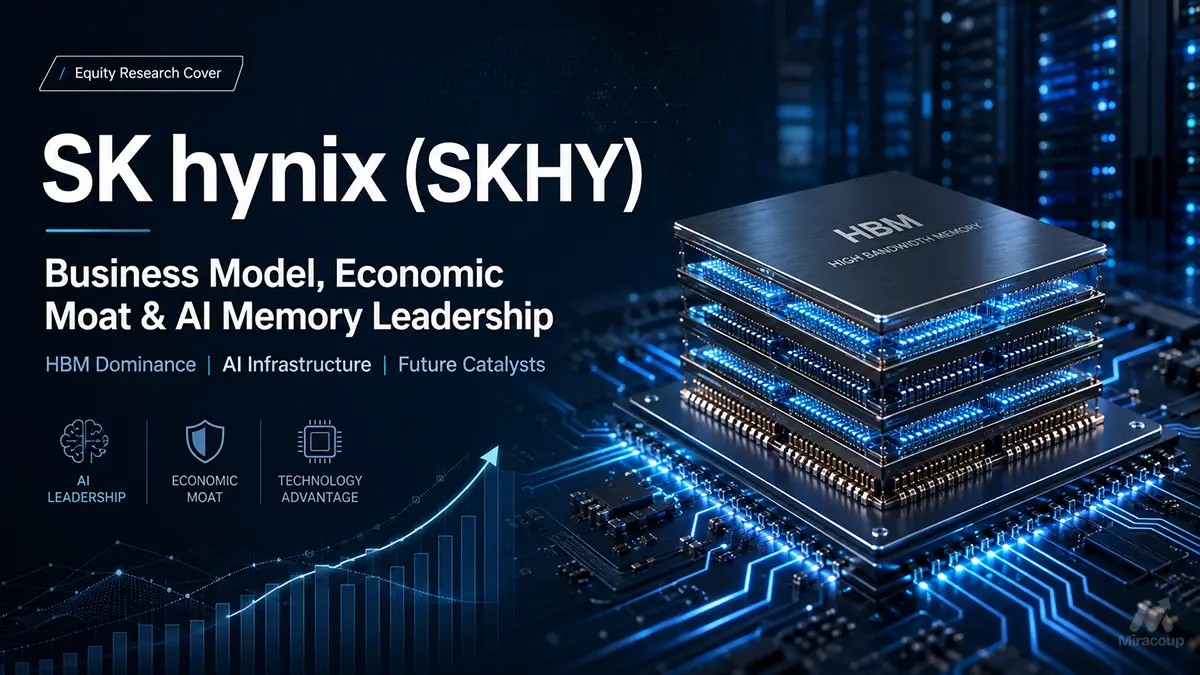
HBM consists of multiple DRAM dies stacked vertically and connected through advanced packaging technologies. It is positioned next to GPUs or custom AI accelerators, allowing enormous volumes of data to move between memory and processors with lower latency and greater energy efficiency than conventional memory architectures.
This changes the commercial character of the product. HBM is not merely another interchangeable memory chip purchased on price. It must meet demanding specifications for bandwidth, power consumption, thermal behavior, physical dimensions, reliability and compatibility with a particular accelerator platform. As a result, HBM carries greater technological content, higher customer qualification requirements and materially stronger pricing power than conventional DRAM.
NAND and Enterprise Storage
NAND flash provides persistent storage for smartphones, PCs, enterprise servers and data centers. The NAND market is generally more fragmented and more vulnerable to oversupply than DRAM, which can make its earnings structurally less predictable.
SK hynix strengthened this business by acquiring Intel’s NAND and SSD operations. The acquired enterprise-storage platform became Solidigm, combining SK hynix’s NAND manufacturing scale with Intel’s controller, firmware and enterprise-customer expertise.
The strategic objective was not simply to sell more commodity NAND. It was to move closer to cloud and AI infrastructure customers through high-capacity enterprise SSDs. As AI systems generate larger training datasets, model checkpoints and inference caches, storage becomes an increasingly important component of data-center architecture. Solidigm therefore gives SK hynix a second route to monetize AI infrastructure beyond HBM.
How SK hynix Converts Revenue Into Profit
SK hynix’s profitability is driven by four interlocking variables:
- Product mix: A greater contribution from HBM, server DRAM and enterprise SSDs raises the value generated per wafer.
- Average selling prices: Tight supply, strong demand or differentiated products allow the company to charge more for each unit of memory.
- Manufacturing yield: Higher yields reduce the effective cost of every saleable chip and are particularly important for complex stacked-memory products.
- Capacity utilization: Semiconductor fabs carry substantial fixed costs. High utilization spreads depreciation and operating expenses across more output, while weak utilization compresses margins rapidly.
The company’s core business model can therefore be summarized as follows: use manufacturing scale and process expertise to shift scarce wafer capacity toward the highest-value memory products, then secure customer commitments before deploying additional capital.
2. Deep Dive into Economic Moats
Under Warren Buffett’s economic-moat framework, SK hynix does not possess a classic consumer network effect. Its brand is largely invisible to end users, and buyers do not select AI servers because they identify with the SK hynix name. Its defensibility instead comes from a combination of intangible manufacturing assets, switching costs and scale-based cost advantages.
Moat One: Process Know-How and High-Yield HBM Manufacturing
The company’s most important barrier is its ability to manufacture leading-edge HBM reliably and in volume. Developing a laboratory prototype is not equivalent to delivering millions of qualified units with predictable performance and acceptable yields.
HBM production requires advanced DRAM fabrication, through-silicon vias, wafer thinning, die stacking, thermal management, testing and packaging. A defect in any layer can impair the entire stack, making yield management economically decisive.
SK hynix’s proprietary Mass Reflow Molded Underfill, or MR-MUF, packaging process has become a central part of this advantage. The technology helps control warpage, improve heat dissipation and support stable production of densely stacked memory. Its real value is not limited to the technical design itself. The deeper moat lies in the accumulated production data, materials expertise, equipment tuning and organizational routines required to reproduce the process at scale.
This creates a form of embedded industrial knowledge. Competitors can study the final product, but they cannot instantly reproduce years of yield learning, supplier coordination and factory-level execution.
Moat Two: Customer Qualification and Co-Development
Leading AI accelerators are built around tightly integrated systems. Memory suppliers must begin working with customers long before a product reaches commercial launch. They may need to coordinate interface specifications, power characteristics, thermal limits, base-die designs, packaging requirements and production schedules.
Once a supplier has passed qualification and demonstrated dependable delivery, replacing it is not frictionless. A customer may need to validate a competing component, adjust system designs, repeat reliability testing and accept execution risk during a critical product launch.
These switching costs are particularly meaningful when AI-chip demand exceeds available supply. In that environment, customers value guaranteed access to qualified capacity as much as nominal unit pricing. SK hynix’s expanding use of multi-year supply agreements can reinforce this relationship by improving demand visibility for the manufacturer while securing supply for the customer.
The emergence of custom HBM could make these relationships even stickier. As memory base dies and interfaces become more closely tailored to individual AI processors, the supplier is no longer providing a standardized component. It becomes a co-development partner embedded in the customer’s architecture and roadmap.
Secondary Moat: Scale and Capital Access
Advanced memory fabrication requires enormous investment in cleanrooms, lithography tools, packaging equipment and process development. Only a small number of companies can finance multiple technology generations while absorbing severe cyclical downturns.
SK hynix’s scale allows it to spread research, equipment and qualification costs across a broad production base. Its position inside SK Group also helped provide the financial backing and strategic patience required to invest through periods when HBM remained a niche technology.
However, scale is not an absolute defense. Samsung has substantial manufacturing resources, Micron remains technologically credible and Chinese memory producers can pressure pricing in conventional DRAM categories. SK hynix’s moat should therefore be described as wide in leading-edge HBM but narrower across commodity memory.
Long-Term Moat Assessment
SK hynix held approximately 56.4% of the global HBM market by revenue in the first quarter of 2026. That position indicates genuine competitive strength, but investors should not confuse leadership with permanent monopoly power.
The moat depends on maintaining a moving technological target. Every new HBM generation requires another cycle of design, qualification, yield improvement and capacity execution. If SK hynix falls behind on performance, thermal management or manufacturing yields, customers have strong incentives to qualify Samsung, Micron or another supplier.
The appropriate investment interpretation is therefore nuanced: SK hynix has a powerful but innovation-dependent moat operating inside a capital-intensive and historically cyclical industry. Its competitive waterline is significantly higher than that of a conventional memory producer, but it must keep investing to prevent rivals from crossing it.
3. Business Inflection Points & Future Catalysts
The Strategic Inflection: From Survival-Mode Memory Producer to HBM Leader
SK hynix began in 1983 as Hyundai Electronics Industries. It merged with LG Semiconductor in 1999, changed its name to Hynix Semiconductor in 2001 and subsequently endured a severe financial crisis as memory prices collapsed. Creditor support allowed the company to survive, but its strategic transformation accelerated after SK Group acquired control in 2012.
The acquisition supplied more than capital. It gave the company permission to invest with a longer time horizon and search for an area where it could escape Samsung’s scale advantage in conventional memory.
That search led SK hynix to HBM. The company introduced an early commercial HBM product with AMD in 2014, well before generative AI turned memory bandwidth into a strategic constraint. The bet initially appeared niche and suffered setbacks during subsequent generations. Management nevertheless preserved the program, improved its packaging capabilities and applied MR-MUF technology to later HBM products.
This was the defining strategic inflection point: SK hynix stopped treating memory solely as a standardized volume product and began engineering it as a performance-critical component of advanced computing systems.
When AI accelerators created an urgent need for bandwidth, the company already possessed product experience, packaging technology, customer relationships and production knowledge. Its current leadership is therefore not simply the result of an unexpected demand boom. It is the monetization of a technical option developed years before the market fully valued it.
Catalyst One: HBM4, HBM4E and Custom HBM
The transition from HBM3E to HBM4 and HBM4E is the most important near-term product catalyst. These generations increase bandwidth and integration complexity while making thermal management and packaging execution even more critical.
SK hynix has entered HBM4 production and has already sampled HBM4E products. Successful volume ramps could support premium pricing, defend market share and reinforce the company’s position in next-generation GPU and custom-accelerator platforms.
Custom HBM may be economically more important than incremental bandwidth improvements. By tailoring memory components to a customer’s processor and workload, SK hynix can capture greater design value and create deeper switching costs. This would shift the company further away from commodity economics and closer to a strategic silicon partnership model.
Catalyst Two: Contracted Demand and Greater Earnings Visibility
SK hynix has disclosed long-term arrangements with approximately ten key customers. Some agreements extend across multiple years and include mechanisms designed to improve supply and financial certainty.
This development could structurally improve the memory business model. Historically, suppliers invested heavily based on uncertain forecasts and then competed aggressively when capacity exceeded demand. Longer contracts, customer-backed commitments and closer roadmap coordination may reduce that mismatch.
The result would not eliminate cyclicality, but it could reduce the amplitude of future cycles and justify a higher valuation multiple than investors traditionally assign to memory manufacturers.
Catalyst Three: Capacity Expansion Without Losing Discipline
SK hynix is expanding HBM and advanced-DRAM capacity through M15X in Cheongju, the Yongin semiconductor cluster and additional packaging infrastructure. These projects are intended to remove production bottlenecks and support demand that existing facilities cannot fully address.
The opportunity is substantial, but capacity expansion is also the central financial risk. If SK hynix, Samsung and Micron simultaneously add too much supply, the industry could recreate the oversupply conditions that have repeatedly damaged memory-sector returns.
The key metric is therefore not capital expenditure alone. Investors should monitor whether new capacity is supported by qualified demand, customer commitments and high-value product ramps. Expansion backed by contracted HBM demand can create value; speculative commodity capacity can destroy it.
Catalyst Four: Solidigm and the AI Storage Layer
AI infrastructure does not end at the accelerator. Training, retrieval, inference and model deployment require enormous storage capacity. High-density enterprise SSDs can reduce data-center space, power consumption and total cost of ownership compared with legacy storage configurations.
Solidigm gives SK hynix access to this opportunity through enterprise controllers, firmware, customer relationships and high-capacity QLC-based drives. If AI storage demand tightens NAND supply and increases adoption of premium enterprise SSDs, the business could become a more meaningful earnings contributor and reduce SK hynix’s dependence on HBM alone.
Catalyst Five: A More Global Capital and Customer Footprint
The 2026 Nasdaq listing under the SKHY ticker broadens access for U.S. investors and may help reduce the valuation discount historically applied to Korean-listed companies. It also provides additional capital for capacity and technology investment.
Meanwhile, the planned advanced-packaging and research facility in Indiana is designed to bring SK hynix closer to North American cloud providers, AI-chip designers and system manufacturers. Although meaningful production is targeted beyond the immediate one-to-two-year window, customer proximity could improve co-development speed, supply-chain resilience and participation in U.S.-based AI infrastructure programs.
The Central Risk to the Thesis
The greatest risk is that the market capitalizes peak-cycle earnings as though they were permanent. SK hynix remains exposed to customer concentration, large capital requirements, export controls, technological misexecution and aggressive competition.
A durable bull case must therefore rest on more than rising HBM prices. It must assume that SK hynix can preserve its qualification advantage, ramp new products at attractive yields, allocate capital rationally and prevent industry capacity growth from overwhelming demand.
4. Key FAQs
How does SK hynix make money from artificial intelligence?
SK hynix sells HBM, server DRAM and enterprise SSDs used in AI data centers. HBM is the most strategically important product because it feeds data to GPUs and custom accelerators at extremely high speeds. AI systems require increasing amounts of memory bandwidth, allowing qualified HBM suppliers to sell higher-value products and secure longer customer commitments.
What is SK hynix’s competitive advantage over Samsung and Micron?
Its primary advantage is the combination of advanced HBM packaging, high-volume manufacturing yields, early customer collaboration and a strong qualification record. Proprietary MR-MUF technology has supported thermal performance and stable production, while years of HBM delivery experience have made SK hynix a lower-risk supplier for major AI-platform customers. Samsung and Micron remain formidable competitors, so the advantage must be renewed with every product generation.
Is SKHY a pure-play artificial intelligence stock?
No. SKHY provides unusually direct exposure to AI memory, but SK hynix still generates revenue from conventional DRAM, NAND flash, mobile devices, PCs and other electronics markets. Its earnings remain influenced by memory pricing, capacity utilization and semiconductor cycles. The company is best understood as a diversified memory manufacturer whose profit mix has become increasingly concentrated in premium AI-infrastructure products.
Disclaimer: This article is intended solely for business logic discussion and corporate research purposes, and does not constitute investment advice of any kind.