

Key Takeaways
- NVIDIA’s economic engine is no longer best understood as a premium GPU franchise. It is increasingly a data-center-scale AI infrastructure platform that monetizes compute, networking, systems, software and services as an integrated stack.
- The company’s strongest moat is the combination of high switching costs and ecosystem network effects around CUDA, accelerated libraries, model tooling, optimized frameworks and deployment infrastructure. Competitors must therefore match not only chip performance, but also software maturity, developer productivity, networking, systems engineering and distribution.
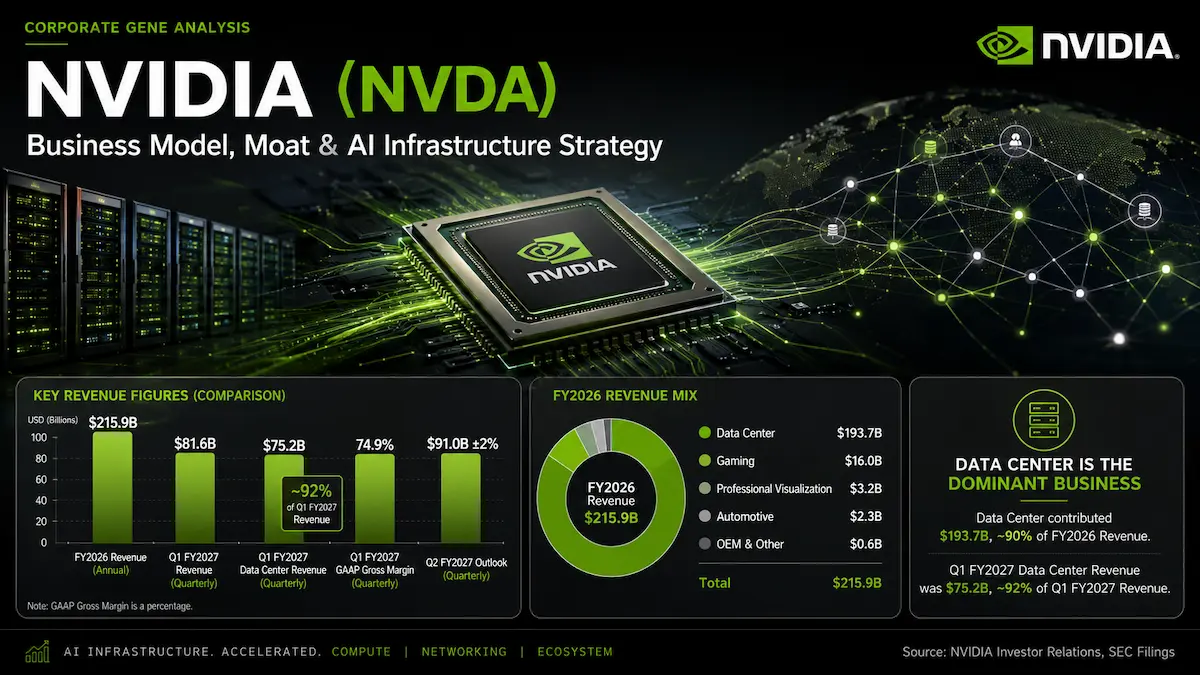
- Data Center has become the center of gravity. Fiscal 2026 Data Center revenue was $193.7 billion, about 90% of company revenue, while first-quarter fiscal 2027 Data Center revenue reached $75.2 billion, about 92% of total revenue.
- The next major catalyst is the Vera Rubin transition, which extends NVIDIA’s strategy from selling accelerators to optimizing the entire AI factory around cost per token, throughput, power, networking and storage. The upside depends on execution, customer data-center readiness and sustained economics for AI inference.
- The principal risks are not limited to rival GPUs. Export controls, customer concentration, custom accelerators, power and capital constraints, supply-chain complexity, faster product transitions and the possibility that AI workloads become materially more compute-efficient could all reduce the durability or monetization of the platform advantage.
1. Business Model Breakdown
From Graphics Silicon to AI Infrastructure Economics
The most important fact about the NVIDIA business model is that the company has migrated up the value chain. Its historical identity was a merchant semiconductor company built around graphics processors. Its current economic model is closer to a vertically coordinated, fabless AI infrastructure platform: NVIDIA designs processors, interconnects, networking, rack-scale systems and software, then uses an extensive cloud, OEM, ODM, systems-integration and developer ecosystem to distribute that platform globally.
This matters because the unit of competition has changed. The buyer is increasingly not comparing one GPU against another GPU. A hyperscaler, AI cloud, enterprise or sovereign customer is evaluating time to train, time to first token, tokens per watt, tokens per dollar, cluster utilization, reliability, networking efficiency, software compatibility, deployment speed and the ability to move workloads across clouds and on-premises environments. NVIDIA’s strategic response has been to increase the amount of that economic stack it designs and optimizes.
Fiscal 2026 revenue reached $215.9 billion. Data Center contributed $193.7 billion, including $162.4 billion from compute and $31.4 billion from networking. Gaming generated $16.0 billion, Professional Visualization $3.2 billion, Automotive $2.3 billion, and OEM and Other $0.6 billion. In other words, the earnings architecture is now overwhelmingly tied to AI infrastructure rather than gaming. The first quarter of fiscal 2027 pushed that mix further: Data Center revenue reached $75.2 billion out of $81.6 billion of total revenue.
The Primary Revenue Engine: Compute Plus Networking
NVIDIA monetizes Data Center through a layered hardware stack. At the compute layer, it sells GPUs and increasingly complete accelerated-computing systems. At the networking layer, it sells NVLink scale-up interconnect, InfiniBand and Spectrum-X Ethernet products, ConnectX network adapters, BlueField data processing units, switches, cables and related software. The Mellanox acquisition in 2020 was strategically important because it gave NVIDIA control over high-performance networking, allowing the company to optimize performance across the cluster rather than only inside the accelerator.
The business logic is powerful: as AI models and inference workloads scale, the bottleneck moves from a single processor to data movement across many processors. That makes networking and interconnect less of an accessory and more of a determinant of system economics. The result is an expanding attach opportunity. A customer that standardizes on NVIDIA at rack or cluster level can buy not only GPUs, but also CPUs, DPUs, NICs, switches, interconnect and system software. NVIDIA therefore has a path to increase revenue per deployed AI factory even if accelerator unit prices eventually face more pressure.
Software Is Both a Monetization Layer and a Demand Multiplier
NVIDIA also sells paid software licenses, including NVIDIA AI Enterprise and virtual GPU software. However, the more important strategic role of software is broader than directly reported software revenue. CUDA, CUDA-X libraries, TensorRT, NeMo, NIM, Dynamo, AI Blueprints and domain-specific frameworks make NVIDIA hardware easier to program, optimize and deploy. Some of this software is monetized directly; much of it is monetized indirectly by increasing demand for NVIDIA infrastructure and reducing the friction of staying on the platform.
This distinction is central to the business model. NVIDIA does not need every software layer to become a stand-alone SaaS profit center for software to create economic value. Free or open software can improve hardware utilization, lower cost per token, accelerate application deployment and widen compatibility. Those benefits can increase demand for the underlying installed base, improve renewal economics at the infrastructure level and make the next NVIDIA architecture easier for a customer to adopt.
Why the Model Can Produce High Margins
NVIDIA is fabless. It relies on external foundries and manufacturing partners for wafer fabrication, assembly, testing and packaging. That structure avoids much of the fixed cost of owning leading-edge fabs, while allowing the company to concentrate capital and talent on architecture, systems, software and ecosystem development. The trade-off is dependency on suppliers such as TSMC and Samsung and exposure to advanced packaging, memory, component and capacity constraints.
The margin engine therefore comes from intellectual-property density and platform value rather than manufacturing ownership. When customers are buying a system that can materially reduce training time or inference cost, the economic value of the solution can exceed the bill of materials by a wide margin. That supports premium pricing. Still, gross margin should not be treated as structurally risk-free. Fiscal 2026 GAAP gross margin fell to 71.1% from 75.0% as the company shifted from Hopper HGX systems toward more complex Blackwell full-scale data-center solutions and absorbed a $4.5 billion H20-related inventory and purchase-obligation charge. In the first quarter of fiscal 2027, GAAP gross margin recovered to 74.9%.
The Emerging Platform Map: Hyperscale, ACIE and Edge Computing
NVIDIA’s new reporting framework is strategically revealing. Beginning in fiscal 2027, the company describes its market platforms as Data Center and Edge Computing. Within Data Center, it separates Hyperscale from AI Clouds, Industrial and Enterprise, or ACIE. In the first quarter of fiscal 2027, Hyperscale revenue was $37.9 billion and ACIE revenue was $37.4 billion. That near-even split indicates that NVIDIA’s opportunity is broadening beyond a small set of U.S. hyperscalers toward neoclouds, industrial enterprises, sovereign AI projects and purpose-built AI factories.
This diversification is strategically important, but it should not be confused with low customer concentration. In the first quarter of fiscal 2027, three direct customers represented 21%, 17% and 16% of total revenue. The business can therefore become broader by end market while remaining concentrated in the distribution and procurement layer. That concentration increases NVIDIA’s bargaining exposure to a small number of very large buyers and makes the quality of downstream end demand an important variable.
2. Deep Dive into Economic Moats
Moat One: Switching Costs
The strongest NVIDIA moat is switching cost, but the switching cost is not simply that CUDA code is difficult to rewrite. The deeper lock-in exists across software, human capital, production tooling, cluster architecture, operational processes and ecosystem dependencies.
A serious AI customer develops against a stack of frameworks, kernels, compilers, libraries, inference engines, observability tools, orchestration systems and deployment workflows. Engineers learn how to optimize models for a specific memory hierarchy, interconnect topology and software runtime. Infrastructure teams qualify servers, networking, firmware and drivers. Cloud platforms package the hardware into commercial services. Software vendors optimize applications around the installed base. Once these layers are operating at production scale, changing accelerator architecture creates retraining, porting, testing, debugging, performance-tuning and reliability costs.
NVIDIA’s latest 10-K states that more than 7.5 million developers use CUDA and its other software tools, while its accelerated computing platform supports about 6,000 applications. Those figures are more economically meaningful than brand awareness because they represent accumulated complementary investment. A competitor can ship a faster chip, but it does not instantly inherit the customer’s optimized code base, trained engineers, deployment scripts, cloud availability, debugging knowledge, libraries and third-party application support.
For a rival to neutralize this moat, it must lower the total migration cost enough that customers are willing to absorb execution risk. That means delivering not only competitive silicon economics, but also mature compilers, broad framework support, optimized kernels, enterprise support, stable drivers, scalable networking, debugging tools, documentation, cloud availability and a credible multi-generation roadmap. The required investment is measured in years of software engineering and ecosystem cultivation, not one product cycle.
The vulnerability is portability. If frameworks increasingly abstract away hardware differences, if open-source inference layers make accelerators more interchangeable, or if large customers own enough software talent to optimize directly for custom ASICs, switching costs can decline. Hyperscalers have an economic incentive to reduce dependence on a premium merchant supplier, so NVIDIA must keep the performance and developer-productivity advantage large enough to offset that incentive.
Moat Two: Ecosystem Network Effects
NVIDIA also benefits from a two-sided ecosystem effect. A large installed base attracts developers and software vendors because optimizing for NVIDIA reaches more users. More software support makes NVIDIA infrastructure more valuable to customers. More customers then encourage cloud providers, OEMs, ODMs, systems integrators and model developers to prioritize NVIDIA compatibility, which in turn increases the utility of the installed base.
This is not a pure consumer-style network effect in which each additional user directly improves the service for every other user. It is an indirect network effect built around complements. Its defensibility comes from coordination. NVIDIA has spent years aligning silicon, systems, cloud availability, developer tools, enterprise software, research libraries and vertical frameworks around one programmable architecture.
The company’s platform strategy deepens this effect. CUDA is now paired with NVLink, InfiniBand, Spectrum-X, BlueField, Grace and Vera CPUs, AI Enterprise, Dynamo, NeMo, NIM, Omniverse, DRIVE and domain-specific libraries. NVLink Fusion extends the ecosystem in another direction by allowing semi-custom CPUs and XPUs to connect into NVIDIA’s broader scale-up and scale-out infrastructure. Strategically, that is a response to custom silicon: rather than insisting that every chip in the data center must be NVIDIA-designed, NVIDIA can attempt to remain the fabric, software and infrastructure standard around heterogeneous compute.
The cost to replicate this network is substantial because competitors must persuade multiple constituencies simultaneously. Developers will not prioritize a platform without users; users will hesitate without software support; cloud providers will limit capacity without customer demand; enterprises will hesitate without support and integration partners. NVIDIA entered that loop early and has reinforced it through successive generations of hardware and software.
Why Intangible Assets and Cost Advantage Are Secondary Moats
NVIDIA owns valuable intellectual property and has a powerful brand, but neither should be the primary moat classification. Patents can protect specific inventions, yet AI infrastructure competition moves fast and customers buy economic outcomes rather than logos. Likewise, NVIDIA has meaningful performance-per-dollar and performance-per-watt advantages when its hardware and software are co-optimized, but it does not own the leading-edge fabs that manufacture its chips. Its fabless model is capital efficient, not a classical low-cost production moat.
The more durable advantage is therefore systemic: customer switching costs reinforced by ecosystem network effects. That combination can support excess returns as long as NVIDIA keeps widening the productivity gap between staying on its platform and moving away from it. If the gap narrows, the moat can compress even if absolute demand for AI remains high.
3. Business Inflection Points & Future Catalysts
The Defining Strategic Inflection Point: CUDA in 2006
The most important strategic turning point in NVIDIA’s history was the introduction of CUDA in 2006. Before CUDA, NVIDIA’s core economic identity was tied primarily to graphics. CUDA opened the GPU’s parallel-processing capability to general-purpose computing. That decision transformed the GPU from a specialized graphics component into a programmable computing platform.
The strategic significance was not immediate revenue. It was option creation. Once developers could program GPUs for scientific computing, data processing and eventually deep learning, NVIDIA gained exposure to workloads far larger than the original gaming market. The 2012 AlexNet breakthrough demonstrated that neural networks trained on NVIDIA GPUs could deliver a step change in image recognition. Tensor Cores, data-center GPUs and software libraries then compounded the advantage. The 2020 Mellanox acquisition later extended the architecture from processor-level acceleration to data-center-scale computing by bringing high-performance networking into the stack.
The corporate gene established by CUDA is still visible today: NVIDIA repeatedly turns a hardware invention into a programmable platform, then surrounds it with software and ecosystem assets that increase the value of the next hardware generation.
Catalyst One: Vera Rubin Converts the Roadmap Into a System-Level Upgrade Cycle
Vera Rubin is the most direct 12-to-24-month product catalyst. NVIDIA says the platform is ramping into full production, with partner availability expected in the second half of 2026. Rubin combines the Vera CPU, Rubin GPU, NVLink 6, ConnectX-9, BlueField-4 and Spectrum-6 into a co-designed AI factory architecture. NVIDIA positions the system around higher agent throughput and lower inference cost, not merely peak GPU performance.
The transmission mechanism is straightforward. If Rubin materially reduces cost per token and raises useful throughput per megawatt, customers can improve the economics of AI services. Better unit economics can justify more inference, more complex reasoning, larger context windows and broader deployment. That can raise demand not only for GPUs, but also for networking, CPUs, DPUs, storage acceleration and software.
Observable indicators include the timing and scale of Rubin cloud availability, conversion of announced deployments into operating capacity, Data Center sequential growth, networking growth, gross-margin behavior during the architecture transition, customer references to cost-per-token improvements, and whether Rubin expands beyond frontier-model training into high-volume inference and enterprise workloads.
The major execution risks are product complexity, advanced packaging and memory availability, qualification delays, customer power constraints and architecture-transition volatility. NVIDIA itself warns that a faster annual product cadence can cause customers to pause purchases ahead of new releases, complicate inventory planning and amplify the financial cost of any delay or defect. If customers cannot secure data-center capacity or power, superior hardware does not automatically convert into revenue.
Catalyst Two: Inference and Agentic AI Increase the Value of the Software Layer
The second catalyst is the shift from training-centric AI spending toward persistent inference and agentic workloads. Training creates large but episodic compute demand. Inference can create recurring utilization because models are serving users, agents and machine workflows continuously. Agentic systems can be especially compute-intensive because they perform multi-step reasoning, call tools, inspect context, generate intermediate outputs and repeat those cycles.
NVIDIA’s strategy is to monetize this shift by optimizing the entire inference stack. Dynamo 1.0, TensorRT-LLM, NIM and other software layers aim to improve scheduling, model serving and token throughput across GPU clusters. Even when parts of this software are open source, improved performance can expand the economically viable workload set for NVIDIA infrastructure. In that sense, software functions as a demand elasticity engine: lower token cost can stimulate more token consumption.
Observable indicators include growth in ACIE revenue, deployment of inference-focused clusters, increased networking attach, customer adoption of Dynamo and NVIDIA inference tooling, expansion of enterprise AI use cases, and evidence that AI applications are producing enough revenue or productivity gains to justify sustained infrastructure spending.
The risk is that inference becomes more heterogeneous and price-sensitive than training. Custom ASICs, lower-cost accelerators, model compression, sparsity, distillation and algorithmic efficiency can reduce the amount of premium compute required per task. If software frameworks make hardware interchangeable and buyers optimize aggressively for workload-specific chips, NVIDIA may retain high absolute demand but lose share or pricing power at the margin.
Catalyst Three: Turning Compute Into a Financeable Infrastructure Asset
On August 10, 2026, NVIDIA announced memorandums of understanding with Apollo, BlackRock, Blackstone, Brookfield, Goldman Sachs and KKR to establish independent compute-financing platforms intended to mobilize more than $500 billion of third-party capital over time. The commercial logic is important: one of the bottlenecks in AI infrastructure is no longer only chip supply; it is also the availability and cost of capital required to build data centers and acquire compute.
If executed, these platforms could reduce financing friction for AI clouds, enterprises and other infrastructure buyers. Lower capital friction can accelerate deployments and broaden the buyer base beyond the largest cash-rich hyperscalers. It also reinforces NVIDIA’s attempt to position its installed base as durable, transferable infrastructure with enough utilization demand to support long-duration financing.
Observable indicators include execution of final agreements, disclosed capital commitments rather than headline targets, financed data-center projects reaching construction and operation, diversification of customer revenue, utilization and offtake contracts, and whether financing produces incremental end demand rather than simply changing the funding source for projects that would have happened anyway.
The risk is material and should not be minimized. The announced partnerships remain subject to final agreements. AI infrastructure assets can suffer if utilization, electricity economics or customer solvency disappoint. Financing can accelerate good demand, but it can also mask weak project economics if underwriting standards loosen. Investors should therefore distinguish between third-party capital availability and proven end-user return on invested compute.
Catalyst Four: Sovereign and Industrial AI Broadens the Demand Base
NVIDIA is also pushing the platform into national and industrial infrastructure. In July 2026, NVIDIA announced a Japan national physical-AI project centered on a Vera Rubin AI factory and the DSX platform. Similar sovereign and industrial projects are strategically valuable because they diversify AI infrastructure spending beyond U.S. consumer-internet hyperscalers and create local ecosystems of developers, enterprises and public-sector users around NVIDIA standards.
The transmission mechanism is ecosystem seeding. A nationally or industrially deployed AI factory can create local compute availability, attract software development, support industry-specific models and pull through networking, systems and enterprise software. If successful, this expands NVIDIA’s addressable market from centralized cloud AI to regional and industry-specific infrastructure.
Observable indicators include commissioned capacity, actual utilization, repeat sovereign deployments, ACIE growth, adoption by industrial software vendors and measurable production use cases in manufacturing, robotics, healthcare and telecom. The main risks are political procurement cycles, project delays, energy constraints, localization requirements and the possibility that governments favor domestic accelerator ecosystems for strategic reasons.
What Could Break the Catalyst Chain?
The central risk is that NVIDIA’s customers invest ahead of monetizable AI demand. High infrastructure spending is rational only if AI services, agents and industrial applications generate sufficient revenue or productivity. If customer returns disappoint, the first response may be slower capacity additions rather than an immediate collapse in AI usage. Because NVIDIA’s revenue is concentrated among large buyers and because its own supply commitments are substantial, even a moderation in buildout velocity can create inventory, pricing and margin volatility.
Geopolitics is another structural constraint. NVIDIA states that it is effectively foreclosed from competing in China’s data-center compute market under the current U.S. export-control and geopolitical environment. That not only removes revenue opportunity but can also accelerate the development of alternative local hardware and software ecosystems. Restrictions that weaken NVIDIA in one region can therefore indirectly strengthen future competitors elsewhere.
Finally, scale itself increases execution risk. NVIDIA is moving from merchant chips to multi-component rack-scale infrastructure with faster annual architecture transitions. More components, more suppliers, more data-center dependencies and more financing relationships create additional points of failure. The company can deepen its moat by controlling more of the system, but it also assumes more responsibility for system-level execution.
4. Key FAQs
How does NVIDIA make money beyond selling GPUs?
NVIDIA makes money from a broader AI infrastructure stack that includes data-center compute systems, networking products, interconnect, CPUs, DPUs, gaming GPUs, professional visualization products, automotive platforms and paid enterprise software. The highest-value part of the model is the interaction among those layers. CUDA and related software increase the usefulness of the hardware; networking allows more GPUs to function as one large computer; rack-scale systems increase NVIDIA’s content per deployment; and enterprise software can add direct recurring licensing revenue. As AI infrastructure becomes more complex, NVIDIA can monetize a larger share of the total system rather than only the accelerator.
Why is CUDA such a strong moat for NVIDIA against AMD and custom AI accelerators?
CUDA is a moat because it sits inside a much larger production ecosystem. Developers, libraries, frameworks, enterprise applications, cloud services and internal engineering workflows have accumulated around NVIDIA over many years. Moving to another accelerator can require code porting, performance tuning, infrastructure requalification and operational retraining. AMD, hyperscaler ASICs and other accelerators can compete successfully in specific workloads, but matching NVIDIA’s silicon is only one part of the challenge. The competitor must also reduce the customer’s migration cost and provide enough software, support, cloud availability and multi-generation performance to justify the change.
Is NVIDIA too dependent on hyperscalers and AI data-center spending?
NVIDIA is highly dependent on AI infrastructure spending, but the demand base is broadening. In the first quarter of fiscal 2027, Hyperscale revenue was $37.9 billion while AI Clouds, Industrial and Enterprise revenue was $37.4 billion, showing that Data Center growth is not confined to a single buyer class. However, direct-customer concentration remains high: three direct customers accounted for 21%, 17% and 16% of total revenue in the quarter. The key question is therefore not simply whether NVIDIA has hyperscaler exposure, but whether downstream AI economics remain strong enough to support continued capital spending across hyperscalers, AI clouds, enterprises and sovereign projects.
5. Conclusion
NVIDIA’s corporate gene is the conversion of specialized hardware leadership into a programmable platform, followed by aggressive expansion into the surrounding bottlenecks. CUDA turned graphics processors into general-purpose accelerators. Mellanox turned processor leadership into cluster-scale computing. Blackwell and Rubin extend the model toward full AI factories in which compute, networking, storage acceleration, systems and software are co-designed around the economics of intelligence production.
The durable part of the moat is therefore not any single GPU generation. It is the accumulated cost of leaving the platform and the growing number of ecosystem participants that have an incentive to keep optimizing for it. That combination can sustain premium economics even as individual chips face competition. The strategic test over the next two years is whether NVIDIA can preserve that advantage as custom accelerators improve, inference becomes more price-sensitive and customers demand stronger returns on AI capital spending.
The bull case for the business model is a widening platform: more compute generations, higher networking content, more inference software, more sovereign and enterprise deployments, and a financing ecosystem that lowers the friction of building AI factories. The counterweight is equally important: greater system complexity, customer concentration, geopolitical exclusion from China, capital and power constraints, and the possibility that algorithmic efficiency reduces the amount of premium compute required per unit of useful AI output.
For corporate analysis, the cleanest conclusion is that NVIDIA has evolved from a semiconductor vendor into an AI infrastructure standard-setter whose economics are increasingly determined by ecosystem control and system-level performance. Whether that corporate gene continues to generate excess returns will depend less on maintaining a permanent lead in any one chip benchmark and more on keeping the total cost, productivity and deployment advantages of the NVIDIA platform sufficiently ahead of credible alternatives.
Official Sources
- U.S. SEC — NVIDIA Fiscal 2026 Form 10-K
- U.S. SEC — NVIDIA Fiscal 2027 First-Quarter Form 10-Q
- NVIDIA Investor Relations — First-Quarter Fiscal 2027 Results
- NVIDIA Investor Relations — Fiscal 2027 Second-Quarter Earnings Schedule
- NVIDIA Newsroom — Vera Rubin Ramps Into Full Production
- NVIDIA Newsroom — Dynamo 1.0 Inference Operating System
- NVIDIA Newsroom — NVLink Fusion Platform
- NVIDIA Investor Relations — AI Compute Infrastructure Financing Platforms
- NVIDIA Investor Relations — Japan National AI Infrastructure
- NVIDIA — Company History and CUDA Introduction
Disclaimer: This article is intended solely for business logic discussion and corporate research purposes, and does not constitute investment advice of any kind.