



Key Takeaways
- Keel Infrastructure’s corporate DNA is not best understood as “a Bitcoin miner that discovered AI.” Its recurring strategic competency has been acquiring, operating, and expanding power-heavy infrastructure; the monetization layer is now shifting from volatile Bitcoin mining to long-duration HPC and AI data center leasing.
- The most defensible competitive asset is scarce, location-specific power capacity with existing interconnections, land control, permits, and development work already in motion. In a market where time-to-power is increasingly the binding constraint, an executable megawatt can be materially more valuable than an unenergized land bank.
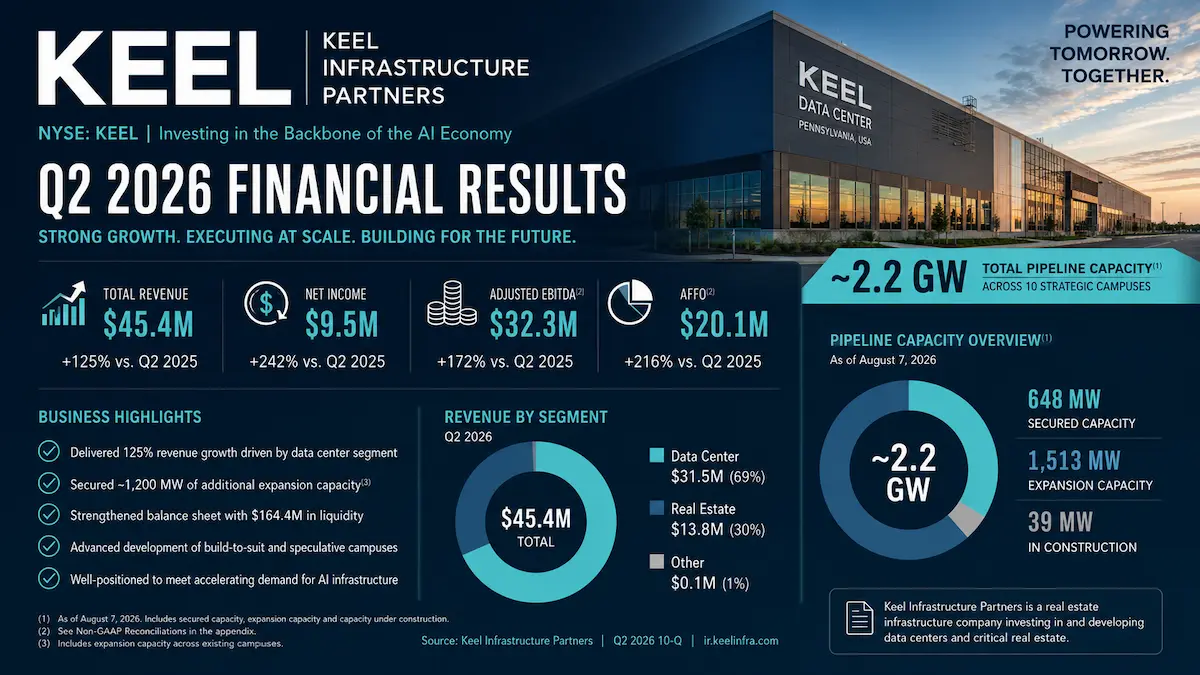
- The headline 2.2 GW development pipeline should not be treated as 2.2 GW of firm, contractually secured capacity. As of June 30, 2026, Keel reported 648 gross MW of secured data center capacity and 1,513 gross MW of expansion capacity, meaning roughly 70% of the stated pipeline remained under evaluation rather than under executed electric supply agreements.
- The business model is still in transition. As of August 7, 2026, Keel had not recognized HPC data center revenue at its Washington or Pennsylvania conversion sites. The investment case therefore depends less on current earnings and more on whether lease execution, project financing, and 2027 commissioning convert power scarcity into contracted cash flow.
- The primary risk is execution, not demand narrative. Keel must obtain remaining permits, sign financeable long-term leases, control construction costs, deliver infrastructure on customer schedules, and convert early-stage expansion megawatts into firm power without allowing financing costs or regulatory requirements to erode project returns.
Keel Infrastructure Corp. is one of the more unusual corporate transformations in the North American digital infrastructure market. The company was founded in 2017 as Bitfarms and spent most of its early life building vertically integrated Bitcoin mining operations around access to electricity. That history matters because the strategic pivot now underway is not a complete rejection of the old business. It is an attempt to monetize the same core asset class—power, interconnection infrastructure, land, substations, operating know-how, and energy-market relationships—through a higher-quality contractual structure.
The strategic question is therefore not whether artificial intelligence demand is strong. The more important question is whether Keel can convert an energy-infrastructure portfolio originally optimized for commodity-like Bitcoin economics into a financeable data center platform with long-duration leases, credible counterparties, and attractive returns on development capital. That distinction separates a genuine business-model re-rating from a thematic rebranding exercise.
The historical sequence supports this interpretation. Bitfarms’ original model was to use low-cost power and in-house electrical and data center capabilities to produce Bitcoin. In 2024, management began publicly discussing HPC and AI opportunities. In early 2025, the company engaged Appleby Strategy Group and World Wide Technology to assess its North American sites for HPC suitability. In March 2025, it completed the acquisition of Stronghold Digital Mining, adding Pennsylvania power-generation assets, grid positions, and a large power-development opportunity set. During 2025 and early 2026, it sold or exited Latin American assets, redirected capital toward North American HPC infrastructure, and progressively shut down U.S. Bitcoin mining. On April 1, 2026, the company redomiciled to the United States and adopted the Keel Infrastructure name. By June 29, 2026, U.S. Bitcoin mining had ceased at Panther Creek, Scrubgrass, and Sharon, leaving the company operationally committed to the infrastructure transition.
1. Business Model Breakdown
From mining economics to infrastructure economics
The legacy Bitfarms model monetized electricity by converting it into computational hashpower and receiving Bitcoin from mining pools. That model exposed revenue and margins to Bitcoin prices, network difficulty, mining efficiency, and halving cycles. It could generate cash quickly, but the revenue stream was inherently cyclical and market-priced.
The Keel Infrastructure business model is designed to replace that volatility with long-duration contractual cash flows. In its Q2 2026 Form 10-Q, Keel states that it is developing data centers and energy infrastructure to lease for HPC and AI workloads and intends to lease capacity to hyperscalers, cloud service providers, AI companies, and enterprises under long-term contracts. Economically, the company is moving from selling compute output into a commodity-like network to selling scarce, powered physical capacity to customers that require predictable access to electricity, cooling, connectivity, and deployment timelines.
This changes the underlying profit equation. Under Bitcoin mining, the key spread was the value of Bitcoin mined minus power, equipment, and operating costs. Under HPC infrastructure, the key spread becomes the risk-adjusted return on development capital: long-term lease economics and residual asset value must exceed the cost of land, electrical infrastructure, cooling, networking, construction, operations, and financing. Contract duration and counterparty credit quality also become central because they influence how cheaply Keel can finance a completed or pre-leased project.
What Keel earns today versus what it is trying to earn tomorrow
Keel is not yet a mature AI data center landlord. Q2 2026 revenue was $30.4 million, down from $60.9 million a year earlier, and the company said the decline primarily reflected lower Bitcoin mining revenue and the shutdown of U.S. mining operations. The company also continues to generate energy-sale revenue at Panther Creek and Scrubgrass while those assets are being repositioned. As of August 7, 2026, however, Keel had not commenced HPC data center operations or recognized related HPC revenue at its Washington or Pennsylvania conversion sites.
That makes the current financial statements a poor proxy for the intended steady-state model. Legacy mining revenue is shrinking by design while development spending and corporate hiring are rising ahead of contracted HPC revenue. The resulting earnings profile looks weak on a trailing basis because Keel is absorbing the costs of one business before the revenue base of the next business is fully established.
The future revenue architecture
Keel’s future revenue model appears likely to be lease-driven rather than dependent on a single standardized operating format. Management’s Q2 2026 prepared remarks indicate that Moses Lake may use a modified-gross lease structure because prospective customers there value speed and a fully operated facility. Keel would retain more operational control under that format. At Sharon, management said commercial discussions are focused on triple-net structures and may pair fast-growing AI customers with investment-grade credit support to produce a financeable long-term lease.
This flexibility is strategically important. It implies that Keel is not trying to force every site into the same product. Instead, it is matching risk allocation and operating responsibility to the customer set and site characteristics. A smaller, speed-oriented campus such as Moses Lake can be positioned as an operated solution, while larger Pennsylvania sites can be structured more like long-duration infrastructure real estate. The common denominator is not lease format; it is monetizing access to power on a timeline customers cannot easily replicate elsewhere.
The platform strategy: power first, contract second, project finance third
Keel’s platform strategy can be reduced to a three-stage capital cycle. First, secure or control power, land, interconnection, and permitting. Second, advance a site far enough that prospective tenants can underwrite a credible ready-for-service date and negotiate a long-term lease. Third, use the lease and customer credit profile to obtain project-level financing at a lower cost of capital than would be available to an uncontracted development.
The company’s capital allocation strategy supports this sequence. In June 2026, Keel closed $458 million of 1.25% convertible senior notes due 2032. By August 7, 2026, it reported approximately $819 million of total liquidity, including unrestricted cash and unencumbered Bitcoin. Management has said that existing liquidity is sufficient to advance its priority sites through lease execution and fund cash SG&A through 2028, while project construction can be financed after leases are signed. That sequencing matters because an investment-grade offtake or credit wrap can materially improve project debt availability and pricing.
In other words, Keel is trying to avoid financing fully built speculative data centers with expensive corporate capital. It is spending enough capital to make the power and delivery schedule credible, then seeking to transfer a larger portion of construction financing into a contracted, project-level capital structure. If executed well, this can improve equity efficiency. If lease execution is delayed or the counterparty credit quality is weak, the same strategy can leave Keel carrying development costs without the financing benefit it expects.
The key accounting reality: the 2.2 GW pipeline is not all equal
Keel markets a roughly 2.2 GW power-capacity pipeline, but the quality of those megawatts varies materially. As of June 30, 2026, the company reported 341 gross MW of current energized capacity, 430 gross MW of secured growth capacity, 648 gross MW of total secured data center capacity, and 1,513 gross MW of expansion capacity. Expansion capacity includes megawatts under utility studies and potential behind-the-meter generation that are not yet contracted under electric supply agreements.
This distinction is essential for valuation discipline. A secured megawatt with a utility agreement, land, permitting progress, and a credible delivery date is not economically equivalent to a megawatt that exists only as an application or potential generation plan. Approximately 70% of the June 2026 total pipeline sat in the expansion category. The upside is large if Keel converts that queue into executable capacity; the risk is equally clear if investors capitalize early-stage megawatts as though they are already firm.
2. Deep Dive into Economic Moats
Under a Buffett-style moat framework, Keel should not be awarded a durable competitive advantage simply because AI infrastructure demand is growing or because the company controls a large number of potential megawatts. Growth is not a moat. Scale is not automatically a moat. A moat exists only if the company can sustain superior economics because competitors face structural difficulty replicating the underlying advantage.
Intangible Assets: the strongest current moat candidate
Keel’s most defensible asset is a bundle of contractual and regulatory rights rather than a consumer brand or patent portfolio. The relevant assets include utility agreements, established grid interconnections, zoning approvals, land control, permitting progress, long-lead equipment procurement, local relationships, and development history at sites where power is already energized or scheduled for delivery.
This matters because the critical scarce input in AI data center development is increasingly not land or servers in isolation, but deliverable power at the right location and on the right timeline. A competitor can buy land relatively quickly. It cannot necessarily reproduce a utility interconnection position, secure hundreds of megawatts in a constrained market, complete local approvals, order long-lead electrical equipment, and compress years of development work into a few quarters.
Panther Creek illustrates the thesis. Keel reports 350 gross MW of secured utility capacity with PPL, with zoning and conditional land-development approval already obtained and environmental permitting in progress. Sharon has 110 gross MW, zoning and land-development approval, and transformers already delivered. Moses Lake has 18 gross MW and is being developed with Vertiv modules, with the first units delivered in 2026. These are not completed data centers, but they are meaningfully farther along than a greenfield concept that still needs to establish power, land, permitting, fiber, and supply-chain readiness.
The August 2026 Pennsylvania regulatory tightening is also strategically relevant. Governor Josh Shapiro’s Executive Order 2026-05 requires data center projects entering the state permitting process to satisfy legally enforceable GRID requirements and removes AI data centers from the state’s Fast Track permitting program. Keel stated on August 20 that the permitting schedules at Panther Creek and Sharon were unaffected by the order. If that remains true, advanced permitting status could become more valuable as new entrants face additional process requirements. That is a potential barrier to entry, but it should not be treated as permanent protection because regulatory requirements can also raise Keel’s own future expansion costs.
Switching Costs: potentially strong after lease execution, but not yet proven
Data center customers can face substantial switching costs once high-density compute is deployed into a specific campus. GPU clusters, networking architecture, cooling design, fiber routes, operational procedures, and workload migration all create practical friction. Long-duration leases further increase economic switching costs.
For Keel, however, this moat is prospective rather than current. As of August 7, 2026, the company had not recognized HPC data center revenue at its Washington or Pennsylvania development sites. It therefore does not yet have an installed base of long-term HPC tenants that can demonstrate renewal behavior, contractual stickiness, or pricing power. The switching-cost moat only becomes real after Keel signs and successfully serves customers for a sustained period.
This distinction is important. It is reasonable to believe that a 15-year infrastructure relationship could become sticky. It is not reasonable to count that stickiness as an existing moat before the leases have been executed and the facilities have been commissioned.
Network Effects: weak
Keel does not currently exhibit a classic network effect. One hyperscaler leasing capacity at Panther Creek does not automatically make the site more valuable to another customer in the way additional users increase the value of a payments network or marketplace. A larger customer base could improve procurement relationships, operating knowledge, vendor access, financing credibility, and commercial reputation, but those are scale and execution benefits rather than a true network effect.
Investors should therefore avoid using “platform” language to imply software-like network economics. Keel is a physical infrastructure platform. Its returns will depend on site economics, capital intensity, contract quality, and development execution, not on near-zero marginal costs or self-reinforcing user growth.
Cost Advantages: plausible through brownfield infrastructure and time-to-power, but not yet demonstrated in consolidated returns
The second most credible moat candidate is a cost-and-time advantage derived from repurposing existing energy infrastructure. Keel’s legacy mining history gave it operating sites, substations, interconnections, power relationships, and in Pennsylvania, owned power-generation assets. Redeveloping existing industrial and energy sites can reduce some of the time and infrastructure burden faced by pure greenfield developers.
The advantage is better described as time-adjusted capital efficiency than as simply “cheap electricity.” For a customer trying to deploy AI compute in 2027, a slightly more expensive megawatt available on time may be economically superior to a cheaper theoretical megawatt that does not arrive until 2030. If Keel can consistently deliver earlier ready-for-service dates, the company can potentially capture a scarcity premium while customers avoid the opportunity cost of delayed compute deployment.
There are limits to this argument. Keel is competing with established data center operators and other infrastructure developers that may possess deeper operating track records, larger procurement programs, and lower costs of capital. Keel’s Q2 2026 filings explicitly acknowledge that some competitors have greater resources and experience. Until Keel reports operating HPC margins and project-level returns, it is too early to conclude that the company enjoys a structural cost advantage across the full data center lifecycle.
Moat verdict: emerging, narrow, and highly execution-dependent
The two strongest moat candidates are therefore the contractual-regulatory scarcity of near-term power and the time/capital advantage of redeveloping existing energy infrastructure. These advantages could support attractive long-term returns if they allow Keel to sign durable leases at economics that more than compensate for construction risk and capital intensity.
But the moat is not yet proven by realized returns. Keel has not demonstrated a mature HPC return on invested capital profile, renewal economics, or sustained pricing power. The current edge is an option on scarce infrastructure becoming cash-generative infrastructure. The durability test will be whether Keel can repeatedly convert early-stage power positions into signed utility agreements, then into leases, then into commissioned data centers, without giving away the economics through high construction costs or expensive financing.
3. Business Inflection Points & Future Catalysts
The decisive inflection point: recognizing that the energy asset was more valuable than the Bitcoin use case
The most important strategic turning point was not the April 2026 name change. It occurred earlier, when management concluded that the company’s North American power and infrastructure assets could generate higher risk-adjusted value as HPC data centers than as Bitcoin mines.
The 2025 Form 10-K states that early-2025 site evaluations by Appleby Strategy Group and World Wide Technology identified attractive HPC characteristics across U.S. and most Québec sites, reinforcing management’s conclusion that reallocating infrastructure from Bitcoin mining to HPC represented the highest-value path. That decision changed the company’s objective function. The portfolio was no longer being optimized for hash rate; it was being optimized for power availability, location, permitting certainty, tenant credit, lease duration, and project financeability.
The Stronghold acquisition accelerated that shift by adding Pennsylvania energy infrastructure and development opportunities, while Latin American asset sales concentrated the portfolio in North America. The 2026 redomiciliation and Keel rebrand then completed the corporate identity change, but the economic transformation had already begun.
Catalyst 1: signing long-term leases at Panther Creek, Sharon, and Moses Lake
The single most important near-term catalyst is lease execution. Keel said in August 2026 that multiple prospective customers were negotiating across its priority sites, including hyperscalers, AI companies, GPU clouds, and large enterprises. Management also stated that interest across the portfolio exceeded the capacity available to lease. Those statements indicate commercial activity, but they are not equivalent to signed contracts.
The transmission mechanism is straightforward. A long-term lease transforms an uncontracted development from a speculative infrastructure asset into a credit-backed cash-flow asset. That can reduce uncertainty around future revenue, support project-level debt financing, lower the cost of capital, and give the market a basis for valuing contracted megawatts rather than merely pipeline megawatts. The effect can be especially meaningful if the tenant or credit wrap is investment grade, because Keel has stated that investment-grade offtake remains critical to efficient project financing.
Observable indicators include executed lease megawatts, lease duration, customer or guarantor credit quality, ready-for-service obligations, rent structure, credit support, and any disclosed project-financing terms. Investors should also watch whether Keel signs modified-gross structures at Moses Lake and triple-net structures in Pennsylvania as management has discussed, because those formats allocate operating and capital risks differently.
The principal execution risk is that scarcity alone does not guarantee attractive economics. Keel may choose to wait for better terms and risk delaying financing, or it may sign quickly and lock in economics that prove suboptimal over a long contract life. Customer credit also matters: a high-growth AI tenant without sufficient credit support can raise debt costs and undermine the financeability of an otherwise attractive lease.
Catalyst 2: first HPC commissioning and revenue in 2027
Moses Lake is expected by management to become Keel’s first fully commissioned HPC data center and first source of HPC revenue in 2027. This milestone is strategically disproportionate to the site’s 18 gross MW size because it would provide the first operating proof that Keel can move from Bitcoin decommissioning to advanced data center delivery.
The transmission mechanism is credibility. A successfully commissioned site can demonstrate that Keel can procure long-lead equipment, integrate power and cooling, deliver fiber redundancy, meet customer density requirements, and operate on schedule. That execution record can improve commercial credibility at larger sites such as Sharon and Panther Creek and may also improve access to project finance.
Observable indicators include final permits, module deliveries, construction milestones, commissioned megawatts, customer occupancy, recognized HPC revenue, capital cost per delivered megawatt, operating uptime, and any disclosed PUE performance. Management currently estimates PUE ranges of roughly 1.15 to 1.35 across the development portfolio, but actual operating performance will matter more than design targets.
The principal risks are construction delay, supplier disruption, commissioning issues, customer deployment delays, or cost overruns. A late first project would have consequences beyond the lost revenue because Keel’s broader commercial proposition rests heavily on time-to-power and delivery certainty.
Catalyst 3: converting expansion capacity into signed electric supply agreements
The largest source of embedded upside is not the already secured capacity; it is the 1,513 gross MW of expansion capacity reported at June 30, 2026. Management has also discussed a roughly 2 GW Pennsylvania expansion pipeline and has said it expects to provide more information on utility progress as early as late 2026 or early 2027.
The transmission mechanism here is a change in asset quality. A megawatt under study carries substantial uncertainty. Once it becomes subject to an executed electric supply agreement with a delivery schedule, the probability of future monetization rises materially. That can expand the addressable leasing base and extend the growth runway without requiring Keel to acquire an entirely new corporate platform.
Observable indicators include secured data center capacity rising above the 648 gross MW reported at June 30, 2026, new electric supply agreements, utility load-study outcomes, incremental Pennsylvania capacity, and provincial approval for the 96 MW Sherbrooke project. Sherbrooke is particularly instructive because Keel is attempting to consolidate existing Bitcoin power agreements into a single HPC campus without requesting incremental electricity, which could improve the project’s fit with Québec’s constrained power environment.
The principal risks are utility rejection or delay, transmission-upgrade costs, adverse power economics, permitting friction, and regulatory constraints. The 2.2 GW headline will only create durable value if a growing share moves from “possible” to “contracted.”
Catalyst 4: regulation may widen the gap between advanced and speculative projects
Pennsylvania’s August 2026 GRID requirements introduce a two-sided catalyst. On one hand, tighter permitting and mandatory community, environmental, workforce, and energy-affordability commitments can slow or eliminate speculative projects. Keel argues that Panther Creek and Sharon are unaffected by the new executive order and that its existing development model already aligns with the core standards. If advanced projects retain schedule certainty while new entrants face additional hurdles, the relative value of Keel’s development position could increase.
On the other hand, regulation can never be treated as a free moat. Future phases and expansion applications may require additional commitments, infrastructure spending, reporting, or process time. The relevant observable indicator is not management’s endorsement of regulation, but whether permit issuance, power-delivery dates, and project economics remain intact under the new framework.
4. Key FAQs
What is the Keel Infrastructure business model and how does KEEL make money?
Keel is transitioning from Bitcoin mining to a digital and energy infrastructure landlord-developer. The intended model is to secure power, land, interconnections, and permits; develop HPC-ready data centers; sign long-term leases with hyperscalers, cloud providers, AI companies, and enterprises; and then finance construction against the contracted cash flows. During the transition, the company still earns legacy Bitcoin mining and energy-sale revenue, but those results are not representative of the target business model. The long-term economics are expected to depend on lease yield, customer credit quality, development cost, and financing cost rather than Bitcoin prices and mining difficulty.
Does Keel Infrastructure already generate AI data center revenue or have signed hyperscaler leases?
Not at the latest verified reporting date used for this analysis. Keel’s Q2 2026 Form 10-Q states that as of August 7, 2026, it had not commenced HPC data center operations or recognized related revenue at its Washington or Pennsylvania conversion sites. Management reported active negotiations with multiple prospective customers, but active negotiations should not be treated as contracted backlog. Lease execution remains the key commercialization milestone.
How much of Keel Infrastructure’s 2.2 GW power pipeline is actually secured?
As of June 30, 2026, Keel reported 648 gross MW of secured data center capacity and 1,513 gross MW of expansion capacity, for a total pipeline of 2,161 gross MW, which the company rounds to approximately 2.2 GW. The expansion category includes capacity under utility studies and potential behind-the-meter generation that is not yet covered by executed electric supply agreements. Therefore, roughly 30% of the reported pipeline was secured data center capacity and roughly 70% remained expansion capacity at that date. This is one of the most important distinctions when evaluating the company’s development claims.
5. Conclusion
Keel Infrastructure’s corporate gene is best described as energy-infrastructure arbitrage rather than Bitcoin mining or AI software. The company has spent years learning how to source, operate, and expand power-intensive infrastructure. Bitcoin was the original monetization mechanism because it could turn electricity into revenue almost immediately. HPC leasing is the attempt to monetize the same core asset base through longer contracts, stronger revenue visibility, and potentially more valuable use of each megawatt.
The most compelling part of the model is the scarcity position: secured power, grid interconnections, existing industrial sites, permitting progress, and long-lead procurement can create a meaningful time-to-market advantage when customers are competing for near-term compute capacity. The most important limitation is that this advantage has not yet been proven in recurring HPC cash flow. As of the latest verified filings, the company remained in the commercialization and construction phase, and most of the headline 2.2 GW pipeline was still expansion capacity rather than firm contracted power.
The next phase of Keel’s corporate development will therefore be judged by conversion ratios, not narratives: how many pipeline megawatts become utility-secured, how many secured megawatts become long-term leased, how many leased megawatts are delivered on time, and whether the resulting project returns exceed the full cost of construction and capital. If those conversions occur at attractive economics, Keel could evolve from a volatile mining operator into a durable infrastructure owner. If they do not, power scarcity alone will not be enough to create a lasting moat.
Primary and Official Sources
- Keel Infrastructure Q2 2026 Form 10-Q
- Keel Infrastructure Q2 2026 Results
- Keel Infrastructure Q2 2026 Earnings Call Prepared Remarks
- Bitfarms / Keel Infrastructure 2025 Form 10-K
- Bitfarms March 2025 Operations Update and Stronghold Acquisition
- Keel Infrastructure U.S. Redomiciliation and Rebrand Announcement
- Keel Infrastructure Sherbrooke Data Center Project Update
- Keel Infrastructure $458 Million Convertible Senior Notes Filing
- Commonwealth of Pennsylvania Executive Order 2026-05 Announcement
- Keel Infrastructure Statement on Pennsylvania GRID Requirements
Disclaimer: This article is intended solely for business logic discussion and corporate research purposes, and does not constitute investment advice of any kind.