

Key Takeaways
- Moderna’s economic engine is still product sales, not licensing. The mRNA platform is best understood as a reusable internal operating system for drug design, delivery, clinical development and manufacturing; it creates value only when repeated approvals translate that shared infrastructure into durable product cash flows.
- The company’s strongest defensible asset is a layered intangible-asset moat combining mRNA engineering, delivery know-how, manufacturing processes, regulatory experience and intellectual property. The moat is meaningful but not absolute: a $950 million 2026 settlement with Arbutus and Genevant underscores that mRNA intellectual property remains contested terrain.
- Moderna has little classical network-effect protection and only modest switching costs in vaccines. Its second potential moat is therefore operational: if multiple respiratory products and individualized cancer therapies can reuse common infrastructure, higher asset utilization could create learning and cost advantages that are difficult to replicate. That economic advantage is still being proven.
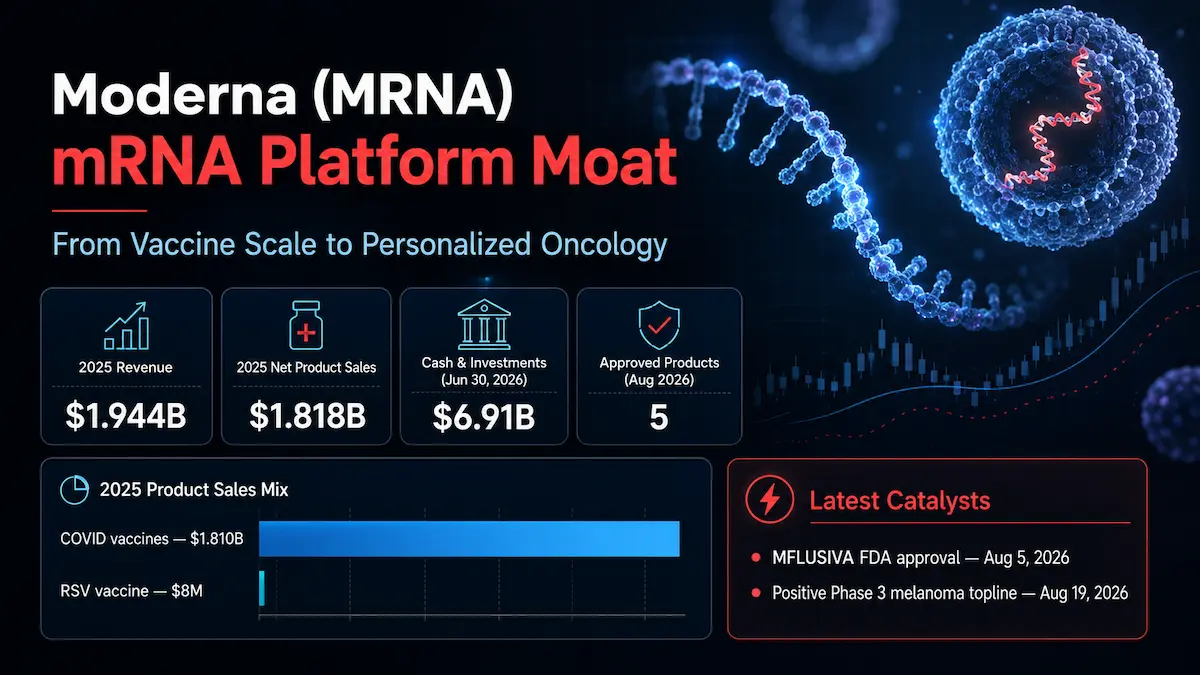
- The most important near-term catalyst has shifted from clinical uncertainty to regulatory and commercial execution. On August 19, 2026, Moderna reported positive Phase 3 topline results for intismeran autogene plus pembrolizumab in resected melanoma, while the August 5 FDA approval of MFLUSIVA expanded the respiratory portfolio to a fifth approved product across Moderna’s markets.
- The central risk is a mismatch between scientific breadth and economic density. Moderna still carries a large R&D and manufacturing cost base, while 2025 product revenue remained overwhelmingly dependent on COVID-19 vaccines. New approvals must generate real uptake, better manufacturing utilization and lower cash burn before the platform can be considered a fully mature economic moat.
Moderna’s corporate story is often compressed into a single sentence: an mRNA biotechnology company that became a pandemic winner. That description is historically accurate but strategically incomplete. The more useful framing is that Moderna has spent more than a decade trying to industrialize messenger RNA as a programmable drug-development architecture. COVID-19 supplied the first large-scale proof that the architecture could move from sequence design to global commercialization. The post-pandemic period is testing the harder proposition: whether the same scientific and manufacturing stack can repeatedly produce economically valuable medicines across respiratory disease, oncology and rare disease.
That distinction matters because the Moderna business model is not inherently recurring in the way a software platform is recurring. There is no automatic monetization merely because the platform exists. Moderna must continually convert scientific optionality into approved products, win reimbursement and market share, manufacture at attractive unit economics, and spread a substantial fixed-cost base over a broader revenue pool. The company’s current transition is therefore less about proving that mRNA works and more about proving that mRNA can support repeatable returns on invested capital.
Freshness is particularly important in assessing Moderna in 2026. Its Form 10-Q for the quarter ended June 30 still described four approved products. Since then, the FDA approved MFLUSIVA, Moderna’s mRNA influenza vaccine, on August 5, and Moderna stated on August 19 that it had five approved products. The same August 19 update also disclosed positive Phase 3 topline results for intismeran autogene in adjuvant melanoma. Any analysis that relies only on the June-quarter filing is therefore already missing two strategically material developments.
1. Business Model Breakdown
The core monetization engine: selling medicines, not renting the platform
Moderna primarily makes money by selling vaccines and, if its therapeutic pipeline succeeds, is positioned to add therapeutic product economics and profit-sharing arrangements. In 2025, net product sales were $1.818 billion and total revenue was $1.944 billion. COVID-19 vaccine sales accounted for $1.810 billion of net product sales, while RSV vaccine sales were only $8 million. The implication is straightforward: Moderna had already become a multi-product company from a regulatory standpoint, but it had not yet become a genuinely diversified company from a revenue standpoint.
The commercial model varies by geography. In the United States, Moderna sells primarily through wholesalers and distributors, with additional sales to retailers and providers. Internationally, it sells into commercial channels and to governments and other organizations. This structure gives the company access to large seasonal vaccine markets, but it also exposes revenue to vaccination rates, public-health recommendations, tender timing, channel inventory and competitor contracting. Unlike a subscription business, demand must be re-earned season by season.
The second revenue layer is smaller but strategically useful: collaboration, licensing, royalty, grant and stand-ready manufacturing revenue. In the second quarter of 2026, Moderna reported $51 million of other revenue alongside $94 million of net product sales. These non-product streams can help monetize scientific assets before a product reaches full commercial scale and can shift development or commercialization risk to partners. They should not, however, be mistaken for the company’s primary profit engine.
The platform is an internal capital-allocation system
The deeper business logic sits beneath the revenue line. Moderna’s platform is built around three shared capabilities: mRNA science, delivery technology and manufacturing. The theoretical advantage is modularity. A new medicine can often begin with a new nucleotide sequence while reusing portions of the same chemistry, delivery architecture, analytical methods, digital design tools and manufacturing processes. If that reuse lowers the marginal cost and time required to advance successive programs, the platform can generate a portfolio-level return that a collection of unrelated drug assets cannot.
This is why Moderna’s long-term economics depend on portfolio reuse rather than any single blockbuster. A conventional biotech company may need to build distinct expertise and production methods around each molecular class. Moderna is attempting to standardize more of the development stack. The company’s 2025 Form 10-K describes a model in which shared fundamental features across mRNA programs can reduce technical and biological risk and allow common infrastructure to support multiple medicines. The commercial payoff appears only when enough successful programs occupy that infrastructure.
The post-COVID financial record shows the other side of this operating leverage. In 2025, R&D expense was $3.132 billion, materially above total revenue of $1.944 billion. Cost of sales equaled 48% of net product sales and included $291 million of inventory write-downs plus $93 million related to unutilized manufacturing capacity and wind-down costs. These figures are not evidence that the platform lacks value; they are evidence that shared infrastructure can become an economic burden when demand falls faster than the cost base can adjust.
Three emerging monetization lanes
The first lane is respiratory vaccines. Spikevax remains the revenue anchor, while mNEXSPIKE adds a newer COVID-19 formulation, mRESVIA addresses RSV, mCOMBRIAX combines influenza and COVID-19 in Europe, and MFLUSIVA adds a standalone influenza vaccine in the United States. The commercial objective is not merely to accumulate labels. It is to build a portfolio that can share seasonal demand generation, payer relationships, distribution, regulatory infrastructure and manufacturing capacity. If successful, one commercial organization can monetize several products during the same vaccination season.
The second lane is individualized oncology. Moderna and Merck have collaborated on individualized neoantigen therapy since 2016. Under the current intismeran arrangement, development costs and any profits or losses are generally shared equally worldwide; Moderna is primarily responsible for process development and manufacturing while Merck generally leads clinical trials. This changes the revenue architecture. Rather than carrying the entire commercial and clinical burden alone, Moderna can combine its individualized mRNA manufacturing capability with Merck’s oncology franchise and checkpoint-inhibitor infrastructure.
The third lane is selective partnering in areas where Moderna owns the platform asset but may not want to build every commercial capability itself. The January 2026 collaboration with Recordati around mRNA-3927 for propionic acidemia is an example: Moderna retained responsibility for clinical development through approval while granting Recordati an exclusive royalty-bearing license and future commercialization responsibility. This is strategically important because it demonstrates that management can monetize platform output through risk-sharing rather than insisting on full vertical integration in every disease.
The corporate gene, therefore, is not simply “sell more vaccines.” It is to use one scientific and manufacturing architecture across several monetization models: wholly commercialized products, government-supported manufacturing relationships, equal-profit collaborations and royalty-bearing licenses. The value of that architecture rises if it generates more approved products per dollar of shared infrastructure; it falls if pipeline breadth produces expense without enough commercial throughput.
2. Deep Dive into Economic Moats
Applying Warren Buffett’s moat framework requires discipline. Moderna’s scientific reputation, historical growth and pandemic scale are not moats by themselves. A moat must make it structurally expensive, slow or uneconomic for competitors to replicate the company’s profit pool. On that basis, Moderna has one established moat candidate and one emerging moat candidate, while switching costs and network effects remain comparatively weak.
Intangible Assets: the strongest moat, but not an invulnerable patent wall
Moderna’s most defensible advantage is the combination of intellectual property, trade secrets, process know-how, regulatory learning and accumulated mRNA engineering expertise. Its patent estate spans mRNA design and engineering, proprietary lipid-nanoparticle components, delivery systems, manufacturing, purification and analytical methods. The company also relies on trade secrets and tacit manufacturing knowledge that cannot be reconstructed simply by reading an issued patent.
The strategic value comes from layering these assets. A competitor does not merely need a sequence that encodes the correct antigen. It must optimize expression, choose a delivery system, manage tolerability, establish analytical controls, build reproducible manufacturing, generate clinical evidence and satisfy regulators. In personalized oncology, the stack becomes even more operationally demanding because each patient’s tumor information must be converted into an individualized therapy and manufactured under a controlled release process. Catching up therefore requires capital, time, multidisciplinary talent, clinical data and production experience rather than a single patent workaround.
Still, describing Moderna as having an uncontested “mRNA patent monopoly” would be analytically inappropriate. In March 2026, Moderna entered into a global settlement with Arbutus and Genevant covering litigation related to Spikevax and mRESVIA and agreed to a $950 million lump-sum payment, while other intellectual-property disputes remain. That episode demonstrates both sides of the moat: the underlying rights are economically valuable enough to litigate aggressively, but Moderna’s freedom to operate has had a real cost. The appropriate conclusion is that its intangible-asset moat is deep and multi-layered, not legally impregnable.
Cost Advantages: strategically plausible, economically unfinished
Moderna’s second moat candidate is a learning and process-cost advantage created by shared mRNA manufacturing and development infrastructure. The company operates integrated manufacturing capabilities in the United States and has built additional capacity internationally. It also completed a purpose-built Marlborough, Massachusetts facility for intismeran clinical supply, designed around automation and the unusual requirements of individualized batches. If that infrastructure supports multiple commercial products, each additional program can absorb fixed capacity and benefit from processes that have already been validated elsewhere in the platform.
This is more subtle than simple scale. A large factory is not a moat if it sits idle. The advantage appears only when Moderna can manufacture more product types, more reliably and at lower incremental cost or faster cycle times than a new entrant that must assemble the same capabilities from scratch. The company’s 2025 write-downs and unutilized-capacity charges show that the cost moat is still conditional. Moderna has the physical and organizational infrastructure; it has not yet demonstrated that post-pandemic demand will keep that infrastructure economically dense enough to produce structurally superior margins.
Personalized oncology may be the area where this operational know-how becomes hardest to replicate. Traditional biologics are manufactured in standardized batches for many patients. Intismeran requires a repeated patient-specific workflow. Competitors must solve not only drug design but also high-throughput individualized manufacturing, quality control, release logistics and coordination with clinical care. If Moderna can industrialize that process at scale, the competitive barrier would look less like a commodity manufacturing cost advantage and more like a proprietary operating system that competitors need years to reproduce.
Switching Costs: limited in the respiratory franchise
Classical switching costs are not a major Moderna moat. Governments, pharmacies, health systems and patients can shift among approved respiratory vaccines when recommendations, efficacy data, safety profiles, supply, contracting or reimbursement change. Moderna’s own RSV experience is instructive: mRESVIA achieved regulatory approval, yet 2025 product sales were minimal compared with the COVID franchise. Approval created market access, not customer lock-in.
Switching costs could become somewhat higher in individualized oncology because treatment pathways, diagnostic workflows, manufacturing coordination and physician familiarity are more complex. Even there, however, the durable economic barrier would arise primarily from clinical differentiation and operational execution, not contractual captivity.
Network Effects: essentially absent
Moderna does not possess a classical network effect. One additional vaccine recipient does not make Spikevax, MFLUSIVA or mRESVIA more valuable to the next recipient. More clinical and manufacturing experience can improve internal learning, but that is a scale-and-knowledge effect, not a network effect. Conflating the two would overstate the moat.
The long-term moat thesis therefore rests on a narrower test: can Moderna’s intangible assets and integrated process know-how repeatedly generate differentiated products faster or more efficiently than competitors, and can management convert that scientific repetition into acceptable margins and returns on capital? The science has accumulated substantial evidence. The economic proof remains incomplete.
3. Business Inflection Points & Future Catalysts
The defining strategic inflection: COVID-19 converted a research platform into an industrial company
Moderna was founded in 2010 around the premise that mRNA could function as a programmable medicine platform. The company entered a collaboration with Merck on individualized neoantigen therapy in 2016 and completed its IPO in 2018, but the decisive corporate inflection came in 2020. BARDA committed substantial funding to accelerate development and manufacturing of Moderna’s COVID-19 vaccine, and the pandemic forced the company to compress years of organizational learning into months: global clinical trials, regulatory submissions, large-scale manufacturing, quality systems, supply agreements and commercial distribution.
The pandemic transformed Moderna from a platform company with clinical optionality into a vertically integrated commercial biotechnology company. It also financed an unusually large R&D and manufacturing footprint. That is why 2020 should be viewed as both the company’s greatest strategic validation and the source of its current economic challenge. Pandemic-scale demand demonstrated the platform’s speed, but it also created infrastructure sized for a revenue base that subsequently contracted sharply.
The 2024–2026 period represents a second-order inflection: management is narrowing the portfolio, reducing costs, adding partnerships and attempting to refill the platform with non-COVID revenue. The next stage is not about recreating pandemic sales. It is about proving that the industrial capabilities built during the pandemic can support a diversified, repeatable product engine.
Catalyst 1: converting positive Phase 3 intismeran data into an oncology franchise
On August 19, 2026, Moderna reported positive topline results from the Phase 3 INTerpath-001 study of intismeran autogene plus pembrolizumab as adjuvant therapy after complete resection of Stage IIB-IV melanoma. Moderna said the study demonstrated a clinically meaningful improvement over pembrolizumab alone. This is strategically different from another vaccine approval: it is a late-stage test of whether the mRNA platform can create value in individualized therapeutics, where manufacturing, biology and commercial economics are materially different from prophylactic vaccines.
Transmission mechanism: successful regulatory conversion could create a new high-value therapeutic profit pool, diversify revenue away from seasonal respiratory vaccines and validate Moderna’s dedicated individualized-manufacturing infrastructure. The Merck structure also matters economically. Because costs and profits or losses are generally shared equally, Moderna sacrifices some upside but gains an experienced oncology partner and avoids carrying the full commercialization burden.
Observable indicators: investors and industry observers should focus on the full Phase 3 RFS and DMFS effect sizes, absolute event curves, safety data, the maturity of overall-survival results, the timing and scope of regulatory submissions, regulatory acceptance, manufacturing-readiness disclosures and progress across additional INTerpath tumor types. The headline “positive Phase 3” is important, but the magnitude and durability of benefit will determine pricing power, physician adoption and competitive response.
Primary execution risks: full data may prove less differentiated than the topline characterization suggests; overall-survival evidence may remain immature; regulators may require extensive chemistry, manufacturing and controls work for a patient-specific product; reimbursement could be complex; and individualized manufacturing must scale without compromising turnaround, reliability or gross margin. A positive pivotal trial meaningfully reduces clinical risk, but it does not eliminate commercial or industrial risk.
Catalyst 2: turning five approved products into a real respiratory franchise
The respiratory portfolio expanded materially in 2026. The European Commission authorized mCOMBRIAX in April for adults age 50 and older, subject to national access procedures. On August 5, the FDA approved MFLUSIVA for influenza prevention in people age 50 and older; the indication for people age 65 and older was granted under accelerated approval and therefore carries confirmatory obligations. Together with Spikevax, mNEXSPIKE and mRESVIA, Moderna now has five approved products across its markets.
Transmission mechanism: a broader respiratory portfolio can improve commercial productivity and manufacturing utilization. Instead of relying on one COVID product, Moderna can approach overlapping adult vaccination channels with COVID, RSV, influenza and combination offerings. More revenue flowing through the same seasonal commercial and production infrastructure would spread fixed costs, reduce concentration risk and potentially improve unit economics.
Observable indicators: the most useful evidence will be MFLUSIVA orders and market adoption in adults 50 and older, the sales mix between legacy Spikevax and newer products, mCOMBRIAX access and reimbursement progress across EU countries, mNEXSPIKE share, mRESVIA trajectory, inventory write-downs, and cost of sales as a percentage of product revenue. The quality of the catalyst should be judged by revenue mix and asset utilization, not by approval count.
Primary execution risks: respiratory vaccines are competitive and recommendation-sensitive markets; large incumbents already have entrenched flu and RSV franchises; public willingness to vaccinate can fluctuate; national reimbursement can slow EU commercialization; and Moderna’s weak early RSV sales demonstrate that regulatory approval does not automatically create share. MFLUSIVA also has confirmatory requirements attached to the accelerated-approval component of its older-adult indication.
Catalyst 3: operating leverage and cash-burn normalization
Moderna still has to finance the transition. At June 30, 2026, the company reported $6.910 billion of cash, cash equivalents and investments. It also reported a $2.1 billion net loss for the first six months of 2026, including the impact of the Arbutus/Genevant settlement accrual, and used $1.2 billion of cash in operating activities during that period. The balance sheet provides time, but time is not the same as a self-funding business model.
Transmission mechanism: if new respiratory revenue, partnership economics and disciplined R&D spending begin to outrun fixed-cost reduction, Moderna’s cash consumption could fall faster than headline revenue needs to grow. Better utilization of manufacturing assets would also reduce the risk of inventory and capacity charges. This would materially improve the economic credibility of the platform because it would show that scientific reuse is translating into financial reuse.
Observable indicators: R&D and SG&A trajectories, year-end cash and investment balances, operating cash flow, cost of sales excluding unusual charges, manufacturing utilization, product gross-to-net trends, and the degree to which late-stage programs are funded with partners rather than solely by Moderna. The company’s $1.5 billion term-loan facility adds liquidity, but debt availability should not be confused with operating self-sufficiency.
Primary execution risks: cost cutting could move faster than portfolio maturation and impair future launches; oncology commercialization may require fresh spending; seasonal vaccine demand may remain volatile; and patent litigation can create large cash obligations. The business will earn a higher-quality financial profile only if diversification and cost discipline reinforce each other rather than merely extending runway.
4. Key FAQs
How does Moderna make money beyond its COVID-19 vaccine?
Moderna is building four additional monetization paths around the same mRNA infrastructure. It sells mRESVIA for RSV and now has MFLUSIVA for influenza in the United States; it has European authorization for the mCOMBRIAX flu-plus-COVID combination vaccine; it earns smaller amounts from collaborations, licensing, grants and stand-ready manufacturing; and it has a generally 50/50 worldwide cost-and-profit-sharing structure with Merck for intismeran autogene. The important caveat is that these newer streams have not yet matched the historical economic importance of COVID-19 vaccine sales. Diversification is strategically visible before it is financially complete.
What is Moderna’s strongest competitive moat in mRNA?
Moderna’s strongest moat is its combined intangible-asset and process-know-how stack rather than brand or scale alone. The company has accumulated mRNA sequence-engineering expertise, delivery technology, patents, trade secrets, regulatory experience and integrated manufacturing systems across clinical and commercial production. Competitors must reproduce an entire chain of capabilities, not merely copy a molecule. The moat is nevertheless contested: the 2026 Arbutus/Genevant settlement shows that intellectual-property freedom to operate can be expensive, so the defensibility comes from the layered system more than from any single patent family.
Can the Moderna business model succeed without renewed COVID-19 vaccine growth?
Yes in principle, but it has not yet been proven economically. The path requires respiratory products such as MFLUSIVA, mCOMBRIAX, mNEXSPIKE and mRESVIA to reduce revenue concentration while intismeran or other therapeutics open non-seasonal profit pools. At the same time, shared R&D and manufacturing assets must become better utilized so expense growth stays below the growth of diversified revenue. The test is not whether Moderna can win more approvals; it is whether those approvals generate enough durable gross profit to support a still-substantial platform cost base without persistent balance-sheet consumption.
5. Conclusion
Moderna’s corporate DNA is best described as an attempt to industrialize programmable medicine. Its core asset is not any single vaccine but a reusable stack spanning mRNA design, delivery, clinical development, digital workflows, regulatory execution and manufacturing. The pandemic proved that this stack could operate at global scale. The post-pandemic period is testing whether it can produce repeatable economics across several categories rather than exceptional economics from one emergency-driven product.
The company’s best moat is therefore scientific and operational before it is financial. Its intangible assets and accumulated process knowledge impose real catch-up costs on competitors, and the August 2026 Phase 3 intismeran result is potentially the most important platform validation since COVID-19 because it moves individualized oncology closer to regulatory and commercial reality. Yet classical switching costs are limited, network effects are absent and the cost advantage remains conditional on utilization. Those distinctions are essential to avoid confusing technological sophistication with guaranteed excess returns.
The decisive question for the next one to two years is whether Moderna can convert platform breadth into economic density. A successful intismeran filing and launch, meaningful MFLUSIVA and mCOMBRIAX uptake, a healthier respiratory revenue mix and falling cash burn would indicate that shared infrastructure is beginning to compound. Weak adoption, disappointing detailed oncology data, continued manufacturing underutilization or renewed legal costs would suggest that the platform remains scientifically valuable but economically overbuilt. That is the line separating a durable corporate moat from an expensive collection of optionality.
Primary and Official Sources
- U.S. SEC — Moderna 2025 Form 10-K
- U.S. SEC — Moderna Form 10-Q for the quarter ended June 30, 2026
- U.S. Food and Drug Administration — MFLUSIVA
- U.S. Food and Drug Administration — August 5, 2026 MFLUSIVA Approval Letter
- European Commission — mCOMBRIAX Union Register
- Moderna — August 19, 2026 Phase 3 Intismeran Autogene IR Update
- Moderna — Product Pipeline
- Moderna — Our Story
Disclaimer: This article is intended solely for business logic discussion and corporate research purposes, and does not constitute investment advice of any kind.