


Key Takeaways
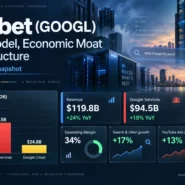
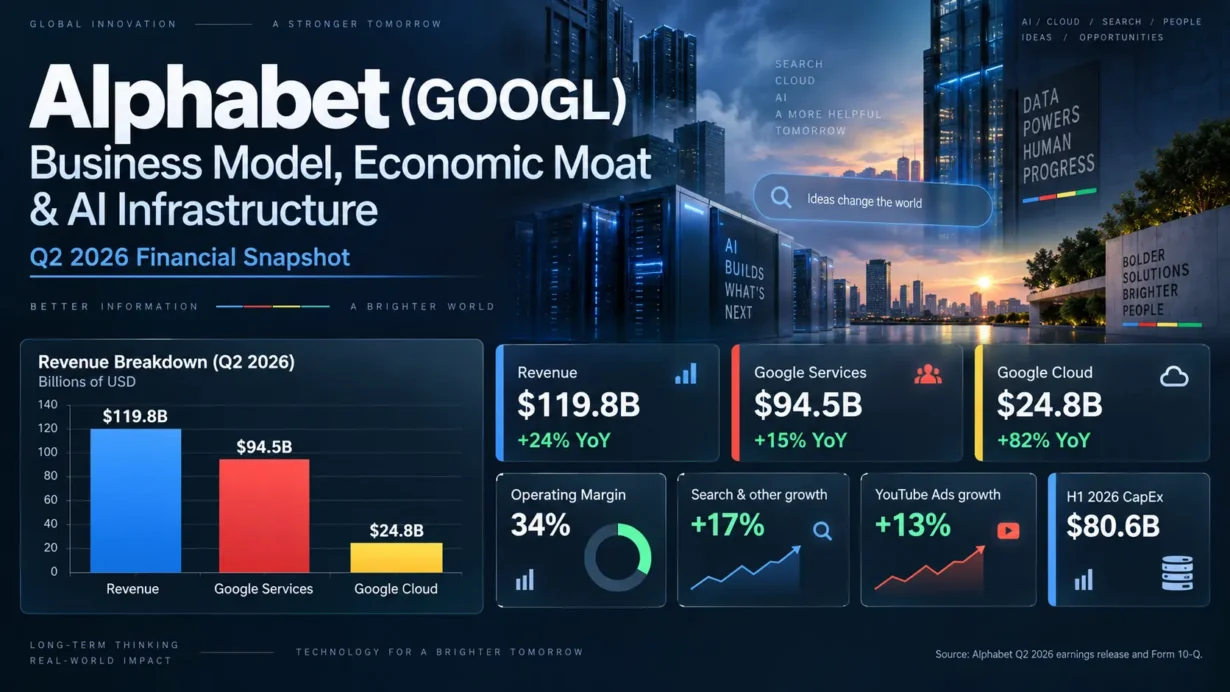
- Advertising remains the cash-generation core: Google advertising accounted for $81.63 billion, or approximately 68.1% of Alphabet’s $119.80 billion revenue, in the second quarter of 2026. Search and related owned properties contributed $63.27 billion.
- The most defensible moat is a system-level advantage in search relevance, advertiser liquidity, and accumulated commercial intent—not brand recognition alone. Its distribution advantage is economically material but legally contestable.
- Google Cloud has become a material second profit pool, with $24.77 billion of second-quarter revenue and $8.81 billion of reported segment operating income. Its growth is not equivalent to pure, fully loaded software-as-a-service economics.
- AI is both a defense of the existing search franchise and a capital-intensive transition: first-half 2026 operating cash flow of $84.86 billion was largely absorbed by $80.60 billion of capital expenditures.
- Search, ad-tech, and digital-market remedies in the United States and European Union directly target distribution privileges, interoperability, and data access. The key risk is erosion of economic rents, not merely the payment of fines.
1. Business Model Breakdown
The Alphabet business model monetizes three distinct economic activities: consumer attention and purchase intent through advertising, enterprise computing and productivity through consumption fees and subscriptions, and ecosystem participation through consumer subscriptions, app-distribution fees, and devices. Google Services, Google Cloud, and Other Bets are Alphabet’s reporting segments; individual product revenue and profit disclosures are more limited. [1] [2]
Search advertising: converting intent into auction revenue
Search is the highest-quality expression of Alphabet’s original business logic. A user reveals a need by entering a query; advertisers compete to reach that user at a moment when a commercial decision may be close. Google monetizes relevant interactions through advertising auctions, making revenue a function of query activity, the mix of commercially valuable searches, paid engagement, and advertiser willingness to pay. In contrast to broad-reach advertising, search demand can often be tied more directly to leads or purchases, supporting performance-oriented budgets.
In Q2 2026, Google Search & other generated $63.27 billion, a 17% year-over-year increase. The company reported 13% growth in paid clicks and 3% growth in cost per click across this category. These measures are not a standalone disclosure of AI-search monetization, nor does the category consist exclusively of Google.com: it also includes other Google-owned properties such as Maps, Gmail, and Google Play. The distinction matters when attributing revenue changes to a specific interface or product. [2] [3]
YouTube and the ad network: different revenue-sharing economics
YouTube extends Alphabet from intent capture into video attention, creator ecosystems, and brand advertising, while also supporting direct-response formats. Q2 2026 YouTube advertising revenue was $11.06 billion. YouTube has a differentiated demand profile, but content acquisition, creator revenue sharing, and delivery costs mean advertising revenue should not be mistaken for platform-level profit. Google Network, which monetizes third-party publisher and app inventory through products such as AdSense and AdMob, generated $7.30 billion in the same quarter, slightly below the prior year. [3]
Accounting presentation also matters. Network advertising revenue is generally reported gross, with payments to partners included in cost of revenue; Google Play app and in-app transaction revenue is generally reported net as a service fee. Comparing reported revenue dollars without adjusting for these economic differences can exaggerate the attractiveness of one activity relative to another. [1]
Cloud, subscriptions, and devices: diversification with different margin structures
Google Cloud sells infrastructure and platform capacity, data and AI services, cybersecurity solutions, and Workspace productivity subscriptions. Consumption-based workloads can scale quickly but are exposed to utilization, infrastructure cost, and pricing competition; subscription software benefits from contract duration and workflow embedding. The segment also began recognizing revenue from sales of Tensor Processing Unit (TPU) systems in Q2 2026, adding a hardware component to its mix. In that quarter, Cloud generated $24.77 billion in revenue, up 82% year over year, and $8.81 billion in reported operating income, implying an approximately 35.6% segment operating margin. That is a reported segment measure, not a fully standalone margin for AI software: Alphabet-level activities include centrally reported shared AI research and development costs. [2]
Outside Cloud, Google Services also earns subscription, platform, and device revenue from products including YouTube Premium and TV, Google One, Google Play, and Pixel devices. This category generated $12.91 billion in Q2 2026. Android and Chrome should be understood primarily as distribution and engagement infrastructure rather than large, separately disclosed operating-system licensing businesses. Other Bets, including businesses such as Waymo, provide strategic optionality but are not the present source of consolidated earnings: the segment reported $382 million of Q2 revenue and a $1.80 billion operating loss. [2]
The profit formula: attractive operating economics, expensive reinvestment
Alphabet reported $40.77 billion of operating income on $119.80 billion of Q2 2026 revenue, a 34% operating margin. The Google Services engine funds substantial reinvestment in data centers, proprietary chips, AI models, product development, and distribution. Traffic acquisition costs (TAC)—payments tied to distribution partners and network properties—were $16.18 billion in the quarter. Distribution access is therefore valuable, but it is not free. [3]
For cash-return analysis, reported earnings require normalization. The same quarter included approximately $97.98 billion of net other income, primarily reflecting unrealized gains on equity securities; this is not recurring operating profit. During the first six months of 2026, Alphabet produced $84.86 billion of operating cash flow and spent $80.60 billion on property and equipment, leaving approximately $4.26 billion of cash flow after those purchases by that simple measure, versus approximately $24.25 billion a year earlier. The strategic issue is the eventual cash yield on the current infrastructure buildout—not the headline growth in GAAP net income. [2] [3]
2. Deep Dive into Economic Moats
Under a Buffett-style economic-moat framework, the relevant test is not market share, user growth, or name recognition in isolation. It is whether a structural advantage permits a company to earn returns above its cost of capital for an extended period despite credible competitive entry. Alphabet’s two most compelling candidates are its accumulated search-and-advertising intangible assets, reinforced by qualified indirect network effects, and its cost-intensive integrated infrastructure. Both require caveats.
Primary moat: intangible assets reinforced by advertiser-market liquidity
Google’s economically relevant intangible assets include its search-quality systems, continuously refined relevance and commercial-matching capabilities, and the learned behavior of users and advertisers operating within its products. The advantage is cumulative: recurring search interactions expose product weaknesses, while an extensive advertiser base creates bidding competition and demand coverage across commercial categories. Better matching can improve conversion economics, which can sustain advertiser participation and the willingness to bid.
This is a qualified indirect network effect, not a frictionless monopoly flywheel. Users do not necessarily benefit merely because more advertisers bid, and incremental query data need not improve quality at a constant rate. The durability lies in combining query interpretation, a current search index, measurement tools, advertiser relationships, and broad commercial coverage. A challenger would need to fund years of crawling, ranking, trust and safety, measurement, advertiser acquisition, and distribution while simultaneously achieving enough traffic for advertisers to care and enough advertiser demand to monetize that traffic efficiently.
The strongest counterargument is that generative-AI interfaces may change where questions originate and how answers are delivered. If consumers shift high-value commercial discovery to other assistants, an incumbent’s historical data and auction liquidity may become less decisive. Moreover, mandated access to certain search data and syndication services can reduce barriers previously created by restricted access. [6] [8]
Secondary moat: infrastructure cost absorption and platform reach
Alphabet operates a broad stack spanning data centers, global networking, specialized TPU hardware, frontier AI models, developer tools, consumer distribution, and enterprise cloud products. High fixed costs can be amortized across Search, YouTube, Cloud, and AI workloads; shared engineering may accelerate iteration and reduce dependence on external suppliers for selected workloads. The competitive entry cost is substantial because a rival must assemble hardware capacity, power, technical talent, reliable global operations, and software adoption—not just train a single model.
That does not prove Alphabet has the industry’s lowest cost per AI inference or a permanent hardware cost advantage. No like-for-like, externally comparable unit-cost series is disclosed, and competitors also operate hyperscale infrastructure. The narrower, supportable proposition is that Alphabet’s cross-product demand and vertical integration give it credible opportunities to absorb fixed costs efficiently, provided utilization and workload economics justify the capital employed. Rapidly rising depreciation, energy requirements, and equipment obsolescence can reverse this advantage. [1] [2]
Android and Chrome extend Google’s consumer access, but distribution should not be treated as an untouchable property right. Device defaults can depend on contractual arrangements and partner incentives. U.S. search remedies restrict specified exclusive distribution agreements, while EU measures require certain Android AI interoperability and access to search data. A platform position that cannot survive changes to default settings without losing material usage is less defensible than one sustained by users deliberately choosing a superior product. [6] [8]
Switching costs: low for search users, higher in enterprise workflows
Consumer search has limited formal switching costs: entering a query in another engine or assistant requires little migration. Advertisers face more friction because campaign histories, optimization practices, conversion measurement, and operating workflows are built around Google Ads, but multi-platform advertising remains possible. Enterprise customers can face materially higher switching costs after adopting Cloud data services, security controls, application integrations, and Workspace collaboration processes. These frictions are meaningful within Cloud but should not be presented as proof that Google’s consumer-search traffic is locked in.
The excess-return test
Search relevance and commercial-matching liquidity remain Alphabet’s most persuasive long-duration sources of potential excess returns. Infrastructure advantages are strategically important but less conclusively proven on a per-unit-cost basis. The durability test is whether sustained user preference, advertising monetization, and Cloud operating profit can grow faster than TAC, inference expense, depreciation, regulatory compliance costs, and incremental invested capital. Scale is the starting condition; cash returns after reinvestment are the verdict.
3. Business Inflection Points & Future Catalysts
The defining strategic turn: Android shifted Google from destination to platform
The acquisition of Android in 2005 and the launch of the first Android phone in 2008 marked a pivotal change in Google’s corporate DNA. Google had built a valuable web destination; mobile computing threatened to put another company’s operating system, browser, and default settings between Google and its users. An open mobile operating system supplied through a hardware-partner ecosystem offered a way to make Google services accessible across a much wider set of devices without needing to dominate handset manufacturing. Google’s own historical account confirms the acquisition and launch sequence. [4]
The strategic lesson was not that Android itself would become a high-margin licensing product. It was that distributing a free or low-friction platform could protect and expand downstream search, advertising, app, and service economics. Chrome, YouTube, and later Cloud similarly extended the surfaces through which Google could aggregate engagement or monetize technical capabilities. The AI transition now poses a related question: can Alphabet own a meaningful part of the new interaction layer without weakening the returns produced by the previous one?
Catalyst 1: monetize AI-assisted search without destroying commercial intent
Transmission mechanism: if AI Overviews, AI Mode, and new commercial formats keep users within Search while enabling more effective product discovery, Alphabet could defend query share and sustain or increase advertiser value per qualified interaction. Google described tests of conversational and highlighted-answer ads in May 2026; tests are evidence of product direction, not evidence of proven mature monetization. [5]
Observable indicators include Search & other revenue growth, paid-click and cost-per-click trends, evidence of advertiser return on spend, commercial-query engagement, and the cost of serving richer answers. The failure case is a migration of valuable journeys into alternative assistants, fewer monetizable click opportunities per session, or inference costs that consume incremental revenue. Alphabet does not separately report a standardized AI Mode revenue or contribution-margin series; claims about AI-search profitability should therefore be treated as unverified.
Catalyst 2: convert Cloud backlog and AI infrastructure demand into recurring profits
Transmission mechanism: enterprise spending on AI infrastructure, data platforms, security, and productivity services can turn fixed-capacity investment into higher recognized revenue and operating leverage. As of June 30, 2026, Alphabet disclosed $513.9 billion of Google Cloud remaining performance obligations within $519.5 billion of total revenue backlog. The company began reporting revenue from TPU-system sales in Q2, and its March 2026 acquisition of Wiz for approximately $29.5 billion added a multicloud-security asset to the portfolio. [2]
Watch recognized Cloud revenue, segment operating profit, backlog conversion, workload consumption, and whether security cross-selling is reflected in customer retention and contract economics. Backlog is not cash received or an unconditional near-term sales forecast: timing depends on delivery and customer utilization, and Alphabet changed its backlog reporting convention in Q1 2026 to include certain shorter-duration contracts. Risks include capacity shortages, hyperscaler price competition, acquisition-integration costs, a greater share of lower-margin hardware, and centralized AI research costs that are not fully visible in Cloud’s reported segment profit.
Catalyst 3: restore free-cash-flow conversion after the infrastructure buildout
Transmission mechanism: today’s capital spending could create future operating leverage if installed capacity fills, revenue per unit of compute improves, and capital expenditure growth eventually moderates. Q2 2026 alone saw approximately $44.92 billion of property-and-equipment purchases against $39.07 billion of operating cash flow, implying a roughly $5.86 billion cash shortfall on the simple operating-cash-flow-less-capex measure. Alphabet also raised equity and debt funding during the quarter, making per-share economics and the cost of capital more relevant to future returns. [3]
Key indicators are quarterly and trailing-twelve-month free-cash-flow conversion, capacity utilization, depreciation growth, Cloud margins after shared costs, and the change in diluted share count. The failure case is persistent overbuilding, rapid chip obsolescence, inadequate power availability, or weak pricing that prevents a satisfactory return on new assets. Higher revenue by itself would not validate the investment cycle.
Catalyst 4: regulatory implementation resets the value of distribution and ad-tech integration
Transmission mechanism: the economic effects of antitrust and digital-market decisions will depend less on a single headline fine than on how distribution contracts, ad-auction access, data portability, and rival interoperability actually change. The U.S. search case resulted in a December 2025 final judgment followed by 2026 compliance proceedings; the Department of Justice also described September 2026 ad-tech remedies requiring competitive integrations, data access, and restrictions on discriminatory bidding. In July 2026, the European Commission issued binding Android-interoperability and search-data-access specifications and announced €890 million in Digital Markets Act fines relating to Search self-preferencing and Google Play steering. [6] [7] [8] [9]
Watch the implementation and enforcement timetable, changes to partner agreements and TAC, competitive access to publisher tools and search data, and Google Network monetization. Compliance with manageable economic impact could reduce uncertainty; broader competitive access or materially different default arrangements could lower the rents earned by an integrated platform. Proceedings and appeals create uncertainty, so neither a complete breakup nor a return to the pre-remedy status quo should be assumed.
4. Key FAQs
How does Alphabet make money if Google Search and Android are free to use?
Free access increases the scale and frequency of consumer interactions; advertisers pay to reach relevant users on Search, YouTube, and partner properties. In Q2 2026, $81.63 billion of Google’s advertising revenue represented about 68% of Alphabet’s consolidated revenue. Android supports device-level access and the wider app ecosystem, while Cloud charges enterprise customers for computing consumption and subscriptions. The monetized asset is primarily commercial intent and distribution, not an operating-system license. [2]
Will Google AI Overviews and Gemini cannibalize Alphabet’s search advertising revenue?
They could, but cannibalization is not established by the presence of AI answers alone. AI experiences might expand query volume and improve commercial discovery, while also reducing traditional link clicks and raising serving costs. The relevant test is whether search advertising revenue and incremental gross profit per useful commercial interaction remain resilient. Q2 2026 Search & other revenue grew 17%, but Alphabet did not separately disclose AI-search contribution margins, so the net long-term effect remains unverified. [3] [5]
Is Google Cloud profitable enough to make Alphabet less dependent on advertising?
Cloud is already profitable on a reported segment basis, but the diversification transition is incomplete. In Q2 2026, Cloud produced $24.77 billion in revenue and $8.81 billion in operating income, compared with $81.63 billion in total Google advertising revenue. Cloud’s reported profitability also excludes certain centrally reported AI research expenses, and its cash requirements are substantial. The decisive measure is sustainable incremental Cloud profit and cash generation after the required infrastructure investment—not growth in Cloud revenue share alone. [2]
5. Conclusion
Alphabet’s defining corporate gene is the ability to turn technical utility into an economic distribution system. Search creates intent; advertising prices access to that intent; Android, Chrome, YouTube, and other services broaden user engagement; and infrastructure investment supports the entire architecture. The company has historically competed not only through superior individual products but by designing the connective tissue between discovery, distribution, monetization, and computing.
The most durable element is the quality and commercial liquidity of its search-advertising engine. The most uncertain element is whether yesterday’s integrated advantage remains equally valuable when users can move to AI-native interfaces and regulators require more open access. Google Cloud offers a credible second profit center, but its promise must be judged against acquisition costs, shared AI expenditure, and an increasingly capital-intensive delivery model.
For the next 12–24 months, the analytical priority is to track three conversions: AI-driven engagement into profitable advertising activity, Cloud commitments into durable operating cash flow, and infrastructure outlays into returns that exceed the cost of capital. If those conversions hold, Alphabet’s economic moat can remain substantial even as its form changes. If they do not, revenue growth may conceal weakening cash economics. That tension—not a simple narrative of either technological inevitability or inevitable disruption—defines the Alphabet business model entering 2027 and 2028.
Primary Sources and Verification Notes
Research reviewed through October 14, 2026. Financial figures refer to Alphabet’s Q2 2026 release and Form 10-Q unless another period is specified. Calculated percentages and free-cash-flow figures are derived from the reported line items, not presented as separate company guidance. Forward-looking catalysts are scenarios, not company forecasts.
- U.S. Securities and Exchange Commission — Alphabet 2025 Form 10-K. Business descriptions, monetization policies, risk factors, and segment reporting.
- U.S. Securities and Exchange Commission — Alphabet Q2 2026 Form 10-Q. Revenue composition, operating income, capital expenditure, backlog, Wiz acquisition, and TPU-system revenue.
- Alphabet Investor Relations / SEC — Second Quarter 2026 Earnings Release, July 22, 2026. Quarterly financial highlights, TAC, cash flow, and non-operating investment gains.
- Official Google Blog — The 2008 Founders’ Letter. Contemporary first-party account of the 2005 Android acquisition and 2008 public launch.
- Google Ads & Commerce Blog — A New Generation of Ads for the AI Era of Search, May 20, 2026. Announced and experimental AI-search advertising formats.
- U.S. Department of Justice — United States and Plaintiff States v. Google LLC (Search Case). December 2025 final judgment, enforcement materials, and 2026 appellate filings; see also the DOJ’s official search-remedies explanation.
- U.S. Department of Justice — Advertising Technology Remedies, September 16, 2026. Interoperability, data-portability, and bidding-related relief.
- European Commission — Binding DMA Measures for Android AI Interoperability and Search Data, July 16, 2026. Competitive-access requirements.
- European Commission — €890 Million in Google DMA Fines, July 23, 2026. Decisions concerning Search self-preferencing and Google Play steering.
Disclaimer: This article is intended solely for business logic discussion and corporate research purposes, and does not constitute investment advice of any kind.