


Key Takeaways
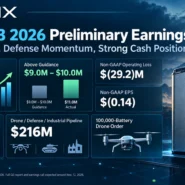
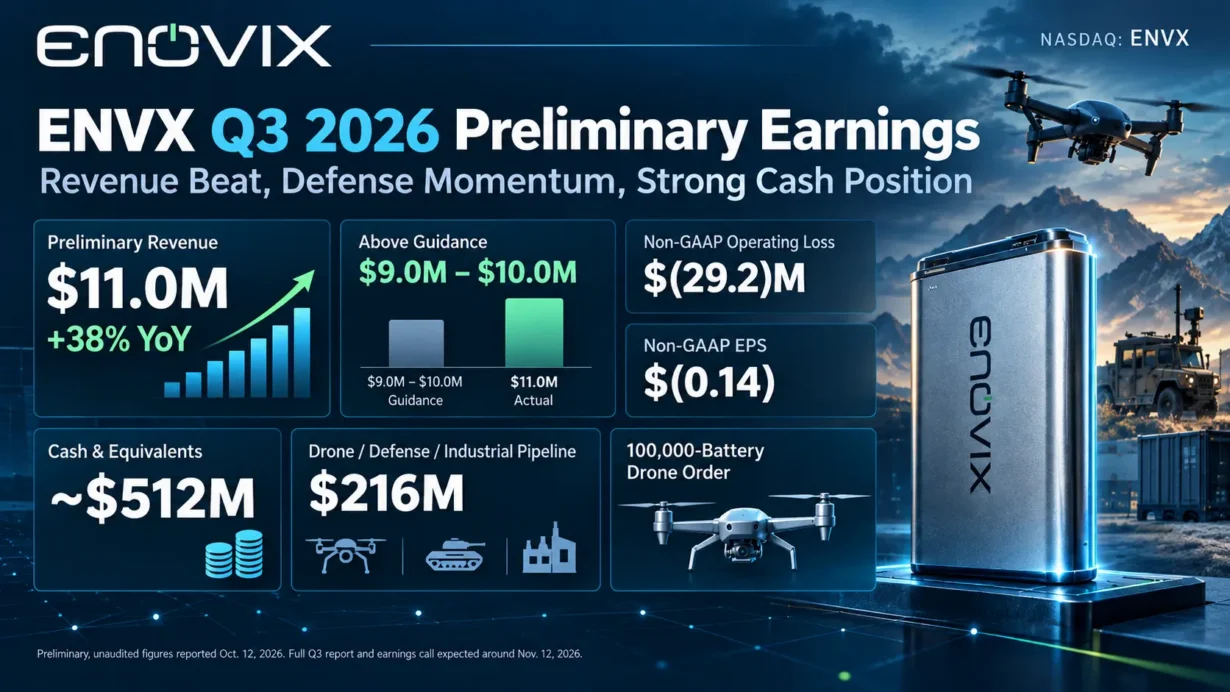
- Enovix reported preliminary, unaudited Q3 2026 revenue of approximately $11.0 million, up 38% year over year and 22.2% sequentially, calculated from company-reported figures. Revenue exceeded the upper end of its $9.0 million–$10.0 million guidance by $1.0 million.
- Preliminary GAAP loss per share was approximately $0.19, while non-GAAP loss per share was approximately $0.14, within the company’s previous non-GAAP guidance range of $0.13–$0.17 per share. Q3 gross margin has not yet been disclosed.
- Drone and defense customers generated approximately 70% of Q3 revenue. The drone, defense and industrial opportunity pipeline reached approximately $216 million, but pipeline is not contracted backlog or recognized revenue.
- An October 13 purchase order covering 100,000 drone batteries provides evidence of order conversion; deliveries are scheduled for the first half of 2027, not Q3 2026.
- The full Q3 earnings release and management call were expected on or about November 12, 2026. The available Q3 figures remain subject to closing procedures and review.
Research cutoff: October 14, 2026 (Asia/Taipei); latest U.S. regular-session share price: October 13, 2026. All amounts are in U.S. dollars unless otherwise noted.
Enovix Corporation (NASDAQ: ENVX) has delivered a stronger-than-guided preliminary quarter, but its investment case still requires an important distinction: proving demand for specialized batteries is not the same as proving scalable profitability. The October 12 official preliminary Q3 announcement offers material financial and commercial detail; it is not the final Q3 earnings release. Enovix’s official quarterly-results archive continues to list Q2 2026 as the latest completed earnings package.
1. Core Earnings Breakdown
Revenue and Profitability Analysis
Preliminary Q3 2026 sales reached approximately $11.0 million, compared with approximately $8.0 million in Q3 2025, representing the 38% year-over-year growth reported by management and a sixth consecutive quarter of annual revenue growth. Revenue advanced from $9.0 million in Q2 2026; the sequential gain is ($11.0 million ÷ $9.0 million − 1) × 100 = approximately 22.2%, calculated from company-reported figures. The revenue numbers are preliminary and unaudited, not finalized results.
Profitability tells a less comfortable story. Preliminary GAAP operating loss was approximately $39.3 million and non-GAAP operating loss approximately $29.2 million. GAAP net loss per share was approximately $0.19; non-GAAP net loss per share was approximately $0.14. The corresponding preliminary operating margins are calculated later in this analysis. Enovix did not release a Q3 gross profit figure or Q3 gross margin in the October 12 announcement; inserting a Q3 gross margin here would be speculative.
For historical context only, Q2 2026 GAAP and non-GAAP gross margins were 14.4% and 19.9%, respectively, according to the August 12 Q2 earnings release. Those are Q2 figures, not Q3 margins, and the Q2 year-over-year margin decline was tied to a change in battery product mix at the South Korean operation.
- Drone and defense: These customers represented approximately 70% of preliminary Q3 sales, implying about $7.7 million of revenue (70% × $11.0 million), calculated from company-reported figures. Management did not publish a separate Q3 growth rate or exact revenue statement for every defense subcategory. Investment interpretation: the near-term earnings engine is the established South Korean defense supply operation, not yet a mass-market smartphone launch; this creates demand visibility but also customer-program concentration risk.
- Smart eyewear and other non-defense activity: The remaining approximately 30%, or roughly $3.3 million (30% × $11.0 million), is only a residual calculated from company-reported figures, not a reported smart-eyewear revenue segment. It cannot be assigned entirely to smart eyewear, smartphones or industrial shipments. Management said it had delivered around 17,000 production samples year to date to one of 24 existing or prospective smart-eyewear customers. Investment interpretation: successful sampling broadens possible future design wins, but sample quantities do not disclose unit economics or prove recurring commercial demand.
- Smartphone battery qualification: In its last completed quarterly report, Enovix said its lead smartphone customer confirmed more than 1,000 cycles under a specified discharge test, with a separate final accelerated cycle-life test still pending. No new smartphone revenue breakdown or completed final qualification was announced in the preliminary Q3 update. Investment interpretation: qualification remains a potentially high-value catalyst but should not be capitalized as contracted smartphone revenue before the customer signs off and volume shipments begin.
The product architecture also matters. Enovix’s Malaysia-based AI platform emphasizes a 100% silicon-anode design for space-constrained consumer electronics, whereas its South Korean MX platform uses silicon-blended graphite cells designed for high-power, weight-sensitive uses such as drones. The South Korean business already has defense manufacturing history and established supply capabilities; the Malaysia commercialization thesis still hinges on manufacturing yields, customer acceptance and repeat orders. The two platforms share silicon know-how, but their commercialization timelines and margins should not be modeled as identical.
Expectations vs. Actual Results
The only directly verified pre-announcement benchmark used below is Enovix’s own Q3 guidance issued on August 12, 2026. These are company-guidance comparisons, not claimed beats or misses against an independently verified Wall Street analyst consensus.
- ✅ Revenue — preliminary actual: approximately $11.0 million; company guidance: $9.0 million–$10.0 million. This beat the range ceiling by $1.0 million, or 10.0% of that ceiling, calculated from company-reported figures.
- ➖ Non-GAAP EPS — preliminary loss of approximately $0.14 per share; guidance: a loss of $0.13–$0.17. Within guidance, not a verified consensus beat. GAAP EPS was a preliminary loss of approximately $0.19 per share; no comparable GAAP EPS guidance was published.
- ➖ Non-GAAP operating loss — preliminary loss of approximately $29.2 million; guidance: a loss of $29.0 million–$32.0 million. Within the range and near its less-negative end. Preliminary GAAP operating loss was approximately $39.3 million; no comparable GAAP operating-loss guidance was published.
- ➖ Operating margin — approximately −357.3% GAAP and −265.5% non-GAAP, each calculated from the preliminary operating loss divided by approximately $11.0 million revenue. Enovix did not guide to a Q3 operating margin; a beat/miss designation would therefore be misleading. Q3 gross margins are undisclosed.
- ⚠ Capital expenditures — preliminary approximately $3.0 million against a prior guidance range of $8.0 million–$12.0 million. Lower spending may conserve liquidity, but the release does not establish whether the difference reflects efficiency, timing or project deferrals.
Next-quarter outlook: As of this research cutoff, Enovix had not issued formal Q4 2026 revenue, EPS or margin guidance in the preliminary Q3 announcement. The $9.0 million–$10.0 million revenue range was earlier guidance for Q3, not guidance for Q4. Management instead pointed to recently received Q4 purchase orders and said it would address initial cost-reduction accomplishments when the full Q3 results are released around November 12.
The source of the top-line beat is more consequential than the headline percentage. Management tied the quarter’s progress to greater defense and drone activity, customer validation and preparations to expand Korean manufacturing capacity. It did not attribute the beat to a new high-volume smartphone deployment. For ENVX, the immediate market test is whether a growing customer pipeline turns into orders, delivery schedules and defensible gross profit—not simply whether losses per share are a few cents above or below expectations.
Price action was mixed rather than a straightforward endorsement of the revenue beat. According to historical daily prices, ENVX closed at $2.46 on October 9, $2.59 on October 12 (up 5.28%) and $2.51 on October 13 (down 3.09% on the day). The October 13 close remained about 2.0% above October 9, calculated from those closing prices. These movements occurred alongside the preliminary results and the subsequent drone order; the data alone cannot prove which news item drove each trade.
Why might buyers remain cautious despite stronger revenue? The preliminary non-GAAP operating loss was still about 2.7 times quarterly sales, gross-margin evidence for Q3 was missing, smartphone qualification remained unfinished and leadership had changed after former CEO Raj Talluri resigned in August. There is no basis to label the October 13 decline a reaction to a newly announced dilutive acquisition: the company instead disclosed approximately $6.2 million of share repurchases during Q3. Valuation, execution risk and cash consumption are more defensible concerns than an unsupported acquisition-dilution narrative.
Earnings Call Highlights
No Q3 2026 earnings call or Q3 call transcript existed as of October 14. The most recent completed earnings call was held for Q2 on August 12, with an official webcast listing and a separately published Q2 call transcript. The five verified management points below are accurate paraphrases of the October 12 Q3 shareholder letter and October 13 company announcement, not quotations falsely attributed to a nonexistent Q3 call.
- Interim CEO Ryan Benton emphasized converting the approximately $216 million drone, defense and industrial pipeline into design wins, purchase orders and shipments; he said early-Q4 orders had already exceeded Q3 revenue. 💡 Reading Between the Lines: The commercial priority has shifted from accumulating opportunities to monetizing them. Purchase orders are stronger evidence than pipeline, but they are not automatically recognized sales and must be tested against shipment timing, cancellation terms and customer concentration.
- Management disclosed a $19 million investment intended to double the manufacturing capacity of its South Korean battery plant. 💡 Reading Between the Lines: Expanding an existing qualified facility can be less capital intensive than building a greenfield plant, supporting the argument for attractive incremental returns. Investors still need evidence of delivered throughput, manufacturing yields and gross profit per cell before underwriting those returns.
- Enovix promoted Steve Bakos to Chief Revenue Officer with direct operating responsibility for the global defense and commercial business. 💡 Reading Between the Lines: Giving one executive commercial and profit-and-loss accountability is designed to align sales claims with delivery capacity and economics. This may shorten decision cycles, although a leadership reorganization also adds execution risk during a scaling phase.
- Executive Chairman T.J. Rodgers said Enovix would report its first cost-reduction accomplishments alongside the full Q3 results expected in November. 💡 Reading Between the Lines: This is a commitment to present evidence, not proof that material savings were achieved in the preliminary period. The relevant test will be lower recurring cash use and sustainable operating leverage, rather than one-quarter accounting adjustments.
- On October 13, Chief Revenue Officer Steve Bakos announced a 100,000-unit drone battery purchase order, with initial deliveries scheduled for the first half of 2027. 💡 Reading Between the Lines: This is a tangible step from opportunity pipeline toward backlog and helps validate demand for non-Chinese-source batteries. The contract value was not disclosed; neither Q3 revenue nor an assumed average selling price should be extrapolated from the unit count.
2. Deep Business Insights
Hidden Metrics That Matter
First, the revenue mix indicates a defense-led business rather than a broadly diversified consumer-battery ramp. Approximately 70% × $11.0 million = $7.7 million in Q3 defense and drone revenue, with the approximately $3.3 million residual covering all other categories combined; both dollar figures are calculated from company-reported figures and are approximate because the 70% share was itself rounded. That concentration can improve near-term pricing power for a supplier with an auditable South Korean supply chain, but it also exposes results to a limited number of military and drone program delivery decisions.
Second, the operating-loss burden remains substantial despite top-line growth. Preliminary GAAP operating margin = −$39.3 million ÷ $11.0 million × 100 = approximately −357.3%; preliminary non-GAAP operating margin = −$29.2 million ÷ $11.0 million × 100 = approximately −265.5%. Both ratios are calculated from company-reported figures, not margins independently disclosed by Enovix. A revenue beat against guidance does not erase this cost structure, and the full earnings release needs to identify how much of the improvement path depends on volume, mix, manufacturing efficiencies or spending reductions.
The pipeline is an important diagnostic but not an additional asset that can be added to market capitalization. The $216 million overall opportunity estimate grew from approximately $183 million in Q2, or ($216 million ÷ $183 million − 1) × 100 = approximately 18.0%, calculated from company-reported figures; management reported the drone portion reached approximately $150 million, up 48%. Enovix explicitly defines this pipeline as estimated peak annual production value of identified design opportunities, not purchase orders, backlog or committed revenue. The October 13 drone order shows conversion is possible, but a 100,000-unit order without a disclosed price cannot be translated into a defensible sales estimate.
Why do customers consider Enovix? In defense, the differentiators include an established, internally controlled production facility in South Korea, defense-oriented manufacturing experience, documented TAA-compliant sourcing for the specified products and cells designed to combine high energy density with demanding power needs. In eyewear and phones, the proposed advantage is more usable energy in limited device space through silicon-anode cell architecture. Customers still require qualification, safety, lifecycle and manufacturing repeatability; technological differentiation matters financially only when it clears those gates at profitable yields.
Industry Chain Reactions
- ✅ Potential beneficiary — AeroVironment (NASDAQ: AVAV). A larger ecosystem of qualified, non-Chinese-source high-performance batteries could improve sourcing flexibility and mission-capability options for unmanned-system manufacturers such as AeroVironment. This is a conditional industry benefit, not evidence of a new Enovix–AeroVironment supply agreement or a forecast of AVAV revenue.
- ❌ Potential competitive pressure — Amprius Technologies (NYSE: AMPX). Amprius also targets high-energy-density batteries for unmanned aircraft and announced up to $75 million of U.S. government support in September 2026 to establish domestic capacity. Enovix’s Korean expansion and customer traction increase competition for qualified drone programs, but the same supply shortage may support multiple vendors. No lost Amprius order or share-price effect is implied.
These names illustrate potential industry transmission mechanisms, not confirmed relationships with the newly announced Enovix buyer. Customers may use several battery suppliers in parallel to manage qualification, geopolitical and manufacturing risk.
Valuation Framework and Key Risks
ENVX finished the October 13, 2026 U.S. regular session at $2.51 per share. Using the 219,195,932 shares outstanding disclosed in Enovix’s Q2 2026 Form 10-Q as an illustrative, earlier-date share count gives an approximate equity value of $550.2 million ($2.51 × 219.195932 million shares), calculated from company-reported figures and the observed market price. This is not an assertion of the exact October 13 share count because subsequent issuance or repurchases may change the total.
On the same explicitly approximate basis, trailing four-quarter revenue incorporating the preliminary Q3 result is $11.3 million (Q4 2025) + $7.6 million (Q1 2026) + $9.0 million (Q2 2026) + $11.0 million (preliminary Q3 2026) = approximately $38.9 million, calculated from company-reported figures. The illustrative price-to-trailing-sales ratio is then $550.2 million ÷ $38.9 million = approximately 14.1 times. The result is sensitive to the earlier-date share count, rounded revenues and any revision to Q3. Price-to-earnings is not useful while earnings remain negative; a revenue multiple alone cannot show whether the company is undervalued.
Balance-sheet context is essential. In Q2, Enovix reported approximately $552.1 million of combined cash, equivalents and marketable securities including restricted cash. Its Q2 balance sheet also showed approximately $10.6 million in short-term debt and $521.0 million in long-term debt, net. The October 12 preliminary Q3 summary separately listed approximately $512 million of cash and cash equivalents as of October 4 and disclosed $6.2 million of Q3 stock repurchases. Because the liquidity descriptions and reference dates differ, the two cash headlines should not be treated as precisely interchangeable or used to infer an exact Q3 cash-flow figure.
For a scenario-based valuation, separate three business drivers instead of applying a single aggressive multiple to the $216 million pipeline: actual defense battery deliveries and their gross margin; consumer-cell qualification followed by commercial unit economics; and the recurring corporate cost base required to support both platforms. An optimistic interpretation requires pipeline conversion, affordable Korean capacity growth and repeatable consumer manufacturing. A more cautious interpretation recognizes that premium battery performance can attract orders while overhead, financing costs and qualification delays still prevent positive cash flow.
The principal risks are commercialization delays at the smartphone customer, weak Fab2 manufacturing yields or throughput, procurement or regulatory qualification failures, defense-program concentration, long conversion cycles between samples and revenue, competition from other compliant battery suppliers, and ongoing operating cash use. CEO succession and subsequent organizational changes add a governance and execution variable. Convertible and other debt, potential future financing dilution and the choice to repurchase shares while loss-making also merit scrutiny. Investors should look for confirmed Q3 gross margins, cash-flow statements, customer-order economics, revised Q4 guidance and specific milestones for cost reductions in the next full report.
3. Key FAQs
Did ENVX beat Q3 2026 earnings expectations?
Enovix’s preliminary Q3 revenue of approximately $11.0 million exceeded the upper end of its own $9.0 million–$10.0 million guidance by $1.0 million. Preliminary non-GAAP loss per share of approximately $0.14 and non-GAAP operating loss of approximately $29.2 million were within the company’s prior guidance ranges. This is a verified beat against revenue guidance, not a claim that the company beat independently established analyst consensus estimates for every metric.
When will the ENVX Q3 2026 earnings call transcript and final results be available?
The October 12 release stated that final Q3 2026 results and an earnings call were expected on or about November 12, 2026, with details to follow. Therefore, as of October 14, no Q3 earnings-call transcript could be verified. The most recent completed earnings call was for Q2 on August 12; its official webcast and third-party written transcript are linked above. Dates described as expected are not confirmed future events.
How much Q3 2026 revenue came from Enovix’s drone business, and is the $216 million pipeline backlog?
Enovix said drone and defense customers together accounted for approximately 70% of preliminary Q3 revenue, equivalent to roughly $7.7 million using the approximately $11.0 million total. It did not separately disclose a drone-only Q3 revenue figure. The approximately $216 million pipeline covers drone, defense and industrial opportunities and represents potential peak annual production value, not signed backlog or guaranteed future revenue. A 100,000-unit drone battery purchase order announced October 13 is a distinct commercial commitment with deliveries scheduled for the first half of 2027; its dollar value was not disclosed.
Sources: Enovix’s official October 12 preliminary Q3 earnings statement, October 13 order announcement, Q2 2026 financial release, official Enovix Investor Relations archive, Q2 earnings-call transcript, SEC Form 10-Q, and historical ENVX share prices. Company statements, preliminary figures, estimates and analyst calculations are identified separately throughout.
Disclaimer: This article/chart is for educational and informational purposes only and does not constitute investment advice of any kind. Past performance is not indicative of future results. Investors should independently evaluate their own risks.