



Key Takeaways
- The Costco business model monetizes a reliable value proposition through merchandise sales and annual memberships. Fee revenue supports the system but is not a separately disclosed profit segment.
- The strongest economic moats are an integrated low-cost operating model and earned trust in Costco’s buying judgment, including Kirkland Signature.
- Membership retention is evidence of value, not proof of hard switching costs. Purchasing scale creates cost feedback rather than a classic network effect.
- Warehouse maturation and deeper member engagement can support growth over the next two years, provided expansion and digital investment preserve unit economics.
- The central risk is weakening the member bargain through poor quality, service friction or costs that outpace productivity.
Costco Wholesale (NASDAQ: COST) turns an unusual commercial constraint into an advantage: it deliberately leaves some potential merchandise margin with the customer. The resulting value can generate repeat visits, purchasing density and annual membership demand. The company’s corporate DNA is the discipline required to maintain that exchange as the business expands.
This analysis is current through October 29, 2026. It draws on Costco’s fiscal 2026 disclosures, official historical records and the latest published monthly sales update. Forward catalysts below are conditional business mechanisms, not earnings forecasts.
1. Business Model Breakdown
What Costco Actually Gets Paid For
Costco is principally a retailer that buys merchandise and resells it to members. It also charges for access to that retail proposition. These are connected revenue streams, with different economic roles: merchandise creates the savings opportunity and shopping frequency, while memberships monetize the continuing expectation of value.
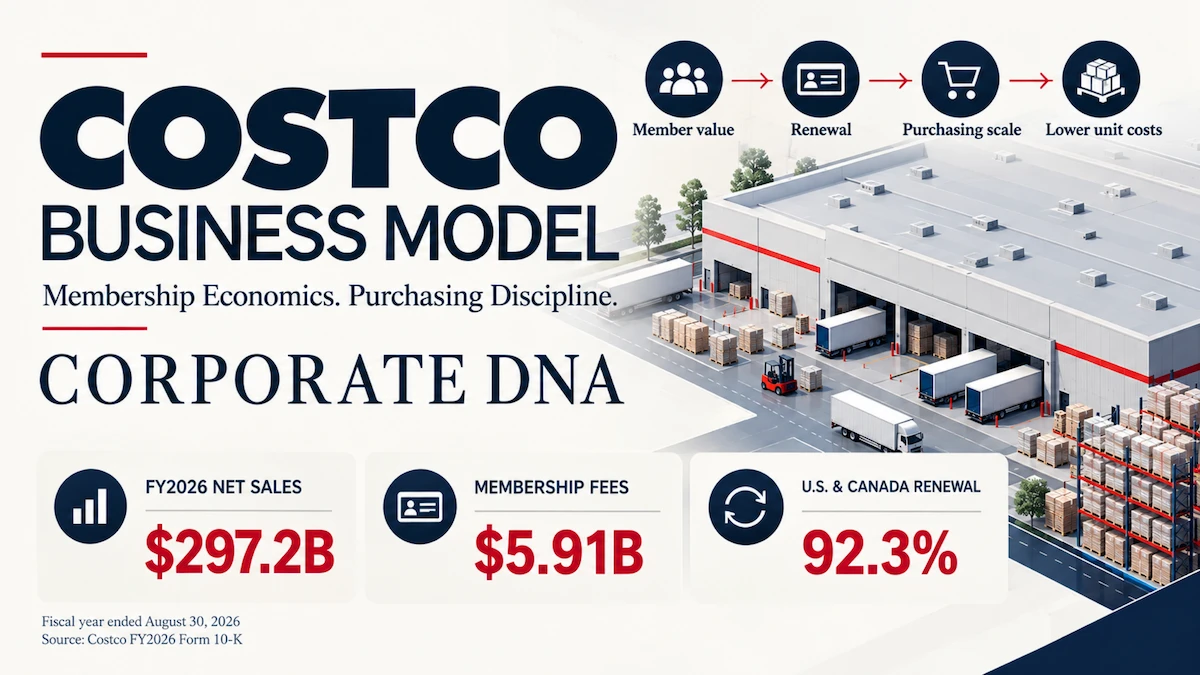
For the 52 weeks ended August 30, 2026, Costco reported net sales of $297.247 billion, membership fees of $5.907 billion and total revenue of $303.154 billion. Operating income was $11.685 billion. The figures come from the official fiscal 2026 results.
Membership fees were 1.95% of revenue, calculated from company-reported figures as $5.907B ÷ $303.154B. Operating margin was 3.85%, calculated from company-reported figures as $11.685B ÷ $303.154B. Those proportions reveal a business that earns attractive aggregate dollars while allowing little room for operating mistakes on each sales dollar.
It is misleading to call membership fees pure profit or to say that they generate all of Costco’s earnings. The company does not allocate the shared costs of warehouses, staffing, technology and member services into a standalone membership profit segment. The merchandise operation must remain productive for the membership proposition to exist.
Why Limited Choice Can Improve the Economics
Costco’s FY2026 Form 10-K describes fewer than 4,000 active core warehouse SKUs, direct sourcing, cross-docking and rapid inventory turnover. The economic objective is concentrated throughput: each selected product has a better opportunity to earn meaningful volume and justify purchasing, shelf space and handling resources.
This is a form of demand aggregation. A broadline retailer competes partly by carrying many alternatives; Costco asks members to accept fewer choices in exchange for a compelling deal. Suppliers receive access to concentrated demand, while Costco gains negotiating relevance within each selected item. Adding assortment indiscriminately could dilute that advantage even if it increased nominal selection.
Ancillary services and digital channels extend the same relationship. Their strategic purpose is to make membership useful across more purchase occasions. They should be evaluated by incremental engagement and contribution after fulfillment costs, rather than by assuming every new service has software-like margins.
How Costco Extends the Member Relationship
Costco’s platform is the member relationship across warehouses, private-label merchandise, services and digital access. It is not principally a marketplace charging third-party sellers for access to shoppers. Costco remains exposed to inventory choices, procurement, labor, real estate and product quality.
Membership revenue is recognized over the membership term, rather than entirely when cash is collected. That accounting matters when evaluating fee growth: collections, recognized revenue, price changes and underlying membership development need not move together in one period.
The practical discipline is to ask whether each addition makes the total membership more valuable without undermining the operating simplicity that helps fund the value. That provides a more useful framework than treating Costco as either a conventional supermarket or a subscription business in isolation.
2. Deep Dive into Economic Moats
Cost Advantages: An Operating System Competitors Must Replicate
Costco’s clearest moat is a cost system built around selection discipline, dense purchasing and efficient physical execution. Low prices alone are easy to copy temporarily. Offering them consistently while covering wages, facilities, shrink and logistics requires a compatible operating model.
A competitor trying to replicate Costco must do more than build a warehouse or negotiate a promotional discount. It needs enough demand per selected item, dependable supplier access, disciplined replenishment and locations that generate sufficient throughput. It must also tolerate low merchandise margins during the period before the customer base reaches attractive density.
Those requirements create a coordination problem. More assortment can help recruit customers but weaken buying concentration. More convenience can improve service but raise handling costs. Higher prices can fund expansion but reduce the perceived value of membership. Costco’s advantage lies in managing those tradeoffs as one system.
The moat is nevertheless contestable. Established warehouse clubs and large retailers already possess purchasing infrastructure and capital. Costco’s defense depends on continuing productivity and execution, not an exclusive legal right to the format. Thin operating margins make wage inflation, delivery expense and poor inventory decisions especially consequential.
Intangible Assets: Trust in the Buying Decision
The second core moat is confidence that Costco has already done useful purchasing work for the member. That trust can reduce the time and perceived risk involved in comparing products. Kirkland Signature extends the relationship from the store to the merchandise itself.
A familiar name is not enough. The valuable asset is repeated evidence that product quality and price justify the trip and the membership. Costco can transfer that credibility across categories, but every extension also puts part of the existing reputation at risk. A serious quality failure under a common private label can affect perceptions beyond the original item.
For a challenger, the cost of catching up includes sourcing capability, quality assurance, inventory risk and years of consistent delivery on the value promise. Buying advertising can create awareness much faster than it can establish this record.
This interpretation is supported, but not mechanically proven, by Costco’s FY2026 renewal rates of 92.3% in the U.S. and Canada and 89.8% worldwide. The filing uses a lagged renewal methodology, so these rates should not be converted into a contemporaneous annual churn estimate. Renewal is an outcome to monitor alongside price competitiveness and service quality.
Switching Costs: Retention Without Captivity
Households can shop at other stores, hold competing memberships or decide that warehouse shopping no longer suits their needs. Rewards, shopping habits and a convenient location can encourage retention, but they do not impose the migration burden associated with replacing an enterprise software system.
That distinction improves the analysis. Costco must continually earn renewal rather than rely on customers being technically unable to leave. Strong retention is more persuasive when the customer has realistic alternatives; it also makes any deterioration a potentially meaningful signal.
Network Effects: Separate Purchasing Feedback from User-to-User Value
Additional members can support greater purchasing scale and better economics. That is a scale feedback mechanism. Members do not inherently make the service more useful to one another in the way additional participants improve a payments network or a communications platform.
More traffic can even create congestion, parking difficulty and checkout friction. Costco therefore should not receive a separate network-effect premium merely because membership is large. The durable moat argument rests primarily on cost advantages reinforced by trust.
Together, those two barriers can support long-term excess returns if the company keeps reinvesting in member value and earns adequate returns on new capital. A defensible business does not, by itself, establish that every stock valuation is attractive.
3. Business Inflection Points & Future Catalysts
The Strategic Inflection: Kirkland Signature in 1995
Costco began operations in 1983, merged with Price Company in 1993 and introduced Kirkland Signature in 1995, according to its official historical highlights. For understanding today’s business model, the Kirkland launch is the most important strategic turning point in this analysis.
The merger increased the purchasing base. Kirkland added a different capability: Costco could put its own credibility behind an alternative to national brands. It could influence specifications, offer distinctive value and reduce dependence on any single branded product’s positioning. The current annual filing describes private label as a source of differentiation and generally higher merchandise margins.
The strategic change was from selecting other companies’ products to underwriting a repeatable promise across categories. That makes product quality part of the membership economics. The opportunity is stronger differentiation; the corresponding obligation is to protect the trust that makes the umbrella brand useful.
Catalyst One: Warehouse Expansion and Cohort Maturation
Costco plans up to 33 warehouse openings in FY2027, including five relocations, and approximately $7.5 billion of capital expenditure. The maximum implied net addition is 28 warehouses, calculated from the company’s stated plan as 33 − 5; it is not separately issued net-opening guidance.
The transmission mechanism is more than additional floor space. A well-located warehouse can recruit members, increase purchasing convenience and eventually spread fixed costs across a larger sales base. As newer locations mature, operating leverage can improve even without a change in the merchandise pricing philosophy.
- Observable indicators: net openings after relocations, membership additions, new-location sales cohorts, comparable sales adjusted for gasoline and currency, and returns on the capital committed.
- Execution risks: scarce sites, construction costs, slow initial ramp-up and sales transferred from existing locations. A busy new warehouse is less valuable if it mainly redistributes nearby demand.
- Invalidation signal: sustained capital spending without improving mature-cohort productivity or enough incremental member demand to justify the expanded asset base.
Over the next one to two years, the quality of expansion matters more than maximizing an opening count. Relocations may improve service or capacity, but they should not be analyzed as entirely new customer markets.
Catalyst Two: Deeper Membership Engagement and Digital Convenience
Executive members represented approximately 75.2% of worldwide net sales in FY2026. That concentration makes the behavior of engaged members strategically important. It does not prove that upgrading causes all of their higher spending: members who already shop frequently may be more likely to upgrade.
The opportunity is to make membership valuable across more of the household’s spending. Better digital discovery, ordering and service can reduce friction, while premium benefits can support engagement. The potential economic gain comes from incremental member value and contribution, not from channel migration alone.
- Observable indicators: Executive membership mix, renewal cohorts, incremental shopping frequency, digital growth and selling, general and administrative expense productivity.
- Execution risks: fulfillment costs, rewards expense, service failures and lower-quality acquisition. Costco discloses that memberships acquired online renew at slightly lower rates on average.
- Invalidation signal: digital sales expand while fulfillment economics deteriorate or member retention weakens, suggesting convenience is being purchased at an unsustainable cost.
Costco’s digitally enabled measure includes orders initiated on a device regardless of fulfillment route, as well as Costco Travel. It should not be labeled pure shipped e-commerce. The definition is important because a channel growth rate alone cannot establish fulfillment profitability.
The latest official September sales release provides an early check: for the five weeks ended October 4, 2026, net sales rose 13.0% to $30.02 billion, comparable sales excluding gasoline-price and foreign-exchange changes rose 7.6%, and digitally enabled sales rose 19.0%. A Labor Day shift added slightly more than 50 basis points to total and comparable growth. That supports engagement momentum while illustrating why headline growth needs calendar and fuel context.
A fresh fee increase is not assumed here. The September 2024 increase still contributed to FY2026 fee-income growth. The next phase should be judged on membership development, mix and retention as that comparison benefit fades.
4. Key FAQs
Does Costco make all its profit from membership fees?
No. Membership fees are revenue, and Costco does not disclose them as an independent profit segment with all shared costs allocated. The stronger interpretation is that fees and productive retail operations reinforce each other: members pay because the merchandise and services continue to justify access.
Why does Costco carry fewer products than a typical large retailer?
A narrower selection concentrates purchasing and inventory resources behind the items Costco chooses. That can strengthen supplier economics and simplify handling. The tradeoff is that buyers must select products well enough that customers accept fewer alternatives without losing confidence in value.
Is Kirkland Signature a bigger moat than Costco’s membership model?
Neither works best in isolation. Kirkland can differentiate merchandise and transfer trust across categories, while membership creates a recurring reason to preserve the value proposition. A private label without quality discipline is vulnerable; a membership without compelling merchandise is difficult to renew.
5. Conclusion
Costco’s enterprise DNA is disciplined restraint in pursuit of repeat business. It accepts limits on assortment and merchandise markup to concentrate demand, simplify operations and make membership worth renewing. The recurring fee is the financial expression of that relationship, rather than a substitute for running the retail business well.
The most defensible advantages are the integrated cost system and trust in Costco’s buying judgment. Neither is guaranteed by size. Competitors can replicate individual practices, but matching the full combination requires productive locations, purchasing density, quality control and a willingness to preserve the customer bargain over time.
Warehouse maturation and deeper engagement can extend the model over the next two years. The decisive evidence will be productive incremental capital, durable renewals and healthy contribution after service and fulfillment costs. The corporate franchise strengthens when growth preserves those economics; it weakens when expansion or monetization begins to erode the reason members joined.
Primary sources: Costco FY2026 Form 10-K filed with the SEC; Costco FY2026 operating results; Costco historical highlights; and Costco September 2026 sales results. Sources and links checked October 29, 2026.
Disclaimer: This article is intended solely for business logic discussion and corporate research purposes, and does not constitute investment advice of any kind.