


Key Takeaways
- Anthropic’s October 26, 2026 founders’ letter makes safety-related limits on commercialization an explicit part of the shareholder proposition.
- The founders pair aggressive infrastructure investment with a willingness to sacrifice near-term revenue. Investors must assess both decisions together.
- Keeping Claude advertising-free places greater weight on customers’ willingness to pay for useful work.
- Amazon and Alphabet provide relevant listed-company exposure, but cloud consumption and profitable shareholder returns are different outcomes.
- The proposed IPO’s price and share count were not set in the October 26 announcement. The letter does not establish a valuation.
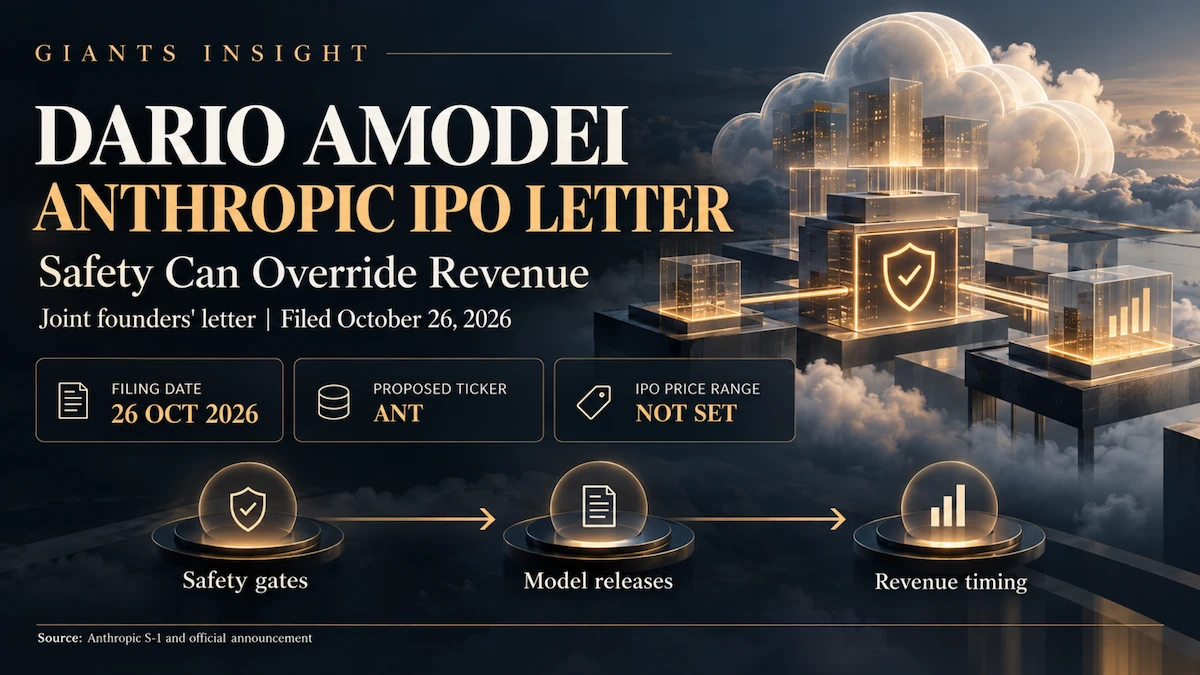
The Anthropic IPO letter signed by Dario Amodei and his co-founders sets out the terms on which the company intends to commercialize its technology. Prospective shareholders are being asked to finance rapid development while accepting that safety judgments can constrain revenue.
The source is the joint founders’ letter included in Anthropic’s October 26, 2026 S-1 registration statement, within the seven-day window ending October 29. Amodei signed alongside his co-founders. This article analyzes their collective statements; it does not present them as a solo interview or treat the founders’ expectations as established outcomes.
The investment issue is a tension between commercial opportunity and the conditions attached to pursuing it. A model can attract demand before it is ready for unrestricted deployment. Infrastructure spending can precede revenue, while public shareholders may have limited influence over the decisions that determine when that revenue arrives.
1. The Core Views in Context
The headings below are paraphrases of the founders’ stated views. The investment interpretations are analytical conclusions drawn from those statements.
Safety Can Delay Commercialization Even When Demand Exists
The letter describes withholding broad access to Claude Mythos Preview until additional safeguards were developed, acknowledging foregone revenue and competitive ground. It also allows for future decisions to advance more slowly for safety.
The commercial implication is that technical capability, product availability and revenue recognition follow different clocks. An impressive demonstration does not establish that a model can be distributed at scale on acceptable terms. Investors should therefore avoid converting every capability improvement directly into a near-term sales assumption.
There is a potential economic benefit to restraint: reliable deployment can support customer confidence and reduce the cost of failures. But that benefit is conditional. It must eventually appear in durable usage, retention, pricing or lower incident costs. A safety commitment does not by itself prove a competitive moat.
Advertising-Free Claude Changes the Monetization Test
The founders reaffirm that Claude will remain free of advertising, seeking to avoid incentives that prioritize engagement over helpfulness.
That narrows the strategic role of attention as a revenue source. The economic test shifts toward whether customers will pay enough for useful output to cover inference, product development, distribution and support. More time spent in a product is less informative than recurring paid work and the cost of delivering it.
For enterprise adoption, the alignment argument is commercially plausible: a customer may prefer an assistant whose recommendations are not influenced by advertising incentives. That is an analyst inference, rather than evidence that buyers will accept any price. Competitors can offer attractive alternatives, and customers can compare quality, latency, reliability and total cost.
Aggressive Compute Investment Requires More Than Confidence in AI Growth
The letter supports substantial advance investment in compute, while discussing ways to manage excess capacity, improve efficiency and raise capital if necessary.
This creates two separate underwriting questions. First, can Anthropic deliver products that attract sustained demand? Second, can that demand produce adequate returns on the resources committed before it arrives? A favorable answer to the first does not guarantee the second.
Capacity can become strategically valuable when supply is tight, but it can also lock in costs while model prices decline or demand shifts. Improving output per unit of compute helps only if the resulting savings are not entirely competed away. The relevant unit is contribution from useful work after delivery costs, rather than raw activity alone.
The financing dimension also matters. Raising capital can protect operating flexibility, but it does not eliminate the cost of the assets or services being funded. Investors should distinguish access to funding from evidence that the underlying economics are self-sustaining.
The Product Strategy Favors Reinvention Over Defending Today’s Revenue Mix
The founders expect to devote comparatively more effort to creating new products and business models as capabilities improve, rather than concentrating on protecting existing ones.
That is an important warning against valuing the business as a stable catalog of current products. New capabilities can enlarge the addressable market, but they can also change pricing, distribution and the useful life of existing offerings. Successful innovation may require deliberate cannibalization.
For investors, optionality deserves a disciplined framework. A new product category needs a paying customer, repeatable deployment and a defensible share of the value created. The possibility of expanding into knowledge work or scientific applications should not be treated as booked revenue or a verified market-size forecast.
The practical question is whether each generation improves the relationship between customer value and delivery cost. If a new model performs more work but requires disproportionate resources, capability growth can outpace financial progress. Conversely, better efficiency and workflow integration can create value even without the most dramatic benchmark headline.
2. Industry and Sector Implications
Amazon (AMZN): Distribution Opportunity with a Funding and Utilization Test
Amazon has a concrete distribution connection to this thesis. The official AWS announcement for Claude Platform describes access to Anthropic’s native experience through existing AWS accounts, credentials and consolidated billing.
That arrangement can reduce procurement friction for organizations already buying cloud services. If Claude adoption turns into sustained paid workloads, AWS can participate in the associated consumption and remain relevant as customers select among models. This is a potential benefit, not a disclosed forecast of incremental Amazon revenue or margins.
The counterweight is capital discipline. Investors need to assess the cash collected from workloads against infrastructure costs and the durability of utilization. Financing an ecosystem participant and selling services into that ecosystem are economically connected, but funding announcements are not independent proof of end-customer demand.
For AMZN, useful indicators include actual workload growth, capacity utilization, customer spending quality and returns after infrastructure costs. The letter’s willingness to delay releases also means that capacity planning cannot assume an uninterrupted product rollout.
Alphabet (GOOGL): A Competitor Can Also Be an Infrastructure Channel
Google Cloud’s October 23 deployment announcement describes both Anthropic-managed and Google-managed Claude options, with Google Cloud billing and eligible customer commitments.
The resulting exposure is more nuanced than a simple contest between Gemini and Claude. Alphabet can compete at the model layer while participating in the infrastructure and distribution of another provider’s products. Model competition does not automatically remove the cloud opportunity.
It does, however, complicate the investment model. Existing cloud commitments can make procurement easier without proving that all resulting consumption is incremental. Workload allocation can also change across providers. Investors should avoid counting the same ecosystem expansion multiple times as model upside, cloud upside and investment upside without examining the cash flows behind each claim.
The potential beneficiaries are therefore cloud platforms that deliver productive, paid capacity. The pressure falls on returns when deployment costs, price competition or financing needs rise faster than monetization. Neither ticker is a pure proxy for the outcome of Anthropic’s proposed listing.
3. Practical Investor Framework
First Defense: Build Valuation from Offering Terms
Anthropic’s October 26 announcement identified ANT as the proposed Nasdaq symbol and said the offering size and price range had not been determined. It also stated that the registration statement was not yet effective at that announcement date. Those disclosures do not establish a completed IPO or a public trading price.
A reviewable valuation requires the actual terms: fully diluted share count, cash entering the company, proceeds going to selling holders, outstanding obligations and the rights attached to each share class. Headline fundraising ambitions cannot substitute for that information.
Governance belongs in the same assessment. The accompanying S-1 proposes founder Class F voting power of 50.1% on matters submitted to shareholders generally, while the Long-Term Benefit Trust separately elects the Class T directors who constitute a board majority. These are different powers; the founder vote should not be interpreted as control over the trust’s director seats.
The operating implication is that economic ownership and influence over commercialization are not interchangeable. Investors should assess the business on the basis of the disclosed mission and control structure, rather than assume public-market pressure will remove those constraints.
Second Defense: Track the Conversion from Capability to Cash
Use a consistent sequence when reviewing new announcements:
- Establish availability: determine who can access the model, under what restrictions and with what deployment requirements.
- Establish paid adoption: separate trials, credits and demonstrations from recurring customer spending.
- Establish economics: examine pricing, delivery costs, gross profit, cash consumption and future compute obligations together.
The downside case should allow for delayed releases, lower pricing or underused capacity. The upside case should require evidence that improvements produce valuable recurring work at an attractive cost. These are analytical scenarios, not predictions that either outcome will occur.
An operational defense is to revisit assumptions when launch restrictions persist, customer expansion weakens or capacity commitments outpace funded demand. A strong narrative is least useful when it prevents the investor from recognizing that the mechanism has changed.
Third Defense: Separate Direct Exposure from Cloud Exposure
For an eventual direct investment, the central questions include model economics, funding requirements and minority-shareholder rights. For AMZN or GOOGL, the relevant question is the contribution to a diversified cloud and technology business after its associated costs.
Do not use a milestone in one layer as automatic confirmation of returns in another. An IPO filing, a model release, a cloud partnership and a customer renewal provide different evidence. A disciplined review identifies which assumption each event actually validates.
The founders’ letter is valuable because it makes the tradeoffs visible. It does not resolve them. Investment conviction should strengthen as deployment, customer value, capital efficiency and governance prove compatible in practice.
4. Frequently Asked Questions
What does Dario Amodei’s Anthropic IPO letter say about AI safety and revenue?
The joint founders’ letter says safety can justify withholding or slowing deployment despite commercial costs. Investors should distinguish technical progress from products available to paying customers, and evaluate whether deployment discipline produces durable economic benefits.
Did Anthropic announce an IPO price or confirm that ANT was trading?
The October 26 announcement described a proposed offering with no determined price range or share count. ANT was the proposed symbol. This article does not infer a completed listing from the filing; offering status and final terms require their own confirmation.
How could the Anthropic IPO affect Amazon and Alphabet investors?
A financially supported Claude ecosystem can create cloud workload opportunities for both companies. The shareholder benefit depends on paid consumption and returns after infrastructure costs. A proposed IPO does not guarantee new orders, favorable margins or a particular allocation of workloads.
Sources: Anthropic’s October 26, 2026 S-1 and joint founders’ letter, including the original letter page on investment, safety and advertising; Anthropic’s official proposed-IPO announcement; AWS’s Claude Platform announcement; and Google Cloud’s Claude deployment announcement. Primary sources checked October 29, 2026.
Disclaimer: This article is for informational purposes only and does not constitute investment advice.