




Key Takeaways
- Huang described neocloud demand as “off the charts” on October 22, but singled out working capital—not a shortage of prospective customers—as a key obstacle to expansion.
- NVIDIA wants its computing systems recognized as financeable assets. That is a financing ambition, not proof that lenders have agreed on durable collateral values or attractive loan terms.
- For the AI infrastructure supply chain, electricity, connected sites, packaging capacity and deployment speed matter alongside chip supply.
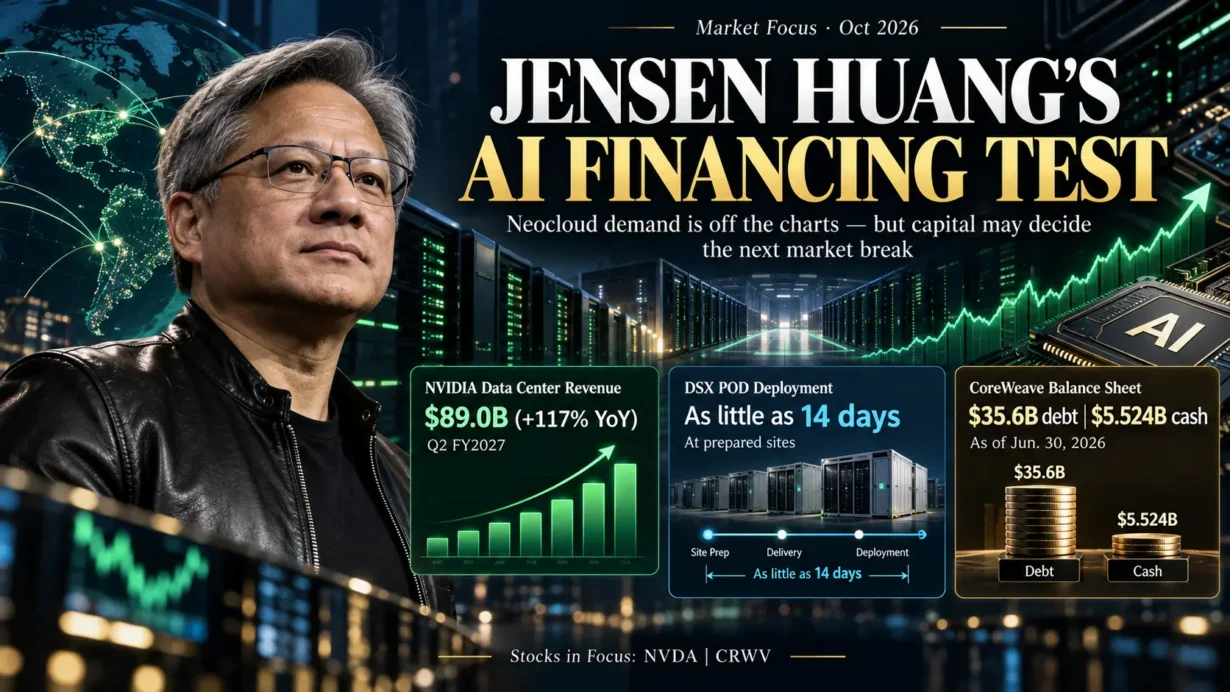
- NVIDIA’s October 21 DSX POD announcement targets deployment in as little as 14 days at a site with the necessary utilities already prepared; the figure is a company-stated target, not a universal construction timeline.
- The investable split is between NVIDIA’s hardware and platform economics and CoreWeave’s more leveraged infrastructure-operator economics. Demand alone does not settle either stock’s valuation.
1. The Core Thesis: What Jensen Huang Actually Said
The first four insights below come from Huang’s October 22 CNBC interview and related reporting from that interview. The fifth adds his separately documented October 21 GTC Berlin announcement, clearly distinguished from the interview itself. Short direct phrases are attributed to Huang; investment implications are analysis, not quotations or management guidance.
1. Neocloud Demand Is “Off the Charts”—Yet Utilization Is Not Equity Value
Huang’s demand assessment supports the case that AI developers and enterprises still want access to accelerated computing. But GPU rental demand is only the beginning of a neocloud income statement. Revenue must cover electricity, networking, maintenance, depreciation, customer-acquisition expenses and financing costs before meaningful cash can reach common shareholders. In capital-intensive markets, a fully committed order book can coexist with negative free cash flow. The critical diligence question is not simply whether capacity can be rented, but whether the contracted rental yield exceeds the all-in cost of supplying it over the equipment’s useful life.
2. Working Capital Is the Missing Link Between AI Demand and Capacity
Huang identified working capital as a central constraint: specialized operators need financing well before newly ordered GPUs begin producing billable tokens. Deposits, server procurement, grid connections and construction cash outlays precede revenue recognition. If debt markets demand higher coupons, more collateral or shorter maturities, the same customer contract can produce a much worse return on equity. Consequently, falling neocloud stocks are not automatically evidence that AI usage has collapsed; they may be repricing the timing, cost and risk of funding future capacity.
3. NVIDIA Compute as a “Financeable Asset” Could Change the Credit Equation
Huang said NVIDIA is seeking to establish its computing hardware as an asset lenders can finance on the strength of its productive life and residual value. The commercial logic is powerful: stronger collateral treatment could increase loan availability or reduce capital costs, enabling operators to buy more systems without relying exclusively on expensive new equity. Yet this is also the sharpest point of vulnerability in his thesis. GPU resale values are sensitive to next-generation performance, rental prices, technology obsolescence, software compatibility and secondary-market liquidity. A lender’s haircut—not a chip vendor’s stated optimism—ultimately determines borrowing capacity. Investors should treat GPU-backed financing as an evolving underwriting proposition, not a completed industry standard.
4. Europe’s AI Flywheel Starts With Power and Local Infrastructure
Huang connected Europe’s prospective AI economy to its ability to develop domestic infrastructure, including neocloud capacity and reliable energy access. This shifts the discussion from chip demand to a physical buildout: utility interconnection, permits, energy pricing, cooling and localized compute must align before an AI application ecosystem can scale. Capital can fund a cluster of GPUs, but it cannot instantly create a commissioned electrical connection. Europe’s infrastructure gap therefore offers a long-duration demand thesis for NVIDIA while simultaneously imposing execution constraints on customers. Backlogs should be discounted when power delivery dates are uncertain.
5. Time to First Token Is Becoming an Investment Metric—From the October 21 GTC Announcement
One day before the interview, NVIDIA unveiled DSX POD, a factory-integrated Vera Rubin AI infrastructure design. According to NVIDIA’s October 21 release, the company aims to reduce deployment at prepared sites from six months to as little as 14 days, with partner delivery planned for early 2027. Economically, faster commissioning can pull forward rental revenue and reduce the period during which financed equipment generates interest expense but no income. Those benefits remain contingent on site readiness and successful real-world deployment. The milestone to track is paid production beginning on schedule, not the announcement of a modular design.
The analytical boundary matters: Huang did not establish that all neocloud projects are profitable, that a particular financing facility has been secured, or that any GPU asset will retain a specified resale value. None of those claims should be inferred from his confidence in demand.
2. AI Supply Chain and Stock-Market Implications
Two listed equities express very different sides of Huang’s thesis. Both are exposed to the AI infrastructure cycle, but capital enters their businesses at different points—and shareholders face different risks when financial conditions tighten.
NVIDIA (NVDA): A Platform Beneficiary With Indirect Customer-Funding Exposure
NVIDIA sells the accelerated-computing platforms around which many AI data centers are built. In its most recently reported quarter as of October 26—fiscal second quarter 2027, released August 26—the company disclosed $89.0 billion of Data Center revenue, up 117% year over year, within $96.2 billion of total quarterly revenue. The scale demonstrates material commercial adoption, but it does not guarantee future stock returns or insulate NVIDIA from a slowdown in customer-funded capital expenditures.
The nearer-term supply-chain catalyst is execution, not another abstract AI spending forecast. On October 21, NVIDIA said substrate-related agreements with suppliers were designed to increase aggregate capacity 2.5 times over three years, while Amkor’s planned advanced-packaging expansion targets more than 300% additional capacity by the end of 2028. These are announced plans with delivery and utilization risks. If projects proceed and financing remains available, NVIDIA can benefit from systems demand, networking content and higher infrastructure throughput. If lenders retrench or operators postpone builds, customer cash constraints can eventually translate into deferred purchases, even when AI end-user demand remains healthy. Watch Data Center growth, gross-margin durability, order conversion and management commentary about customer financing together.
CoreWeave (CRWV): Demand Optionality Versus Balance-Sheet Duration Risk
CoreWeave is a clearer test of Huang’s financing argument because its business model requires substantial infrastructure investment before the corresponding rental cash flows arrive. In its SEC Form 10-Q for the quarter ended June 30, 2026, CoreWeave reported $35.6 billion of total indebtedness and $5.524 billion of cash and cash equivalents. For the first six months of 2026, operating activities generated $3.663 billion of cash while investing activities consumed $14.874 billion. At the same quarter-end, the company also reported approximately $10.0 billion of undrawn availability under existing credit facilities—a meaningful liquidity resource that should not be confused with cash or ignored when discussing its debt load.
These figures establish a capital-intensive growth profile, not a prediction of imminent distress. A large pipeline of committed compute demand can sustain revenue expansion; however, debt service, additional collateral demands, refinancing spreads, dilution and equipment useful life govern the value left for shareholders. If asset-backed lending becomes cheaper on attractive terms, CoreWeave could benefit disproportionately. If collateral haircuts widen or refinancing becomes punitive, incremental growth can destroy equity value despite strong contracted demand. That asymmetry explains why simply calling CRWV an AI winner is not an adequate investment thesis.
October 22’s market action provides a cautionary cross-check: broad AI financing worries coincided with a sharp fall in the Nasdaq and especially large losses in neocloud equities. The price action does not disprove Huang’s demand claims; it signals that the market is charging a higher premium for balance-sheet quality and realized cash returns.
3. A Practical Investor Playbook: Three Decision Rules
Rule 1: Underwrite the Financing Bridge Before Paying for the Backlog
For CRWV, update a three-part checklist when new filings arrive: accessible liquidity (unrestricted cash plus genuinely undrawn committed financing), the gap between operating cash generation and investing outlays, and debt-service exposure by maturity and rate type. Compare changes in all three rather than citing backlog in isolation. A constructive signal would be stronger operating cash conversion and financing secured on terms that do not materially dilute equity. A defensive trigger would be accelerating infrastructure spending alongside deteriorating liquidity, higher effective borrowing costs or additional shareholder dilution. June 30 balances are historical starting points, not October 26 live balances.
Rule 2: Demand Proof of Monetization, Not Just Proof of Deployment
For NVIDIA’s ecosystem, monitor whether announced DSX POD projects actually achieve commissioned power, on-schedule delivery and sustained billable utilization in 2027. For operators, track average revenue per installed unit of compute, cash gross profit after energy costs, and contract terms that protect against rapid GPU rental-price declines. The 14-day figure applies only after site preparation; it cannot eliminate permitting, grid or upstream component constraints. On the positive side, a shorter interval between financing a GPU and earning cash from it can improve project returns. On the negative side, faster deployment is no cure for weak unit economics.
Rule 3: Separate the AI Demand Trade From the AI Credit Trade
NVDA and CRWV should not be evaluated or risk-sized as interchangeable exposures. NVIDIA’s fundamental test is whether accelerated-computing revenue and platform margins justify the valuation investors pay. CoreWeave’s test adds leverage, funding availability and the residual value of financed hardware. Use distinct thesis-invalidation points: a meaningful reversal in NVIDIA’s Data Center growth or margins would challenge the supplier thesis; worsening credit terms without improving cash generation would challenge the neocloud equity thesis. Avoid treating a steep selloff as a sufficient entry signal, and limit position size or leverage to a potential loss the portfolio can absorb.
The next observable cross-check is close: Microsoft and Alphabet have both scheduled quarterly earnings calls for October 28, 2026. Their commentary on AI capacity, infrastructure spending and return on deployed compute can help validate or challenge the broader demand backdrop. Those calls are future catalysts as of this article’s October 26 publication date, not results already known.
4. Frequently Asked Questions (FAQ)
What did Jensen Huang say about neocloud demand at GTC Berlin in October 2026?
In a CNBC interview on October 22, 2026, Huang said specialist AI cloud providers were seeing very strong demand and emphasized that working capital was restricting their ability to expand. His view concerned infrastructure demand and capital availability; it was not a forecast of specific share prices, future utilization rates or equity returns.
How could Jensen Huang’s financeable GPU strategy affect CoreWeave (CRWV) stock?
If lenders become more willing to finance NVIDIA compute against robust collateral values, CoreWeave could potentially expand capacity at a lower cost of capital and with less reliance on equity issuance. The countercase is that short equipment lives, declining rental yields or tighter loan terms increase funding pressure. Investors should examine actual credit agreements, cash flow and dilution rather than assuming the strategy has already been adopted at scale.
Is NVDA or CRWV the better way to invest in AI data center growth after Jensen Huang’s October 2026 interview?
The answer depends on the risk being purchased. NVDA offers more direct exposure to demand for accelerated-computing systems, but its valuation and growth expectations can still disappoint. CRWV offers exposure to GPU rental demand with greater sensitivity to leverage, refinancing and utilization. Neither is automatically the better investment without assessing entry valuation, balance-sheet developments and an investor’s loss tolerance.
Sources: CNBC’s full Jensen Huang interview (October 22, 2026); CNBC’s interview reporting; NVIDIA’s October 21 DSX POD announcement; NVIDIA’s October 21 supply-chain announcement; NVIDIA’s fiscal Q2 2027 results; CoreWeave’s June 30, 2026 Form 10-Q; Associated Press market report (October 22); and Microsoft’s October 28 earnings schedule.
Disclaimer: This article is for informational purposes only and does not constitute investment advice.