


Key Takeaways
- Visa monetizes payment connectivity, transaction processing and related services. It does not earn cardholder interest or record interchange as its own revenue.
- Its strongest moat is the interaction between payment acceptance and issuer distribution, reinforced by the operational effort required to connect institutions reliably.
- Client incentives are an essential part of the economics: growing transaction activity does not guarantee that Visa retains a larger share of the value created.
- Commercial payment tools and new money-movement services could deepen client relationships, but pilots and settlement volumes must translate into recurring use and attractive net revenue.
- Alternative payment rails, client bargaining power, security failures and scrutiny of fees and network rules can weaken monetization without eliminating the network’s usefulness.
The Visa business model is best understood as the economics of coordinated acceptance. A consumer can pay a merchant without the consumer’s bank negotiating a separate relationship with every merchant’s financial institution. Visa helps make that interoperability work, then charges for network access, processing and services surrounding the transaction.
The investment question is how much value Visa can retain as payment interfaces and settlement rails change. A larger network creates opportunity; the durability of its returns depends on whether clients continue to pay for the reliability, distribution and capabilities embedded in that network.
This analysis uses official information available through October 26, 2026. Visa trades on the NYSE under V. Its latest released financial quarter was fiscal Q3 2026; full-year 2026 results were scheduled for October 27. No unreleased full-year figures are treated as actual results.
1. Business Model Breakdown
The network earns fees; the issuing bank owns the cardholder lending relationship
Visa’s 2025 Form 10-K describes a four-party model involving the account holder, issuer, merchant and acquirer. Visa supplies the connecting network and associated capabilities. It does not issue cards or extend cardholder credit. Interchange generally moves from the acquirer to the issuer; it is distinct from Visa’s own fees. The merchant’s total acceptance cost therefore should not be confused with Visa’s revenue.
This distinction changes the analytical framework. Visa benefits when clients use its infrastructure and services, rather than when consumers carry larger interest-bearing balances. Its direct exposures center on payment activity, commercial terms, operational performance and settlement obligations. The absence of consumer lending does not make the company free of financial or operational risk.
Four revenue categories, followed by a substantial deduction
Visa’s revenue accounting disclosures explain the principal fee categories:
- Service revenue reflects use of Visa payment services and includes volume-related fees and certain issuing services. The economic driver is the value of activity supported, not simply the number of cards.
- Data processing revenue covers authorization, clearing, settlement and related capabilities. More transactions can increase demand even when individual purchases are small.
- International transaction revenue includes cross-border processing and currency conversion. The geographic mix of spending matters alongside total activity.
- Other revenue includes advisory and selected issuing services, licensing and other fees. Its composition makes it unsuitable as a pure software subscription proxy.
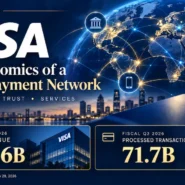
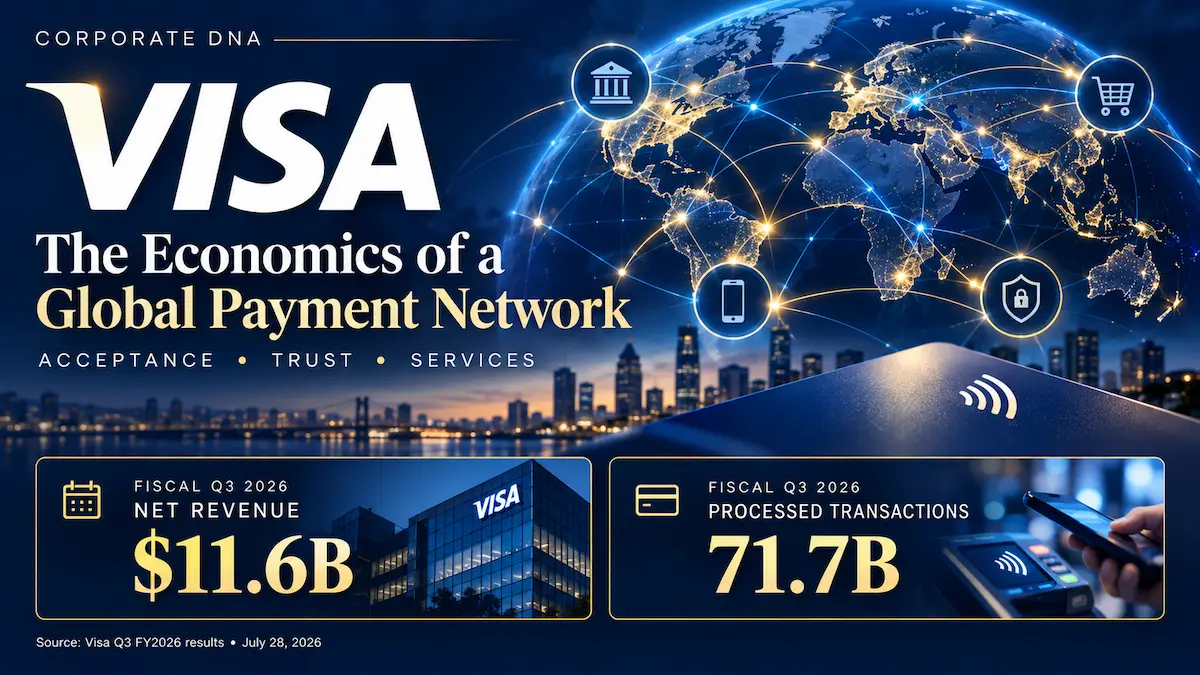
In fiscal Q3 2026, these categories generated $4.922 billion, $6.042 billion, $3.853 billion and $1.496 billion, respectively. Deducting $4.680 billion of client incentives produced $11.633 billion of net revenue, up 14% year over year. Visa processed 71.7 billion transactions. Service revenue generally reflects the previous quarter’s payments volume, while the other categories reflect current-quarter activity.
Client incentives equaled approximately 28.7% of the four categories before incentives, calculated from company-reported figures: $4.680 billion ÷ ($4.922 billion + $6.042 billion + $3.853 billion + $1.496 billion) × 100. This is an analytical calculation, not a company-reported margin or take rate.
The strategic implication is straightforward: distribution has a price. Incentives help secure relationships and encourage activity, but reduce the revenue Visa retains. The relevant test of pricing power is the net economic outcome after these commitments, rather than gross fees in isolation. Contract accounting also means the reported deduction should not be interpreted as cash paid entirely within the same quarter.
The platform strategy extends beyond card routing
Visa’s June 2026 Form 10-Q reported $3.8 billion of value-added-services revenue, up 33% as calculated by the company. That revenue sits within service, data processing and other revenue; it is not a fifth category to add to the totals. The offering includes issuing, acceptance, risk, security and advisory services. Marketing demand associated with the FIFA World Cup also supported the quarter, so the growth rate should not be treated as a pure recurring-software trend.
The platform’s commercial logic is to solve more of a client’s payment problems through an existing relationship. Fraud prevention, acceptance tools and operational services can increase value per client while making the relationship relevant beyond the routing decision.
There is evidence that this strategy is broader than directing every payment onto Visa cards. Its April 2026 Intelligent Commerce Connect announcement describes support for Visa and other-network capabilities through an integration that was then in pilot. Cross-network functionality can preserve Visa’s role when the user interface changes, but does not establish that it captures every underlying payment fee.
2. Deep Dive into Economic Moats
Network effects: acceptance and distribution reinforce each other
Visa’s most defensible network effect is indirect. Relevant merchant acceptance makes a payment credential more useful to its holder and more attractive for a bank to issue. A large pool of usable credentials gives merchants a reason to maintain acceptance. The value comes from being able to transact across institutions with common operating expectations.
A new entrant cannot replicate that benefit merely by building a fast payment interface. It must secure issuer distribution and merchant access together, establish operating rules, support exceptions and persuade institutions to trust it with live activity. The replication cost includes years of integration, compliance work and commercial incentives before either side receives sufficiently broad utility.
This assessment does not imply that every additional merchant materially improves the network for every existing user. Coverage must be relevant to actual spending. Nor is the network exclusive: customers and merchants can use several payment methods, and banks can maintain competing products. A domestic account-to-account service can win a specific use case without reproducing Visa’s entire global footprint.
Institutional switching costs: continuity matters more than consumer loyalty
The reinforcing barrier is the work institutions perform around a network relationship. Authorization, reconciliation, risk controls, settlement and dispute handling must function together. Replacing an arrangement can require migration and operational testing while preserving customer acceptance and continuity.
These switching costs are an analytical inference from Visa’s documented operating model, not a disclosed universal cost estimate. They are more substantial at the institutional level than at the consumer interface, where selecting another card or wallet may be easy. Visa’s annual filing also makes clear that clients can offer competing products; integration does not equal permanent exclusivity.
The durable advantage is therefore the combination of useful acceptance and reliable integration. Either alone is weaker. Broad reach with poor service encourages alternatives, while an elegant integration with insufficient acceptance has limited distribution value.
Intangible assets and cost advantages support the moat, with limits
Trust is economically relevant when it reduces uncertainty about whether a payment will work and how an exception will be handled. The brand represents that expectation. Recognition without dependable performance would be a weaker asset; outages, security failures or poor dispute experiences can consume accumulated trust.
Scale can spread technology, security and operating investment across more activity. That is a potential cost advantage, not proof of unassailable cost leadership. Other networks also have scale, domestic rails may be less expensive for particular transactions, and Visa shares economics with clients through incentives.
These barriers can support long-term excess returns if the service remains worth more to clients than competing arrangements after all costs. They do not grant unlimited pricing power. Fee and routing scrutiny, alternative rails and sophisticated clients can constrain monetization even while acceptance remains valuable.
3. Business Inflection Points & Future Catalysts
The 2007–2008 transition changed how the network could be governed
The pivotal strategic transition was Visa’s 2007 corporate reorganization, followed by its March 2008 stock-market debut. Visa USA, Visa Canada and Visa International came under Visa Inc.; Visa Europe remained separately governed at that stage.
The network and its acceptance advantages existed before the IPO. The commercial significance was a change in the governance and capital framework through which investment, product priorities and shareholder returns could be coordinated. That is the strategic interpretation, rather than a claim that becoming public created the network effect.
The same logic carries into the present: Visa’s corporate DNA is coordinating participants that retain their own customers and economics. Its success depends on making participation attractive while retaining enough value to reinvest in the common infrastructure.
Catalyst one: commercial payment tools move from pilots to production
Visa’s October 21, 2026 commercial-payments announcement identified Commercial Supplier Validation and Commercial Virtual Authentication as pilots with general availability planned for 2027. It also described a live agentic invoice-payment pilot with BILL and Billtrust. These are specific implementation stages, not evidence of scaled product revenue.
The potential mechanism is the removal of practical barriers to commercial card use. Supplier validation, authentication and controls can make acceptance and automated payment execution easier to manage. If clients deploy the tools successfully, Visa could gain additional commercial flows and sell related services into existing relationships.
- Observable indicators: active issuer deployments after availability, participating suppliers, repeat production transactions, commercial payments activity and disclosed service economics.
- Execution risks: supplier acceptance costs, integration work, invoice data quality, agent permissions and responsibility for errors or fraud.
- Failure condition: a functioning pilot may fail to scale if workflow benefits do not outweigh acceptance and support costs. New transactions can also arrive before attractive incremental profit.
Catalyst two: money movement earns a place above changing settlement rails
Visa’s July 2026 Visa Direct explanation described existing card, account and wallet payout options, with stablecoin-wallet payouts in pilot for eligible clients in specified jurisdictions. Visa cautioned that stablecoins are not always cheaper. Its institutional stablecoin platform announcement outlined infrastructure and controls for managing new settlement workflows.
The 2027–2028 business opportunity is converting experimentation into repeated, monetized activity. New rails can compete with card routing, but also create demand for integration, endpoint access and risk controls. Visa can seek to earn fees for those functions even when the settlement technology changes. This is an analytical thesis, not company revenue guidance.
- Observable indicators: active paying clients, repeat commercial flows, rollout by jurisdiction and disclosed net revenue and support costs. Settlement principal and transaction counts must be evaluated separately from fees.
- Execution risks: clients may use direct rails or build orchestration internally; local restrictions, liquidity arrangements and operational controls can limit deployment.
- Failure condition: volume can grow without meaningful monetization. Visa could support a useful new payment method while capturing less value per transaction than investors assume.
The common test across both catalysts is whether clients pay for better outcomes. Product launches alone do not establish pricing power or a higher valuation. Evidence of repeat use, client retention and attractive net economics would strengthen the case; heavy incentives and support costs without corresponding revenue would weaken it.
4. Key FAQs
Does Visa make money from credit-card interest or interchange fees?
Visa does not earn cardholder interest or record interchange as its own revenue. The issuer owns the lending relationship and generally receives interchange from the acquirer. Visa earns network, processing and related service fees. Rising card debt therefore does not mechanically increase Visa revenue in the way it can increase an issuer’s interest income.
Can stablecoins or account-to-account payments replace Visa’s business model?
They can bypass card routing in particular use cases, especially where direct transfers offer better economics. The harder question is who supplies acceptance, access, controls and exception handling around those transfers. Visa’s opportunity is to sell useful services across rails; its risk is that clients obtain those capabilities elsewhere or need fewer of them.
Why does Visa pay client incentives if it has a strong network moat?
A valuable network can still face powerful customers. Banks, acquirers and other partners control distribution and can support alternatives. Incentives share the value created and help secure activity. Their existence does not disprove the moat, but the cost of retaining business determines how much of that moat’s economics reaches shareholders.
5. Conclusion
Visa’s corporate DNA is coordinated interoperability: connecting institutions with different commercial interests so that payments work across a broad acceptance environment. Its core product is the functioning relationship among those participants, supported by processing, operating rules and services.
The strongest moat combines indirect network effects with institutional integration and operating trust. Competitors must reproduce relevant distribution and dependable execution together. Yet multi-network usage, client bargaining power and alternative rails prevent that advantage from becoming unrestricted control over pricing.
The next phase will be judged by whether Visa can extend useful capabilities into commercial payments and new money-movement workflows while preserving attractive net economics. The essential measure is the value retained after incentives, investment and support costs. Visa’s future depends on remaining worth paying for as the way money moves continues to change.
Sources: Visa 2025 Form 10-K; Visa fiscal Q3 2026 Form 10-Q; Visa Investor Relations quarterly results; and the official historical and product announcements linked above. Calculations and competitive assessments are identified as analysis; product plans and pilots are distinguished from realized results.
Disclaimer: This article is intended solely for business logic discussion and corporate research purposes, and does not constitute investment advice of any kind.