


Key Takeaways
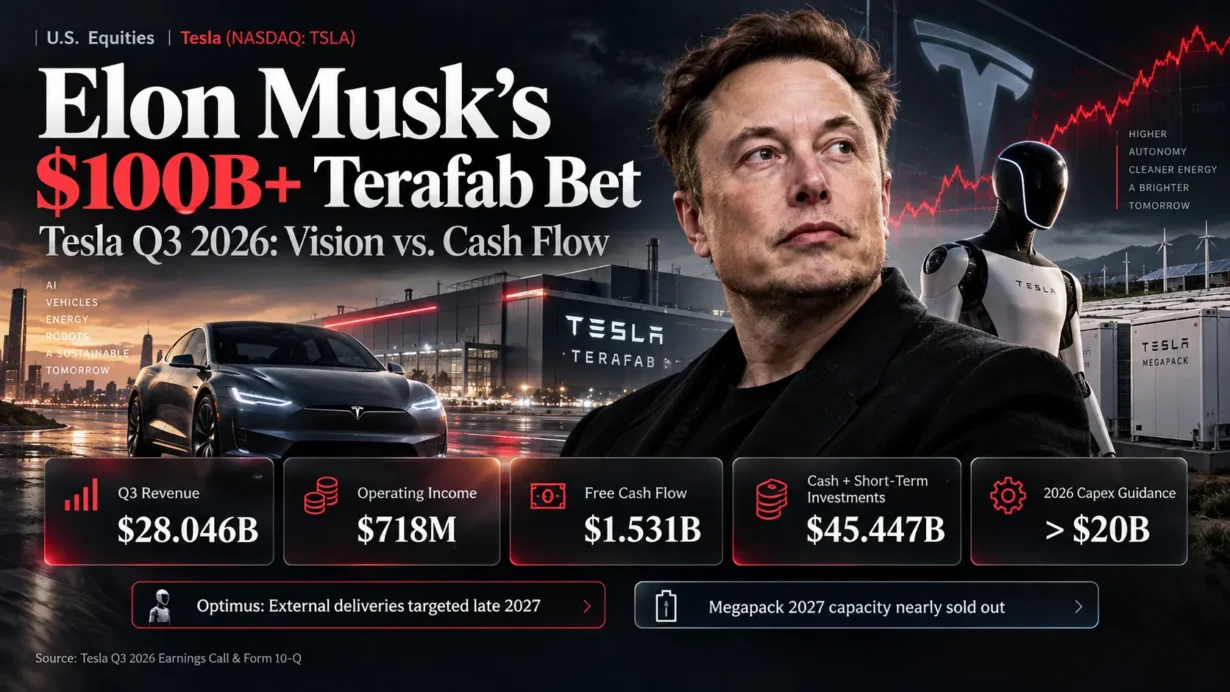
- Musk estimated that Terafab may require tens of billions of dollars in equipment spending through early 2028 and more than $100 billion over the long term. Tesla’s share versus SpaceX’s share remains undetermined.
- Optimus early production has begun, but Musk placed initial deliveries to businesses outside Tesla around late 2027, dependent on AI performance, hand dexterity, durability and scale-up.
- Musk said Tesla’s 2027 Megapack capacity is nearly sold out. That demand signal contrasts with a 16% year-over-year decline in Q3 energy revenue and margin benefits that were partly nonrecurring.
- Musk said Austin’s Cybercab fleet expanded tenfold from a small launch base in roughly a month. Revenue per paid mile, operating costs and regulatory approvals—not fleet-growth percentages alone—must validate the economics.
- Tesla generated $1.531 billion in Q3 free cash flow, but its SEC filing anticipates more than $20 billion in total 2026 capital expenditures. Capital discipline remains the key valuation filter.
1. What Elon Musk Actually Said: Five Market-Moving Signals
1. Terafab could exceed $100 billion in long-term capital investment
Asked about Tesla’s semiconductor ambitions, Musk described capital-equipment spending in the tens of billions through early 2028 and a potential long-run total north of $100 billion. His timing was explicitly aspirational: initial research-fab test chips around mid-2027 and useful production chips potentially in late 2028. The commercial logic is control of scarce AI compute, memory, packaging and manufacturing capacity for an expanding fleet of cars and robots. The financial logic is less forgiving. A foundry is a multiyear, low-utilization-before-ramp asset with material execution risk. Crucially, Musk said Tesla and SpaceX had not determined how to divide the Terafab bill. Investors should therefore neither charge the entire $100 billion to TSLA today nor treat it as a funded, approved commitment. The valuation catalyst is a disclosed cost split, phased capacity plan and independently measurable manufacturing progress.
2. Optimus is a massive addressable-market thesis—not a 2027 volume-sales forecast
Musk reiterated his view that general-purpose humanoid robots could eventually represent an enormous product category, while explicitly tempering near-term expectations. Tesla has started early production on its Fremont line, but the design is still changing; AI capability, sophisticated hand mechanics and operating life must improve before the system can handle open-ended work reliably. He targeted deliveries to external business customers around the end of 2027, with hazardous or repetitive industrial tasks likely to precede household use. That order matters: factories offer a clearer willingness to pay for around-the-clock output than consumers do for a still-developing general-purpose robot. A line designed for a high theoretical annual rate is not the same as realized production, field reliability, paying customers or recognized revenue. No material 2027 Optimus profit should be assumed without evidence.
3. Megapack demand looks supply-constrained, but the reported margin needs normalization
Musk said demand for energy storage is exceptionally strong and that Tesla was nearly sold out of Megapack capacity for 2027. AI data centers and grid reliability create a plausible structural demand channel: the more electricity-intensive the compute economy becomes, the more valuable grid-scale load-shifting and backup flexibility can be. But investors must separate demand commentary from income-statement conversion. Tesla deployed 13.7 GWh of energy storage in Q3, while energy generation and storage revenue fell 16% year over year to $2.881 billion. Its segment gross margin reached 33.1%, yet management attributed a substantial sequential lift to tariff refunds and warranty-related adjustments. A credible bullish case needs sustained order conversion, higher shipments and a margin profile that remains attractive after temporary benefits fade.
4. Cybercab is scaling in Austin; profitable Robotaxi scale is still unproven
Musk cited a roughly tenfold increase in Austin’s Cybercab fleet since its launch about a month earlier and rapidly growing autonomous miles. The strategic ambition is to shift Tesla from selling vehicles once to monetizing transportation repeatedly, retaining fleet ownership and earning revenue over a vehicle’s useful life. That can expand lifetime value, but it also puts cleaning, charging, fleet operations, insurance, depreciation and safety on Tesla’s balance sheet or operating model. CFO Vaibhav Taneja acknowledged Tesla had not yet achieved its targeted approximately $0.30 per paid Robotaxi mile, although he described a route toward it as utilization improves. Meanwhile, Tesla’s services-and-other revenue grew 33% year over year, but its SEC filing attributes much of that growth to used vehicles, maintenance and charging. It would be a mistake to treat the entire segment as proof of Robotaxi unit economics.
5. Full Self-Driving adoption supports demand, but regulatory milestones are not guaranteed
Musk linked stronger vehicle demand to Full Self-Driving and hoped for broader European approval by the first quarter of 2027, while acknowledging regulators control the timetable. Tesla’s CFO reported more than 1.7 million paid FSD customers worldwide and that over 75% of North American Q3 deliveries included a paid FSD subscription sign-up at delivery. That signals potential software monetization layered onto hardware sales, though it does not imply that 75% of the worldwide Tesla fleet pays for FSD or that driver-supervised software is equivalent to unrestricted autonomous operation. For equity valuation, the inflection occurs when subscription retention, regional approvals and autonomous service utilization generate identifiable incremental profit—not merely when an approval target is restated.
2. Sector and Stock Impact: Where Capital May Flow
Tesla (NASDAQ: TSLA): AI optionality versus the cost of owning the infrastructure
TSLA is the direct vehicle for Musk’s convergence thesis across transport, software, energy and robotics. It could benefit if recurring FSD and Robotaxi receipts rise faster than incremental operating costs, and if Megapack backlog turns into high-quality earnings. The counterweight is operating leverage in reverse: Q3 gross profit rose year over year, yet operating expenses climbed to $4.776 billion, leaving only $718 million of operating income. Management discussed roughly $20 billion of 2026 capital spending, while its subsequently accessible quarterly SEC filing describes expected spending as in excess of $20 billion; those formulations should not be flattened into an exact cap. The company also disclosed $30 billion of borrowing commitments for future flexibility, not $30 billion already drawn. Until a Terafab cost split and Robotaxi unit economics are disclosed, TSLA remains exposed to swings in both growth expectations and capital-intensity assumptions.
Applied Materials (NASDAQ: AMAT): conditional upside from wafer-fab equipment
If Terafab proceeds on the scale Musk described, semiconductor manufacturing equipment is a logical second-order area to watch. Applied Materials sells tools and services tied to deposition, etch, metrology, packaging and other fabrication steps, according to its latest available SEC filing. Multiyear fab buildouts could increase demand for those capabilities across the industry. This is a conditional supply-chain thesis, not a claim that AMAT has won a Tesla or SpaceX contract: no such specific award was established by the sources reviewed. Furthermore, fab timing, procurement competition, technology selection and the split of spending between the two companies could change who benefits and when. Investors should seek confirmed purchase orders or management commentary before treating the Terafab headline as incremental AMAT revenue.
3. Practical Investor Strategy: Three Decision Rules
Rule 1: Require cash conversion, not just accelerating project milestones
Use Q3 as a transparent baseline: $28.046 billion revenue, $718 million operating income, about 2.6% operating margin, $4.732 billion capital expenditures and $1.531 billion free cash flow. In coming quarters, compare trailing-four-quarter free cash flow with planned capex and verify whether operating margin improves as manufacturing capacity ramps. A disciplined bullish thesis would look for recurring positive cash generation alongside revenue acceleration; repeated free-cash-flow deterioration without stronger contracted revenue would trigger a thesis review. Avoid annualizing one favorable quarter, especially because warranty changes and tariff refunds influenced segment profitability.
Rule 2: Put dated evidence gates around each AI promise
Track near-term European FSD regulatory decisions separately from driverless Robotaxi authorizations; track the number of commercially available cities, paid rides, paid miles and cost per paid mile against management’s roughly $0.30 target; and monitor actual Optimus deployments with outside industrial clients ahead of the late-2027 objective. For Terafab, the milestones are 2027 research-chip results, disclosed partner funding commitments and 2028 production readiness. These are indicators to test—not guarantees or a timetable imposed on regulators. In particular, a tenfold increase from a small fleet base should not replace utilization, safety and gross-profit evidence.
Rule 3: Treat project financing and a possible SpaceX transaction as portfolio risks
Musk referenced a possible Tesla-SpaceX merger but provided no transaction terms on the Tesla call; investors should not price a merger as completed. Tesla’s Form 10-Q also reports a $2.0 billion investment in SpaceX common shares during the first nine months of 2026, making independent valuation, related-party governance and Terafab cost allocation especially important to review. For volatile, event-driven exposure, establish a maximum position-level loss budget before entering a trade, size the holding against a clearly defined thesis-invalidating event and avoid relying on stop orders to protect against overnight gaps. A staged approach that waits for disclosures can sacrifice some upside but reduces the risk of paying today for an undisclosed financing structure.
4. Frequently Asked Questions (FAQ)
Did Elon Musk confirm Tesla will spend more than $100 billion on Terafab in 2026?
No. On the October 21, 2026 earnings call, he described a possible long-term Terafab investment above $100 billion, with tens of billions of dollars in equipment potentially needed through early 2028. He specifically noted that the funding split between Tesla and SpaceX had not yet been resolved. Tesla’s separately disclosed 2026 capital-spending expectation is above $20 billion across its initiatives; these are different time horizons and spending categories.
When does Elon Musk expect Tesla Optimus robots to reach outside industrial customers after Q3 2026?
He pointed to around late 2027 for initial deliveries to companies outside Tesla, provided the product clears remaining AI, hand-dexterity, durability and production hurdles. Industrial applications involving repetitive or hazardous tasks are the likely first use cases. That is a targeted commercial starting point, not confirmed mass-market shipment volume or 2027 profit guidance.
What should TSLA investors watch after Tesla Q3 2026 earnings: Robotaxi, Megapack or cash flow?
All three, but in a specific order: first establish that company-wide free cash flow can support growing investment; next verify whether Megapack orders convert into revenue with sustainable margins; then use paid Robotaxi utilization and disclosed cost per paid mile to measure autonomy’s economics. FSD adoption and Optimus milestones can improve long-term optionality, but they cannot substitute for measurable returns on invested capital.
Sources: Tesla Investor Relations’ October 21, 2026 Q3 webcast and results, the earnings-call transcript, Tesla’s September 2026 Form 10-Q, and Applied Materials’ Form 10-Q.
Disclaimer: This article is for informational purposes only and does not constitute investment advice.