

Key Takeaways
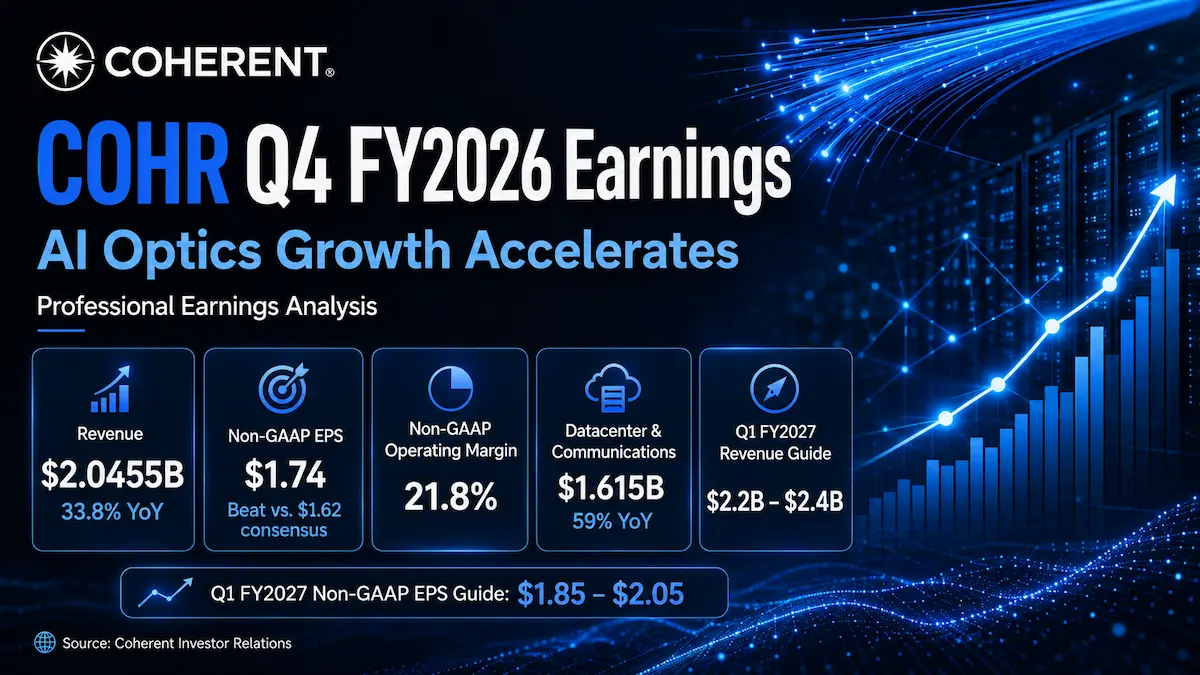
- Coherent reported Q4 FY2026 revenue of $2.0455 billion, up 33.8% year over year and 13.3% sequentially; on a pro forma basis excluding divested businesses, revenue rose 42% year over year.
- Non-GAAP EPS reached $1.74 versus $1.62 FactSet consensus, while non-GAAP operating margin expanded to 21.8% from 18.0% a year earlier.
- Datacenter & Communications generated $1.615 billion, or about 79% of Q4 revenue, and grew 59% year over year, making AI optical connectivity the overwhelming engine of company growth.
- Q1 FY2027 guidance of $2.2-$2.4 billion revenue and $1.85-$2.05 non-GAAP EPS was above published Wall Street consensus, but the stock still fell 7.99% in the first full session after earnings as investors focused on valuation, capital intensity and the pace of margin expansion.
- Management said fiscal 2027 is essentially booked through year-end calendar 2027, orders now extend into 2028, and long-term agreements extend through the end of the decade, materially improving demand visibility while raising the stakes for capacity execution.
1. Core Earnings Breakdown
Revenue and Profitability Analysis
Coherent’s fiscal fourth quarter ended June 30, 2026 marked its first quarter above $2 billion of revenue. Reported revenue was $2.0455 billion, up 33.8% from $1.5294 billion a year earlier and up 13.3% from $1.8056 billion in Q3. Because Coherent sold its former Aerospace & Defense business and a Munich product division during fiscal 2026, management also presented pro forma growth excluding those businesses; on that basis, Q4 revenue increased 42% year over year and approximately 14% sequentially.
Profitability scaled faster than revenue. GAAP gross margin was 38.5%, up 277 basis points year over year, while non-GAAP gross margin reached 40.2%, up 215 basis points. Non-GAAP operating income rose to $445.8 million and non-GAAP operating margin expanded to 21.8%, compared with 20.3% in Q3 and 18.0% a year ago. Non-GAAP diluted EPS was $1.74, up 74% year over year, while GAAP diluted EPS was $1.19 versus a loss of $0.83 in Q4 FY2025.
- Datacenter & Communications: $1.615 billion, about 79% of total Q4 revenue, up 59% year over year and 19% sequentially. Investment view: this is no longer simply one strong end market inside a diversified photonics company; it is the economic center of gravity of Coherent, and the stock will increasingly trade on AI optical capacity, 800G/1.6T transceiver execution, CPO/NPO adoption and inter-datacenter connectivity.
- Industrial: $430.5 million, about 21% of total revenue. On a reported basis, revenue fell 15.8% year over year and 3.0% sequentially, but the investor presentation showed approximately 1% pro forma year-over-year growth after excluding divested operations. Investment view: Industrial is not driving the current equity story, but a stabilization led by semiconductor capital equipment would reduce concentration risk and make earnings quality more balanced.
For the full fiscal year, revenue was $7.1182 billion, up 22.5%, non-GAAP operating margin reached 20.5% versus 17.8% in FY2025, and non-GAAP EPS rose 59% to $5.61. The important earnings-quality signal is that operating leverage is now visible below gross profit: Q4 non-GAAP SG&A fell to 8.2% of revenue from 10.3% a year earlier even as R&D increased to support transceivers, co-packaged optics, optical circuit switching and thermal-management products.
Expectations vs. Actual Results
- Revenue: $2.0455 billion actual versus approximately $1.99 billion FactSet consensus — ✅ beat by about $56 million, or roughly 2.8%.
- Non-GAAP EPS: $1.74 actual versus $1.62 FactSet consensus — ✅ beat by $0.12, or about 7.4%.
- Non-GAAP operating margin: 21.8% actual versus approximately 21.3% implied by the midpoint of Coherent’s prior Q4 guidance — ✅ roughly 50 basis points above the guide-implied midpoint. This comparison uses the prior midpoint assumptions of $1.98 billion revenue, 40.0% non-GAAP gross margin and $370 million non-GAAP operating expenses; a directly comparable public Street operating-margin consensus was not located.
- Q1 FY2027 guidance: revenue of $2.2-$2.4 billion, non-GAAP gross margin of 39.5%-41.5%, non-GAAP operating expenses of $400-$420 million, a non-GAAP tax rate of 18%-20%, and non-GAAP EPS of $1.85-$2.05.
- Published consensus before the Q1 guide was roughly $2.13-$2.14 billion revenue and $1.77 non-GAAP EPS. At the company-guidance midpoints of $2.30 billion and $1.95, the outlook was therefore materially above the published Street numbers.
The beat came from more than a single favorable line item. Datacenter & Communications revenue accelerated, manufacturing yields and lower input costs helped gross margin, pricing optimization added another profitability lever, and SG&A leverage allowed operating income to grow 62% year over year on a non-GAAP basis. In other words, the quarter combined volume, pricing/cost improvement and operating leverage rather than relying on tax or below-the-line noise.
The market is now likely to care less about whether Coherent can beat a quarterly revenue consensus by a few percentage points and more about four variables: how quickly 6-inch indium phosphide capacity converts backlog into shipments, whether 1.6T/CPO/OCS products carry enough margin to move the company sustainably above its greater-than-42% gross-margin target, how much capital is required to support that ramp, and whether long-term customer commitments protect pricing as industry capacity expands.
The stock reaction makes that distinction clear. COHR closed at $355.64 on August 12, 2026 after rising 8.24% during the regular session before the after-hours earnings release, then fell 7.99% to $327.23 on August 13. By August 14, the consolidated market price was $325.83. The decline was not consistent with a demand collapse or a weak headline guide: both Q4 results and Q1 revenue/EPS guidance were above published consensus. The more credible explanation is that the valuation and pre-earnings positioning had already embedded a very high bar, while the Q1 gross-margin midpoint of 40.5% implies only modest sequential expansion from 40.2% despite a large revenue step-up. At the same time, Q4 capital expenditures were $556 million and management expects capex to rise sequentially again in Q1. For a stock that had already gained more than 200% over the prior year, investors appear to have repriced execution, cash-conversion and margin risk rather than simply reacting to the direction of revenue guidance.
Earnings Call Highlights
Management expects Coherent to produce its first quarter above $3 billion of revenue by the end of fiscal 2027, with Datacenter & Communications as the primary driver.
💡 Reading Between the Lines: This reframes the earnings model from a cyclical optical-component recovery into a capacity-conversion story. The upside case increasingly depends on the company turning already-visible AI demand into physical output without sacrificing pricing, yields or product quality.
Indium phosphide remains the main production constraint; Coherent expects to double internal InP output year over year by the end of the current quarter and more than double it again by the end of calendar 2027.
💡 Reading Between the Lines: The bottleneck is upstream laser capacity rather than transceiver assembly and test. That matters because solving the InP constraint can unlock revenue across 800G, 1.6T and CPO while the 6-inch platform also offers a structural cost advantage.
Management said 6-inch InP wafers provide roughly four times the output of 3-inch wafers at about half the cost structure, with current 6-inch yields running above 3-inch yields.
💡 Reading Between the Lines: If sustained at scale, this is not merely a capacity expansion; it is a potential gross-margin reset. The key valuation question is whether those manufacturing economics survive the rapid ramp and translate into company-level margins rather than being competed away through pricing.
Coherent says nearly every large strategic customer is engaged on CPO, NPO or both, with similar Coherent content opportunity across the two architectures; CPO revenue is expected to begin contributing in fiscal Q2 2027.
💡 Reading Between the Lines: The company is positioning itself to be architecture-agnostic. That lowers the risk that one form factor wins at the expense of Coherent, because its value proposition spans lasers, interconnects, optical components, fiber and attach technologies rather than one discrete component.
Fiscal 2027 is described as effectively booked through the end of calendar 2027, customer purchase orders now extend into 2028, and many LTAs run through the end of the decade with pricing and minimum-volume commitments.
💡 Reading Between the Lines: Long-duration commitments can justify aggressive capacity spending because they reduce demand and pricing uncertainty. They also raise customer-concentration and execution stakes: once capacity is built around committed programs, delays in qualification, architecture changes or customer capex plans can have a larger financial impact.
2. Deep Business Insights
Hidden Metrics That Matter
First, Datacenter & Communications contributed more than 100% of the company’s year-over-year revenue increase. This is calculated from company-reported figures: Datacenter & Communications grew by $596.7 million ($1,615.0 million minus $1,018.3 million), while consolidated revenue grew by $516.1 million ($2,045.5 million minus $1,529.4 million). $596.7 million divided by $516.1 million equals approximately 115.6%. The reason the contribution exceeds 100% is that Industrial revenue declined by $80.6 million on the reported basis. This calculation shows both the power and the risk of the current thesis: AI optics is more than offsetting weakness elsewhere, but the earnings multiple is increasingly exposed to one dominant demand complex.
Second, reported earnings growth has not yet translated into conventional free cash flow because the capacity build is exceptionally capital intensive. This is calculated from company-reported figures: FY2026 net cash provided by operating activities was $79.5 million and additions to property, plant and equipment were $1.1029 billion, producing simple unadjusted free cash flow of approximately negative $1.0234 billion ($79.5 million minus $1,102.9 million). This should not be read as evidence that the AI program is economically unattractive: management says data-center capacity projects have roughly an 18-month payback period, and the company raised approximately $1.999 billion through common-share issuance during FY2026. But it is a critical valuation variable because the market is being asked to capitalize future earnings before the capacity cycle has matured into strong cash conversion.
Why are customers willing to commit to Coherent years in advance? The answer is the combination of technology breadth and manufacturing control. Coherent can supply materials, lasers, photodiodes, transceiver components, optical interconnects, subsystems and systems, while its 6-inch InP production is being ramped in multiple locations. For CPO and NPO, management emphasizes that it can bring a platform rather than a single component. That breadth can shorten qualification complexity for hyperscalers, improve supply assurance, and allow capacity to be shifted across product families. Its large U.S. manufacturing footprint also matters strategically as customers place more value on supply-chain resilience and domestic production.
Industry Chain Reactions
- ✅ Benefit — Marvell Technology (MRVL): Coherent’s accelerating 1.6T transceiver ramp and broader move toward optical connectivity validate the market in which Marvell sells 1.6T PAM4 optical DSPs and related connectivity silicon. The read-through is positive for optical bandwidth content per AI cluster, although supplier share remains competitive and is not guaranteed.
- ❌ Face Pressure — Credo Technology (CRDO): Coherent’s management repeatedly framed the long-term scale-up architecture as a transition of more copper electrical links to optics. That can pressure the addressable market for active electrical cables and electrical retiming in link lengths where optics becomes economically necessary. The risk is not binary, however: Credo also sells optical DSP and silicon-photonics products, so the architecture shift can redistribute rather than eliminate its opportunity.
Valuation Framework and Key Risks
At $325.83 per share as of the August 14, 2026 close and a market capitalization of approximately $63.75 billion, COHR is priced as a structural AI infrastructure winner rather than a normal optical-component manufacturer. Using company-reported FY2026 non-GAAP EPS of $5.61, the stock trades at approximately 58.1 times trailing non-GAAP earnings. Using FY2026 GAAP diluted EPS of $4.12, the corresponding price-to-earnings multiple is about 79.1 times. Market capitalization is approximately 9.0 times FY2026 revenue.
A simple enterprise-value framework produces a similar conclusion. Using approximately $3.222 billion of current and long-term debt, $1.162 billion of cash and cash equivalents, $825 million of short-term investments, and the $63.75 billion market capitalization, estimated enterprise value is about $64.98 billion. Dividing that by FY2026 revenue of $7.1182 billion gives roughly 9.1 times trailing sales. These ratios are calculated from company-reported balance-sheet figures and the August 14 market price; they are not company-provided valuation metrics.
The current valuation therefore embeds more than strong demand. It implicitly requires Coherent to convert record bookings into shipments, execute the 6-inch InP ramp, deliver a timely 1.6T/CPO/OCS product transition, expand gross margin beyond the current low-40% range, and eventually turn heavy capacity spending into substantially stronger cash generation. The stock can still work at a high multiple if those milestones are met, but the margin for operational disappointment is narrow.
- Capacity execution risk: InP is the primary constraint. A yield problem, equipment delay or substrate bottleneck would directly limit revenue conversion.
- Margin risk: Q1 FY2027 non-GAAP gross-margin guidance of 39.5%-41.5% is healthy but not yet at management’s greater-than-42% target. High-volume transceiver growth must be accompanied by manufacturing and pricing gains for the valuation to de-risk.
- Capital-intensity and cash-flow risk: Q4 capex was $556 million, FY2026 PP&E additions were $1.1029 billion, and management expects another sequential capex increase in Q1.
- Dilution risk: FY2026 average diluted shares rose to 195.4 million from 154.8 million in FY2025, and the cash-flow statement recorded approximately $1.999 billion of proceeds from common-share issuance. The strategic capital strengthened the balance sheet and funded growth, but per-share investors should explicitly model the larger share base.
- Customer and AI-capex concentration: Datacenter & Communications is approximately 79% of revenue, making hyperscaler spending, product qualifications and network-architecture choices increasingly important to the whole company.
- Competitive risk: Lumentum and other optical suppliers are also investing aggressively in AI photonics. Coherent’s manufacturing scale is an advantage only if it continues to translate into superior cost, supply assurance and customer content.
The central investment debate is therefore not whether Q4 FY2026 was strong; it clearly was. The debate is whether Coherent can transform a supply-constrained AI optics boom into a durable manufacturing and margin advantage before industry capacity catches up. The earnings call strengthened the demand and backlog side of that thesis, but the post-earnings stock decline shows that investors are now demanding evidence on cash conversion and margin realization as well.
3. Key FAQs
Why did COHR stock fall after Q4 2026 earnings despite beating estimates?
COHR fell 7.99% in the first full trading session after the report even though revenue, EPS and Q1 FY2027 guidance were above published consensus. The more important issues were the very high starting valuation, an 8.24% rally immediately before the release, Q1 gross-margin guidance that implies only modest sequential expansion, and another expected increase in capital spending. The reaction therefore looks more like a repricing of execution and cash-flow risk than a negative read on demand.
What were Coherent’s Q4 2026 revenue, EPS and operating margin?
Coherent reported Q4 FY2026 revenue of $2.0455 billion, GAAP diluted EPS of $1.19 and non-GAAP diluted EPS of $1.74. GAAP gross margin was 38.5%, non-GAAP gross margin was 40.2%, and non-GAAP operating margin was 21.8%. Datacenter & Communications contributed $1.615 billion, approximately 79% of quarterly revenue.
What is COHR’s Q1 FY2027 guidance and what does it imply for AI optics demand?
Coherent guided Q1 FY2027 revenue to $2.2-$2.4 billion, non-GAAP gross margin to 39.5%-41.5%, non-GAAP operating expenses to $400-$420 million, a non-GAAP tax rate of 18%-20%, and non-GAAP EPS to $1.85-$2.05. The revenue midpoint of $2.30 billion is about 12.4% above Q4 FY2026 revenue, consistent with management’s statement that demand remains supply constrained and that additional InP output should convert into higher transceiver shipments.
Primary sources: Coherent’s official Q4 FY2026 earnings release and Coherent Investor Relations financial releases and official earnings webcast. The official IR site hosts the webcast/replay but no standalone official text transcript was located; call details were cross-checked against the Quartr-sourced transcript available at StockAnalysis.
Disclaimer: This article/chart is for educational and informational purposes only and does not constitute investment advice of any kind. Past performance is not indicative of future results. Investors should independently evaluate their own risks.