
Key Takeaways
- Robinhood still monetizes trading heavily, but the revenue engine is becoming multi-rail: transaction-based revenue, net interest income, subscriptions, advisory, credit, banking-related services, proxy services, digital-asset listings, and other platform fees increasingly reinforce one another.
- The strongest emerging moat is not zero-commission trading. It is the combination of a vertically integrated technology and clearing stack, a widening portfolio of regulatory permissions, and a low-friction digital distribution channel that can be reused across new products.
- Switching costs remain moderate rather than structurally high. Brokerage assets can be transferred, and Robinhood itself acknowledges that customers can move accounts. The strategic goal is therefore to manufacture deeper retention through Gold, retirement incentives, direct deposit, banking, advisory, credit, and multi-account relationships.
- The next 12 to 24 months hinge on three monetization vectors: active-trader share gains and prediction markets, deeper wallet share through banking/credit/advisory, and international plus tokenized-asset expansion. Each has visible operating metrics, but each also carries meaningful regulatory and execution risk.
- Robinhood can plausibly earn excess returns if fixed compliance, engineering, clearing, and acquisition costs are spread across more customer assets and more monetization products. However, the moat remains execution-dependent because financial-product pricing and user-interface features are highly copyable.
1. Business Model Breakdown
The Robinhood business model is best understood as a financial distribution platform rather than a conventional online broker. The company uses low headline pricing and a highly integrated user experience to attract and retain customers, then monetizes the resulting order flow, asset balances, cash balances, borrowing activity, subscriptions, card spending, advisory relationships, and other financial behaviors. The economic engine therefore improves when Robinhood captures a larger share of both a customer’s investable assets and the customer’s recurring financial activity.
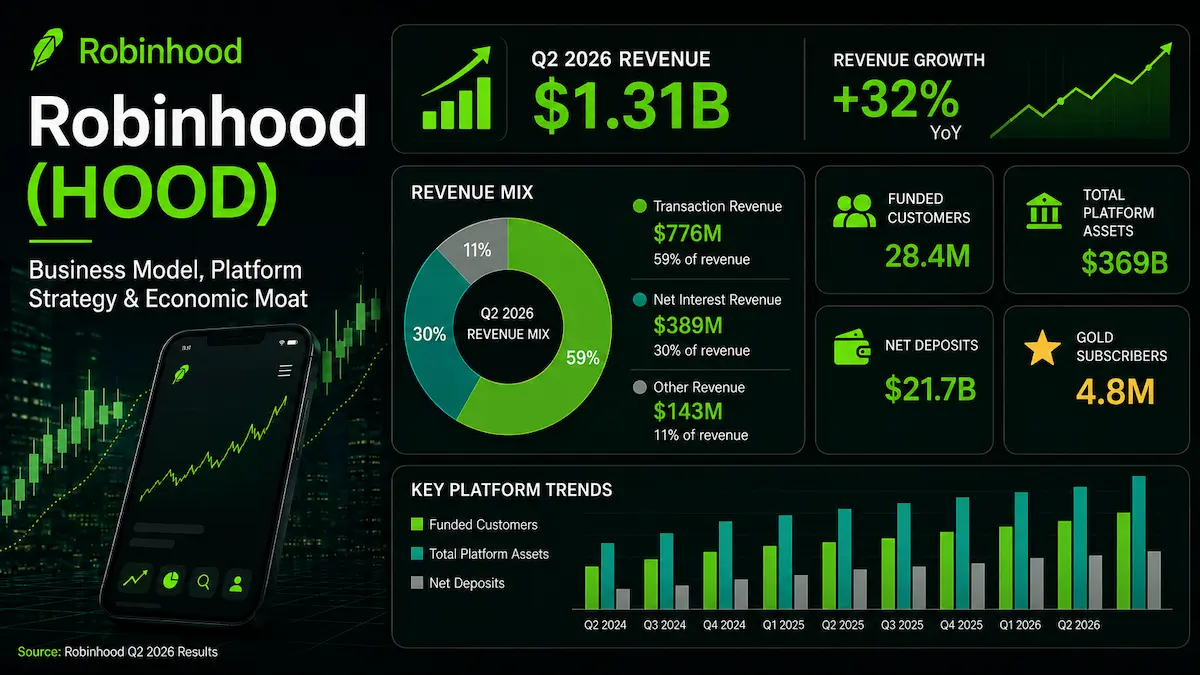
For full-year 2025, Robinhood generated $4.473 billion of net revenue. Transaction-based revenue was $2.628 billion, or roughly 59% of the total; net interest revenue was $1.514 billion, or about 34%; and other revenue was $331 million, or roughly 7%. By Q2 2026, the mix was approximately 59% transaction-based, 30% net interest, and 11% other revenue. The stable transaction share alongside a rising contribution from other services is important: diversification is occurring without requiring the original trading engine to shrink.
Transaction-Based Revenue: Monetizing Financial Activity
Robinhood earns transaction-based revenue across equities, options, cryptocurrencies, event contracts, futures-related activity, instant withdrawals, and other transaction services. For equities and options, a significant portion of revenue comes from routing customer orders to market makers, commonly described as payment for order flow. Crypto monetization includes transaction rebates and other trading economics. Prediction markets generate commissions on event contracts.
In 2025, options were Robinhood’s largest transaction category at $1.123 billion of revenue, followed by cryptocurrencies at $901 million, equities at $302 million, and other transaction-based revenue at $302 million. The 2026 mix is shifting again. In Q2 2026, Robinhood reported $342 million of options revenue, $129 million of equities revenue, $100 million of crypto revenue, and $156 million of event-contract revenue. Event-contract revenue increased more than tenfold year over year, demonstrating how quickly a new product can become economically material when distributed through an existing customer base.
The attraction of this model is operating leverage: once the trading infrastructure, licenses, risk systems, and user distribution are in place, incremental products can monetize engagement without requiring a separate consumer brand. The weakness is cyclicality. Trading revenue is sensitive to market volatility, investor enthusiasm, asset prices, spreads, and regulation. Robinhood explicitly warns that lower trading activity, changes to payment-for-order-flow economics, or restrictions on those practices could reduce profitability.
Net Interest Revenue: Monetizing Balances Rather Than Clicks
The second engine is balance-driven. Robinhood earns net interest revenue from interest-earning corporate and customer cash, margin lending, securities lending, cash sweep arrangements, and credit-card financing economics. This revenue stream matters strategically because it converts customer custody into recurring monetization even when trading activity slows.
Q2 2026 net interest revenue was $389 million, up 9% year over year despite lower short-term rates and softer securities-lending activity. The offset was growth in interest-earning assets. This illustrates the core transmission mechanism: more deposits, more cash, more margin balances, and more financed card receivables can partially compensate for rate compression. Robinhood’s Cash Sweep program also gives the company some ability to manage its spread by adjusting the interest rate passed through to users as partner-bank economics change, subject to competitive and contractual constraints.
This is why Total Platform Assets and Net Deposits are strategically more important than raw account growth. Q2 2026 Total Platform Assets reached $368.7 billion, up 32% year over year, while trailing-12-month Net Deposits were $75.7 billion. A customer who moves from a small trading account to a larger relationship containing retirement assets, uninvested cash, margin balances, advisory assets, and direct-deposit banking is economically more valuable even if trade frequency does not increase.
Gold, Advisory, Banking, Credit, and Services: The Recurring-Revenue Layer
Robinhood Gold is the clearest subscription layer. Gold provides a bundle of premium financial benefits, including enhanced cash yields and retirement incentives, rather than functioning as a pure software subscription. Gold subscription revenue was $54 million in Q2 2026, up 23% year over year, while Gold subscribers reached 4.84 million, up 39%. Management reported an overall Gold adoption rate of roughly 17% and said approximately 40% of new Funded Customers in Q2 signed up for Gold.
The strategic value of Gold exceeds the subscription fee itself. It acts as an economic bundle that can increase asset retention, cash balances, retirement contributions, card usage, and adoption of other products. In other words, Gold is increasingly a loyalty and cross-sell architecture rather than simply a premium feature pack.
Robinhood is also layering in businesses with different revenue mechanics. Robinhood Strategies charges advisory fees on managed portfolios. TradePMR extends the company into RIA custody and advisor distribution. Robinhood Banking generates service-related economics through a partner-bank structure. The Gold Card and other credit products generate lending and card-related economics. Robinhood Ventures adds asset-management fees around private-market exposure. Proxy services, digital-asset listing fees, advertising, and other services contribute additional revenue.
In Q2 2026, Robinhood reported that its credit-card business had surpassed $100 million in annualized revenue, with more than one million Gold Card customers and more than $17 billion of annualized purchase volume. Robinhood Banking had more than $3 billion of deposits from more than 240,000 Funded Customers, with approximately 40% of those customers using direct deposit. Robinhood Strategies had nearly $2 billion of assets under management from more than 300,000 Funded Customers, while TradePMR reached approximately $50 billion of assets under management. These are not yet individually dominant franchises, but together they show the intended architecture: convert one customer relationship into several monetization rails.
The Underlying Profit Logic: Increase Wallet Share, Then Reuse the Stack
The deepest logic of the Robinhood business model is not “free trading.” It is customer acquisition through accessible pricing and product design, followed by progressively broader monetization as the customer’s financial life becomes more embedded in the platform. That creates three potential forms of operating leverage.
- Distribution leverage: a new product can be marketed to tens of millions of existing customers rather than launched from zero.
- Infrastructure leverage: clearing, compliance, risk, identity, payments, custody, data, and support systems can be reused across multiple products.
- Balance-sheet and asset leverage: larger customer balances generate more opportunities for interest, lending, securities lending, advisory fees, and other asset-linked economics.
This model also explains why Robinhood has been willing to spend aggressively on transfer matches and Gold incentives. Those incentives reduce near-term reported revenue, but they can be rational if they import durable customer assets that subsequently generate multiple years of interest, trading, subscription, advisory, and lending economics. The key analytical test is therefore not the size of the incentive, but the lifetime gross profit created by the assets and behaviors it attracts.
2. Deep Dive into Economic Moats
Under a Buffett-style moat framework, Robinhood should not receive credit simply because it has grown quickly, has a recognizable brand, or launches products faster than many incumbents. A real moat must allow the company to sustain attractive economics despite competition. The strongest evidence today sits in two categories: cost advantages and intangible assets. Switching costs are rising but still incomplete, while network effects are localized rather than platform-wide.
Moat 1: Cost Advantages from Vertical Integration and Reusable Distribution
Robinhood operates a self-clearing system for stocks, ETFs, and options, a proprietary order-routing system, a cloud-based data and application architecture, and an integrated front end across mobile and desktop. It is also a licensed introducing broker-dealer, clearing broker-dealer, money transmitter, and futures commission merchant. This matters because the company can internalize more of the operating stack instead of paying third parties for every layer of the customer journey.
The cost advantage is not that Robinhood has uniquely cheap servers. The advantage is that a common regulated and technical infrastructure can support a growing number of products. The incremental economics of adding index options, futures, event contracts, short selling, advisory, banking connectivity, or new international products can therefore be more attractive than building each business as an isolated company.
There is also a distribution cost advantage. Robinhood’s 28.4 million Funded Customers create an installed base to which new products can be cross-sold. Legend surpassed $100 million in annualized revenue roughly 18 months after rollout, while prediction markets and the Gold Card scaled rapidly. That speed is evidence that existing distribution can shorten the revenue ramp of adjacent products.
Competitors can replicate any single feature, but replicating the combination is more expensive. A challenger would need comparable customer reach, regulated entities, clearing and risk infrastructure, engineering capacity, market-maker and banking relationships, and enough product breadth to cross-subsidize aggressive pricing. Large incumbent financial institutions already possess many of those pieces, which is why Robinhood’s cost moat should be viewed as meaningful but not unassailable.
Moat 2: Intangible Assets in Regulatory Architecture and Institutional Permissions
Robinhood’s second defensible advantage is the accumulation of licenses, registrations, operating permissions, and institutional infrastructure across multiple financial regimes. These are intangible assets in the economic sense: they do not guarantee demand, but they can impose time, capital, compliance, and organizational costs on would-be competitors.
The Bitstamp acquisition accelerated this advantage by bringing more than 50 active licenses and registrations across global crypto markets and an established institutional crypto business. WonderFi added regulated Canadian platforms. Robinhood’s European entities operate under MiCA and MiFID-related permissions, its U.K. brokerage is FCA-regulated, and Robinhood Singapore received a capital-markets-services license from the Monetary Authority of Singapore. In the U.S., Robinhood’s Rothera joint venture acquired a CFTC-licensed exchange and clearinghouse platform for prediction markets.
The accounting disclosures make the replacement-cost logic unusually visible. In the MIAXdx acquisition, Robinhood assigned $47 million of identifiable intangible value to licenses and used a replacement-cost method to estimate their fair value. In the WonderFi acquisition, licenses were valued at $21 million. Accounting fair value is not the same thing as economic moat value, but it does illustrate that permissions can carry measurable reconstruction cost.
The limitation is equally important: licenses are not exclusive. Well-capitalized banks, brokers, exchanges, and fintechs can obtain or acquire comparable permissions. The moat emerges only if Robinhood can combine those permissions with superior product iteration and distribution. Regulatory architecture is therefore a barrier to entry, not a guarantee of market power.
Why Switching Costs Are Not Yet a Primary Moat
Robinhood is actively trying to increase switching costs, but investors should distinguish manufactured retention from structural lock-in. Brokerage customers can transfer accounts to other broker-dealers, and Robinhood explicitly discloses this risk. Core holdings such as stocks, ETFs, and cash are portable. Competitors also routinely offer transfer bonuses and can copy pricing features.
Robinhood’s strategy is to make leaving increasingly inconvenient rather than impossible. Retirement and asset-transfer matches can be forfeited if customers do not keep eligible assets on the platform for specified periods. Direct deposit makes banking relationships more habitual. Credit cards, Gold benefits, managed portfolios, multiple investment accounts, retirement balances, and advisory relationships increase the number of financial workflows a customer would need to reconstruct elsewhere.
This is an important emerging advantage, but it should not yet be treated as a high-grade switching-cost moat. The better evidence will be declining churn, sustained Net Deposit growth, deeper Gold penetration, rising direct-deposit usage, and higher product-per-customer ratios over several years.
Why Network Effects Remain Localized
Robinhood’s core brokerage business does not exhibit a classic direct network effect. A stock investor does not receive dramatically more utility simply because another Robinhood customer joins; order execution ultimately connects into broader market infrastructure and liquidity providers. The platform benefits from scale, but scale alone is not a network effect.
Prediction markets and Robinhood Chain could create more genuine liquidity and ecosystem effects. More traders can improve market depth in event contracts, while more developers, applications, token issuers, liquidity providers, and users can make a blockchain ecosystem more useful. Robinhood Chain launched its public mainnet in July 2026 with integrations including Uniswap, Alchemy, BitGo, and Chainlink. Those are early ingredients of an ecosystem, not proof of a durable network moat. The relevant evidence will be sustained on-chain activity, third-party developer adoption, liquidity depth, repeat usage, and economics retained by Robinhood rather than by external protocols.
Can These Moats Support Long-Term Excess Returns?
The answer is potentially, but conditionally. Robinhood’s best path to excess returns is to spread large fixed investments in engineering, compliance, risk, clearing, licenses, and brand across a rapidly expanding base of customer assets and financial products. If customer acquisition costs remain efficient, Net Deposits remain strong, and new products raise ARPU without proportionally raising servicing and risk costs, returns on incremental capital can improve.
The counterargument is that consumer finance is brutally competitive. Robinhood’s own filings acknowledge that competitors have copied commission-free trading, fractional shares, no account minimums, and even retirement incentives. Price competition can transfer economics back to customers, while regulation can compress transaction monetization. The moat is therefore not a static possession. Robinhood must continually convert speed, distribution, and regulatory breadth into customer value faster than competitors can neutralize each individual product advantage.
3. Business Inflection Points & Future Catalysts
The Strategic Inflection Point: From Trading App to Financial Operating System
The most important strategic turning point was not the 2021 IPO itself. It was the period beginning in 2024 and accelerating through 2025, when Robinhood’s corporate identity shifted from a high-engagement retail brokerage toward a multi-product financial platform. The original commission-free wedge had already been copied across the industry. Robinhood therefore needed a second act that could deepen customer economics without depending exclusively on speculative trading cycles.
Financially, 2024 was the first full year in which Robinhood reported positive GAAP net income. Strategically, the company then accelerated product and capability expansion: Legend for active traders, futures and prediction markets, Gold Card, Robinhood Strategies, Robinhood Banking, the TradePMR acquisition, the Bitstamp acquisition, private-market products, and a wider international footprint. By Q2 2026, management said 13 business lines had reached at least $100 million of annualized revenue.
The strategic significance is greater than the product count. Robinhood is attempting to transform customer engagement from episodic trading into continuous financial activity. If successful, that changes the quality of the business: more recurring balances, more diversified fees, more cross-sell, and less dependence on a single market cycle. If unsuccessful, the company risks becoming a complex collection of expensive adjacent products without enough incremental retention or margin benefit.
Catalyst 1: Active-Trader Monetization and Prediction Markets
Robinhood’s first near-term catalyst is greater monetization of sophisticated and high-frequency customers. Legend, index options, futures, short selling, margin, prediction markets, and AI-enabled trading tools broaden the addressable customer set beyond the beginner investor that originally defined the brand.
- Transmission mechanism: more advanced products can raise trade frequency, transaction revenue, margin balances, market-data engagement, and ARPU while smoothing activity across more asset classes and market regimes.
- Observable indicators: options and equities volumes, event-contract revenue, futures activity, Legend annualized revenue, margin balances, ARPU, and active-trader market-share disclosures. Event-contract revenue was already $156 million in Q2 2026, while Legend had surpassed $100 million of annualized revenue.
- Main execution risks: prediction markets face material regulatory and legal uncertainty; transaction businesses remain sensitive to market activity; advanced trading increases risk-management demands; and larger brokers or specialized trading platforms can respond with aggressive pricing and product parity.
The most important point is that prediction markets should not be valued merely as a fast-growing novelty. Their strategic value is that Robinhood is adding another high-engagement transaction rail to an existing brokerage relationship. The downside is that revenue can reverse quickly if regulation, exchange access, customer demand, or competitive economics change.
Catalyst 2: Wallet-Share Expansion Through Gold, Banking, Credit, Retirement, and Advisory
The second catalyst is deeper penetration of each customer’s financial life. This is potentially more important to long-term business quality than trading growth because it can convert Robinhood from an app used during market hours into a platform that receives payroll, holds cash, manages retirement assets, extends credit, and manages portfolios.
- Transmission mechanism: direct deposits and banking increase cash balances; Gold can improve retention and attach premium benefits; credit cards create spending and lending economics; retirement and transfer matches import long-duration assets; Strategies and TradePMR add advisory fees and larger balances. Together these can lift Net Deposits, Total Platform Assets, net interest revenue, other revenue, and customer lifetime value.
- Observable indicators: Gold subscribers and adoption rate, Net Deposits, direct-deposit penetration, banking deposits, card customers and purchase volume, credit receivables and losses, retirement assets, Strategies AUM, TradePMR assets, and the percentage of revenue generated outside transaction-based trading.
- Main execution risks: deposit and transfer incentives can become expensive; credit growth can create higher loss provisions; partner-bank arrangements add operational and regulatory dependencies; advisory carries fiduciary obligations; and customers may resist consolidating their primary financial relationships at a historically trading-led brand.
There is already tangible evidence of adoption. Gold reached 4.84 million subscribers in Q2 2026. Robinhood Banking had more than $3 billion of deposits, the Gold Card exceeded one million customers, and Robinhood Strategies approached $2 billion of assets under management. The key question is not whether these products can acquire users, but whether they create durable incremental gross profit after rewards, incentives, credit losses, servicing, and compliance.
A related distribution catalyst is Robinhood’s role in servicing Trump Accounts, the U.S. federal child-investment account program launched in July 2026. Robinhood disclosed that it will earn service revenue for technology, front-end, education, and support. Management reported more than seven million account sign-ups and nearly $1.5 billion deposited by late July 2026. The opportunity is potentially meaningful because it can create a large, long-duration account base; the risks include implementation complexity, policy changes, economics that prove less attractive than headline account counts, and the need to maintain high service quality at national scale.
Catalyst 3: Global Expansion, Bitstamp, and Tokenized Financial Infrastructure
The third catalyst is the attempt to export Robinhood’s product and distribution model beyond the U.S. while using crypto infrastructure as a bridge into new markets. Bitstamp added international licenses and institutional crypto capabilities. WonderFi accelerated the company’s entry into Canada. Robinhood operates brokerage in the U.K., crypto and tokenized products in Europe, and has secured a capital-markets-services license in Singapore.
The July 2026 launch of Robinhood Chain’s public mainnet extends this strategy from distribution into infrastructure. Robinhood is positioning stock tokens, tokenized real-world assets, DeFi integrations, and international trading as a unified architecture rather than a collection of regional apps.
- Transmission mechanism: international customers expand the addressable market; Bitstamp adds institutional and exchange economics; tokenized assets can increase trading hours, product availability, and cross-border distribution; Robinhood Chain could create infrastructure economics if meaningful third-party liquidity and developer activity develops around it.
- Observable indicators: international Funded Customers, country launches, regulatory approvals, Bitstamp institutional volumes, international revenue, stock-token adoption, assets and transaction activity on Robinhood Chain, third-party integrations, and the cost required to acquire and support customers outside the U.S.
- Main execution risks: financial regulation differs sharply across jurisdictions; tokenized products can face securities, derivatives, custody, disclosure, and market-structure constraints; crypto volumes are volatile; acquisitions add integration risk; and local incumbents can have stronger trust and distribution in individual countries.
This catalyst deserves a lower confidence level than the domestic wallet-share thesis because the economics are less proven. A global license footprint is strategically valuable, but international expansion can destroy value if compliance, localization, and customer acquisition costs outrun monetization. Robinhood Chain is similarly best treated as an option on future financial infrastructure rather than an established moat.
4. Key FAQs
How does Robinhood make money without charging stock commissions?
Robinhood monetizes customer activity and balances through several channels. For equities and options, it earns transaction-based revenue from order routing and related trading economics. It also generates crypto and event-contract transaction revenue, net interest income from cash, margin lending, securities lending and credit-related balances, Gold subscription revenue, advisory fees, banking-related service revenue, card economics, proxy revenue, digital-asset listing fees, and other platform services. In 2025, approximately 59% of revenue was transaction-based, 34% was net interest revenue, and 7% came from other sources. The strategic direction is to increase the recurring and balance-based portion without sacrificing trading engagement.
Does Robinhood have an economic moat compared with traditional brokers?
Robinhood has an emerging moat, but it is narrower than the company’s growth rate might imply. The strongest elements are its vertically integrated digital brokerage infrastructure, self-clearing capabilities, reusable consumer distribution, and expanding portfolio of regulatory licenses. Its original features such as zero commissions and fractional trading are not durable moats because competitors copied them. Switching costs are still moderate because brokerage assets are portable. The moat becomes stronger only if customers consolidate more assets, direct deposits, retirement balances, advisory relationships, banking, and credit activity on the platform.
Is Robinhood becoming more than a brokerage platform?
Yes, and that transition is now economically visible. Robinhood remains a trading-led company, but it also operates or distributes subscription, credit-card, banking, retirement, advisory, RIA custody, crypto exchange, prediction-market, private-market, and international products. The practical test is whether those products increase customer lifetime value and reduce reliance on transaction cycles. Rising Net Deposits, Gold penetration, banking deposits, card spending, advisory AUM, and non-transaction revenue would confirm the transition. If those metrics stall while operating complexity rises, the platform thesis would weaken.
5. Conclusion
Robinhood’s corporate gene is best described as consumer financial distribution built on product design, low-friction pricing, and increasingly integrated regulated infrastructure. The company disrupted brokerage by making investing easier to start; its second act is to make the relationship harder to outgrow. That is why the strategic center of gravity has moved from “commission-free trading” toward active traders, wallet share, and a global financial ecosystem.
The most defensible moat today is the combination of vertical integration and regulatory breadth. Robinhood can reuse clearing, risk, compliance, data, customer identity, and distribution across a growing number of products, while acquisitions such as Bitstamp, TradePMR, and WonderFi accelerate entry into markets that would otherwise require years of capability-building. This can create favorable incremental economics, but it remains a moat that must be continuously reinforced through execution.
The principal risk is that Robinhood’s most visible innovations are often replicable. Competitors can cut prices, add transfer bonuses, introduce fractional trading, launch premium subscriptions, and improve mobile interfaces. The long-term quality of the business therefore depends less on whether Robinhood launches the next feature first and more on whether it can convert speed into deeper assets, higher recurring revenue, stronger retention, and better unit economics before competitors commoditize that feature.
For corporate research purposes, the most important indicators over the next several quarters are Net Deposit growth, Total Platform Assets, ARPU, Gold adoption, non-transaction revenue growth, credit-loss trends, advisory and banking penetration, active-trader monetization, and international unit economics. Those metrics will show whether Robinhood is becoming a compounding financial platform or simply a broader transaction marketplace.
Primary Sources
- U.S. Securities and Exchange Commission — Robinhood Markets Form 10-Q for the quarter ended June 30, 2026
- U.S. Securities and Exchange Commission — Robinhood Q2 2026 Earnings Release, Exhibit 99.1
- U.S. Securities and Exchange Commission — Robinhood Markets 2025 Form 10-K/A
- U.S. Securities and Exchange Commission — Robinhood Markets 2021 Form S-1
- Robinhood Newsroom — Robinhood Completes Acquisition of Bitstamp
- Robinhood Newsroom — Robinhood Enters Canada as It Completes Acquisition of WonderFi
- Robinhood Newsroom — Introducing Robinhood Strategies, Robinhood Banking, and Robinhood Cortex
- Robinhood Newsroom — Robinhood Chain Mainnet, Stock Tokens, Agentic Trading, and Global Expansion
Disclaimer: This article is intended solely for business logic discussion and corporate research purposes, and does not constitute investment advice of any kind.