

Key Takeaways
- IREN is undergoing a business-model rewrite from Bitcoin-led monetization toward contracted AI Cloud services. Bitcoin mining still represented most revenue in the latest reported quarter ended March 31, 2026, but management has explicitly designated AI Cloud Services as the strategic growth engine and has begun repurposing mining infrastructure for GPUs.
- The company’s most defensible potential moat is not brand or network effects. It is the combination of scarce grid-connected power, owned data-center infrastructure, in-house development capability and control over the compute layer. That stack can compress time-to-power and reduce dependence on third-party landlords, hosts and developers.
- Commercial validation has accelerated materially. IREN has a five-year Microsoft agreement valued at approximately $9.7 billion, a five-year NVIDIA cloud-services agreement valued at approximately $3.4 billion, and additional multi-year AI customer contracts. On August 13, 2026, Microsoft accepted Horizon 1, the first 50MW IT-load tranche of the four Horizon deployments.
- IREN’s platform strategy is moving upward from infrastructure into software. The Mirantis acquisition adds cloud software, orchestration and services, while the Nostrum Group acquisition adds European data-center development capability and approximately 490MW of secured grid-connected power in Spain.
- The principal risks are equally structural: enormous capital intensity, GPU obsolescence, hyperscaler and AI-customer concentration, delivery and acceptance risk, power-price exposure, potential cloud-capacity oversupply, and financing or dilution if expansion outpaces internally generated cash flow.
1. Business Model Breakdown
IREN’s corporate history is best understood as a progression in how the company monetizes access to electricity and compute infrastructure. The business was incorporated in Australia in 2018 as Iris Energy, went public in the United States in 2021, began operating AI Cloud Services in February 2024, adopted the IREN business name in 2024, and later changed its legal name to IREN Limited. The more important evolution, however, is economic rather than cosmetic: the company has moved from using owned power and data centers primarily to mine Bitcoin toward using the same infrastructure base to host high-value GPU clusters for AI training and inference.
Legacy Engine: Bitcoin Mining as Power Monetization
Historically, IREN monetized its infrastructure by owning Bitcoin-mining ASICs, operating those machines in company-controlled data centers, contributing hash calculations to mining pools, receiving Bitcoin as consideration, and generally converting mined Bitcoin into fiat currency rather than holding a material Bitcoin treasury. The model is operationally straightforward but economically volatile. Revenue depends heavily on the Bitcoin price, global network hashrate, block economics, machine efficiency and electricity cost.
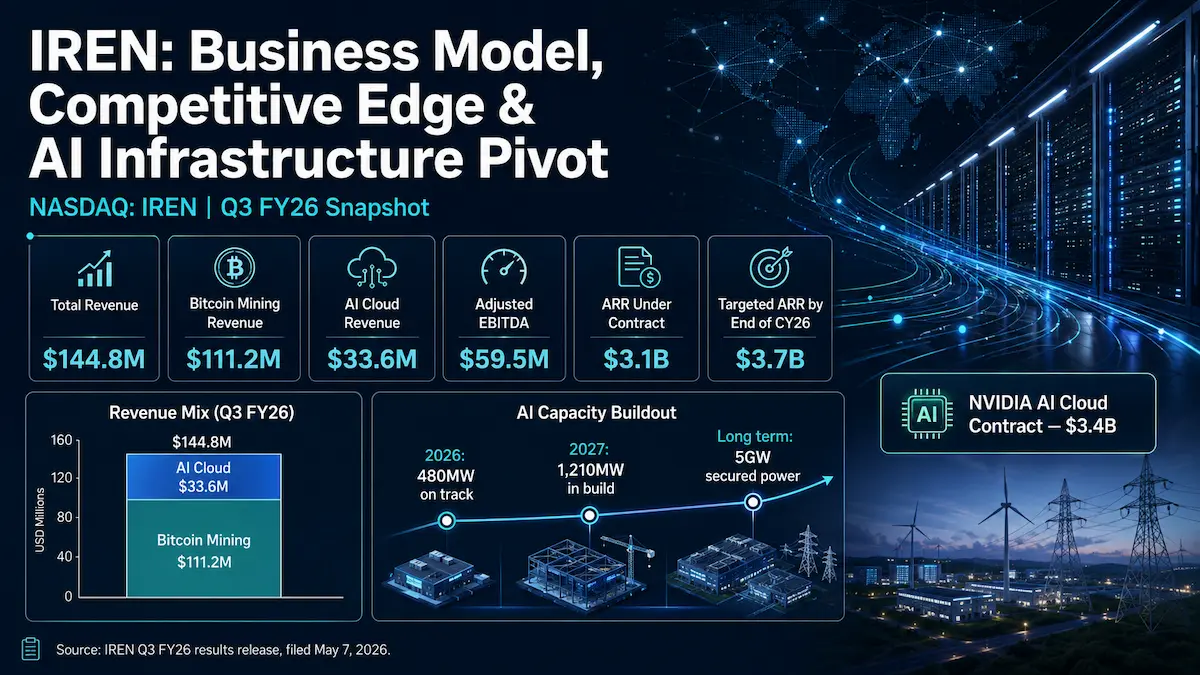
That legacy engine remained financially important in the latest reported quarter. For the three months ended March 31, 2026, IREN reported $111.2 million of Bitcoin Mining revenue and $33.6 million of AI Cloud Services revenue, for total revenue of $144.8 million. Over the nine months ended March 31, 2026, Bitcoin Mining generated $511.5 million versus $58.3 million from AI Cloud Services. In other words, the income statement had not yet caught up with the strategic narrative. The forward business mix is being rebuilt faster than the trailing revenue mix.
Strategic Engine: Contracted GPU Infrastructure and AI Cloud Services
The AI Cloud model is structurally different. IREN procures GPU systems and ancillary networking equipment, installs them inside its data centers, and sells remote access to compute for AI training and inference. Reported AI Cloud revenue can include infrastructure access, computational power, storage and support. Contract revenue is generally recognized over the enforceable service term as access is provided, while usage-based services are recognized as consumed.
The economic objective is to convert a large fixed-cost asset base into high-utilization, contracted compute revenue. The key revenue variables are GPU model, contracted price, utilization, contract duration, storage and ancillary services, and customer mix. The key cost variables are electricity, operating labor, networking, maintenance, depreciation, financing costs and the pace at which each GPU generation becomes economically obsolete. This distinction is critical: a very high direct contribution margin before depreciation does not necessarily imply an equally attractive economic return once the cost and replacement cycle of GPU hardware are included.
IREN’s largest disclosed AI contracts substantially improve revenue visibility relative to Bitcoin mining. The Microsoft agreement has an approximate total contract value of $9.7 billion over an average five-year term and covers four Horizon tranches with a combined IT load of approximately 200MW. The agreement includes a 20% prepayment on the contract value of each applicable tranche before delivery. Separately, IREN entered into a five-year NVIDIA cloud-services agreement with approximately $3.4 billion of total contract value, with three tranches targeted for deployment during 2027.
By July 20, 2026, IREN said it had signed an additional $2.8 billion of multi-year contracts with leading AI developers, had increased its year-end 2026 AI Cloud annualized run-rate revenue target to more than $4 billion, and had approximately 85% of that target under contract. The company also said contracts executed since June 1 included customer prepayments equal to roughly 45% of the estimated GPU capital expenditure associated with those deployments. That matters because customer prepayments reduce the amount of capital IREN itself must fund before revenue begins. It also partially shifts deployment risk from a speculative build model toward a customer-backed infrastructure model.
Investors should not confuse annualized run-rate revenue with recognized GAAP revenue. IREN defines the metric using GPU-hour pricing for commissioned GPUs multiplied by annual hours, plus annualized storage and ancillary revenue. The number therefore depends on commissioning, acceptance, utilization and pricing assumptions and can materially differ from GAAP revenue in any reporting period.
Platform Strategy: From Power to Data Centers to Compute to Software
The most important strategic shift is that IREN is attempting to own more of the AI infrastructure stack rather than compete as a single-layer provider. At the physical layer, it secures land, grid interconnections, substations and data centers. At the compute layer, it deploys and operates GPU clusters. At the service layer, it sells bare-metal and managed cloud capacity. Following the August 2026 closing of the Mirantis acquisition, IREN also owns cloud software and services capabilities that can support orchestration, cluster management and enterprise operations.
This architecture matters because AI infrastructure is a coordination problem as much as a hardware problem. A provider that controls power, construction, cooling, networking, GPU deployment and software can potentially eliminate handoffs between utilities, developers, data-center landlords, hosting providers and cloud operators. If executed well, that can reduce schedule risk, improve asset utilization and make customer deployments harder to displace. If executed poorly, the same vertical integration simply concentrates capital requirements and operating complexity on IREN’s balance sheet.
The Nostrum Group transaction extends that model geographically. IREN’s acquisition of the Spanish data-center developer added approximately 490MW of secured, grid-connected power in Spain and an additional development pipeline, while also bringing a local team across development, engineering, construction and operations. Strategically, this is not just geographic diversification; it is an attempt to replicate IREN’s power-to-compute playbook in another region where customers may value local or sovereign AI capacity.
2. Deep Dive into Economic Moats
Under a Buffett-style moat framework, IREN should not receive credit simply for rapid growth, large contracts, a rising GPU count or association with well-known technology companies. Those are evidence of demand and execution, not by themselves durable competitive advantages. The relevant question is whether competitors must incur structurally higher costs, accept worse economics, wait materially longer, or overcome meaningful customer friction to replicate IREN’s position.
Moat 1: Cost Advantage and Time-to-Power Scarcity
IREN’s strongest potential moat is a supply-side cost and speed advantage built around grid-connected power and vertically integrated development. Large-scale AI infrastructure is constrained not only by GPU availability but by energized land, transmission capacity, substations, cooling systems, fiber connectivity, permitting and construction expertise. IREN owns and operates much of this stack rather than relying entirely on third-party hosting.
The company’s current infrastructure position includes a 750MW Childress campus in Texas, a 2GW Sweetwater campus that NVIDIA and IREN have identified as a future flagship for NVIDIA DSX-aligned infrastructure, and a broader global power portfolio that the companies describe as supporting deployment of up to 5GW over time. These assets do not automatically guarantee low unit costs, but they give IREN something competitors cannot reproduce with a GPU purchase order alone: a pipeline of power and sites that has already progressed through material development and interconnection work.
The replication cost for a competitor is therefore measured in both capital and calendar time. A rival needs to secure suitable land, obtain interconnection rights, fund substations and transmission work, procure cooling and networking systems, establish fiber diversity, construct the facility, pass customer acceptance testing, and then prove operating reliability. In markets where power queues and construction resources are constrained, time itself becomes an economic asset. A provider able to bring a megawatt of AI-ready capacity online earlier can capture scarce demand before a later entrant competes on price.
IREN’s ownership model may also reduce economic leakage. The 2025 Form 10-K states that the company owns computing hardware, electrical infrastructure, proprietary data centers and freehold land, which gives it more operational control than a model built entirely on third-party hosting or short-term leases. The company can also participate in demand-response programs and has used power hedges to reduce electricity-price variability for the Microsoft deployment. These are useful cost-management tools, though they should not be interpreted as proof that IREN is the industry’s lowest-cost AI cloud provider.
The durability of this moat depends on continued scarcity. If utilities accelerate interconnections, capital floods into new data centers, and AI demand becomes overbuilt, the value of early power access could compress. Conversely, if grid bottlenecks remain acute, IREN’s pre-secured power portfolio can become more valuable precisely because it is difficult to reproduce quickly.
Moat 2: Contracted Switching Costs and Operational Qualification
IREN’s second defensible advantage is moderate switching cost created by dedicated, multi-year GPU deployments and customer qualification. A hyperscaler or AI developer does not evaluate a large GPU cluster solely on headline price. It must underwrite performance, uptime, networking, storage, security, cooling reliability, support, data movement and the provider’s ability to deliver expansion on schedule. Once a dedicated cluster is accepted and integrated into production workflows, moving equivalent workloads to another provider can require requalification, data migration, software changes and operational revalidation.
The August 13, 2026 acceptance of Horizon 1 by Microsoft is important in this context. It is not merely a construction milestone. It is third-party evidence that IREN can take a 50MW IT-load, direct-to-chip liquid-cooled deployment through delivery and customer acceptance. NVIDIA’s Exemplar Cloud designation on IREN’s GB300 NVL72 deployment adds another layer of external technical validation focused on AI workload performance, security and reliability.
Still, switching costs should not be overstated. AI customers can multi-source capacity, redirect incremental workloads to another provider, or change vendors at renewal. Contractual duration creates revenue visibility, but it is not the same as permanent customer captivity. IREN’s switching-cost moat becomes stronger only if software, orchestration, managed services and operational tooling make the platform more deeply embedded in customer workflows.
What Is Not Yet a Proven Moat
Intangible assets are supportive but not decisive. The Microsoft relationship, NVIDIA partnership and Exemplar Cloud status enhance credibility, yet they are not exclusive licenses that prevent peers from winning similar customers or certifications. They function more like trust accelerators than monopoly rights.
Network effects are currently weak. More IREN customers do not automatically make the service materially more valuable to every other customer in the way a marketplace, payment network or social platform compounds with each participant. Mirantis may help create software ecosystem effects over time, but that case has not yet been demonstrated in IREN’s reported economics.
The moat conclusion is therefore conditional. IREN appears to possess a potentially durable advantage in power access, infrastructure control and deployment speed, reinforced by moderate customer switching costs. Whether that advantage produces long-term excess returns will depend on disciplined capital allocation, utilization, contract pricing and hardware lifecycle management. Asset scale only creates a moat if the return on those assets remains above the cost of capital after depreciation and financing.
3. Business Inflection Points & Future Catalysts
The Defining Inflection Point: From Bitcoin Optionality to Bankable AI Contracts
The decisive strategic turning point was not the 2024 rebrand. It was the transition from a Bitcoin-first infrastructure model to a customer-backed AI Cloud model, crystallized by the November 2025 Microsoft agreement and accelerated in 2026. The $9.7 billion Microsoft contract changed the economic use case for IREN’s power portfolio: instead of monetizing megawatts primarily through volatile Bitcoin block economics, IREN could underwrite multi-year GPU infrastructure against a large enterprise counterparty and use contracted cash flows to support financing.
That pivot became explicit in May 2026, when IREN announced a strategic initiative to transition its remaining Bitcoin mining operations toward AI Cloud Services, including repurposing certain air-cooled data centers at Childress and developing additional liquid-cooled Horizon facilities. The same month, IREN signed the approximately $3.4 billion NVIDIA cloud-services agreement and a broader strategic partnership aimed at supporting up to 5GW of NVIDIA DSX-aligned AI infrastructure. The subsequent Microsoft acceptance of Horizon 1 in August provided the first visible proof that the strategy could move from contract signing to delivered production infrastructure.
Catalyst 1: Horizon 2-4 Acceptance and the 2026 Ramp Toward 480MW
The near-term catalyst is conversion of contracted and under-construction capacity into accepted, revenue-generating AI Cloud infrastructure. IREN has targeted 480MW of gross AI Cloud capacity in 2026. Horizon 1 is now accepted; Horizons 2-4 remain the most important proof points for the remainder of the year.
The transmission mechanism is straightforward. Each delivered and accepted tranche moves capital from construction work-in-progress into productive infrastructure, activates contractual service obligations, expands recognized AI Cloud revenue and increases the portion of IREN’s economics that is based on contracted compute rather than Bitcoin volatility. Successful delivery can also improve supplier and customer confidence, potentially lowering the perceived execution risk of later projects.
Observable indicators include accepted IT load, commissioned GPU counts, AI Cloud revenue, remaining performance obligations, utilization, service-level performance, customer prepayments and capital expenditure per deployed megawatt. The major execution risks are construction or cooling delays, GPU shipment timing, customer acceptance failures, power or network interruptions, cost overruns and the possibility that financing closes later or at a higher cost than planned.
Catalyst 2: 2027 Expansion Toward 1.2GW and NVIDIA-Backed Scale
The second catalyst is the planned 2027 expansion to approximately 1.2GW of gross AI Cloud capacity, including NVIDIA-related deployments and further development at Childress and Sweetwater. If IREN can move from hundreds of megawatts to gigawatt-scale cloud infrastructure while preserving contract quality, the company’s earnings profile could change far more dramatically than its historical Bitcoin growth ever allowed.
The mechanism is a combination of scale, contract duration and asset reuse. The NVIDIA cloud-services agreement is targeted to deploy in three tranches during 2027. The broader NVIDIA partnership also links IREN’s power pipeline to NVIDIA DSX architecture, potentially improving the company’s ability to win customers that want current-generation NVIDIA infrastructure with validated deployment standards. At the same time, repurposing selected Bitcoin facilities can shorten lead times because some electrical and site infrastructure already exists.
Investors should monitor the percentage of targeted ARR that is actually under signed contract, delivered megawatts, GPU mix, customer prepayment levels, contract duration, realized pricing, utilization and AI Cloud operating margins after depreciation. The principal risk is that industry supply expands faster than AI compute demand, pressuring GPU-hour pricing before IREN earns an adequate return on newly purchased hardware. GPU obsolescence is another critical risk: newer accelerators can make older fleets less desirable well before the physical equipment fails.
Catalyst 3: Mirantis Integration and the Shift from Infrastructure Vendor to AI Platform
The Mirantis acquisition is strategically important because it addresses a weakness in an infrastructure-heavy business model: commodity risk. Power and GPUs are valuable, but if customers perceive every provider as interchangeable, returns eventually gravitate toward the cost of capital. Software, orchestration, support and enterprise operational tooling can increase wallet share and make the service layer less substitutable.
The intended mechanism is to combine IREN’s physical infrastructure with Mirantis cloud software and services so customers can consume not just raw GPU capacity but a more complete managed environment. If successful, IREN may be able to serve enterprises that value deployment automation, Kubernetes expertise, governance and support rather than simply renting bare-metal GPUs. That could broaden the addressable customer base and potentially deepen switching costs.
Observable indicators include growth in managed-cloud customers, the mix of managed versus bare-metal services, customer retention, utilization across the GPU fleet, expansion of storage and ancillary revenue, evidence of cross-selling into Mirantis relationships, and whether software-related value improves margins or contract duration. The risk is integration complexity. IREN is simultaneously building data centers, financing GPUs, migrating away from Bitcoin mining, integrating Mirantis and expanding internationally through Nostrum. A broader platform creates more optionality, but it also creates more ways for execution to fragment.
Capital Structure as Both Enabler and Constraint
Funding capacity will materially influence whether these catalysts translate into shareholder economics. On July 20, 2026, IREN reported preliminary unaudited cash and cash equivalents of approximately $7.6 billion as of June 30, including approximately $1.7 billion of restricted cash tied to GPU financing for the Microsoft contract. Customer prepayments and contract-backed financing can reduce the equity burden of expansion, but the overall program remains extremely capital intensive.
IREN has used convertible debt, equity issuance, equipment financing and customer prepayments to fund growth. NVIDIA also holds rights that can result in the purchase of up to 30 million IREN shares at $70 per share if specified conditions are met. These mechanisms can provide strategic capital, but they also mean that investors must evaluate enterprise growth alongside interest expense, share-count expansion and the possibility that financing conditions deteriorate before projects reach steady-state cash generation.
4. Key FAQs
How does the IREN business model make money from AI cloud services compared with Bitcoin mining?
Bitcoin mining monetizes electricity and ASIC hardware through block rewards and transaction fees, creating revenue that is highly sensitive to Bitcoin price, network difficulty and energy cost. AI Cloud Services monetize electricity, data centers, GPUs, networking, storage and support through customer contracts. The AI model can offer longer-duration revenue visibility and customer prepayments, but it requires much larger upfront GPU investment and carries hardware-obsolescence and customer-concentration risk. IREN is strategically shifting toward the second model because contracted AI infrastructure can produce a more underwritable cash-flow stream than Bitcoin mining if utilization and pricing remain strong.
Why is IREN moving from Bitcoin mining to AI cloud infrastructure?
The strategic logic is to redeploy scarce power toward workloads with potentially higher and more contractable economic value. IREN already controlled large electrical and data-center assets from Bitcoin mining, so AI Cloud offers a way to reuse that infrastructure while adding GPUs, liquid cooling, networking and software. The Microsoft and NVIDIA contracts demonstrate that large customers are willing to commit to multi-year capacity. The trade-off is that AI requires substantially more capital per megawatt and exposes IREN to GPU technology cycles, service-level commitments and enterprise delivery risk.
Does IREN have a sustainable competitive moat versus other AI cloud providers?
IREN has the beginnings of a moat, but it is not yet proven to be permanent. Its strongest advantage is access to grid-connected power combined with ownership and control across land, substations, data centers, cooling and GPU operations. Competitors can buy GPUs, but reproducing energized sites and operating large clusters can require years of development and significant capital. IREN also benefits from multi-year customer contracts and third-party validation from Microsoft acceptance and NVIDIA Exemplar Cloud status. However, network effects are weak, customers can multi-source, and competing providers can build similar capabilities. The moat will be proven only if IREN consistently converts infrastructure scarcity into high utilization and attractive returns on invested capital after depreciation and financing costs.
5. Conclusion
IREN’s corporate gene is infrastructure-first capital allocation. The company secures power, develops and owns physical infrastructure, installs compute, and then seeks the highest-value monetization path for that power. Bitcoin mining was the original application of that model; AI Cloud is now the strategic destination. Seen through that lens, the company is less a former crypto miner trying to become a technology company than a power-and-data-center operator attempting to move progressively upward into compute and software.
The most credible moat is therefore on the supply side: grid-connected power, site development, construction execution and end-to-end control. Microsoft’s Horizon 1 acceptance, NVIDIA’s strategic partnership and Exemplar Cloud designation provide important validation that this infrastructure can meet enterprise AI requirements. Mirantis is an attempt to deepen the moat by adding software and managed-service capabilities, while Nostrum extends the development playbook into Europe.
The central question over the next two years is not whether IREN can announce more megawatts or GPUs. It is whether the company can convert its contracted pipeline into recognized revenue and durable free cash flow at returns that exceed the cost of capital after depreciation, interest, customer concentration and dilution are properly accounted for. If it can, the shift from volatile Bitcoin monetization to contracted AI infrastructure would represent a genuine improvement in business quality. If industry capacity becomes commoditized or execution slips, the same vertical integration that creates strategic control could magnify capital risk.
Primary and Official Sources
- U.S. Securities and Exchange Commission — Iris Energy 2021 Registration Statement on Form F-1
- U.S. Securities and Exchange Commission — IREN 2025 Annual Report on Form 10-K
- U.S. Securities and Exchange Commission — IREN Quarterly Report for the Quarter Ended March 31, 2026
- U.S. Securities and Exchange Commission — IREN Quarterly Report Detailing the Microsoft Agreement
- IREN — July 20, 2026 Customer Contracts and AI Cloud ARR Update
- IREN — August 13, 2026 Horizon 1 Delivery and Microsoft Acceptance Announcement
- NVIDIA Newsroom — NVIDIA and IREN Strategic Partnership for Up to 5GW of AI Infrastructure
- NVIDIA — Exemplar Cloud Program and Provider Validation
- U.S. Securities and Exchange Commission — IREN Current Report on Form 8-K for the Mirantis Acquisition Closing
- IREN — Nostrum Group Acquisition and European Expansion Announcement
Disclaimer: This article is intended solely for business logic discussion and corporate research purposes, and does not constitute investment advice of any kind.