

Key Takeaways
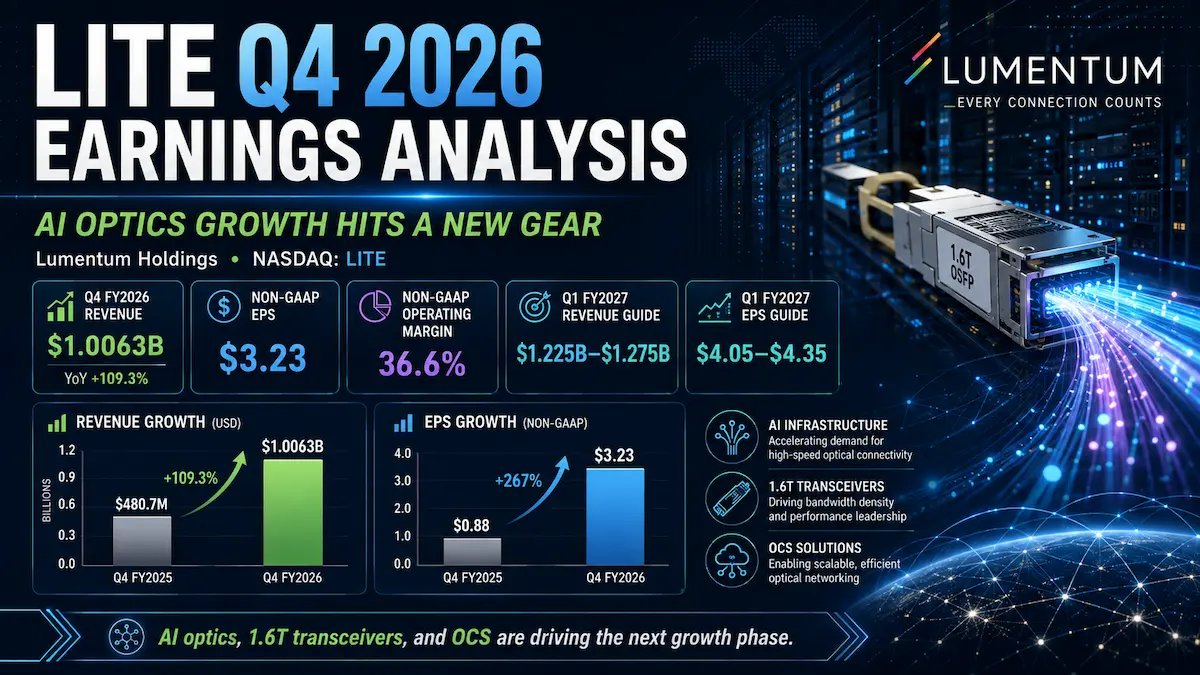
- Lumentum delivered fiscal Q4 2026 revenue of $1.0063 billion, up 109.3% year over year and 24.5% sequentially, while non-GAAP EPS reached $3.23 and non-GAAP operating margin expanded to 36.6%.
- The quality of the beat was stronger in profitability than in revenue: revenue exceeded the FactSet consensus by about 1.9%, while EPS beat consensus by about 8.8% and operating margin finished 60 basis points above the high end of management’s prior guidance.
- Q1 FY2027 guidance raised the earnings trajectory again, with revenue of $1.225 billion to $1.275 billion, non-GAAP operating margin of 39.5% to 40.5%, and non-GAAP EPS of $4.05 to $4.35.
- The earnings call shifted the debate from whether AI optics demand is real to how quickly Lumentum can supply it: 1.6T transceivers, OCS, EMLs, CW lasers, pump lasers, CPO and NPO are all contributing to a wider addressable market.
- At the August 14, 2026 closing price of $926.14, the stock already discounts substantial execution. The next leg of upside requires continued product ramps and margin delivery, while supply constraints, dilution and a premium valuation remain the main risks.
1. Core Earnings Breakdown
Revenue and Profitability Analysis
Lumentum Holdings closed fiscal 2026 with its strongest quarterly financial profile to date. Fiscal Q4 revenue was $1.0063 billion, up 109.3% from $480.7 million a year earlier and up 24.5% from $808.4 million in fiscal Q3. Non-GAAP gross margin reached 50.4%, compared with 37.8% a year ago, while non-GAAP operating margin expanded to 36.6% from 15.0%. Non-GAAP diluted EPS increased to $3.23 from $0.88.
The headline GAAP result requires special care. Lumentum reported a GAAP net loss of $7.2 billion, or $84.65 per diluted share, but that loss was driven by a one-time, non-cash $7.8 billion loss on debt extinguishment tied to the equitization of convertible notes. Management said the transaction reduced debt by approximately $1.1 billion, or about 35% of outstanding convertible debt. That means the GAAP loss does not represent a collapse in operating economics, although the related expansion in the equity share base is economically relevant for per-share valuation.
- Components revenue was $649.4 million, representing 64.5% of company revenue, up 102.7% year over year and 21.8% sequentially. The investment significance is that the fastest-growing mix is increasingly concentrated in higher-value optical components such as EMLs, CW lasers, narrow-linewidth lasers, pump lasers and ultra-high-power lasers, where Lumentum is demonstrating pricing power and where product scarcity can support structurally stronger margins.
- Systems revenue was $356.9 million, representing 35.5% of company revenue, up 122.6% year over year and 29.7% sequentially. The more important point is that systems are no longer merely a diversification leg: the transition from 800G to 1.6T transceivers and the ramp of optical circuit switches are becoming material contributors to quarterly growth and can deepen Lumentum’s strategic position with hyperscale customers.
Within components, management highlighted record 100G and 200G EML shipments, with 200G EMLs contributing more than 25% of total EML revenue. Narrow-linewidth lasers posted a tenth consecutive quarter of sequential growth and increased more than 130% year over year. Pump lasers grew 80% year over year, and Lumentum said it continues to expect a roughly fourfold increase in pump-laser shipments over the next several quarters. Ultra-high-power laser shipments for CPO also increased, with management expecting meaningful revenue as calendar 2026 exits.
Within systems, Lumentum posted record cloud transceiver shipments and began shipping 1.6T transceivers, with some modules using internally sourced CW lasers. OCS shipments doubled sequentially, and management expects Q1 FY2027 to be the first quarter with OCS revenue meaningfully above $100 million. This matters because it moves OCS from a future-optionality narrative into a measurable revenue contributor.
Expectations vs. Actual Results
Street consensus figures referenced below are FactSet estimates reported by financial media. For operating margin, a consistently published Street consensus was not identified in the sources reviewed, so the cleanest verified benchmark is management’s prior Q4 guidance of 35.0% to 36.0%.
- Revenue: $1.0063 billion actual versus approximately $987.7 million FactSet consensus. Result: ✅ Beat by about $18.6 million, or 1.9%.
- Non-GAAP diluted EPS: $3.23 actual versus $2.97 consensus. Result: ✅ Beat by $0.26, or about 8.8%.
- Non-GAAP operating margin: 36.6% actual versus management’s prior 35.0% to 36.0% guidance. Result: ✅ Beat the high end by 60 basis points.
- Q1 FY2027 revenue guidance: $1.225 billion to $1.275 billion, midpoint $1.25 billion, versus approximately $1.157 billion prior Street consensus. The midpoint is about 8.0% above that consensus.
- Q1 FY2027 non-GAAP EPS guidance: $4.05 to $4.35, midpoint $4.20, versus approximately $3.61 prior Street consensus. The midpoint is about 16.3% above that consensus.
- Q1 FY2027 non-GAAP operating margin guidance: 39.5% to 40.5%, which implies another 290 to 390 basis points of sequential expansion from Q4.
The true source of the upside was not a massive revenue surprise. Revenue was only modestly ahead of consensus and finished near the top of management’s prior range. The larger surprise came from gross margin, operating leverage and earnings conversion. Management attributed the 50.4% non-GAAP gross margin to better manufacturing utilization, favorable mix and selective pricing. Non-GAAP operating expenses rose only 26.3% year over year while revenue grew 109.3%, allowing a much larger share of incremental gross profit to reach operating income.
For investors, the market is now more likely to care about product mix, margin durability, forward guidance and the timing of 1.6T, OCS, NPO and CPO ramps than about a one-quarter revenue beat. The strongest evidence is Q1 guidance: the revenue midpoint implies another 24.2% sequential increase from Q4, while the EPS midpoint implies roughly 30.0% sequential growth. That combination says management expects the next layer of revenue to remain highly accretive rather than simply buying growth with higher operating expense.
The stock reaction also became more constructive after investors had time to process the call. LITE rose only about 2% in immediate after-hours trading, despite the headline beat. On August 12, shares then closed up 13.63% at $932.47, fell 5.58% on August 13, and rebounded 5.19% on August 14 to $926.14. Relative to the August 11 pre-earnings close of $820.59, the stock finished the week about 12.9% higher. That pattern suggests the call’s pipeline and margin commentary mattered more than the initial headline numbers; this was not a classic “sell the news” outcome.
Earnings Call Highlights
Management said Lumentum is reaching its $1.25 billion quarterly revenue target more than one quarter earlier than planned, while Q1 FY2027 operating-margin guidance already exceeds the upper end of the model previously associated with that revenue level.
💡 Reading Between the Lines: The debate has shifted from whether Lumentum can reach its prior medium-term model to how much that model must be raised. If the company can sustain gross-margin expansion as revenue scales, consensus earnings revisions may continue to outpace revenue revisions.
Management said the lead CPO customer’s production plan remains on track, its demand signal has increased, and Lumentum has received its first external light source module order for delivery in the second half of calendar 2027; NPO engagements are also expanding across multiple customers.
💡 Reading Between the Lines: NPO is not replacing the CPO thesis; management is treating it as an additive bridge that expands optical content before full CPO adoption. That makes Lumentum’s laser opportunity less dependent on a single architecture winning immediately.
Management expects Q1 FY2027 to be Lumentum’s first OCS quarter meaningfully above $100 million and believes it is currently the only merchant supplier with a meaningful shipping track record outside a captive manufacturing relationship.
💡 Reading Between the Lines: OCS is becoming a strategic platform rather than a niche system product. If Lumentum can remain the default merchant supplier while hyperscalers diversify away from internal-only sourcing, OCS can create both revenue concentration risk and an unusually valuable first-mover position.
Management said laser pricing and product mix still have room to support gross margin, noting that customers are willing to pay a premium for CW lasers because tighter performance specifications can improve transceiver manufacturing yields.
💡 Reading Between the Lines: The moat is not simply raw laser output. It is the customer’s total manufacturing economics. If a higher-priced Lumentum laser reduces downstream scrap and improves module yield, pricing power can persist even as new competitors add nominal wafer capacity.
Management said EML shipments remain below customer demand and that the supply gap in ultra-high-power lasers has widened because demand accelerated faster than Lumentum’s capacity ramp.
💡 Reading Between the Lines: This is simultaneously bullish and risky. Unfilled demand supports visibility and pricing, but it also means near-term revenue is supply constrained and gives competitors an incentive to invest aggressively. Capacity execution, substrate availability and customer-funded expansion therefore become core valuation variables.
2. Deep Business Insights
Hidden Metrics That Matter
One of the most important underappreciated metrics is Lumentum’s year-over-year incremental non-GAAP operating margin. Calculated from company-reported figures, the formula is ($368.8 million Q4 FY2026 operating income – $72.3 million Q4 FY2025 operating income) divided by ($1.0063 billion Q4 FY2026 revenue – $480.7 million Q4 FY2025 revenue) = approximately 56.4%. In other words, more than half of the incremental year-over-year revenue translated into incremental non-GAAP operating income. That is unusually powerful operating leverage and helps explain why EPS outperformed the revenue beat.
A second overlooked metric is dilution. Calculated from company-reported figures, non-GAAP diluted shares increased from 72.0 million in Q4 FY2025 to 101.1 million in Q4 FY2026: 101.1 / 72.0 – 1 = approximately 40.4% growth. Management assumes about 102.0 million diluted shares in Q1 FY2027. The company has reduced debt through convertible-note equitization, which improves financial leverage, but shareholders should not ignore the larger denominator in per-share earnings. The positive counterpoint is that non-GAAP EPS still increased 267% year over year despite this materially higher diluted share count.
Why do customers choose Lumentum? The earnings call points to three practical reasons. First, management says its lasers can hold unusually tight specifications, improving transceiver yields for customers and reducing total manufacturing cost. Second, Lumentum spans the stack from laser chips and external light sources to transceivers and OCS, allowing it to participate across scale-out, scale-across and emerging scale-up architectures. Third, its manufacturing know-how and early 1.6T execution can shorten hyperscaler qualification and deployment cycles. In a constrained AI supply chain, reliability, yield and time to volume can matter more than nominal component price.
Industry Chain Reactions
- ✅ Benefit — AXT, Inc. (NASDAQ: AXTI): AXT signed a long-term agreement to reserve indium phosphide substrate capacity for Lumentum through 2031. Lumentum’s call then indicated that ultra-high-power laser demand had accelerated enough to require additional substrate sourcing. If Lumentum’s laser capacity build continues, AXTI has a direct volume and customer-quality read-through rather than merely a thematic AI-optics correlation.
- ❌ Face Pressure — Applied Optoelectronics (NASDAQ: AAOI): AOI is also ramping 1.6T transceivers and high-power optical products, so the overall market can still grow rapidly for both companies. However, Lumentum’s claim that it is frequently first to market in 1.6T, its internally sourced laser content, and its premium-yield positioning raise the competitive bar. The pressure is relative market share, customer qualification speed and pricing power, not necessarily an immediate decline in AAOI revenue.
Valuation Framework and Key Risks
LITE closed at $926.14 on August 14, 2026. A useful way to frame valuation without importing an unverified full-year consensus is to annualize the midpoint of management’s Q1 FY2027 non-GAAP EPS guidance. The calculation is $926.14 divided by ($4.20 × 4) = approximately 55.1 times annualized run-rate non-GAAP EPS. Using the just-reported Q4 EPS instead gives $926.14 divided by ($3.23 × 4) = approximately 71.7 times. These are not standard forward P/E estimates and should not be treated as price targets; they simply show how much the valuation depends on the rapid earnings ramp embedded in current guidance.
The bull case is that the multiple can compress quickly even if the share price remains high, because 1.6T transceivers, OCS, CW lasers, EMLs, pump lasers and later CPO/NPO revenue are arriving in layers while operating margin moves toward and potentially above 40%. Management has already reached gross-margin and operating-margin milestones earlier than its prior target model implied, which supports the argument that future earnings revisions can remain positive.
The bear case is that a 55-times-plus run-rate multiple leaves little tolerance for execution errors. The most important risks are supply constraints in EMLs and high-power lasers; indium phosphide substrate availability; manufacturing-capacity timing in Japan, Rose Orchard, Thailand and Greensboro; customer concentration and hyperscaler program timing; a slower-than-expected 2027-2028 NPO/CPO transition; aggressive capacity expansion by competitors; and dilution from the enlarged share base. The $167 million of Q4 capital expenditure also shows that sustaining growth requires significant manufacturing investment.
Investors should also separate accounting noise from genuine economics. The $7.8 billion debt-extinguishment charge is non-cash and not a proxy for operating weakness, but the conversion of debt into equity changes capital structure and per-share ownership. Likewise, current supply shortages are evidence of demand strength, but shortages only create shareholder value if Lumentum converts them into durable capacity, pricing and customer retention before competitors close the gap.
3. Key FAQs
Did Lumentum beat Q4 2026 earnings expectations?
Yes. Lumentum reported fiscal Q4 2026 revenue of $1.0063 billion versus approximately $987.7 million FactSet consensus and non-GAAP EPS of $3.23 versus $2.97 consensus. Non-GAAP operating margin was 36.6%, 60 basis points above the high end of management’s prior 35.0% to 36.0% guidance. The more important beat was profitability rather than revenue, because favorable mix, utilization, selective pricing and operating leverage drove a much larger EPS surprise.
Why did LITE stock rise after Q4 2026 earnings?
The initial after-hours reaction was modest, but the stock rose sharply in the next regular session as investors absorbed the stronger Q1 FY2027 guidance and the earnings-call pipeline. Management described accelerating 1.6T adoption, the first triple-digit OCS revenue quarter, stronger CPO demand visibility, additive NPO opportunities and continued margin upside. By August 14, LITE had closed at $926.14, about 12.9% above its August 11 pre-earnings close.
What does Lumentum’s Q1 FY2027 guidance imply for LITE valuation?
The midpoint of Q1 FY2027 guidance is $1.25 billion of revenue and $4.20 of non-GAAP EPS, with 39.5% to 40.5% non-GAAP operating margin. At a $926.14 share price, annualizing the $4.20 quarterly EPS midpoint produces a rough run-rate multiple of about 55.1 times. That is a demanding valuation, but it is materially lower than the roughly 71.7-times multiple produced by annualizing Q4 EPS because management is guiding to another step-up in earnings. The investment question is therefore whether the product ramps and margin structure can sustain that earnings velocity beyond Q1.
Sources: Lumentum’s official Q4 FY2026 earnings release, official Investor Relations quarterly results and webcast materials, and the third-party earnings call transcript used to cross-check management commentary. Lumentum’s official IR site provides the webcast and presentation but does not provide a machine-readable official transcript.
Disclaimer: This article/chart is for educational and informational purposes only and does not constitute investment advice of any kind. Past performance is not indicative of future results. Investors should independently evaluate their own risks.