

Key Takeaways
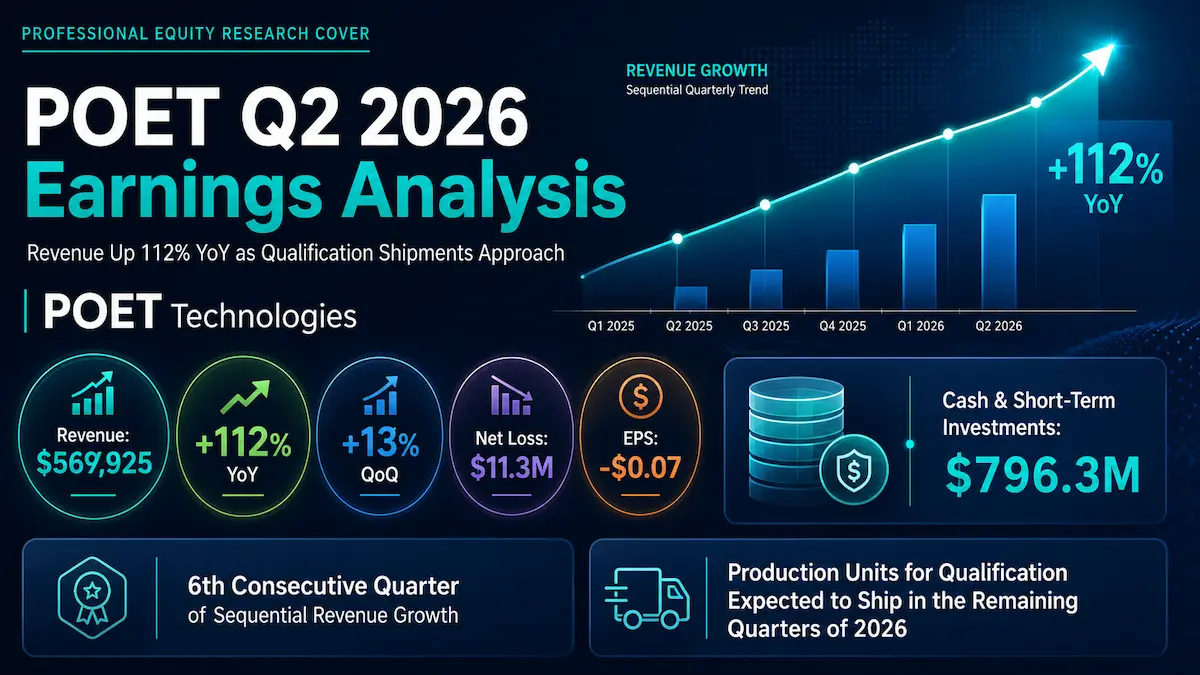
- POET Technologies reported Q2 2026 revenue of $569,925, up 112% year over year and 13% sequentially, marking a sixth consecutive quarter of sequential revenue growth.
- The headline loss improved to $11.3 million, or $0.07 per share, but the quarter also included a $5.5 million non-cash warrant-liability gain and $4.3 million of other income, primarily interest. Core operating economics remain deeply loss-making.
- Quarter-end cash and short-term investments reached $796.3 million after the $400.0 million May financing, giving POET exceptional funding capacity relative to its current revenue base.
- The central investment question has shifted from financing survival to commercialization execution: management expects substantial production-unit shipments for qualification during the remaining quarters of 2026, but issued no numeric Q3 revenue or EPS guidance.
- At the August 18 regular-session close of $8.48, POET’s equity value was approximately $1.47 billion using the August 13 share count. After subtracting reported cash and short-term investments, investors were assigning roughly $671 million to the operating platform, intellectual property and future order conversion.
1. Core Earnings Breakdown
Revenue and Profitability Analysis
POET Technologies reported Q2 2026 revenue of $569,925, compared with $503,389 in Q1 2026 and $268,469 in Q2 2025. That represents 13% sequential growth and 112% year-over-year growth. The absolute revenue base remains small, but the direction is important: Q2 was the sixth consecutive quarter of sequential revenue growth.
There is one disclosure limitation that matters more than the headline growth rate. POET reports non-recurring engineering, or NRE, and product revenue as a single combined revenue line. The company did not disclose the exact Q2 split between NRE and product sales, nor revenue by optical-engine family. Therefore, a precise product-revenue mix or product-only growth rate cannot be calculated without inventing data. This is itself investment-relevant because investors still cannot determine from the reported revenue line how much of the growth came from repeatable production shipments versus customer-funded engineering work.
- NRE and product revenue combined: $569,925, representing 100% of reported Q2 revenue; up 112% year over year and 13% sequentially. Investment view: the six-quarter progression is constructive, but the missing NRE-versus-product split means the quality of the revenue inflection is not yet fully observable.
- Commercial optical-engine pipeline: not recognized as a Q2 revenue segment. During Q2, Lumilens placed an initial $50 million purchase order within a broader supply relationship that POET said could potentially exceed $500 million of cumulative purchases over five years. After quarter-end, POET disclosed an additional $2.4 million purchase order from an existing customer. Investment view: these orders are far larger than current quarterly revenue, but purchase orders and potential framework value should not be treated as recognized revenue until qualification, delivery and acceptance milestones are met.
- External light-source and next-generation engine activity: POET disclosed a post-quarter agreement with a Tier 1 laser company to combine that supplier’s technology with POET’s advanced light-source engine, along with an exclusive supplier arrangement intended to increase Blazar platform output power. Investment view: the strategic value is less about immediate Q2 sales and more about broadening the addressable architecture set for AI data-center connectivity while reducing dependence on a single component configuration.
Profitability remains the weak side of the story. Q2 net loss was $11,338,060, or $0.07 per share, compared with a $12.3 million loss in Q1 2026 and a $17.3 million loss in Q2 2025. Research and development expense increased to $5.8 million from $3.1 million a year earlier as POET expanded engineering work for commercialization, customer-specific programs and manufacturing readiness.
The apparent improvement in net loss should not be interpreted as a comparable improvement in the underlying operating margin. Using POET’s company-reported quarterly expense lines, Q2 operating loss can be calculated as follows: $569,925 revenue minus $5,784,056 of R&D, $1,026,953 of depreciation and amortization, $725,691 of professional fees, $2,778,119 of wages and benefits, $3,816,906 of stock-based compensation, $456,171 of general expenses and rent, and $6,172,500 of finance advisory fees = negative $20,190,471. That implies an operating margin of approximately -3,542.7%, calculated from company-reported figures. The gap between that operating loss and the smaller net loss was helped materially by a $5.5 million non-cash fair-value gain on derivative warrant liabilities and $4.3 million of other income, primarily interest.
Accuracy note: one sentence in the filed Q2 MD&A describes the year-over-year revenue increase as 12%. That appears to be a typographical error. The reported figures, $569,925 versus $268,469, mathematically imply approximately 112%, and POET’s official earnings release also states 112%.
Expectations vs. Actual Results
- Revenue: $569,925 actual versus $500,000 FactSet estimate reported by MT Newswires. Result: ✅ Beat by $69,925, or approximately 14.0%.
- EPS: negative $0.07 actual versus a negative $0.08 FactSet estimate. Result: ✅ Beat FactSet by $0.01 per share. However, MarketBeat’s earnings snapshot listed consensus at negative $0.07, which would classify the result as a meet. The most accurate conclusion is that EPS was a FactSet beat but not a universal consensus beat across data vendors.
- Operating margin: approximately -3,542.7%, calculated from company-reported quarterly revenue and operating expense lines. No reliable published operating-margin consensus was identified, so assigning a beat or miss would be misleading.
- Q3 2026 guidance: POET did not issue numeric Q3 revenue, EPS or margin guidance. Management said it expects to begin shipping substantial numbers of production units for qualification in the remaining quarters of 2026 and indicated that additional updates would come in September.
The revenue beat came from a very small base: the absolute upside versus the $500,000 estimate was about $70,000. That matters because a 14% percentage beat can look more dramatic than the dollar economics. The more important development is the persistence of sequential growth and whether qualification shipments begin to turn the $50 million Lumilens order and other customer commitments into recognized product revenue.
The EPS result requires even more care. Q2’s $11.3 million net loss benefited from a $5.5 million non-cash gain on the remeasurement of derivative warrant liabilities and $4.3 million of other income, primarily interest on the enlarged cash balance. On a sequential basis, the warrant-liability gain increased by roughly $3.9 million from Q1, while finance advisory fees increased by $2.9 million to $6.2 million. In other words, the improvement in reported net loss was not driven solely by operating leverage from revenue growth.
For the market, pipeline conversion is currently more important than EPS. POET’s reported quarterly revenue is still below $1 million, while the company is discussing customer orders and commercial frameworks measured in tens or hundreds of millions of dollars. The valuation therefore depends much more on production qualification, delivery cadence, yield, customer acceptance and gross-margin economics than on a one-cent quarterly EPS variance.
The stock reaction confirms that distinction. POET closed at $8.91 on August 13, up 0.45% on the earnings day, then rose 7.52% to $9.58 on August 14. It subsequently fell to $9.40 on August 17 and $8.48 on August 18, leaving it about 4.4% below the August 12 pre-earnings close of $8.87. This was not a simple negative earnings reaction: investors initially rewarded the report, then reversed that move.
No single public data point proves why the later pullback occurred. The most defensible fundamental interpretation is that the initial enthusiasm around revenue growth and production timing ran into a demanding valuation, the absence of numeric Q3 guidance, continued qualification risk, high operating cash burn relative to current revenue, and a large potential dilution overhang from outstanding warrants and equity awards. It would also be inaccurate to describe the weakness simply as surprise financing dilution: the $400 million May offering had already been disclosed before Q2 earnings. Its dilution is structurally relevant, but it was not new information on August 13.
Earnings Call Highlights
Source-integrity note: as of August 19, 2026, POET’s Investor Relations and News & Media pages list the Q2 release but do not publish a standalone company-hosted Q2 2026 earnings-call transcript. A public Quartr event record states that its Q2 event summary combines an earnings-call transcript, report and presentation. To avoid presenting third-party transcript text as an official company transcript, the points below use only management messages that can be independently verified in POET’s official Q2 release and SEC-filed MD&A.
Production ramp remains on schedule for the second half of 2026.
💡 Reading Between the Lines: The investment thesis is moving from technology validation to manufacturing execution. The next valuation step-up requires evidence that production yields, customer qualification and delivery timing can support order conversion at a scale far above today’s revenue.
Management expects substantial production-unit shipments for qualification during the remaining quarters of 2026.
💡 Reading Between the Lines: Qualification shipments are an essential commercial milestone, but they are not equivalent to final volume acceptance or recognized revenue. Investors should treat September updates as an execution checkpoint rather than assume the full purchase-order value immediately enters the income statement.
The $400 million premium financing was positioned as a way to strengthen POET’s strategic and manufacturing staying power.
💡 Reading Between the Lines: Capital scarcity is no longer the dominant near-term risk. The burden has shifted to capital allocation: investors need to see the balance sheet converted into production capacity, supply-chain security and customer wins without excessive strategic spending or dilution.
Post-quarter commercial activity broadened across an existing customer’s $2.4 million order, a Tier 1 laser collaboration and the Blazar light-source supply chain.
💡 Reading Between the Lines: POET is trying to become an integration platform rather than a single-product vendor. That can increase customer stickiness, but it also raises coordination risk across lasers, modulators, packaging partners and customer qualification schedules.
The board decided not to proceed with U.S. redomiciling at this time.
💡 Reading Between the Lines: Avoiding a near-term corporate reorganization reduces execution distraction, but it leaves U.S. investors exposed to continued uncertainty around PFIC status. POET said it believed it was a PFIC for 2025 and that future status must be determined annually.
2. Deep Business Insights
Hidden Metrics That Matter
Metric one is the gap between current reported revenue and contracted or indicated commercial demand. The $50 million initial Lumilens purchase order is approximately 87.7 times Q2 revenue: $50,000,000 divided by $569,925 = 87.7x, calculated from company-reported figures. The separate $2.4 million post-quarter order is approximately 4.2 times Q2 revenue: $2,400,000 divided by $569,925 = 4.2x, calculated from company-reported figures.
This is the single most important asymmetry in the story. If qualification and manufacturing proceed successfully, recognized revenue could eventually move by multiples of the current quarterly base. If qualification slips, customer programs change, or purchase orders do not convert on the expected timeline, the present valuation will have very little current revenue to support it. The broader Lumilens relationship that POET said could scale beyond $500 million over five years should be treated as potential framework value, not as booked revenue or an unconditional $500 million backlog.
Metric two is potential equity dilution. POET reported 173,058,088 common shares outstanding as of August 13, 2026 and 78,734,968 warrants outstanding. Warrants therefore equal approximately 45.5% of the current common-share count: 78,734,968 divided by 173,058,088 = 45.5%, calculated from company-reported figures. Adding 5,369,393 options and 4,252,504 restricted stock units produces 88,356,865 potential incremental securities, equivalent to approximately 51.1% of the current share count, calculated from company-reported figures. This is not a forecast of actual dilution: warrants have different strike prices, options may not be exercised, RSUs vest over time, and warrant exercises can bring additional cash into the company. It is nevertheless a material per-share valuation consideration.
Why would customers choose POET despite the execution risk? The differentiator is the Optical Interposer architecture. POET says its platform uses wafer-level semiconductor manufacturing and packaging to integrate electronic and photonic devices into a single multi-chip module, reducing costly components, assembly, alignment and testing steps used in conventional photonics. The value proposition is therefore not simply faster optics. It is the possibility of lower assembly complexity, lower power, smaller form factors and greater manufacturing scalability across multiple optical-engine configurations. The $50 million Lumilens order is meaningful because it represents external commercial validation of that integration thesis, even though revenue conversion still depends on execution.
Industry Chain Reactions
- ✅ Benefit — Quantum Computing Inc. (NASDAQ: QUBT): POET and QCi announced a joint program to develop 3.2 Tbps optical engines using QCi’s thin-film lithium niobate modulators on the POET Optical Interposer platform. If POET successfully qualifies and scales its next-generation optical-engine architecture, QUBT could gain a more credible commercialization pathway for its TFLN technology in AI data-center connectivity. This is a strategic read-through, not a statement that POET’s Q2 revenue directly flows to QUBT.
- ❌ Face Pressure — Coherent Corp. (NYSE: COHR): Coherent is already demonstrating 1.6T and 3.2T pluggable optical technologies and has deep scale in lasers, silicon photonics and transceivers. If POET proves that its integrated interposer approach can deliver comparable performance with lower packaging complexity and cost at high volume, incumbent component and transceiver economics could face incremental pricing or design-win pressure in overlapping applications. This is a competitive scenario, not evidence of an immediate Q2 financial impact on Coherent; Coherent’s broad product portfolio and manufacturing scale remain substantial defenses.
Valuation Framework and Key Risks
Using the August 18 regular-session closing price of $8.48 and POET’s August 13 reported share count of 173,058,088, the implied equity market value is approximately $1.468 billion: 173,058,088 multiplied by $8.48, calculated from company-reported share figures and market-price data. Subtracting $796.342 million of cash, cash equivalents and short-term investments produces a cash-adjusted equity value of approximately $671 million. This is not a formal enterprise-value calculation because it does not adjust for every liability or non-operating asset, but it is a useful way to isolate what investors are paying for the operating platform and future commercialization.
That framework is more informative than applying a conventional price-to-sales multiple to a business whose Q2 revenue was only $569,925 and whose customer orders are many times larger than recognized revenue. Roughly 54% of the calculated equity value is represented by reported cash and short-term investments, which substantially reduces financing risk. At the same time, the remaining approximately $671 million still embeds a major assumption that POET will convert qualification programs into meaningful product revenue.
The bull case requires three things to happen in sequence: qualification shipments must occur on schedule; those shipments must turn into repeat production orders; and the resulting product mix must demonstrate economically attractive gross margins once scale rises. POET has disclosed the first two pieces as strategic objectives, but it has not yet provided investors with enough product-revenue or gross-margin disclosure to validate the third.
The principal risks are therefore execution rather than liquidity. They include customer qualification delays; manufacturing-yield or supply-chain issues; uncertain timing between purchase orders and revenue recognition; a lack of disclosed product-versus-NRE mix; high operating expense while revenue remains small; material potential dilution from warrants, options and RSUs; and competitive pressure from larger optical-component and transceiver vendors. POET also reported negative Q2 operating cash flow of $12.2 million, up from $8.8 million in Q1 2026, demonstrating that the production transition is currently consuming more cash even as the balance sheet is exceptionally strong.
There is also a tax-structure risk for U.S. holders. POET’s filing states that the company believes it was classified as a passive foreign investment company for 2025 and that PFIC status for 2026 and future years depends on annual factual tests. The board’s decision not to proceed with U.S. redomiciling means this issue remains relevant. Investors should obtain tax advice specific to their circumstances rather than assume the corporate decision eliminates PFIC exposure.
The most useful valuation conclusion is therefore not that POET is simply “cheap” because it has $796 million of cash or “expensive” because its current sales multiple is extreme. At $8.48, the market is effectively pricing a well-funded commercialization option. The stock can justify a materially higher value if qualification converts into high-volume revenue with credible margins; it can also compress sharply if order conversion is delayed because current recognized revenue provides little fundamental support for a billion-dollar-plus equity value.
3. Key FAQs
Did POET Technologies beat Q2 2026 earnings estimates?
On revenue, yes. POET reported $569,925 versus a $500,000 FactSet estimate, a beat of approximately 14.0%. On EPS, the answer depends on the consensus source. MT Newswires reported a FactSet estimate of a $0.08 loss, making the reported $0.07 loss a $0.01 beat. MarketBeat listed a $0.07 consensus loss, which makes the result a meet. Investors should therefore avoid describing the EPS result as an undisputed consensus beat.
What is POET Technologies’ Q3 2026 guidance after Q2 earnings?
POET did not provide numeric Q3 revenue, EPS or margin guidance. Management’s verified qualitative outlook is that the company expects to ship substantial numbers of production units for qualification during the remaining quarters of 2026, with additional updates expected in September. The key distinction is that qualification shipments are a step toward volume revenue, not the same thing as completed customer acceptance or recognized sales.
Is POET stock overvalued after Q2 2026 earnings?
There is no useful one-number answer because POET is still at the commercialization stage. At the August 18 close of $8.48, the calculated equity value was about $1.47 billion, while reported cash and short-term investments were $796.3 million. The resulting cash-adjusted equity value of roughly $671 million represents what the market is paying for POET’s technology, customer pipeline and future production economics. That valuation can be justified only if qualification programs convert into material product revenue and ultimately sustainable margins; delays, poor conversion, dilution or competitive pressure would make the current price much harder to support.
Consensus-reference sources used for the expectations comparison include the verified MT Newswires/FactSet revenue estimate and the MarketBeat Q2 earnings snapshot. Historical price references were cross-checked against MarketWatch historical quotes.
Primary company sources: POET Technologies’ official Q2 2026 earnings release, the SEC-filed Q2 2026 MD&A, and the company’s official Investor Relations page.
Disclaimer: This article/chart is for educational and informational purposes only and does not constitute investment advice of any kind. Past performance is not indicative of future results. Investors should independently evaluate their own risks.