


Key Takeaways
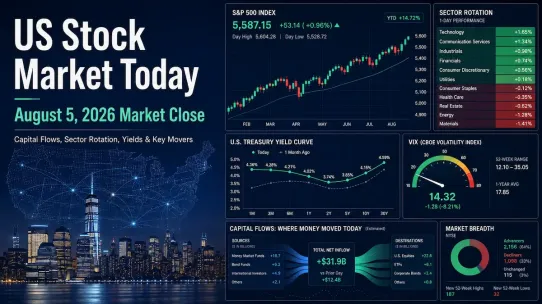
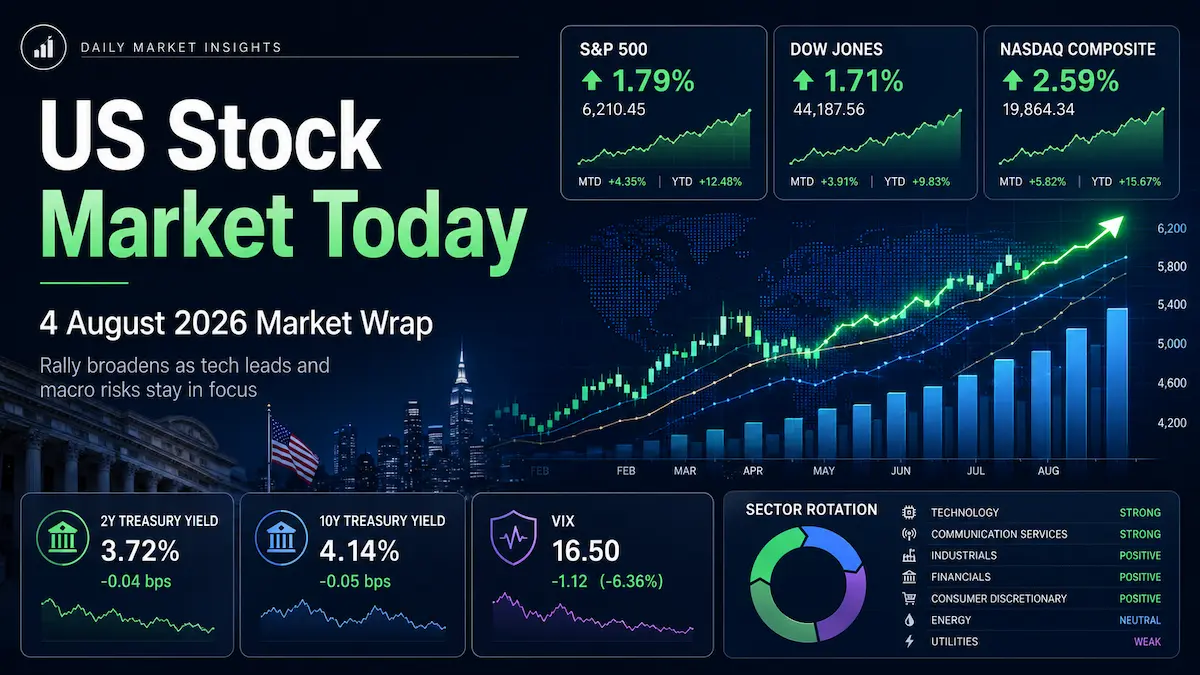
- The S&P 500 rose 1.79% to a record 7,736.52, the Dow Jones Industrial Average gained 1.71% to a record 54,085.88, and the Nasdaq Composite advanced 2.59% to 26,584.99.
- Technology led all S&P 500 sectors with a 4.1% gain, while energy was the weakest, falling 0.49% as crude oil fell roughly 5% on reduced Middle East supply-risk concerns.
- Palantir jumped 29.5% and Caterpillar rose 5.6% in the regular session after results reinforced two related investment themes: monetized artificial intelligence and the physical infrastructure required to support it.
- The U.S. 2-year Treasury yield fell to 4.20% and the 10-year yield declined to 4.63%, but the Cboe VIX increased 4.04% to 16.50, showing that the equity rally coexisted with continued event hedging.
U.S. equities finished the August 4 regular session with a powerful, earnings-led advance. The move was not merely a late-day quotation effect: breadth was positive, trading volume exceeded its recent average, and both large-cap growth and smaller companies participated. All index and stock moves cited below refer to regular-session closing prices; no after-hours move is presented as an official market close.
1. Market Capital Flows and Sector Rotation
The S&P 500 added 136.02 points, or 1.79%, to 7,736.52. The Dow gained 907.47 points, or 1.71%, to 54,085.88, while the Nasdaq rose 671.10 points, or 2.59%, to 26,584.99. The Russell 2000 advanced 1.8% to 3,036.98. The S&P 500 recorded its first closing high since July 2, and the Dow posted a second consecutive record close.
Information technology was the strongest S&P 500 sector, rising 4.1%, and the Philadelphia Semiconductor Index surged 6.6%. Energy ranked last with a 0.49% decline as oil prices retreated sharply. That dispersion captures the session’s central allocation decision: investors shifted toward businesses with visible AI-linked revenue and margin momentum while reducing exposure to the inflation and geopolitical risk premium embedded in energy.
Growth decisively outperformed value at the margin, as shown by the Nasdaq’s lead and technology’s sector-level dominance. Value and cyclicals were not abandoned: Caterpillar’s gain, the Dow’s record close and the Russell 2000’s 1.8% advance showed participation beyond mega-cap software and semiconductors. The result was best characterized as large-cap growth leadership inside a broader risk-on session rather than a narrow rally confined to a few index heavyweights. Defensive assets did not set the pace.
Market breadth confirmed broader participation. Advancing stocks outnumbered decliners by 2.84 to 1 on the New York Stock Exchange and 2.89 to 1 on Nasdaq. Consolidated U.S. exchange volume reached 18.89 billion shares, above the 20-session average of 17.33 billion. Those figures strengthen the quality of the index move because they indicate that rising prices were supported by both participation and turnover.
Institutional Flow Insight: The most plausible allocation logic was a combination of duration support and earnings visibility. Lower Treasury yields increased the present value of longer-duration growth cash flows, while Palantir and Caterpillar supplied company-specific evidence that AI spending is reaching both software platforms and physical infrastructure. Month-start re-risking and benchmark pressure may have amplified demand after record highs were breached, but public market data cannot confirm those flows. The simultaneous increase in the VIX also suggests that some institutions added equity exposure without fully removing options protection or geopolitical hedges.
2. Decoding the Biggest Market Movers
Palantir Technologies (PLTR)
Palantir closed 29.5% higher in the regular session, its largest one-day percentage gain since February 2024. The move followed second-quarter results that materially strengthened the market’s confidence in the company’s ability to convert AI demand into revenue, operating leverage and cash generation.
Palantir reported second-quarter revenue of $1.935 billion, up 93% year over year. U.S. commercial revenue increased 149% to $764 million, while U.S. government revenue rose 90% to $809 million. GAAP operating income was $912 million, representing a 47% margin, and adjusted operating income was $1.194 billion, a 62% margin. Both GAAP and adjusted diluted EPS were $0.41.
The company guided third-quarter revenue to $2.160 billion to $2.164 billion and raised full-year revenue guidance to $8.150 billion to $8.158 billion. It also increased its full-year U.S. commercial revenue outlook to more than $3.424 billion, implying growth of at least 134%, and raised adjusted operating income guidance to $4.889 billion to $4.897 billion.
The index impact extended beyond Palantir itself. The combination of 93% revenue growth and a 62% adjusted operating margin supported higher valuation confidence across profitable AI software, while the company’s government and commercial growth reduced the perception that demand was concentrated in one customer channel. The key risk is that such an exceptional share-price response raises the future execution threshold: any deceleration in bookings, revenue conversion or margin expansion could produce disproportionate multiple compression.
Caterpillar (CAT)
Caterpillar finished the regular session 5.6% higher and contributed roughly 280 points to the price-weighted Dow’s gain. Its results broadened the AI trade from chips and software into power generation, construction equipment and data-center infrastructure.
Second-quarter sales and revenue increased 24% to $20.543 billion, the first quarterly total above $20 billion in the company’s history. GAAP profit per share was $7.77 and adjusted profit per share was $8.17. Operating margin expanded to 20.9% from 17.3%, while adjusted operating margin rose to 21.9% from 17.6%.
Construction Industries sales increased 35% to $8.346 billion, including a 50% increase in North America. Power & Energy sales rose 17% to $8.238 billion, with power-generation sales up 29%; the company specifically identified data-center applications as a driver of higher sales of large reciprocating engines, turbines and related services. Resource Industries sales increased 20% to $4.648 billion, showing that the quarter was not dependent on one segment.
Caterpillar’s reaction mattered for industrials and the Dow because it provided evidence that AI capital spending is generating demand farther down the supply chain. The market treated the result as a read-through for electrical equipment, backup power, cooling, construction and other data-center enablers. Investors should nevertheless separate durable end demand from cyclical order timing, tariff effects and the possibility that unusually strong infrastructure spending pulls future demand into the present.
3. Macro Indicators and Market Outlook
The Cboe VIX closed at 16.50, up 0.64 point or 4.04% from 15.86. A rising VIX alongside a strong equity rally is unusual but not contradictory. It implies that demand for index options and event protection remained firm even as cash equities advanced. With major labor data approaching and geopolitical developments still capable of moving oil, the volatility signal was more consistent with hedged risk-taking than with complete investor complacency.
The U.S. Treasury’s official constant-maturity rates showed the 2-year yield at 4.20%, down 5 basis points from August 3, and the 10-year yield at 4.63%, down 7 basis points. The 2s10s curve remained positively sloped by approximately 43 basis points and flattened slightly. The decline in both maturities supported equity duration, but it should not be interpreted as a definitive monetary-policy forecast. Lower oil prices, balanced labor-flow data and reduced near-term geopolitical inflation pressure likely contributed to the move, while the still-elevated 10-year yield indicates that growth, inflation uncertainty and term premium remain relevant.
The June Job Openings and Labor Turnover Survey showed 7.4 million job openings, 5.3 million hires and 1.8 million layoffs and discharges. The report was consistent with a labor market that is cooling at the margin without displaying broad stress. That mix reduced immediate growth fears while leaving investors focused on the more comprehensive payroll report later in the week.
Oil was the most relevant cross-asset signal. Brent crude fell below $80 a barrel and both major benchmarks declined by roughly 5% as expectations for reduced Middle East supply risk improved. The drop relieved some inflation and term-premium pressure, supported rate-sensitive equities and directly weighed on the energy sector. Because the move was geopolitically driven, however, it remains vulnerable to reversal if shipping or supply risks re-escalate.
Upcoming Economic Data & Catalysts:
- Productivity and Costs, preliminary second-quarter 2026 release (Release date: August 6, 2026, at 8:30 a.m. ET): Investors will watch productivity and unit labor costs for evidence on whether wage growth can coexist with easing inflation pressure. A material upside surprise in unit labor costs could challenge the day’s lower-yield narrative.
- Employment Situation for July 2026 (Release date: August 7, 2026, at 8:30 a.m. ET): Payroll growth, unemployment, wage gains and prior-month revisions will influence expectations for growth, Federal Reserve policy and the durability of the equity risk rally.
Market Insights:
The August 4 advance was broad enough to qualify as a genuine risk-on session, but leadership remained concentrated in a powerful AI and technology factor. Positive breadth, above-average volume, small-cap gains and Caterpillar’s contribution distinguish it from a purely mega-cap-driven move. The most important reversal risks are a renewed oil spike, a sharp rebound in Treasury yields, weaker market breadth after the record breakout, downward earnings revisions, or a volatility move above recent ranges despite stable index prices.
Trading & Investment Strategy:
Investors should treat record highs as a reason to strengthen risk controls rather than chase vertical price action. Position sizes should reflect the wider outcome distribution around labor data and geopolitical headlines. Staggered entries are preferable to one-time purchases, particularly in stocks that have repriced sharply after earnings. Exposure can be balanced between high-quality growth with demonstrated cash generation and cyclical infrastructure beneficiaries with visible order support. Predefined loss limits, portfolio-level drawdown thresholds and disciplined rebalancing remain essential; leverage should be kept modest while the VIX and oil market signal unresolved event risk.
4. Key FAQs About the US Stock Market Today
Why did the US stock market move on August 4, 2026?
Stocks rallied because strong AI-linked earnings from Palantir and Caterpillar improved confidence in both digital and physical AI investment, while a roughly 5% oil decline reduced inflation concerns and Treasury yields moved lower. Positive breadth and above-average volume confirmed that the advance extended beyond a small group of mega-cap stocks.
Which sectors performed best and worst in the US stock market on August 4, 2026?
Information technology was the best-performing S&P 500 sector with a 4.1% gain, supported by software and a 6.6% surge in the Philadelphia Semiconductor Index. Energy was the weakest sector, declining 0.49%, as falling crude prices reduced the near-term earnings and inflation premium attached to oil producers.
What should investors watch after the US stock market close on August 4, 2026?
The next major tests are the August 6 productivity and unit labor cost report and the August 7 July Employment Situation. Investors should also monitor whether the 10-year Treasury yield stays below its prior-session level, whether breadth remains positive after the record breakout, whether the VIX continues rising against higher stock prices, and whether oil’s decline holds or reverses on geopolitical news.
Disclaimer: This article is intended solely for the exchange of investment ideas and does not constitute investment advice of any kind.