



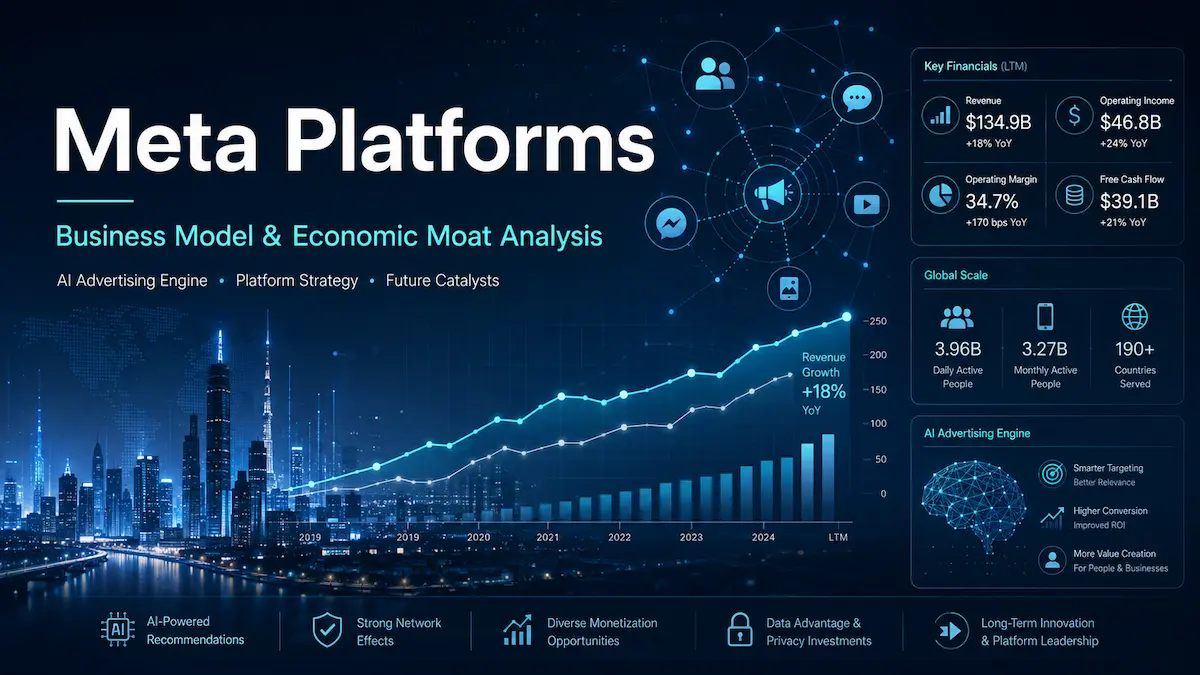

Key Takeaways
- Meta Platforms remains an advertising company at its economic core. In the second quarter of 2026, advertising generated $59.36 billion, or approximately 97.6% of total revenue, while the Family of Apps produced nearly all revenue and all consolidated operating profit before Reality Labs losses.
- The most defensible moat is not brand recognition or user switching costs. It is the interaction of multi-sided network effects, massive cross-app distribution, dense advertiser demand, proprietary recommendation systems, and a feedback loop that improves content ranking and ad conversion.
- Meta’s defining corporate gene is its willingness to rebuild the distribution layer before the legacy model breaks. The 2012-2014 mobile pivot converted a desktop monetization threat into a mobile feed advertising engine and remains the clearest precedent for today’s AI-led product transition.
- The most credible 12- to 24-month catalysts are higher monetization efficiency from AI ranking and creative tools, plus the gradual commercialization of WhatsApp, Threads, subscriptions, and business messaging. Material enterprise AI or hardware revenue remains possible, but is not yet established.
- The principal risks are advertising concentration, dependence on operating systems and data signals Meta does not control, escalating AI infrastructure costs, regulatory remedies, youth-related litigation, and founder-controlled capital allocation.
Meta Platforms is best understood as a global attention-and-intent exchange rather than a collection of social media applications. Facebook, Instagram, WhatsApp, Messenger, Threads, and Meta AI attract users for different jobs: social identity, entertainment, discovery, private communication, public conversation, commerce, and assistance. Meta then applies shared recommendation, advertising, measurement, safety, and infrastructure systems across that portfolio.
This distinction matters. A surface can be strategically valuable before it is directly monetized because it can deepen user frequency, improve cross-app distribution, create new commercial intent, or defend Meta’s relevance as consumer behavior migrates. Conversely, a fast-growing app is not automatically a durable moat if users can multi-home, advertisers can redirect budgets, or regulators can restrict the data and product integration that make the system economically productive.
Analytical Classification
- Confirmed facts refer to reported financial results, filed disclosures, completed corporate actions, or official regulatory decisions.
- Management statements refer to objectives, product claims, guidance, or expectations stated by Meta executives. They are not treated as guaranteed outcomes.
- Analytical inferences are conclusions drawn from reported economics and observable operating relationships.
- Unverified expectations are plausible market narratives that have not yet been demonstrated in reported revenue, margin, or cash flow.
1. Business Model Breakdown
What Meta Actually Sells
Meta does not primarily sell access to its consumer applications. It gives consumers free access, aggregates attention and commercial intent, and sells marketers the probability of reaching or converting a relevant user. The unit of economic value is therefore not simply an impression. It is a measured business outcome generated by matching an advertiser’s objective, creative, bid, and target audience with a user context that Meta’s systems predict will produce the highest combined value.
Confirmed fact: Meta reports two segments, Family of Apps and Reality Labs. Family of Apps includes Facebook, Instagram, Messenger, WhatsApp, Threads, Meta AI, and related services. Reality Labs includes virtual and augmented reality hardware, software, and content. Meta’s 2025 Form 10-K states that substantially all revenue is generated from selling advertising placements, while Reality Labs generates revenue from consumer hardware, software, and content.
Q2 2026 revenue source | Revenue | Share of total revenue | Economic role |
|---|---|---|---|
Family of Apps advertising | $59.36 billion | 97.6% | Core profit engine: auction-based advertising across Facebook, Instagram, Messenger, Threads, WhatsApp, and selected partner inventory |
Family of Apps other revenue | $1.01 billion | 1.7% | Primarily paid messaging and subscriptions; strategically important but not yet a material diversification of the consolidated model |
Reality Labs | $431 million | 0.7% | Consumer hardware, software, and content; currently an option on future computing interfaces rather than a mature earnings engine |
Total | $60.80 billion | 100.0% | Consolidated revenue |
Confirmed fact: Q2 2026 advertising revenue increased 27% year over year. Ad impressions rose 14%, while average price per ad increased 12%. This combination illustrates Meta’s basic revenue equation: monetizable engagement expands the inventory base, while better advertiser returns, auction demand, macro conditions, and mix influence price.
Analytical inference: The quality of Meta’s business is driven less by raw user growth than by the rate at which it can turn each unit of engagement into measurable advertiser value without degrading the user experience. At 3.60 billion Family daily active people in June 2026, user growth still matters, but monetization efficiency and engagement depth increasingly carry the revenue algorithm.
The Advertising Flywheel
The advertising model contains four reinforcing layers. First, consumer applications produce attention, content, messages, and commercial signals. Second, recommendation systems decide what organic content and ads to show. Third, an auction allocates inventory among marketers with different objectives and bids. Fourth, conversion and measurement systems feed performance data back into ranking, audience selection, budget allocation, and creative generation.
The model becomes more valuable when Meta improves either side of the marketplace. More relevant content can increase sessions and time spent, creating additional opportunities to show ads. Better ad matching can raise conversion rates, which can support higher advertiser bids. Automated creative and campaign tools can reduce the expertise required to advertise, broadening participation among small and medium-sized businesses. Greater advertiser density can then improve auction liquidity and monetization across more user cohorts and geographies.
Confirmed fact: Meta disclosed that its Advantage+ end-to-end advertising solutions exceeded a $75 billion annual revenue run rate in Q2 2026. Management also reported that more than nine million small businesses were using at least one generative AI advertising creative tool. These are company-reported operating metrics, not independently audited product-level revenue disclosures.
Profit Pools and Capital Intensity
Confirmed fact: Family of Apps generated $60.37 billion of Q2 2026 revenue and $23.39 billion of operating income, implying an operating margin of approximately 38.8%. Reality Labs generated $431 million of revenue and an operating loss of $4.62 billion. Consolidated operating margin was 31%, compared with 43% in the prior-year quarter.
The consolidated margin decline requires context. Q2 2026 expenses included $2.40 billion of charges related to legal proceedings and $1.18 billion of severance expense. Management stated that operating income would have increased 9% year over year excluding those items. Even after adjusting for one-time charges, however, the underlying cost structure is becoming more capital intensive as Meta spends on servers, data centers, networking, third-party cloud capacity, AI talent, and model inference.
Confirmed fact: Q2 2026 capital expenditures, including principal payments on finance leases, were $31.08 billion, while free cash flow was $784 million. Management’s full-year 2026 capital expenditure outlook was $130 billion to $145 billion as of July 29, 2026. That guidance is a management estimate, not a completed expenditure.
Analytical inference: Meta is using the cash generation of an unusually profitable advertising franchise to finance three objectives simultaneously: defend the core recommendation and ad systems, open new revenue pools in messaging and AI, and reduce strategic dependence on third-party computing platforms through wearables and longer-term Reality Labs investments. The trade-off is that reported free cash flow can become volatile even when the advertising engine remains healthy.
Platform Strategy: A Portfolio With Shared Infrastructure
Facebook remains a broad social utility for identity, communities, video, Marketplace, and local or interest-based connection. Instagram is the portfolio’s creator, visual discovery, entertainment, and aspirational commerce surface. WhatsApp provides high-frequency private communication and a growing business interaction layer. Messenger supports communication and business contact, particularly around Facebook. Threads gives Meta a public-conversation product that can be distributed from Instagram’s identity and social graph. Meta AI can be inserted across these surfaces rather than relying on a single standalone acquisition funnel.
Analytical inference: The portfolio strategy lowers the cost and risk of product experimentation. Meta can launch a new surface, seed identity and social connections from an existing app, use shared recommendation infrastructure to find interested users, and eventually connect the surface to its advertising or business-messaging systems. Threads is the clearest recent example of distribution as a strategic asset: the product did not need to build identity, graph, safety, and advertiser relationships entirely from zero.
Management statement: Meta describes AI as a horizontal technology that improves content ranking, ad performance, product development, assistants, business agents, and future hardware. The commercial logic is coherent, but the return on the current infrastructure buildout will depend on whether incremental revenue and gross profit outpace depreciation, energy, cloud, talent, and financing costs.
2. Deep Dive into Economic Moats
Moat Scorecard
Moat category | Assessment | Why it matters | What weakens it |
|---|---|---|---|
Intangible assets | Strong, but dynamic | Recommendation models, ad auction systems, accumulated behavioral and conversion signals, creator relationships, advertiser tooling, brands, safety systems, and operating know-how improve product relevance and monetization. | Algorithms can be copied conceptually, data use can be restricted, frontier models can commoditize, and brand strength does not guarantee attention. |
Switching costs | Low for users; moderate for advertisers | Advertisers may build workflows, conversion APIs, catalogs, audiences, and creative processes around Meta, creating operational friction. | Users and marketers routinely multi-home. Advertisers generally have no long-term spending commitments and can move budgets when relative returns change. |
Network effects | Very strong | Users attract creators and businesses; content attracts users; users and intent attract advertisers; advertiser density improves auctions; businesses increase messaging utility. | Public-content discovery reduces dependence on the friend graph, and multi-homing allows rival platforms to scale without fully displacing Meta. |
Cost advantages | Meaningful, not exclusive | Global infrastructure, internal silicon efforts, shared AI systems, automated ad tools, and cross-app distribution spread fixed costs across billions of users and millions of businesses. | Other hyperscale technology companies can fund comparable infrastructure, while Meta’s own scale creates large depreciation, power, safety, and compliance costs. |
Core Moat One: Multi-Sided Network Effects
Meta’s strongest moat is the interaction among users, creators, businesses, developers, and advertisers. The network effect is not merely that more friends make Facebook useful. The more durable advantage is that Meta operates several interconnected networks with different content and communication modes, then monetizes them through a common advertiser marketplace.
A new competitor can purchase compute and recruit creators, but it must still solve a coordination problem. It needs enough users to attract content and businesses, enough content to sustain engagement, enough engagement and intent to attract advertisers, enough advertisers to create auction density, and enough measured conversions to prove return on ad spend. Building one side without the others can produce growth without equivalent economics.
Meta’s cross-app architecture raises the replication cost. A rival would need to match public identity and communities, visual entertainment, private encrypted messaging, business communication, creator distribution, advertiser demand, safety operations, and global infrastructure. It would also need to persuade users and businesses to reproduce relationships and workflows that already exist across Meta’s family.
This is not an absolute lock-in. Consumer switching costs are low, younger users can allocate time elsewhere, and advertisers can shift budgets rapidly. The moat therefore depends on continuous product relevance. Meta cannot harvest the network indefinitely without reinvesting in ranking, formats, creators, integrity, and new surfaces.
Core Moat Two: The Data-Learning and Distribution System
Meta’s second major advantage is an intangible operating system built from recommendation models, advertising prediction, outcome measurement, automated campaign tools, and global distribution. The defensible element is not any single algorithm. It is the speed and scale of the learning loop.
Every additional content interaction can improve user-interest models. Every ad auction provides information about demand. Every measured conversion can refine predicted action rates. Every new creative variation can generate performance data. When these systems are deployed across billions of daily users and a broad advertiser base, small model improvements can create material revenue effects.
Confirmed fact: In Q2 2026, management reported that a new ads ranking and sequence-learning combination generated an 8.3% increase in ad clicks and a 15.7% uplift in conversions on Facebook. Meta also reported that an early large-language-model pilot increased app-event conversions on Instagram by 1%. These are management-reported experiment results and should not be interpreted as guaranteed portfolio-wide lifts.
Analytical inference: The economic moat comes from compounding operational knowledge and deployment scale, not from a permanent technical lead. Competitors can develop strong models, but reproducing Meta’s integrated loop requires comparable consumer distribution, advertiser demand, conversion feedback, experimentation infrastructure, and trust from businesses that allocate real budgets.
Why Switching Costs and Brand Are Not the Primary Moats
Users can keep several social applications on the same device. Creators can cross-post. Advertisers can reallocate spend among search, commerce media, short-form video, connected television, and other channels. Meta’s own filings acknowledge that marketers usually have no long-term commitments and will reduce spending when returns become less competitive.
That makes switching costs a supporting factor rather than the foundation. Brand awareness helps acquisition and trust, but a famous social platform can still lose relevance if the product graph no longer matches how users want to communicate or discover content. The durable moat is the system’s ability to keep producing utility and advertiser outcomes despite low formal lock-in.
Can the Moat Support Long-Term Excess Returns?
Analytical inference: The moat can support excess returns if three conditions hold. Meta must preserve engagement across changing formats, maintain superior advertiser economics despite reduced external data signals, and earn an adequate return on the rapidly expanding AI capital base. The first two conditions have been demonstrated repeatedly, including through the mobile and short-form-video transitions. The third remains open because the current infrastructure cycle is unusually large.
The most important variable is not whether Meta can grow AI usage. It is whether AI improves revenue and product durability at a rate that exceeds the full cost of compute. A company can possess a strong consumer and advertising moat while still reducing shareholder economics through overinvestment. Meta’s founder-controlled governance increases both the ability to make long-duration bets and the risk that outside shareholders have limited influence over capital allocation.
3. Business Inflection Points & Future Catalysts
The Defining Strategic Inflection Point: The Mobile Pivot
Meta’s most consequential strategic turning point was not the 2021 corporate rebrand. It was the transition from desktop social networking to mobile feed distribution and monetization between 2012 and 2014.
Confirmed facts: Facebook’s 2012 filings warned that rising mobile use could reduce ad delivery because mobile monetization was not yet mature. Mobile advertising represented approximately 11% of advertising revenue for full-year 2012 and 23% in the fourth quarter. It reached approximately 53% in the fourth quarter of 2013 and 69% in the fourth quarter of 2014. Facebook also agreed to acquire Instagram in April 2012, strengthening its position in mobile visual sharing.
Analytical inference: The pivot established Meta’s enterprise gene. Management accepted near-term product and monetization uncertainty, moved the highest-value inventory into mobile feeds, built native ad formats, and allowed Instagram to retain a distinct product identity while integrating infrastructure and monetization over time. The result was not merely a successful format change; it converted a platform threat into the foundation of Meta’s modern advertising economics.
The 2021 rebrand to Meta was still strategically important because it formalized a willingness to fund the next computing platform. However, Reality Labs has not replaced advertising as the profit engine. The rebrand is therefore better classified as a capital-allocation and platform-control thesis, while the mobile pivot was the decisive business-model inflection.
Catalyst One: AI Raises Engagement and Advertising Yield
Confirmed facts: In Q2 2026, Family daily active people reached 3.60 billion, ad impressions increased 14%, and average price per ad increased 12%. Management reported double-digit year-over-year growth in Instagram time spent, a 9% increase in global Facebook video time, and conversion improvements from newer recommendation and ads models.
Management statement: Meta expects large language models and recommendation foundation models to improve understanding of content, user goals, ad relevance, creative generation, and product-development speed. Management also expects continued progress in the second half of 2026.
Transmission mechanism: Better organic recommendations can increase sessions, time spent, and reshares. That expands monetizable inventory. Better ad retrieval, ranking, audience understanding, and creative generation can increase conversion probability. Higher expected conversions improve advertiser return on spend, which can support auction demand and average price per ad. The strongest outcome is simultaneous growth in impressions and price without a material increase in perceived ad burden.
Observable indicators: Family engagement, Instagram time spent, Facebook video time, ad impression growth, average price per ad, advertising revenue growth, conversion-lift disclosures, Advantage+ adoption, and the ratio of incremental operating profit to infrastructure expense and depreciation.
Primary execution risks: Recommendation gains may diminish; synthetic content may reduce user trust; ad load can impair engagement; privacy or operating-system changes can restrict signals; and infrastructure costs may rise faster than monetization. Q2 2026 already showed the tension between strong revenue growth and a much heavier expense and capital expenditure profile.
Catalyst Two: Monetizing WhatsApp, Threads, and Business Conversations
Confirmed facts: Family of Apps other revenue reached $1.01 billion in Q2 2026 and increased 73% year over year, driven primarily by WhatsApp paid messaging and subscriptions. Meta completed the global expansion of ads on Threads and continued work toward a global rollout of ads in WhatsApp Status. Meta also reported that more than one million businesses were using Meta Business Agents on WhatsApp and Messenger.
Management statement: Meta has described a mix of subscriptions, volume-based pricing, and outcome-based pricing for business agents. The company has also introduced enterprise infrastructure intended to let businesses customize and deploy agents across messaging surfaces.
Transmission mechanism: Threads and WhatsApp Status can add new advertising inventory. Click-to-message ads can convert discovery on Facebook or Instagram into a sales or service conversation. Paid WhatsApp messaging, subscriptions, and business agents can monetize the communication itself. If agents improve lead qualification, support resolution, bookings, or purchases, Meta can potentially price closer to business outcomes rather than simple message volume.
Observable indicators: Family of Apps other revenue, paid messaging growth, subscription adoption, Threads ad load and engagement, WhatsApp Status ad rollout, business-agent adoption, click-to-message ad growth, and any future disclosure of outcome-based pricing or enterprise retention.
Primary execution risks: Commercialization could reduce the private and low-friction character of messaging; regulators may constrain data combination or targeting; businesses may resist paying unless agents produce measurable outcomes; and Meta may disclose adoption metrics without enough revenue detail to assess unit economics.
Not verified: It is not yet established that WhatsApp, Threads, subscriptions, or business agents will become a large enough profit pool to materially reduce Meta’s advertising concentration within the next two years. The direction of travel is supported by product launches and reported other-revenue growth, but the consolidated mix remains overwhelmingly advertising-based.
Catalyst Three: Enterprise AI, Compute, and AI Glasses as Strategic Optionality
Confirmed facts: Management has launched model APIs, business agents, and AI subscription features, and has discussed the possibility of monetizing compute directly. Reality Labs revenue was $431 million in Q2 2026, up 16% year over year, with growth in AI glasses partly offset by lower Quest sales. Reality Labs nevertheless recorded a $4.62 billion operating loss in the quarter.
Management statement: Meta believes its distribution across billions of consumers and millions of businesses can support personal agents, enterprise APIs, business agents, productivity tools, compute services, and AI-enabled glasses. Management’s 2026 capital expenditure outlook of $130 billion to $145 billion is designed to support both the core business and new AI opportunities.
Transmission mechanism: A competitive model API or enterprise agent platform could create usage-based or subscription revenue. Selling surplus compute could improve infrastructure utilization. AI glasses could provide a differentiated interface for Meta AI and reduce long-term dependence on smartphone operating-system gatekeepers. Success in any of these areas could broaden the revenue base and increase the strategic value of Meta’s distribution.
Observable indicators: API and subscription revenue disclosures, Family of Apps other revenue, Reality Labs revenue and losses, AI-glasses unit or partner disclosures, capex utilization, depreciation growth, third-party cloud spend, free cash flow, and evidence that enterprise products retain customers after introductory pricing.
Primary execution risks: Frontier models may become difficult to differentiate; enterprise customers may prefer established cloud vendors; compute could be overbuilt or underutilized; hardware adoption may remain niche; and the cost of AI talent, chips, energy, data centers, and financing could overwhelm early revenue.
Not verified: The public record does not yet demonstrate that enterprise AI, compute sales, or AI glasses will become a material consolidated earnings contributor in the next one to two years. These opportunities should be treated as strategic options rather than embedded base-case economics.
Risk Conditions That Could Invalidate the Catalysts
Regulation can affect both the demand side and the data side of Meta’s model. In April 2025, the European Commission found Meta in breach of the Digital Markets Act regarding its consent model. Meta’s filings also state that privacy rules, mobile operating systems, browsers, and its own product choices have reduced the availability of data signals used for targeting and measurement.
Antitrust risk has not disappeared. A U.S. district court ruled in Meta’s favor in the FTC monopolization case in November 2025, but the FTC filed an appeal in January 2026. The appeal is an official procedural fact; the eventual outcome and any remedy remain unresolved.
Litigation and product-safety risk are also financially relevant. Meta recorded $2.40 billion of legal-related charges in Q2 2026 and stated that youth-related trials could result in a material loss. These statements do not establish the ultimate liability, but they demonstrate that platform scale creates recurring legal and compliance costs.
Finally, capital intensity can suppress otherwise strong operating performance. A sustained period in which depreciation, cloud expense, AI compensation, and financing costs grow faster than incremental gross profit would weaken the investment case for new AI capacity even if engagement metrics remain positive.
4. Key FAQs
How does Meta Platforms make money from Facebook, Instagram, WhatsApp, and Threads?
Meta makes nearly all of its money by selling advertising placements through an auction across its Family of Apps. Facebook and Instagram remain the primary revenue surfaces. WhatsApp contributes through paid business messaging and is adding advertising in Status, while Threads has expanded advertising globally. Meta also earns smaller amounts from subscriptions and other paid services. In Q2 2026, advertising represented approximately 97.6% of total revenue, so the business is not yet meaningfully diversified away from ads.
What is Meta Platforms’ strongest economic moat in digital advertising?
Meta’s strongest moat is the combination of multi-sided network effects and a scaled data-learning system. Billions of users attract creators and businesses; their activity attracts advertisers; advertiser density improves the auction; and conversion feedback improves ranking, targeting, budgeting, and creative tools. Competitors can copy individual features, but matching the full system requires consumer distribution, content supply, advertiser demand, measurement infrastructure, global safety operations, and years of feedback data.
Can WhatsApp, Threads, Meta AI, and AI glasses materially diversify Meta’s revenue?
They can create new revenue pools, but material diversification is not yet confirmed. WhatsApp paid messaging and subscriptions helped Family of Apps other revenue reach $1.01 billion in Q2 2026, and Threads advertising is now globally available. Meta is also testing APIs, business agents, subscriptions, compute monetization, and AI glasses. However, advertising still contributes almost all consolidated revenue, while Reality Labs remains deeply loss-making. Diversification should be judged by reported non-ad revenue, segment profit, retention, and return on infrastructure capital rather than product adoption alone.
5. Conclusion
Meta Platforms’ corporate DNA is defined by distribution, iteration, and monetization engineering. The company repeatedly uses a vast consumer network to absorb format changes, then applies shared ranking, advertising, measurement, and infrastructure systems to convert engagement into commercial outcomes. The mobile pivot demonstrated that Meta can cannibalize its own product architecture and rebuild monetization around a new interface before the legacy model becomes obsolete.
The moat is real, but it is not passive. Consumer switching costs are low, advertisers are performance-sensitive, and Meta depends on operating systems, data signals, and regulatory permissions it does not fully control. Its advantage must therefore be renewed through better recommendations, creator economics, business tools, safety systems, and new distribution surfaces. AI strengthens the moat only when it produces measurable engagement or advertiser returns at a cost below the incremental economic value created.
Over the next one to two years, the central question is whether Meta can convert its AI infrastructure cycle into higher advertising yield and credible new revenue streams without allowing depreciation, legal exposure, or Reality Labs losses to absorb too much of the core franchise’s cash generation. The company’s enterprise gene supports bold platform transitions; its founder-controlled governance means those transitions also carry concentrated execution and capital-allocation risk.
Primary and Official Sources
- Meta Platforms 2025 Form 10-K — U.S. Securities and Exchange Commission
- Meta Reports Second Quarter 2026 Results — Meta Investor Relations
- Meta Q2 2026 Earnings Call Transcript — Meta Investor Relations
- Meta Reports Fourth Quarter and Full Year 2025 Results — Meta Investor Relations
- Facebook 2012 Form 10-K — U.S. Securities and Exchange Commission
- Facebook Full Year 2013 Results — Meta Investor Relations
- Facebook Full Year 2014 Results — Meta Investor Relations
- Facebook to Acquire Instagram — Meta Newsroom
- Facebook to Acquire WhatsApp — Meta Newsroom
- The Facebook Company Is Now Meta — Meta Newsroom
- Meta Business Agent — Meta Newsroom
- European Commission DMA Decision Concerning Meta — European Commission
- FTC Appeals Ruling in Meta Monopolization Case — U.S. Federal Trade Commission
- Meta 2026 Proxy Statement — U.S. Securities and Exchange Commission
Disclaimer: This article is intended solely for business logic discussion and corporate research purposes, and does not constitute investment advice of any kind.