


Key Takeaways
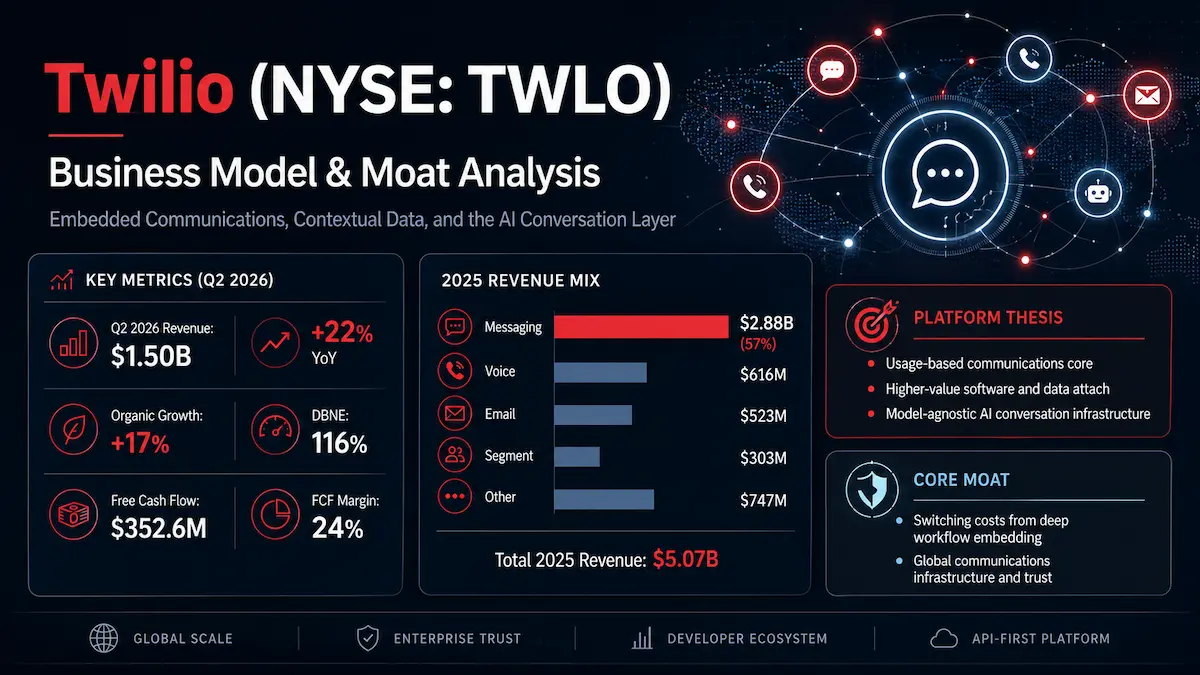
- Twilio remains economically anchored in usage-based communications. In 2025, 74% of revenue came from usage-based fees, while Messaging alone generated $2.88 billion, or about 57% of total revenue. The company therefore behaves less like a pure high-margin SaaS vendor and more like a software-controlled communications utility with a growing software and data layer.
- The strongest moat is switching cost, not a classic network effect. Twilio becomes difficult to remove when its APIs, phone numbers, routing logic, authentication flows, compliance configuration, contact-center workflows, customer profiles, and observability are embedded across production systems. The moat gets stronger as customers use more of the stack, but it is not absolute because competing CPaaS vendors, cloud platforms, carriers, and enterprise software companies can still attack individual workloads.
- Segment is strategically more important than its current revenue weight suggests. Segment produced about $303 million of 2025 revenue, roughly 6% of the company total, but it supplies the contextual data layer Twilio needs if it wants communications to evolve from commodity transport into persistent, personalized conversations.
- The operating evidence has improved materially. Twilio reported Q2 2026 revenue of $1.50 billion, up 22% year over year and 17% organically, while Dollar-Based Net Expansion reached 116% and free cash flow reached $353 million. Management also raised its full-year 2026 organic growth and free-cash-flow outlook. These are confirmed results and management guidance, not guarantees of future performance.
- The central risk is that AI expands communications volume without expanding Twilio’s economic take rate. Carrier pass-through fees can inflate reported revenue without adding gross profit, competitors can pressure pricing, and model or cloud vendors may capture much of the value created by AI agents. The investment case therefore depends on gross-profit growth, software attach, retention, and operating leverage—not headline message volume alone.
Evidence convention: “Confirmed fact” refers to information reported in Twilio filings or official company disclosures. “Management target” refers to guidance, strategic objectives, or product claims made by management. “Analytical inference” is a conclusion derived from disclosed economics and product architecture. “Unverified market expectation” refers to outcomes that may be discussed by investors or the market but have not been established by company results.
1. Business Model Breakdown
The core economic engine: metered communications infrastructure
Twilio was founded in 2008 to abstract the complexity of global telecommunications networks into software APIs. That origin still defines the company’s economic DNA. Instead of asking developers to negotiate carrier relationships, provision telecom infrastructure, and build routing logic from scratch, Twilio exposes communications capabilities through programmable interfaces. Customers can embed messaging, voice, email, authentication, and related workflows directly into applications.
Confirmed fact: Twilio’s 2025 Form 10-K states that 74% of revenue came from usage-based fees. Messaging and Voice are primarily usage-based: customers pay according to units such as messages sent or received and call minutes. Subscription-oriented products such as Email and Segment account for a smaller share of the business. This mix matters because usage revenue can scale quickly with customer activity, but it also carries telecom pass-through costs and is more exposed to traffic volatility than conventional seat-based SaaS.
Confirmed fact: 2025 revenue was $5.07 billion. Messaging generated $2.88 billion, Voice $616 million, Email $523 million, Segment $303 million, and other products $747 million. Messaging therefore represented about 57% of annual revenue. This concentration explains why carrier economics, messaging regulation, deliverability, fraud prevention, and global routing remain financially important even as Twilio increasingly presents itself as a customer-engagement and AI infrastructure platform.
The underlying model can be understood as a layered monetization system. The first layer is communications transport: Twilio earns revenue when an application causes a message, call, verification, or other communication event. The second layer is software abstraction: APIs, orchestration, identity, compliance, monitoring, and developer tooling make telecom infrastructure easier to consume. The third layer is data and application software: Segment, Flex, marketing tools, and newer conversation products attempt to capture higher-value workflows above the transport layer.
Analytical inference: the strategic objective is not to abandon usage-based communications. It is to increase the amount of software value attached to every communications workload. If Twilio can make a customer’s messaging and voice traffic depend on identity, consent, customer context, orchestration, analytics, and persistent memory, the company can deepen retention and potentially improve gross-profit dollars per customer even if raw telecom transport remains competitive.
Why the revenue model is structurally different from pure SaaS
Twilio’s 2025 GAAP gross margin was 49%, materially below the gross margins of many application-software companies. The reason is structural: cost of revenue includes network service provider fees and cloud infrastructure costs. Twilio must pay carriers and other network providers when communications traffic traverses their networks.
Confirmed fact: Twilio discloses that major U.S. carriers have increased application-to-person messaging fees and that Twilio generally passes these charges through to customers at cost. That accounting creates equal revenue and cost of revenue, increasing reported revenue without increasing gross profit. It can therefore dilute reported gross margin even when the underlying economics of Twilio’s own software layer have not deteriorated.
This creates an important analytical rule: investors should not evaluate Twilio only on reported revenue growth. Organic revenue growth is useful, but gross-profit growth, Dollar-Based Net Expansion, free-cash-flow generation, and the mix of higher-value software products are often more informative measures of economic quality.
Platform strategy: from communications API to conversation infrastructure
The company’s development history shows a deliberate broadening of scope. Twilio went public in June 2016 after establishing a developer-first communications platform. It completed the acquisition of SendGrid in February 2019, adding email to its channel portfolio. In November 2020, it completed the approximately $3.2 billion stock acquisition of Segment, adding a customer data platform designed to unify first-party customer information.
The strategic logic of these transactions is coherent even though the financial results have been uneven. SendGrid expanded the number of channels Twilio could deliver. Segment addressed a different problem: communications without customer context are easier to commoditize. By combining a communications event with identity, behavioral history, consent, preferences, and prior interactions, Twilio can attempt to sell an engagement system rather than a transport endpoint.
Confirmed fact: at SIGNAL 2026, Twilio made Conversation Memory, Conversation Orchestrator, Conversation Intelligence, and Agent Connect generally available. Management describes these products as a new conversation layer that preserves context across channels and coordinates interactions among human and AI agents. Agent Connect is model-agnostic, allowing customers to connect their preferred AI models and agents to Twilio communications infrastructure.
Management target: Twilio wants its platform to become the infrastructure layer for customer conversations in the AI era, combining global communications, persistent memory, orchestration, identity, governance, and observability. This is a strategic objective, not a proven market outcome.
Analytical inference: the model-agnostic approach is commercially significant. Rather than compete directly to own the foundation model, Twilio is positioning itself as neutral infrastructure between models, enterprise data, communications channels, and end users. If the AI application layer remains fragmented, neutrality can widen Twilio’s addressable integration surface. If a small number of cloud or AI platforms vertically integrate communications and enterprise workflow, that same neutrality could become less valuable.
2. Deep Dive into Economic Moats
Moat #1: Switching costs created by production embedding
Among Warren Buffett’s four common moat categories, switching costs are Twilio’s most defensible advantage. The source of the switching cost is not simply contractual lock-in. It is operational entanglement.
A mature Twilio deployment can touch application code, customer phone numbers, authentication logic, routing rules, messaging templates, carrier registrations, fraud controls, consent records, call flows, contact-center configurations, customer profiles, observability, and incident-response procedures. Replacing the provider can require engineering work, testing, re-certification, number migration, data migration, compliance review, and operational retraining. The risk of degrading deliverability or breaking customer-facing communications raises the practical cost of migration.
This moat is strongest with enterprise customers running mission-critical workflows. A developer using a single SMS API for a low-volume application can switch relatively easily. An enterprise using Twilio across messaging, voice, authentication, email, Flex, customer profiles, routing, and AI orchestration faces a much more complex migration.
Confirmed fact: Twilio’s Dollar-Based Net Expansion Rate reached 116% in Q2 2026, up from 108% a year earlier. The metric rises when existing customers expand usage, extend products to new applications, or adopt additional Twilio products. The improvement is evidence of stronger expansion within the installed base, although it does not by itself prove durable pricing power.
Analytical inference: Twilio’s platform strategy is fundamentally a switching-cost strategy disguised as product expansion. Every additional shared service—identity, data, orchestration, monitoring, compliance, memory—creates another dependency around the communications workload. The commercial goal is to make Twilio less replaceable at the architectural level even if individual channels remain competitively priced.
What would a competitor have to spend to catch up? The cost is not only software development. A credible challenger needs global carrier and channel connectivity, regulatory coverage, deliverability expertise, fraud systems, developer tooling, enterprise reliability, support, and integrations. It must then persuade customers to accept migration risk. Large cloud providers and established CPaaS companies can finance such capabilities, which is why the moat should be described as meaningful rather than impregnable.
Moat #2: global communications infrastructure, trust, and operational scale
Twilio’s second moat is a combination of intangible assets and operating scale. Its “Super Network” connects communications networks and inbox providers around the world and uses software to optimize communications quality and cost. The asset is not a proprietary physical network in the traditional telecom sense; rather, it is the accumulated routing, carrier relationships, compliance processes, deliverability know-how, APIs, and operational data required to make fragmented communications systems behave like one programmable platform.
This advantage matters because global communications are locally regulated and operationally messy. Sender registration, phone-number rules, authentication, spam controls, fraud, carrier policies, data residency, and channel-specific requirements create friction that developers would otherwise have to manage individually. Twilio’s value proposition is partly the removal of that complexity.
However, scale should not be confused with an automatic cost moat. Twilio’s gross margin is constrained by carrier and network fees, and some of those fees are passed through at cost. Regional carriers may have structural advantages in their own markets, while other CPaaS vendors can aggregate traffic at significant scale. The defensible element is therefore less “Twilio is always the cheapest provider” and more “Twilio can offer a broad, globally operable abstraction layer with established reliability and compliance capabilities.”
What is not a strong moat: classic network effects
Twilio does not have a classic two-sided network effect comparable with a payments network, social network, or marketplace where each new participant directly increases utility for other participants. A new Twilio customer does not automatically make Twilio more useful to every existing customer.
There are secondary data effects. More traffic can produce more information about routing quality, fraud patterns, deliverability, and operational performance, and Twilio can use those signals to improve products. But these effects are indirect, difficult to isolate economically, and available in some form to other scaled communications providers.
Analytical inference: investors should resist describing Twilio’s developer community or communications volume as a “network effect” without qualification. Developer familiarity is an intangible distribution asset; scale can improve operations; neither necessarily creates a self-reinforcing monopoly.
Can the moats support long-term excess returns?
Potentially, but the answer depends on where incremental gross profit is created. If Twilio remains primarily a reseller and software wrapper around increasingly commoditized communications transport, switching costs may defend revenue without producing exceptional returns on capital. If the company successfully attaches higher-value identity, data, orchestration, analytics, and AI workflow software to the same customer relationships, the economic quality of the installed base can improve.
The moat thesis therefore requires evidence of monetization above the carrier layer. Durable indicators would include sustained DBNE above 100%, gross-profit growth that keeps pace with or exceeds organic revenue growth, growing adoption of multi-product solutions, stable or improving free-cash-flow margins, and evidence that new AI conversation products generate incremental revenue rather than merely protecting legacy traffic.
3. Business Inflection Points & Future Catalysts
The critical inflection point: the 2024 shift from expansion at any cost to integrated profitable growth
Twilio’s most important strategic turning point was not a single acquisition. It was the leadership and capital-allocation reset in early 2024.
Confirmed fact: Khozema Shipchandler became CEO in January 2024 after previously leading Twilio Communications and serving in senior operating and finance roles. Management and the board then conducted an operational review of Segment, including consideration of a potential sale. In March 2024, Twilio chose to retain Segment, cut and refocus investment, accelerate product integration with Communications, and target Segment break-even on a non-GAAP operating basis by Q2 2025.
Confirmed fact: the target was subsequently achieved. In Q2 2025, Segment produced approximately $75.5 million of revenue and $6.0 million of segment non-GAAP income from operations. This did not prove that Segment had become a major growth engine—its Q2 2025 revenue was roughly flat year over year—but it demonstrated that the business could be run without the prior level of losses.
Analytical inference: this reset changed Twilio’s corporate gene from acquisition-led platform expansion toward return-on-investment discipline. The company stopped treating product breadth as sufficient evidence of value and began forcing the portfolio to earn its place through profitability, cross-sell, and strategic integration. The subsequent improvement in company-wide growth and cash generation is consistent with that reset, although causation cannot be attributed to one management action alone.
Catalyst 1: sustained expansion in the installed base
Confirmed fact: Q2 2026 revenue was $1.50 billion, up 22% year over year, while organic revenue increased 17%. DBNE reached 116%, compared with 108% in Q2 2025. Free cash flow reached $352.6 million, or a 24% margin.
Management target: for full-year 2026, Twilio raised its reported revenue growth outlook to 18%–18.5%, organic revenue growth to 13%–13.5%, non-GAAP income from operations to $1.135–$1.155 billion, and free cash flow to $1.135–$1.155 billion.
Transmission mechanism: a higher DBNE means the existing customer cohort is spending more, whether through greater traffic, new applications, or additional products. Because Twilio already bears the customer acquisition and integration cost, expansion can produce operating leverage if incremental gross profit grows faster than operating expenses.
Observable indicators: DBNE; organic revenue growth excluding carrier-fee distortions and acquisitions; gross-profit growth; non-GAAP operating margin; free-cash-flow margin; and commentary on self-service, ISV, partner-led, cross-sell, and solution-selling performance.
Execution risk: usage can weaken with customer activity, messaging prices can face competition, and carrier fee pass-throughs can make reported revenue appear stronger without adding gross profit. A high reported growth rate that is not accompanied by gross-profit and cash-flow growth would be a lower-quality catalyst.
Catalyst 2: monetization of the AI conversation layer
Confirmed fact: in May 2026, Twilio made Conversation Memory, Conversation Orchestrator, Conversation Intelligence, and Agent Connect generally available. The new architecture is intended to carry context across channels and participants, including AI agents and humans. Twilio also redesigned its Console and is continuing to add communications and data-residency capabilities.
Transmission mechanism: AI agents can increase the number and complexity of machine-mediated customer interactions. Twilio can benefit if it supplies the communications channel, real-time context, identity, routing, memory, and observability around those interactions. The economic upside is greater if AI drives adoption of multiple Twilio software layers rather than only creating more low-margin messaging or voice minutes.
Observable indicators: disclosed customer adoption of the new conversation products; increases in Voice or messaging usage tied to AI workloads; Segment reacceleration; rising multi-product attach; customer examples that move from pilots into scaled production; gross-profit growth relative to traffic growth; and evidence that AI products create incremental paid usage rather than being bundled primarily as retention features.
Execution risk: the products are newly generally available, so broad commercial adoption remains unproven. Hyperscale clouds, model providers, CCaaS vendors, CRM platforms, and rival CPaaS companies can all compete for the orchestration layer. Open-source agent frameworks may reduce software pricing power. In addition, Twilio’s model-agnostic design lowers customer lock-in at the model layer by design; that flexibility can help win customers, but it also means Twilio must capture value through infrastructure quality rather than proprietary AI dependency.
Catalyst 3: margin conversion and capital efficiency
Confirmed fact: Twilio generated GAAP operating income of $84.5 million and non-GAAP operating income of $284.6 million in Q2 2026. It also generated $352.6 million of free cash flow. These results show that the company is no longer operating with the cost structure associated with its earlier hypergrowth phase.
Transmission mechanism: if revenue grows at a double-digit rate while sales, administrative, and infrastructure costs grow more slowly, incremental gross profit can convert into operating income and free cash flow. Stronger cash generation also gives the company flexibility to repurchase shares, offset stock-based compensation dilution, invest in product development, or make disciplined acquisitions.
Observable indicators: GAAP and non-GAAP operating margins, free-cash-flow margin, stock-based compensation as a percentage of revenue, diluted share count, repurchase activity, and the relationship between research-and-development spending and product monetization.
Execution risk: margin expansion can stall if Twilio must reinvest heavily to defend market share, if higher-margin software fails to scale, if international and carrier costs rise, or if price competition forces lower take rates. Investors should also distinguish recurring operating improvement from accounting effects: Q2 2026 GAAP diluted EPS included a large non-cash tax benefit related to releasing part of the valuation allowance on U.S. deferred tax assets.
Unverified market expectation to treat cautiously
One possible market narrative is that Twilio becomes a default communications backbone for autonomous AI agents. That outcome is plausible but not verified. The company has relevant assets—real-time communications, global reach, identity, customer data, orchestration, and developer APIs—but the competitive architecture of agentic software is still unsettled. It is not yet established whether most economic value will accrue to model providers, agent platforms, cloud infrastructure, enterprise applications, communications networks, or a combination of these layers.
A disciplined assessment should therefore value the AI opportunity as an option whose probability must be updated through adoption and gross-profit evidence, not as revenue that already exists.
4. Key FAQs
How does the Twilio business model make money from messaging and voice?
Twilio primarily charges messaging customers according to the number of messages sent or received and voice customers according to call usage such as minutes. These workloads are usage-based rather than conventional per-seat SaaS subscriptions. Twilio then pays network service providers and carriers to deliver the traffic. The difference between customer economics and network costs, plus the value created by APIs, routing, security, compliance, and software features, determines gross profit. Because some carrier fees are passed through at cost, investors should track gross-profit growth as well as revenue growth.
What is Twilio’s strongest competitive moat versus other CPaaS providers?
Twilio’s strongest moat is switching cost created by deeply embedded production infrastructure. A customer using Twilio across code, phone numbers, routing, authentication, compliance, contact-center flows, data profiles, and monitoring faces meaningful migration cost and operational risk. Twilio also benefits from global communications infrastructure and developer familiarity. However, it does not possess an unassailable network effect, and well-funded CPaaS vendors, carriers, cloud providers, and enterprise software companies can compete for individual workloads.
Can Twilio benefit from AI agents without owning a foundation model?
Yes, if AI agents create more real-time customer conversations and enterprises need a neutral layer to connect models with voice, messaging, identity, customer context, routing, and governance. Twilio’s 2026 conversation products are explicitly model-agnostic, which allows customers to switch models without rewiring communications infrastructure. The business logic is attractive because Twilio can monetize the interaction layer rather than the model itself. The uncertainty is whether this layer becomes sufficiently differentiated and paid, or whether cloud, CRM, CCaaS, and AI vendors bundle comparable functionality.
5. Conclusion
Twilio’s enterprise gene is still rooted in a simple idea: make globally fragmented communications programmable. That abstraction created a developer distribution engine and a large usage-based revenue base. The same history also explains the company’s limitations. Communications transport carries third-party network costs, pricing pressure, regulatory complexity, and lower gross margins than pure application software.
The strategic evolution is an attempt to move the center of gravity upward. SendGrid added email. Segment added customer context. The 2024 operating reset forced the portfolio toward measurable profitability and tighter integration. The 2026 conversation layer extends that logic into AI by combining communications, memory, orchestration, and intelligence. The most defensible moat is therefore not “Twilio has the most messages.” It is the accumulated switching cost of being deeply embedded in how an enterprise identifies customers, moves conversations across channels, preserves context, complies with telecom rules, and connects software to real-world communications networks.
The next test is economic, not conceptual. Q2 2026 shows stronger organic growth, expansion, profitability, and cash generation, but the durability of those trends must still be demonstrated. The key question for the next one to two years is whether Twilio can turn AI-driven communications demand into higher-quality gross profit and deeper software attachment rather than merely higher traffic. If it does, the company’s business model can evolve from a communications API vendor into a more defensible engagement infrastructure layer. If it does not, the market may continue to value Twilio primarily on the economics of a competitive CPaaS business.
Primary Sources
- U.S. Securities and Exchange Commission — Twilio 2025 Form 10-K
- Twilio Investor Relations — Second Quarter 2026 Results
- Twilio Investor Relations — Next Generation Platform for the Agentic Era, May 2026
- Twilio Investor Relations — CEO Transition, January 2024
- Twilio Investor Relations — Segment Operational Review, March 2024
- Twilio — Second Quarter 2025 Results and Segment Operating Results
- Twilio — Completion of SendGrid Acquisition, February 2019
- Twilio — Completion of Segment Acquisition, November 2020
- Twilio — Company History
Disclaimer: This article is intended solely for business logic discussion and corporate research purposes, and does not constitute investment advice of any kind.