

Key Takeaways
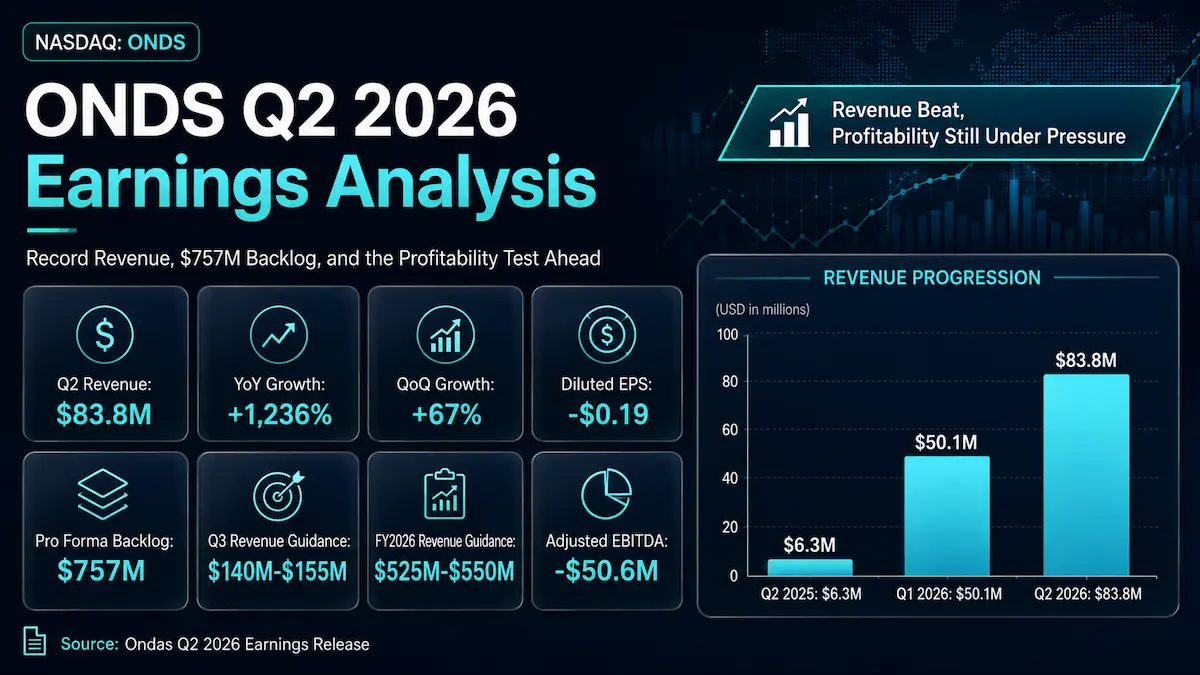
- Ondas reported $83.772 million of Q2 2026 revenue, up 67% sequentially and more than 13-fold year over year, while pro forma organic revenue growth was 85%.
- Revenue beat the published consensus by roughly 22%, but diluted EPS of -$0.19 missed the roughly -$0.10 consensus and adjusted EBITDA loss widened to $50.6 million.
- Pro forma backlog reached $757 million, while management raised full-year 2026 revenue guidance to $525-$550 million and guided Q3 revenue to $140-$155 million.
- The biggest debate is no longer demand. It is execution: at the midpoint of full-year and Q3 guidance, Ondas would need roughly $256.1 million of Q4 revenue to hit the 2026 midpoint.
- At the latest U.S. close of $9.24 on August 14, 2026, Ondas carried a market capitalization of roughly $5.27 billion, implying about 9.8x the midpoint of 2026 revenue guidance before the company has reached company-wide adjusted EBITDA profitability.
1. Core Earnings Breakdown
Revenue and Profitability Analysis
Ondas Inc. delivered a genuine top-line breakout in Q2 2026. Revenue was $83.772 million for the three months ended June 30, 2026, compared with $50.122 million in Q1 2026 and $6.273 million in Q2 2025. That represents 67% sequential growth and approximately 1,236% year-over-year growth. Management also disclosed 85% pro forma organic growth, meaning the current portfolio would still have produced very strong year-over-year expansion even if the acquired businesses had been owned in both comparison periods.
Gross profit rose to $36.131 million from $24.658 million in Q1 2026 and $3.332 million a year earlier. GAAP gross margin, however, fell to 43.1% from 49.2% in Q1 and 53.1% in Q2 2025. Management attributed part of the pressure to amortization of capitalized intellectual property. On a non-GAAP basis, adjusted gross profit was $42.3 million and adjusted gross margin was 50.4%, only modestly below 51.5% in Q1. This is an important distinction: underlying product economics remained near management’s long-term target, but acquisition accounting and mix are making GAAP profitability look materially weaker.
The more serious issue was below gross profit. Operating expenses surged to $199.077 million from $67.329 million in Q1, producing a GAAP operating loss of $162.946 million. The implied GAAP operating margin was approximately -194.5%, calculated as -$162.946 million divided by $83.772 million of revenue. Management said $105.8 million of Q2 operating expense consisted of non-cash or acquisition-related items, including $67.6 million of stock-based compensation, $19.2 million from changes in contingent consideration, $14.0 million of amortization and $4.4 million of transaction-related expense. Adjusted cash operating expense was still substantial at $93.3 million, and adjusted EBITDA was a loss of $50.6 million.
Ondas does not separately disclose Q2 revenue by its four strategic market segments, so assigning a precise revenue share to Aerial Security, ISR and Persistent Intelligence, Precision Strike, or Autonomous Ground Systems would be unsupported. The company did, however, provide useful growth and backlog markers that show where economic concentration is forming.
- Aerial Security: Management said Sentrycs’ pro forma revenue increased approximately 298% year over year, while Airobotics revenue increased approximately 112%, supported by counter-UAS demand, Iron Drone, autonomous drone infrastructure and integrated systems engagements. Investment view: this is the clearest evidence that Ondas is not relying solely on acquired revenue; the counter-UAS platform is generating real same-business acceleration and has both defense and civilian-security applications.
- ISR and Persistent Intelligence: During Q&A, roughly $258 million of backlog was referenced for ISR. Against the $757 million pro forma backlog, that equals about 34.1%, calculated from company-reported and call-referenced figures. The portfolio now includes Stratollite, ULTRA and related long-endurance ISR capabilities. Investment view: ISR is becoming a core revenue-visibility engine, but the value of the backlog depends on production scaling and the timing of large government deliveries.
- Precision Strike: Roughly $300 million of backlog was referenced during Q&A, equal to about 39.6% of the $757 million pro forma backlog, calculated from company-reported and call-referenced figures. Ondas also said it had captured more than $240 million of aggregate orders associated with the U.S. Army’s $982 million Lethal Unmanned Strike IDIQ, while Rotron captured approximately $34.2 million of Q2 orders. Investment view: precision strike is potentially the largest near-term backlog contributor, but it is also one of the most timing-sensitive categories and therefore a major source of quarterly revenue volatility.
- Autonomous Ground Systems: Management highlighted strong Q2 order activity, while 4M delivered approximately 258% pro forma year-over-year revenue growth. The company also expects volume deliveries in Q4 under a combat engineering vehicle program with total potential value of approximately $140 million. Investment view: ground systems diversify Ondas away from pure air-platform exposure, but the thesis still requires manufacturing and field-support execution at a scale the company has not historically demonstrated.
Taken together, ISR and Precision Strike represented roughly 73.7% of the pro forma backlog referenced on the call, calculated as ($258 million + $300 million) divided by $757 million. That is not the same as Q2 revenue mix, but it does tell investors where future revenue sensitivity is concentrated.
Expectations vs. Actual Results
- Revenue: $83.772 million actual versus approximately $68.54 million published consensus. Result: ✅ Beat by about $15.23 million, or 22.2%.
- Diluted EPS: -$0.19 actual versus approximately -$0.10 published consensus. Result: ❌ Miss by $0.09 per share.
- GAAP operating margin: approximately -194.5%, calculated from the reported $162.946 million operating loss and $83.772 million of revenue. A reliable public pre-earnings consensus operating-margin estimate was not available, so assigning a beat or miss would be inappropriate.
- Adjusted EBITDA: -$50.6 million actual versus a FactSet expectation of approximately -$31.6 million cited in post-earnings coverage. Result: ❌ The loss was about $19.0 million wider than expected.
- Q3 2026 guidance: $140-$155 million of revenue, implying approximately 76% sequential growth at the midpoint from Q2.
- Full-year 2026 guidance: raised to $525-$550 million, including expected Cyberhawk revenue in the second half.
- Profitability timing: operating-platform adjusted EBITDA profitability is now targeted for Q4 2026, while company-wide adjusted EBITDA profitability is targeted for Q4 2027.
The revenue beat came from two sources that matter very differently for valuation. First, acquisitions expanded the consolidated revenue base. Second, and more importantly, management reported 85% pro forma organic growth, with very high growth rates at businesses such as Sentrycs, Airobotics and 4M. That reduces the risk that the headline growth rate is merely the result of buying revenue.
The earnings miss had a different origin. Ondas is front-loading operating infrastructure, corporate development, acquisition integration, sales capacity, manufacturing support and field-service costs ahead of a very steep second-half revenue ramp. Some of the GAAP loss was non-cash, but the $93.3 million of adjusted cash operating expense and $50.6 million adjusted EBITDA loss show that the spending burden is economically meaningful even after stripping out purchase accounting and stock compensation.
For the market, the most important metric is therefore not Q2 EPS in isolation. The stock is being valued on backlog conversion, product shipment velocity, gross-margin durability and management’s ability to turn a rapidly assembled portfolio into a scalable operating platform. Revenue growth is already strong enough to support the strategic narrative; the unresolved question is whether that revenue can produce operating leverage quickly enough to justify the valuation.
The stock reaction captured that tension. Ondas shares fell roughly 8% on August 13 after earnings, despite the large revenue beat and higher full-year guidance. The decline is better explained by the much wider-than-expected adjusted EBITDA loss, a still-heavy cash cost structure, acquisition integration risk and dilution than by a generic “sell the news” narrative. The shares then recovered to $9.24 on August 14, but the post-report volatility shows that investors are no longer willing to reward order growth without simultaneously demanding evidence of profitability and execution.
Earnings Call Highlights
Management emphasized that Q2 growth was not simply acquisition-driven: pro forma organic revenue increased approximately 85% year over year.
💡 Reading Between the Lines: This is the most important defense of the acquisition strategy. If acquired businesses continue to accelerate inside Ondas rather than merely add static revenue, the company can argue for a platform multiple rather than a low-quality roll-up discount.
Management characterized Q2 as the expected peak quarter for adjusted EBITDA losses and expects operating leverage to improve from Q3 onward.
💡 Reading Between the Lines: The investment case now has a measurable profitability checkpoint. If adjusted EBITDA does not improve meaningfully while Q3 revenue moves toward $140-$155 million, the market will likely question whether the cost structure is truly front-loaded or structurally too high.
The operating platform is targeted to reach adjusted EBITDA profitability in Q4 2026, with company-wide adjusted EBITDA profitability targeted for Q4 2027.
💡 Reading Between the Lines: Management is separating the economics of the operating businesses from corporate-level growth spending. That makes Q4 2026 a useful test of unit-level operating leverage, while Q4 2027 remains the more demanding test of whether M&A, corporate development and holding-company costs can be absorbed.
Ondas said its two-year strategic program pipeline exceeds $11 billion, while pro forma backlog stands at approximately $757 million and Q3-to-date orders reached about $105 million as of August 10.
💡 Reading Between the Lines: Demand visibility is no longer the weak point of the thesis. The critical conversion funnel is pipeline to orders, orders to backlog, and backlog to recognized revenue; execution slippage anywhere in that chain would have a disproportionate effect because the 2026 guide assumes a very large second-half ramp.
Management said Palantir Foundry and Warp Speed are being used to create a common operating picture across manufacturing, supply chain, inventory and financial systems, while SkyWeaver supports cross-platform mission integration.
💡 Reading Between the Lines: Palantir is not only a marketing partnership. Ondas is using the software stack to shorten integration time and standardize acquired businesses, while SkyWeaver may improve win rates where customers require command-and-control interoperability. The valuation payoff depends on whether those tools reduce integration friction and increase cross-selling faster than overhead expands.
2. Deep Business Insights
Hidden Metrics That Matter
Metric one is book-to-bill. Ondas captured approximately $175 million of new orders in Q2 against $83.772 million of revenue. The calculation is $175 million / $83.772 million = approximately 2.09x, calculated from company-reported figures. A book-to-bill ratio above 2x means orders were replenishing backlog at more than twice the pace at which revenue was being recognized during the quarter. That is a strong demand signal and helps explain why management was comfortable raising full-year guidance.
Metric two is the implied Q4 revenue requirement. The midpoint of full-year guidance is $537.5 million. First-half revenue was $133.894 million, and the midpoint of Q3 guidance is $147.5 million. Therefore, the implied Q4 requirement is $537.5 million – $133.894 million – $147.5 million = approximately $256.1 million, calculated from company-reported figures. That would be approximately 73.6% above the Q3 midpoint and about 3.06x Q2 revenue. This is the single most important execution number in the current model: the full-year guide can be raised and backlog can be large, but the market still needs to see a step-function increase in deliveries during Q4.
Why are customers choosing Ondas? The answer increasingly appears to be the combination of mission-ready technology, access to a broad multi-domain portfolio, financial capacity to fund production, and a shared operating layer that can support deployment and sustainment. Government and critical-infrastructure customers are not only buying a drone or sensor; they are increasingly looking for long-term suppliers that can integrate sensing, autonomy, command-and-control, counter-UAS, ISR and strike capabilities while maintaining field support. Ondas is attempting to differentiate itself by becoming that platform company rather than remaining a collection of narrowly focused product vendors.
The company also has a tangible integration mechanism. Palantir Foundry has been deployed across four of five U.S. business sites and across global operations, with eight enterprise workstreams and 24 active use cases. Ondas expects those deployments to improve G&A productivity and create additional efficiencies in supply chain, manufacturing and flight operations. If that operating architecture works, acquired companies can potentially scale faster inside Ondas than they could independently. If it fails, the same acquisition strategy can create duplicated overhead, integration delays and persistent margin leakage.
Industry Chain Reactions
- ✅ Benefit — Palantir Technologies (NASDAQ: PLTR): Ondas is actively deploying Foundry and Warp Speed across its operating platform and developing SkyWeaver with Palantir. If Ondas continues to scale through acquisitions, manufacturing expansion and larger government programs, Palantir can benefit from a broader deployment footprint and deeper operational integration. The direct financial effect on Palantir may be small relative to its overall revenue base, but Ondas provides a visible defense-autonomy reference case for its industrial and mission software.
- ❌ Face Pressure — AeroVironment (NASDAQ: AVAV): Ondas is moving deeper into precision strike, counter-UAS and ISR, categories where AeroVironment already has strong positions through Switchblade and its counter-UAS portfolio. Ondas’ growing backlog, LUS exposure, DZYNE capabilities and integrated systems strategy could increase competition for selected U.S. and allied defense programs. This should not be interpreted as an immediate negative earnings read-through for AVAV, but it raises the probability of more direct competitive overlap in high-growth autonomous defense procurement.
Valuation Framework and Key Risks
At the August 14, 2026 U.S. close of $9.24, Ondas had a market capitalization of approximately $5.27 billion. Against the $537.5 million midpoint of 2026 revenue guidance, the stock trades at roughly 9.8x current-year sales. That is a demanding multiple for a company with a Q2 adjusted EBITDA margin of approximately -60.4%, calculated as -$50.6 million divided by $83.772 million of revenue, and with company-wide adjusted EBITDA profitability not targeted until Q4 2027.
The bullish argument is that a simple current-year price-to-sales multiple understates the potential earnings power of a platform growing organically at a very high rate, with adjusted gross margin around 50%, more than $750 million of pro forma backlog, an $11 billion-plus two-year pipeline and major programs entering volume delivery. If management sustains 30%-40% organic growth beyond 2026, converts backlog without major gross-margin erosion, and demonstrates operating leverage, today’s valuation can become much less demanding on forward revenue.
The bearish argument is that investors are already paying for a large portion of that future success. Several risks can break the valuation framework:
- Execution risk: The midpoint of the 2026 guide requires approximately $256.1 million of Q4 revenue, a major step up from both Q2 actual revenue and the Q3 guidance midpoint.
- Margin risk: GAAP gross margin fell to 43.1%, while adjusted gross margin slipped to 50.4%. Management expects mix to remain variable as system sales and acquisitions change the revenue composition.
- Cost risk: Adjusted cash operating expense reached $93.3 million in Q2. Management expects operating leverage, but corporate development and platform investment may remain elevated for several quarters.
- M&A integration risk: World View, Mistral, Omnisys, DZYNE and Cyberhawk materially expanded the portfolio in a short period. Integration is now a core operational variable, not a secondary consideration.
- Dilution risk: Q2 weighted-average basic shares were 500.709 million versus 150.653 million in Q2 2025, an increase of approximately 232.4%, calculated from company-reported figures. Even if acquisitions create enterprise value, per-share value creation can lag if the share count grows faster than sustainable earnings power.
- Backlog timing risk: Backlog is substantial, but large government and defense programs can move between quarters based on production, acceptance, procurement and customer scheduling. Management itself declined to precisely shape some precision-strike deliveries by quarter.
- Valuation risk: At roughly 9.8x the midpoint of 2026 sales, the stock has limited tolerance for missed shipment schedules, delayed margin improvement or evidence that the acquisition platform requires permanently high overhead.
The most useful framework is therefore not to ask whether Ondas is “cheap” or “expensive” on one static multiple. The stock is effectively pricing a transition from an acquisition-enabled high-growth defense platform into a scaled operating company. The next two checkpoints are Q3 revenue and adjusted EBITDA improvement, followed by Q4 backlog conversion. If those milestones are met, investors can begin underwriting 2027 on a more conventional growth-and-margin basis. If they are missed, the market is likely to compress the sales multiple before the company reaches positive company-wide adjusted EBITDA.
3. Key FAQs
Did ONDS beat Q2 2026 earnings expectations?
Ondas beat revenue expectations decisively but missed on profitability. Q2 2026 revenue was $83.772 million versus a published consensus of approximately $68.54 million, a beat of about 22.2%. Diluted EPS was -$0.19 versus roughly -$0.10 expected, while adjusted EBITDA loss of $50.6 million was also materially wider than the approximately $31.6 million loss expected by FactSet according to post-earnings reporting.
What is ONDS Q3 2026 revenue guidance and full-year 2026 guidance?
Management guided Q3 2026 revenue to $140-$155 million and raised full-year 2026 revenue guidance to $525-$550 million. The full-year range includes expected Cyberhawk revenue during the second half. At the midpoint of both ranges, Ondas would need approximately $256.1 million of Q4 revenue to reach the full-year midpoint.
Is ONDS stock expensive after Q2 2026 earnings?
At the August 14, 2026 close of $9.24 and a market capitalization of roughly $5.27 billion, ONDS traded at approximately 9.8x the midpoint of 2026 revenue guidance. That is a premium valuation for a company still reporting negative adjusted EBITDA, but the multiple is being supported by rapid organic growth, a $757 million pro forma backlog, a more than $11 billion two-year pipeline and management’s expectation of substantial operating leverage. The key question is whether Q3 and Q4 execution can convert those forward indicators into revenue and narrowing losses fast enough to support the premium.
Primary data sources: Ondas Inc. official Q2 2026 earnings release, Ondas Investor Relations, and the Q2 2026 earnings call transcript sourced from Refinitiv StreetEvents. Consensus and market-reaction figures were cross-checked against Investing.com earnings data and Barron’s post-earnings coverage. Latest closing price and market capitalization were cross-checked against Yahoo Finance.
Disclaimer: This article/chart is for educational and informational purposes only and does not constitute investment advice of any kind. Past performance is not indicative of future results. Investors should independently evaluate their own risks.