

Key Takeaways
- Marvell makes money primarily by selling semiconductor products, not software subscriptions or advertising. Its economic engine is a mix of merchant silicon and custom ASIC programs delivered through a fabless operating model.
- The strongest moat is the combination of differentiated intellectual property and customer switching costs. Marvell can reuse SerDes, DSP, silicon photonics, processor, security, storage, advanced packaging, and leading-node design capabilities across multiple programs, while hyperscaler qualification cycles make replacement costly and time-consuming.
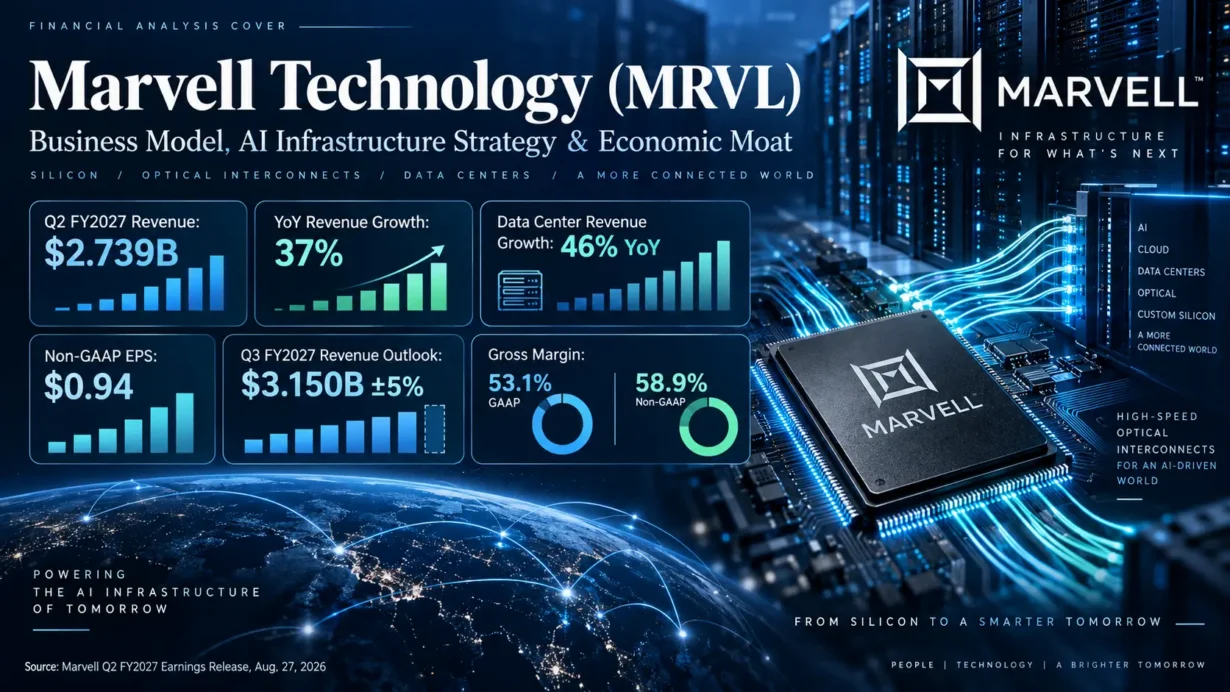
- Data center has become the center of gravity: it represented 74% of fiscal 2026 revenue and 79% of second-quarter fiscal 2027 revenue. AI demand is broadening from custom XPUs into optics, switching, memory, storage, and scale-up connectivity.
- The platform strategy has become more defensible through Avera, Inphi, Innovium, Celestial AI, XConn, and Polariton, plus strategic relationships with NVIDIA and Google. The commercial logic is to increase Marvell content per AI cluster rather than depend on a single chip category.
- The central risk is that custom silicon is not automatically a higher-margin business. Marvell itself states that its end-to-end ASIC model tends to carry lower gross margins, while customer concentration, long design cycles, acquisition integration, and hyperscaler capital-spending volatility can amplify execution risk.
1. Business Model Breakdown
From Storage Silicon to AI Infrastructure
Marvell was founded in 1995 as a fabless semiconductor company and initially concentrated on data-storage technology. Its early revenue base was dominated by read-channel and preamplifier products for disk drives. The original business DNA was already visible: combine analog, mixed-signal, and digital signal processing expertise, outsource fabrication, and concentrate internal capital on silicon design rather than wafer manufacturing.
The modern Marvell was assembled through a sequence of portfolio decisions that progressively moved the company up the data-infrastructure stack. The 2018 acquisition of Cavium added processors, networking, security, and broader infrastructure exposure. The 2019 acquisition of Avera Semiconductor, originally rooted in IBM Microelectronics, gave Marvell a scaled custom ASIC capability. The 2021 acquisition of Inphi added high-speed electro-optics and data-center interconnect technology, while Innovium strengthened cloud switching. In August 2025, Marvell sold its Automotive Ethernet business to Infineon for $2.5 billion, further concentrating capital and management attention on data infrastructure.
That concentration accelerated in 2026. Marvell acquired Celestial AI for Photonic Fabric scale-up interconnect technology, XConn for PCIe and CXL switching silicon, and Polariton Technologies for advanced plasmonics-based optical modulation. The portfolio now spans custom ASICs, optical DSPs, silicon photonics, Ethernet switches, PCIe and CXL connectivity, DPUs, storage controllers, and emerging memory-fabric architectures.
How Marvell Actually Makes Money
The majority of Marvell’s revenue comes from product sales. This is not a SaaS model with recurring subscription revenue, nor an advertising model with audience monetization. Revenue is generated when semiconductor products are sold either directly to customers or through distributors. In the second quarter of fiscal 2027, direct customers and distributors each represented approximately 50% of revenue.
The business has two commercially distinct but strategically reinforcing engines. The first is merchant silicon: standardized products such as optical DSPs, Ethernet switches, storage controllers, DPUs, PCIe/CXL devices, and other connectivity components that can be sold across multiple customers. The second is custom silicon: chips designed around an individual customer’s system architecture, performance targets, software stack, power envelope, packaging configuration, and product roadmap.
Custom silicon changes the economics of the relationship. Marvell does not merely license a block of IP and walk away. Its ASIC model can include intellectual property, design engineering, foundry access, packaging, test, yield management, and delivery of a finished semiconductor. This turns Marvell into an outsourced silicon-development platform for customers that want proprietary differentiation without building every layer of semiconductor capability internally.
The revenue opportunity can therefore expand in two directions. First, a successful custom program can scale with the customer’s installed base. Second, Marvell can sell adjacent connectivity and infrastructure silicon around the same compute architecture. The expanded Google relationship disclosed in August 2026 illustrates this logic: the collaboration covers custom semiconductor programs attached to the TPU ecosystem, including AI inference accelerators, storage controllers, network interface controllers, memory interface controllers, and near-memory compute. The breadth matters because it suggests Marvell is competing for platform content, not only for one accelerator socket.
The Fabless Model and the Margin Equation
Marvell outsources the vast majority of wafer fabrication, assembly, packaging, and test. This avoids the enormous capital burden of owning leading-edge semiconductor fabs and lets the company allocate resources toward architecture, IP development, system engineering, and customer programs. Fiscal 2026 research and development expense was approximately $2.075 billion, or 25.3% of revenue, demonstrating where the economic capital of the business is concentrated.
However, the fabless model should not be confused with an automatic cost moat. Many major semiconductor competitors are also fabless, and all advanced-node vendors compete for scarce foundry, packaging, substrate, and testing capacity. Marvell has entered long-term capacity arrangements with foundries and partners, but its advantage is better understood as time-to-market and design reuse rather than uniquely low manufacturing cost.
Profitability also depends on mix. Fiscal 2026 GAAP gross margin was 51.0%, and second-quarter fiscal 2027 GAAP gross margin improved to 53.1%. Non-GAAP gross margin in that quarter was 58.9%. Yet Marvell explicitly notes that certain end-to-end ASIC programs tend to carry lower gross margins. This creates an important analytical distinction: rapid custom-silicon growth can be highly valuable if it increases gross profit dollars, operating leverage, customer duration, and strategic relevance, even if it does not maximize reported gross-margin percentage.
The Platform Strategy: Reuse the Hard Parts
The deeper business model is a platform strategy built around reusable technology. Marvell’s custom offerings can draw from high-speed SerDes, Arm-based compute, security, storage, silicon photonics, die-to-die interfaces, chiplets, co-packaged optics, high-bandwidth-memory integration, and advanced packaging. The company has executed multiple 5nm designs, is progressing through 3nm programs, and has demonstrated 2nm silicon IP with TSMC while developing even more advanced-node capabilities.
This matters because the cost and risk of developing a leading-edge ASIC are increasingly dominated by non-recurring engineering, verification, physical design, packaging, signal integrity, and software-hardware co-optimization. A platform vendor can amortize some of those investments across multiple customers and product generations. The customer receives a more customized outcome than a pure merchant chip, while Marvell preserves leverage from technology it has already developed.
At the same time, merchant products give Marvell visibility into the bottlenecks emerging around custom compute. As AI clusters scale, value shifts toward data movement: accelerator-to-accelerator links, rack-to-rack fabrics, data-center interconnect, memory pooling, and storage. Marvell’s 102.4 Tbps Teralynx T100 Ethernet switch, 1.6T optical DSP portfolio, Structera PCIe/CXL products, and Photonic Fabric technology are all attempts to monetize this widening connectivity tax on AI infrastructure.
2. Deep Dive into Economic Moats
Moat No. 1: Intangible Assets — Reusable IP, Design Know-How, and System-Level Engineering
Marvell’s most defensible advantage is not brand recognition. It is a portfolio of engineering assets that are expensive, slow, and risky to reproduce. The company operates across analog and mixed-signal design, DSPs, high-speed SerDes, electro-optics, silicon photonics, storage, security, processors, switch silicon, and advanced packaging. These capabilities become more valuable when combined because modern AI infrastructure is constrained by interactions between compute, memory, networking, optics, power, thermals, and packaging rather than by a single transistor metric.
The durability mechanism is accumulated engineering reuse. A competitor can buy access to the same leading-edge foundry node, but it cannot instantly replicate validated IP blocks, production-quality firmware, packaging know-how, customer-specific design methodology, signal-integrity expertise, and engineers who have already taken multiple generations of complex silicon to volume. Marvell’s fiscal 2026 R&D spending of more than $2 billion is therefore better interpreted as maintenance and expansion of an intangible-asset base than as a conventional operating expense alone.
The catch is that semiconductor IP depreciates economically. A SerDes generation, optical DSP, or process-node advantage can be overtaken. Marvell must keep reinvesting aggressively to sustain the moat. The relevant test is not whether Marvell owns advanced IP today, but whether the company can repeatedly translate that IP into design wins before competitors close the gap.
Moat No. 2: Switching Costs — Qualification, Co-Development, and Roadmap Integration
The second major moat is customer switching cost. Marvell’s own regulatory filings state that customer qualification processes can take several months, and that even a manufacturing-process change or supplier change can trigger requalification. In custom silicon, the switching cost is deeper because the semiconductor becomes intertwined with the customer’s architecture, firmware, validation plan, packaging, supply chain, and product-launch schedule.
Once a hyperscaler has spent years co-designing an ASIC and surrounding infrastructure, replacing the silicon partner is not comparable to changing a commodity component. A new supplier must prove functional correctness, performance, power, yield, security, reliability, manufacturing readiness, and schedule execution. The economic cost of a missed launch window can exceed the nominal savings from a lower chip price.
Marvell’s recent ecosystem relationships increase this embeddedness. Through NVIDIA NVLink Fusion, Marvell is positioning custom XPUs and compatible scale-up networking inside the NVIDIA AI infrastructure ecosystem; NVIDIA also invested $2 billion in Marvell in March 2026. Separately, Marvell’s expanded Google agreement reaches multiple custom-silicon categories around the TPU ecosystem, with most warrant vesting tied to purchases of custom products in $500 million revenue increments. These structures do not guarantee future revenue, but they demonstrate unusually deep technical and commercial alignment.
Why Network Effects Are Not the Core Moat
Marvell does not possess a classic network effect in the Buffett sense. The value of a Marvell chip does not automatically increase because more unrelated customers use it, as would occur in a payment network or social platform. Standards compatibility and ecosystem participation can increase addressability, and merchant silicon can benefit from broader adoption, but those are not strong direct network effects.
The ecosystem still matters strategically. Compatibility with standards such as Ethernet, PCIe, CXL, UALink, and NVLink Fusion can lower adoption friction and expand the number of architectures in which Marvell can participate. But this should be treated as a distribution and integration advantage, not as a self-reinforcing network moat.
Why Cost Advantage Is Real but Secondary
Marvell’s fabless structure avoids the fixed-capital burden of owning advanced fabs and allows the company to work with external manufacturing partners. That is economically attractive, but it is not unique. Several direct competitors also operate fabless models and can access leading foundry processes.
The more meaningful cost advantage is engineering efficiency: reuse of validated IP, process platforms, packaging technology, software, and design flows can reduce the customer’s development risk and shorten time to deployment. In other words, Marvell’s cost advantage is less about producing a transistor more cheaply and more about reducing the total cost of creating a differentiated system.
That distinction is important when assessing long-term excess returns. Intangible assets and switching costs can support durable economic value because they reduce customer risk and raise the cost of replacement. Network effects are weak, and manufacturing cost advantages are limited. Marvell’s moat is therefore credible but execution-dependent: it must continuously refresh technology and convert technical credibility into high-volume, multi-generation design wins.
3. Business Inflection Points & Future Catalysts
The Strategic Inflection Point: Cavium Made Infrastructure the Center of Gravity
The most important strategic turning point was the 2018 acquisition of Cavium. Before that transaction, Marvell was still strongly associated with storage, connectivity, and more fragmented semiconductor markets. Cavium brought processors, networking, security, and infrastructure-oriented system expertise at scale. The deal changed the strategic destination of the company: Marvell would compete for the data-infrastructure control plane rather than remain primarily a storage-silicon franchise.
The subsequent deals are best understood as extensions of that decision. Avera added custom ASIC design capacity; Inphi added high-speed optical interconnect; Innovium added cloud switching. The 2025 Automotive Ethernet divestiture then removed a business that was less central to the new thesis, while the 2026 Celestial AI, XConn, and Polariton acquisitions pushed Marvell deeper into AI scale-up, memory, and photonics. The corporate history is therefore not a random acquisition roll-up. It is a progressive concentration around moving, processing, storing, and connecting data inside advanced infrastructure.
Catalyst 1: Custom Silicon Acceleration in the Second Half of Fiscal 2027
Transmission mechanism: management said in August 2026 that it expects a significant acceleration in the custom business beginning in the second half of fiscal 2027. If large hyperscaler programs transition from development into volume production, revenue can rise quickly because a custom accelerator or attach chip can carry meaningful dollar content and ship across a large installed base. The expanded Google agreement broadens the number of potential custom products connected to the TPU ecosystem, while the NVIDIA relationship increases Marvell’s relevance to customers seeking customized infrastructure that remains compatible with NVIDIA architectures.
Observable indicators: investors should watch quarterly data-center revenue growth, management commentary on custom program ramps, customer concentration, design-win disclosures, and the gap between revenue growth and operating-expense growth. Marvell’s third-quarter fiscal 2027 revenue outlook of $3.15 billion, plus or minus 5%, implies continued sequential expansion if achieved. The October 6, 2026 Investor Day is also likely to provide more detail on long-term custom and connectivity roadmaps, although any targets presented there will remain forward-looking.
Main execution risks: custom silicon programs have long development cycles and can be delayed, resized, or canceled. Revenue can also become concentrated around a small number of hyperscalers. Most importantly, Marvell states that the ASIC model can carry lower gross margins. A custom ramp that boosts revenue but requires disproportionate R&D, customer incentives, advanced-packaging costs, or price concessions may produce less incremental operating leverage than top-line growth alone would imply.
Catalyst 2: The 800G-to-1.6T Optical Transition and the Expansion of Scale-Up Connectivity
Transmission mechanism: AI systems are increasing the number of accelerators per cluster and the amount of data moved between compute, memory, storage, racks, and data centers. That raises demand for higher-speed optical DSPs, Ethernet switching, PCIe/CXL connectivity, and eventually more optical links inside the scale-up domain. Marvell’s opportunity is to capture more semiconductor content per deployed accelerator as bandwidth and power constraints intensify.
The product roadmap is unusually broad. Marvell has expanded its 1.6T optical DSP portfolio, introduced the 3nm Teralynx T100 102.4 Tbps Ethernet switch, added high-radix PCIe 6.0 and CXL switches through XConn, and is extending optical technology through Celestial AI’s Photonic Fabric and Polariton’s modulation capabilities. XConn is expected by Marvell to begin contributing revenue in the third quarter of fiscal 2027 and reach a $50 million annualized run rate in the fourth quarter, providing one concrete marker for early integration progress.
Observable indicators: 1.6T product adoption, T100 customer sampling and production progress, XConn revenue contribution, data-center connectivity growth, and the cadence of scale-up design wins are the most useful evidence. Over time, the stronger signal would be customer adoption across multiple layers—switching plus optics plus custom silicon—because that would validate the platform thesis rather than a single-product cycle.
Main execution risks: standards can evolve, hyperscalers can choose internally developed or rival connectivity solutions, and the timing of co-packaged optics and optical scale-up remains uncertain. Marvell also has to integrate multiple acquired engineering teams without slowing product roadmaps. Optical architectures can deliver compelling power and bandwidth advantages, but commercialization timelines are often longer than laboratory demonstrations imply.
Catalyst 3: AI Memory and Storage Become a Larger Part of the Bottleneck
Transmission mechanism: inference workloads are increasingly constrained not only by compute but also by memory capacity, bandwidth, data movement, and key-value cache management. Marvell is attempting to monetize this shift through CXL memory expansion and pooling, near-memory acceleration, PCIe storage controllers, DPUs, and Photonic Fabric shared-memory concepts. If AI infrastructure spending migrates from a compute-centric model toward system-level optimization, Marvell’s addressable content can increase even when accelerator growth normalizes.
Observable indicators: adoption of Structera CXL products, sampling of the Bravera SC6 PCIe 6.0 SSD controller, customer demonstrations involving pooled or disaggregated memory, and revenue growth in storage and switching within the data-center segment. The strategic metric is whether these products become production deployments rather than remaining ecosystem demonstrations.
Main execution risks: CXL-based memory architectures and optical shared-memory concepts are still evolving. Customers may solve memory bottlenecks through higher HBM capacity, software optimization, accelerator architecture changes, or alternative interconnect approaches. Marvell must prove that its system-level solutions create enough improvement in utilization and total cost of ownership to justify architectural change.
Catalyst 4: Operating Leverage — With a Margin-Mix Caveat
Transmission mechanism: semiconductor platforms carry substantial upfront R&D costs, so successful volume ramps can generate operating leverage when revenue grows faster than engineering and corporate expenses. Fiscal 2026 revenue grew 42% year over year, and second-quarter fiscal 2027 gross profit increased faster than revenue. If Marvell can reuse its core IP across a larger number of programs, the economics can improve even as the company continues investing heavily in next-generation nodes and photonics.
Observable indicators: GAAP and non-GAAP gross margin, R&D as a percentage of revenue, operating expense growth, operating cash flow, free-cash-flow conversion, and acquisition-related amortization should all be monitored together. A high-quality ramp would show expanding gross profit dollars and operating cash flow without requiring operating expenses to rise at the same pace as revenue.
Main execution risks: second-quarter fiscal 2027 R&D expense increased 42.8% year over year, reflecting both organic investment and acquired headcount. Custom silicon mix can also pressure gross-margin percentage. The key question is therefore not whether gross margin reaches a particular headline level, but whether gross profit and operating income compound faster than the capital required to support the platform.
4. Key FAQs
How does Marvell Technology make money from AI data centers?
Marvell earns revenue by selling semiconductor products used across AI data-center infrastructure. The largest opportunity is no longer one category of chip. It includes custom AI accelerators and attach chips, Ethernet switching, optical DSPs, silicon photonics, PCIe/CXL devices, DPUs, storage controllers, and memory-connectivity products. The business logic is that larger AI systems create more data movement between processors, memory, storage, racks, and data centers, increasing the amount of connectivity silicon required per unit of compute. In second-quarter fiscal 2027, data center represented 79% of Marvell revenue.
What is Marvell’s competitive advantage in custom AI silicon?
Marvell’s advantage is the combination of reusable leading-edge IP and a full-service custom-silicon delivery model. A customer can draw on Marvell technology in SerDes, networking, silicon photonics, storage, security, compute, die-to-die interconnect, advanced packaging, and high-bandwidth-memory integration rather than building every block independently. Once a custom device is qualified inside a hyperscaler’s system architecture, switching suppliers can require extensive redesign, validation, and schedule risk. That gives successful programs meaningful customer stickiness, although it does not eliminate pricing pressure or execution risk.
Is Marvell a fabless semiconductor company, and how does that affect margins?
Yes. Marvell is fabless and outsources the vast majority of wafer fabrication, packaging, assembly, and testing. This lowers the capital intensity that would come with owning leading-edge manufacturing facilities and allows Marvell to focus spending on R&D and customer engineering. However, being fabless does not guarantee superior margins because competitors can use similar manufacturing partners, and advanced-node capacity remains expensive. In addition, Marvell’s end-to-end custom ASIC model can carry lower gross margins than some merchant products, so the economic payoff depends on scale, IP reuse, operating leverage, and multi-generation customer relationships.
5. Conclusion
Marvell’s corporate gene can be summarized as engineering leverage applied to data movement. The company began by solving signal-processing problems in storage and has repeatedly redeployed that capability into networking, custom compute, optics, switching, memory, and advanced data-center interconnect. The strategic through-line is more coherent than the acquisition history initially appears: Marvell has been assembling the IP and design capacity required to become an infrastructure silicon platform rather than a collection of isolated chip franchises.
The most defensible elements of that platform are intangible assets and switching costs. Reusable IP at advanced process nodes lowers the risk and time required to build complex chips, while long qualification cycles and deep co-development make a proven silicon partner costly to replace. The latest NVIDIA and Google relationships add commercial validation, but they should not be interpreted as guaranteed future revenue. Marvell still operates in a market where customer concentration, hyperscaler bargaining power, rapid technology transitions, and large R&D requirements can redistribute economics quickly.
The next phase of the thesis depends on execution across multiple layers at once. If custom silicon ramps as expected while 1.6T optics, 102.4 Tbps switching, PCIe/CXL scale-up, and memory infrastructure move into meaningful production, Marvell can increase its content per AI cluster and spread a common technology base over a larger revenue pool. If those ramps slip, if customers internalize more silicon design, or if custom mix compresses profitability faster than operating leverage expands, the same platform strategy can produce volatility. The company is therefore best understood not as a pure AI accelerator vendor, but as a diversified picks-and-shovels supplier whose economic value rises when data movement becomes the limiting factor in AI infrastructure.
Official Sources and External Links
- Marvell Technology Fiscal 2026 Form 10-K — U.S. Securities and Exchange Commission
- Marvell Technology Q2 Fiscal 2027 Form 10-Q — Marvell Investor Relations
- Marvell Q2 Fiscal 2027 Financial Results — Marvell Investor Relations
- Marvell and Google Custom Semiconductor Agreement — Form 8-K
- NVIDIA and Marvell NVLink Fusion Strategic Partnership — Marvell Investor Relations
- Marvell Completes Acquisition of Celestial AI — Marvell Investor Relations
- Marvell Completes Acquisition of XConn Technologies — Marvell
- Marvell Acquisition of Polariton Technologies — Marvell Investor Relations
- Marvell Teralynx T100 102.4 Tbps AI Switch Announcement — Marvell
- Marvell 1.6T Optical DSP Platform Expansion — Marvell
- Marvell AI Memory Infrastructure Portfolio — Marvell
- Marvell End-to-End AI Data Center Connectivity Portfolio — September 2026
- Marvell Completes Acquisition of Cavium — Marvell
- Marvell Completes Acquisition of Avera Semiconductor — Marvell
- Marvell Completes Acquisition of Inphi — Marvell Investor Relations
- Marvell Completes Automotive Ethernet Divestiture to Infineon — Marvell Investor Relations
Disclaimer: This article is intended solely for business logic discussion and corporate research purposes, and does not constitute investment advice of any kind.