




Key Takeaways
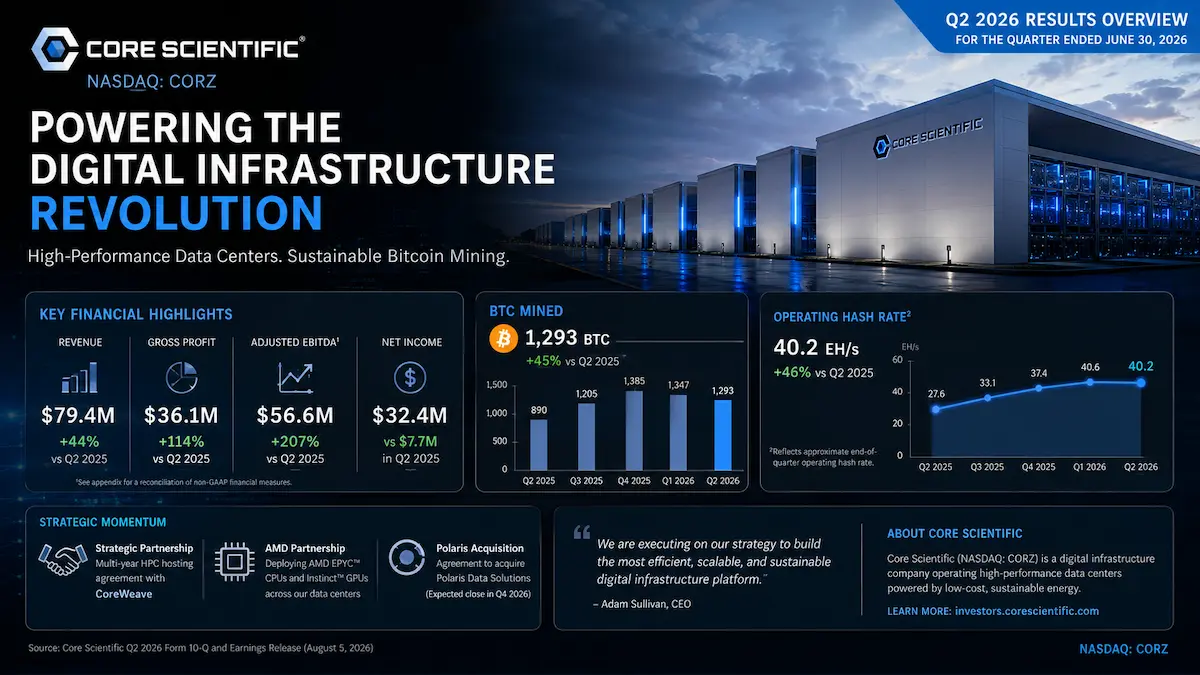
- Core Scientific’s economic identity has changed faster than its historical reputation. In Q2 2026, high-density colocation generated $136.7 million, or 83% of quarterly revenue, while Bitcoin self-mining contributed only 13%. The company is now economically closer to a power-and-data-center infrastructure developer than to a pure-play cryptocurrency miner.
- The most credible moat is not brand, scale by itself, or an AI narrative. It is the combination of controlled utility power, already-developed campuses, interconnection positions, and a demonstrated ability to convert mining-era electrical infrastructure into high-density compute capacity faster than many greenfield developers can bring equivalent power online.
- Long-duration customer contracts create meaningful switching costs. CoreWeave’s approximately 590 MW commitment is largely structured around long-term, fixed-capacity economics, while the July 2026 AMD-related agreements add approximately 529 MW of 15-year leased capacity and introduce a second strategic demand ecosystem. These contracts can convert scarce power into recurring infrastructure cash flow, but they also create counterparty and delivery concentration.
- The principal earnings catalyst is the conversion of contracted megawatts into billable megawatts. Core Scientific had 395 MW billing at June 30, 2026 and reported 437 MW billing by mid-July, leaving a visible bridge from construction activity to revenue. The next layer is the phased delivery of AMD and Neocloud capacity beginning in 2027.
- The central risk is capital intensity. Core Scientific is building a much more predictable business model, but it is doing so through a development platform that requires large upfront capital, reliable utility execution, construction discipline, and financially healthy customers. The moat can deepen if execution compounds; it can also erode quickly if projects are delayed or financing becomes uneconomic.
1. Business Model Breakdown
Core Scientific, Inc. (NASDAQ: CORZ) began its operating history as a large-scale digital asset infrastructure company. Its legacy model combined Bitcoin self-mining with third-party mining hosting, using large power-intensive data centers to monetize electricity, land, cooling systems, electrical distribution equipment and operating expertise. That model produced substantial revenue when mining economics were favorable, but it also exposed the company to Bitcoin price volatility, network difficulty, equipment obsolescence, halving cycles and power-cost sensitivity.
The current Core Scientific business model is structurally different. Management is redeploying the same scarce physical inputs—utility power, substations, land, data-center shells, electrical engineering, cooling infrastructure and operations teams—toward high-density colocation for artificial intelligence and high-performance computing workloads. In economic terms, the company is attempting to convert a commodity-exposed mining asset base into a contracted infrastructure platform.
High-Density Colocation: The New Core Earnings Engine
The high-density colocation segment sells licensed data-center space, electrical capacity and related operating services to customers deploying AI and HPC compute. Customers generally pay fixed monthly fees based on billable customer power capacity, plus variable usage-based charges and other services. Electricity is generally passed through without markup, meaning reported revenue can move with power prices even when underlying economics are unchanged. For that reason, billable megawatts, license fees and colocation gross profit are more informative operating indicators than headline revenue alone.
The transition became visible in the financial statements during 2026. Core Scientific reported Q2 2026 colocation revenue of $136.7 million, up from $10.6 million a year earlier. Colocation represented 83% of quarterly revenue and generated approximately $80.0 million of gross profit, equivalent to a 59% reported segment gross margin. By contrast, self-mining produced $21.5 million of Q2 revenue and a $12.2 million gross loss, while hosted mining produced $6.0 million of revenue and $2.2 million of gross profit.
This mix shift matters more than the simple increase in AI-related revenue. Bitcoin mining historically monetized power through a volatile output price over which Core Scientific had little control. Colocation monetizes power through long-duration contracts tied to capacity availability and service delivery. That changes the company’s earnings architecture from variable commodity spread capture toward recurring infrastructure rent.
CoreWeave: The Contract That Repriced the Asset Base
Core Scientific’s first major high-density colocation relationship began with CoreWeave in 2024 and expanded to approximately 590 MW of leased customer power capacity across five sites. As of June 30, 2026, 395 MW had begun billing; by mid-July the company reported 437 MW of billing capacity, representing approximately $635 million in average annualized colocation GAAP revenue at that run-rate.
The strategic importance of CoreWeave goes beyond revenue. The relationship demonstrated that former mining infrastructure could be re-engineered for GPU-intensive workloads at commercial scale. It also provided a financing template in which the customer funds a substantial portion of construction expenditures and Core Scientific recovers economics through long-duration capacity agreements. Company materials describe the CoreWeave arrangement as having more than $10 billion of potential revenue over the contract terms, with take-or-pay characteristics, annual escalators and substantial customer funding of build-out costs.
This is the essential commercial mechanism: Core Scientific controls scarce physical infrastructure, invests to convert it into AI-ready capacity, and monetizes that capacity over multi-year contracts. The value creation is therefore driven by the spread between the economic value of contracted megawatts and the all-in cost of acquiring, converting, financing and operating those megawatts.
AMD and the Second Demand Ecosystem
In July 2026, Core Scientific announced a strategic infrastructure relationship involving AMD and a Neocloud customer. SEC filings show approximately 377 MW of 15-year leases directly with AMD across Pecos, Texas; Muskogee, Oklahoma; and Hunt County, Texas, plus approximately 152 MW of 15-year leases with a Neocloud at Auburn, Alabama and Dalton, Georgia. AMD also entered into credit-support arrangements related to the Neocloud leases and received a reservation right that, under specified conditions, can expand its access by up to approximately 1,925 MW through December 28, 2028.
The distinction between direct AMD leases and Neocloud leases is important. It would be inaccurate to describe the entire approximately 530 MW as direct AMD tenancy. Economically, however, the arrangement still broadens Core Scientific beyond a single demand channel and ties part of its future capacity roadmap to the AMD compute ecosystem. Management stated that the initial approximately 530 MW of agreements represent more than $14 billion of potential base contracted revenue, with deliveries beginning in 2027 and the full initial capacity targeted by the end of 2028.
Bitcoin Mining: From Primary Business to Transitional Monetization
Digital asset self-mining is now better understood as a transitional monetization tool rather than the company’s strategic destination. Core Scientific still earns Bitcoin using its owned mining fleet, but it is winding down self-mining as facilities are repurposed. The company also provides remaining third-party digital asset hosting services, which it expects to conclude by the end of 2026.
This creates an unusual bridge economics advantage. A conventional greenfield data-center developer can hold land and power for years before revenue begins. Core Scientific can, in some locations, continue monetizing power with mining until conversion work requires that capacity. That does not eliminate development risk, but it can partially offset the carrying cost of waiting for AI infrastructure to become ready for service.
The Underlying Profit Formula
The economic model can be reduced to four variables. First, secure power at locations where large blocks of electrical capacity can actually be delivered. Second, convert gross utility power into leasable critical IT load with acceptable capital cost and time-to-market. Third, sign long-duration customers at returns that exceed the cost of capital and operating expense. Fourth, move contracted megawatts into billable status without schedule slippage.
That is why Core Scientific should not be analyzed primarily by hash rate, Bitcoin production or even total contracted revenue. The more durable operating dashboard is controlled power, leasable power, leased customer power, billable customer power, colocation gross profit, development cost per MW and the amount of external capital required to turn backlog into service revenue.
2. Deep Dive into Economic Moats
Under a Buffett-style moat framework, Core Scientific does not possess a classic consumer brand moat, a software-style network effect, or an obvious patent monopoly that guarantees pricing power. Its defensibility is more physical and contractual. The two most credible sources are cost-and-time advantages around power infrastructure and switching costs embedded in long-duration, purpose-built deployments.
Cost Advantages: Scarce Power, Interconnection Position and Brownfield Conversion
Core Scientific’s strongest potential moat is best described as a time-to-power and conversion-cost advantage rather than simply “cheap electricity.” AI infrastructure demand has shifted the bottleneck from servers to energized sites. GPUs can be purchased faster than large blocks of grid power can be permitted, interconnected, transformed, cooled and commissioned. A company that already controls substations, utility relationships, land and power-intensive campuses can therefore possess an economically meaningful head start.
As of June 30, 2026, Core Scientific controlled approximately 2.1 GW of gross utility power capacity and approximately 1.3 GW of leasable customer power capacity across 11 data centers in seven U.S. states. After the July AMD-related agreements, total leased customer power increased to roughly 1.1 GW. In August 2026, the company completed its approximately $444 million cash acquisition of Polaris DS, securing about 440 MW of currently in-service, grid-connected gross power adjacent to its Muskogee campus.
The Polaris transaction is useful evidence for the moat question because it reveals the replacement cost of scarce electrical infrastructure. Core Scientific paid hundreds of millions of dollars not for a mature AI revenue stream, but primarily to secure land, substation assets and contracted grid power that could support a larger future campus. A competitor trying to replicate Core Scientific’s position cannot simply order equivalent capacity from a vendor. It must find suitable land, obtain utility commitments, enter interconnection queues, secure transformers and switchgear, negotiate local approvals, finance construction and then wait for energization.
That advantage can persist because the slowest inputs are governed by physical constraints and regulated utility processes rather than by software iteration. The competitive cost is therefore measured in both capital and calendar time. However, this is not an absolute moat. Power rights can be acquired, utilities can approve competing projects, and better-capitalized hyperscalers or infrastructure funds can outspend Core Scientific. The defensibility strengthens only if the company repeatedly turns secured power into operating capacity faster and at better risk-adjusted returns than competitors.
Switching Costs: Long-Term Capacity Commitments and Site-Specific Infrastructure
The second meaningful moat is switching cost. High-density AI deployments are not generic office leases. Customer systems are engineered around power density, electrical redundancy, networking, cooling, security, commissioning schedules and GPU deployment plans. Once a customer has committed capital and equipment to a specific campus, relocating equivalent capacity can require new utility availability, new construction, network redesign, physical migration and operational downtime.
Core Scientific’s contracts make these frictions more explicit. The CoreWeave relationship spans long-duration agreements across multiple sites, and company materials describe take-or-pay economics and no unilateral termination right under the principal arrangement. The AMD and Neocloud leases run for 15 years with three five-year extension options. These structures can make revenue more durable after capacity is accepted and operational.
The important qualification is that switching costs work in both directions. Core Scientific becomes dependent on the customer’s credit quality and deployment pace while the customer becomes dependent on Core Scientific’s delivery performance. At June 30, 2026, all colocation revenue still came from CoreWeave, which represented approximately 77% of total company revenue for the first half of 2026. That concentration is not a moat; it is a risk created by the same long-term relationship that produces switching costs.
The July 2026 AMD-related agreements are strategically valuable because they begin to reduce that single-customer dependence. If Core Scientific can add multiple large counterparties without weakening pricing or overbuilding speculative capacity, the switching-cost moat becomes more portfolio-like and less dependent on one relationship.
Intangible Assets: Real, but Secondary
Core Scientific has accumulated operational know-how in running large power-intensive sites and now has a growing execution record in high-density conversion. Utility relationships, procurement experience, local permitting knowledge and customer credibility are economically relevant intangible assets. They can shorten timelines and reduce execution mistakes.
They should not, however, be overstated. Competitors can hire experienced engineers, construction managers and data-center executives. These capabilities become a moat only when embedded in a repeatable process that consistently delivers faster commissioning, lower cost per MW or superior uptime. In other words, the intangible advantage is an execution system, not a brand name.
Network Effects: Essentially Absent
Core Scientific does not currently exhibit a meaningful network effect in the classical sense. One customer leasing capacity does not automatically make the service more valuable to another customer. There may be ecosystem benefits from working with major GPU and cloud platforms, but these are commercial signaling effects rather than self-reinforcing network economics.
This distinction matters because investors should not assign software-platform economics to a capital-intensive colocation business. The company’s return profile will ultimately depend on asset utilization, contract quality, financing discipline and the cost of adding each incremental megawatt.
Can the Moat Support Long-Term Excess Returns?
Potentially, but the answer depends on capital discipline. Secured power and long-term contracts can generate durable cash flows, yet a moat only creates excess returns if Core Scientific earns more on developed capacity than its weighted cost of capital after construction risk, financing costs and maintenance capital. A company can own scarce infrastructure and still destroy value by paying too much for sites or overleveraging projects.
The most important proof point over the next several years will therefore be whether Core Scientific can replicate the CoreWeave conversion model across additional customers while maintaining attractive project-level returns. The moat becomes stronger if each completed project improves customer confidence, financing access and utility relationships, thereby lowering the risk and cost of the next project. It becomes weaker if expansion requires progressively more expensive acquisitions and balance-sheet capital.
3. Business Inflection Points & Future Catalysts
The Defining Strategic Inflection: From Bankruptcy-Era Miner to Contracted AI Infrastructure
Core Scientific’s corporate history contains several major events. The operating business began mining at scale in 2018, expanded third-party hosting in 2020, and entered the public markets through a business combination with Power & Digital Infrastructure Acquisition Corp. in January 2022. It then filed for Chapter 11 protection on December 21, 2022 during a period of severe stress in mining economics and capital structure.
The company emerged from Chapter 11 on January 23, 2024 after a reorganization that reduced debt by approximately $400 million through conversions to equity and reset the public capital structure. The more important strategic inflection followed soon after: beginning in 2024, Core Scientific signed and expanded its high-density colocation relationship with CoreWeave and started converting mining infrastructure into AI-capable data centers.
That pivot changed the corporate gene. Before the transition, Core Scientific mainly monetized electricity by producing a commodity whose price and network economics it could not control. After the pivot, it increasingly monetizes electricity by leasing scarce, engineered capacity under long-term contracts. The physical assets are related; the revenue quality is fundamentally different.
A second signal arrived in 2025. CoreWeave agreed to acquire Core Scientific in an all-stock transaction, but Core Scientific shareholders rejected the merger and the agreement was terminated on October 30, 2025. The company therefore entered 2026 as a standalone platform with the burden of financing its own expansion—and the opportunity to retain the economics of that expansion. The subsequent AMD relationship and Polaris acquisition show that management chose to accelerate rather than retrench.
Catalyst 1: Converting the Remaining CoreWeave Backlog into Billable Capacity
The cleanest near-term catalyst is operational rather than speculative. At June 30, 2026, Core Scientific had approximately 590 MW of leased CoreWeave capacity and 395 MW of billable capacity, leaving about 195 MW still moving through construction and commissioning. By mid-July, billable capacity had increased to 437 MW. Company guidance has indicated substantial completion of the CoreWeave projects by the first half of 2027.
Transmission mechanism: each additional commissioned megawatt moves from contracted backlog into monthly colocation billing. Because the mining segment is shrinking and has recently been loss-making, the same conversion can also improve consolidated revenue quality and gross-profit mix even if headline total revenue is affected by pass-through power accounting.
Observable indicators: billable customer power capacity, incremental colocation license revenue, colocation gross profit, site-level completion milestones and the gap between leased and billable MW. A sustained rise in billable MW should precede a fuller run-rate realization of contracted economics.
Execution risks: transformer and switchgear availability, labor constraints, permitting, interconnection sequencing, customer deployment timing and construction budget control. Core Scientific explicitly identifies these factors as determinants of when capacity becomes billable. A contract can secure demand, but it does not eliminate the risk that revenue starts later than planned.
Catalyst 2: AMD-Related Capacity Creates Customer Diversification and a Second Growth Leg
The July 2026 AMD-related agreements materially changed the forward demand profile. The initial leases cover approximately 529 MW across five sites, with deliveries expected to begin in 2027 and the full initial capacity targeted by the end of 2028. Core Scientific describes the agreements as representing more than $14 billion of potential base contracted revenue. AMD also has conditional reservation rights for substantially more capacity, creating an option for the relationship to scale toward 2.5 GW.
Transmission mechanism: the first effect is diversification. A second major demand ecosystem can reduce Core Scientific’s dependence on CoreWeave and improve the strategic value of unleased capacity. The second effect is backlog duration: 15-year lease terms can extend revenue visibility well beyond the original CoreWeave deployment cycle. The third is platform validation: securing capacity commitments associated with two major AI-compute ecosystems can improve Core Scientific’s credibility with additional customers, utilities and project financiers.
Observable indicators: construction starts at Pecos, Muskogee, Hunt County, Auburn and Dalton; contracted versus billable MW; financing structures for the new builds; customer prepayments or support; and any exercise of AMD’s additional reservation rights. Investors should separate signed initial leases from optional future capacity because reservation rights are not the same as guaranteed revenue.
Execution risks: the capital burden is larger than the original customer-funded conversion model, and technology requirements may change before 2027–2028 delivery. Higher rack densities and new cooling architectures can force redesigns. In addition, approximately 152 MW of the initial arrangement is leased to a Neocloud rather than directly to AMD, so counterparty analysis should incorporate the specific credit-support structure instead of assuming the entire contract carries identical AMD credit exposure.
Catalyst 3: Power Portfolio Expansion Could Extend the Growth Runway Beyond Current Contracts
Core Scientific has moved from simply converting legacy mining sites to actively acquiring and expanding power positions. The August 2026 acquisition of Polaris DS added approximately 440 MW of currently in-service grid-connected gross power adjacent to Muskogee. Management plans to scale the Muskogee campus toward approximately 1.5 GW of gross power, or roughly 1.0 GW of leasable power, using grid-connected and behind-the-meter solutions. The company has also acquired Hunt County, Texas and is pursuing expansion at additional sites.
Transmission mechanism: additional secured power increases the inventory of future revenue-producing megawatts. If customer demand remains strong, controlling power before competitors can source equivalent capacity can support higher leasing velocity and potentially better contract economics. Power portfolio expansion also reduces the risk that growth stops once the original CoreWeave sites are fully utilized.
Observable indicators: total gross power, leasable customer power, unleased power, signed leases, utility interconnection milestones, acquisition cost per MW, development cost per MW and the time between power acquisition and customer billing. Management has said the next approximately 82 MW at Muskogee is expected to be delivered to a customer beginning in the second half of 2027, providing a concrete milestone for the Polaris strategy.
Execution risks: buying power is not the same as earning an attractive return on it. The Polaris purchase required approximately $444 million in cash before the full data-center build-out. Large campus expansions can require billions of dollars of additional capital, while utility upgrades, behind-the-meter generation, local regulation and construction inflation can change project economics. The moat only creates value if the company does not overpay to maintain growth.
Catalyst 4: Mining Wind-Down Can Improve the Quality of Consolidated Margins
In Q2 2026, self-mining carried a negative 56% gross margin while colocation posted a 59% gross margin. Core Scientific is winding down self-mining and expects the remaining hosted mining business to conclude by December 31, 2026. That creates a potential mix catalyst even without a new customer signing.
Transmission mechanism: as power is reallocated away from loss-making mining and toward contracted colocation, consolidated gross profit can improve faster than total revenue. The company also becomes less exposed to Bitcoin price, network difficulty and halving-driven economics.
Observable indicators: declining mining power consumption, falling self-mining revenue as a percentage of sales, reduced mining gross losses, asset-sale proceeds and rising colocation share of gross profit.
Execution risks: transition costs can include asset impairments, equipment disposal losses, stranded infrastructure and periods in which mining has stopped but new colocation capacity is not yet billing. A clean strategic narrative does not guarantee a smooth accounting transition.
4. Key FAQs
How does Core Scientific make money from AI data centers in 2026?
Core Scientific earns AI infrastructure revenue primarily by licensing high-density data-center capacity to customers that need large amounts of power, cooling, space and operational support for GPU-based workloads. Customers generally pay recurring fixed fees tied to billable megawatts plus variable service charges, while electricity is passed through without markup. The profit pool therefore comes from monetizing engineered capacity and facility operations rather than marking up power. In Q2 2026, this colocation business generated $136.7 million of revenue and approximately $80.0 million of gross profit.
Is Core Scientific still a Bitcoin mining company or an AI data center company?
Operationally, it still has both businesses, but the economic center of gravity has shifted to AI and high-density colocation. Colocation represented 83% of Q2 2026 revenue, while self-mining represented 13%. Core Scientific is winding down self-mining and expects third-party hosted mining to conclude by the end of 2026. The more accurate description is therefore an AI-oriented digital infrastructure developer that is using legacy Bitcoin mining assets and power positions as the foundation for a contracted colocation platform.
What is Core Scientific’s competitive advantage versus other AI data center developers?
The strongest advantage is time-to-power. Core Scientific controls large blocks of utility capacity at existing U.S. campuses and has experience operating power-intensive infrastructure. That can allow it to convert or expand sites faster than a greenfield developer starting with undeveloped land and no energized interconnection. Long-term contracts then create switching costs once customers deploy equipment into those sites. The advantage is not guaranteed: competitors with lower capital costs, better sites or stronger utility access can still win. Core Scientific’s moat depends on repeatedly converting secured power into billable capacity at attractive returns.
5. Conclusion
Core Scientific’s enterprise gene is best understood as power conversion. The company first converted electricity into Bitcoin, then discovered that the same infrastructure could be more economically valuable when converted into long-duration AI colocation capacity. Bankruptcy forced a capital-structure reset; the CoreWeave agreements proved the asset-conversion thesis; the rejected 2025 merger preserved the standalone platform; and the 2026 AMD-related agreements plus the Polaris acquisition expanded the strategy from brownfield conversion into a broader power-development franchise.
The company’s most defensible advantage is not that it is large or that AI demand is growing. It is that it already controls scarce electrical infrastructure and has demonstrated an ability to move meaningful megawatts from utility access to billable high-density compute. If Core Scientific can repeat that process across multiple customers while preserving project-level returns, the combination of time-to-power advantage and long contractual switching costs could support durable excess economics.
The counterweight is capital intensity. The same strategy that creates scarcity value also demands large amounts of funding before revenue starts, and the company remains exposed to construction schedules, utility execution, customer concentration and financing costs. The next phase of the story will therefore be determined less by announced gigawatts than by how efficiently contracted megawatts become billable megawatts and how much incremental capital is required to make that conversion.
Official Sources
- Core Scientific Q2 2026 Form 10-Q — U.S. Securities and Exchange Commission
- Core Scientific Q2 2026 Earnings Release — Core Scientific Investor Relations
- AMD and Neocloud Lease Disclosure — Core Scientific Form 8-K / SEC
- Core Scientific and AMD Infrastructure Partnership — Official Joint Announcement
- Polaris DS Acquisition Closing — Core Scientific Form 8-K Exhibit
- Core Scientific 2025 Form 10-K — U.S. Securities and Exchange Commission
- January 2024 Chapter 11 Emergence Announcement — Core Scientific Investor Relations
- Termination of CoreWeave Merger Agreement — Core Scientific Form 8-K Exhibit
- Core Scientific 2024 Registration Statement — Corporate History and Business Combination Background / SEC
Disclaimer: This article is intended solely for business logic discussion and corporate research purposes, and does not constitute investment advice of any kind.