


Key Takeaways
- Sandisk is fundamentally a NAND semiconductor and storage-systems company, not a software subscription business. Its earnings are driven by bit shipments, average selling prices, product mix, cost per bit, manufacturing utilization and the quality of its customer commitments.
- The most defensible element of the Sandisk business model is its cost-and-technology position built around Flash Ventures with Kioxia. Sandisk co-develops NAND technology, generally receives roughly half of joint-venture output, and buys wafers at cost plus a small markup, giving it scale economics that would be expensive for a new entrant to replicate.
- A second, emerging moat is contractual and operational switching friction. Enterprise SSD qualification, firmware and system integration, supply assurance and multi-year New Business Model agreements make Sandisk harder to displace than a commodity NAND supplier, although customers still have strong incentives to multi-source.
- The company’s 2025 separation from Western Digital was the corporate inflection point; the 2026 rollout of long-term NBM contracts is the more important business-model inflection. Management is attempting to convert a historically cyclical memory business into one with more committed volumes, structured pricing and cash-flow visibility.
- The central risk is that Sandisk remains exposed to NAND economics even after the contracting shift. Technology ramps, Kioxia dependence, customer execution, aggressive competitor capacity, AI infrastructure timing and unfavorable contract pricing can still overwhelm apparent moat advantages.
Sandisk Corporation, traded on Nasdaq under SNDK, is best understood as a vertically integrated flash-memory platform whose economic engine spans NAND technology, controller and firmware design, enterprise and client SSD systems, embedded storage and consumer products. The company’s history is unusually instructive: the legacy business helped commercialize removable flash formats, spent nearly a decade inside Western Digital after the 2016 acquisition, and returned to the public market as a standalone flash company in February 2025. The strategic question today is no longer whether Sandisk can sell NAND. It is whether the company can convert technology leadership and manufacturing scale into more durable economics than the NAND cycle has historically allowed.
That distinction matters. Memory companies can post extraordinary margins during periods of tight supply and strong pricing, then surrender much of that profitability when industry capacity catches up. Sandisk’s current strategy therefore has two layers. The first is technical: improve density, performance and cost through joint NAND development, controller expertise, firmware and system-level optimization. The second is commercial: lock more production into multi-year customer frameworks that improve demand visibility and reduce the amount of output exposed to the spot-like behavior of the memory market. The resulting corporate gene is a combination of semiconductor process economics and increasingly contractualized capacity allocation.
1. Business Model Breakdown
What Does Sandisk Actually Sell?
Sandisk monetizes physical flash-memory products and integrated storage systems. Its portfolio includes enterprise solid-state drives for datacenters and cloud infrastructure; client SSDs and embedded flash for PCs, mobile devices, gaming, automotive, industrial systems and other edge applications; and consumer products such as portable SSDs, memory cards and USB drives. It also sells wafers and components. Software and firmware are strategically important because they determine performance, reliability and system integration, but they are primarily embedded in the value proposition of the hardware rather than operating as a large stand-alone SaaS revenue stream.
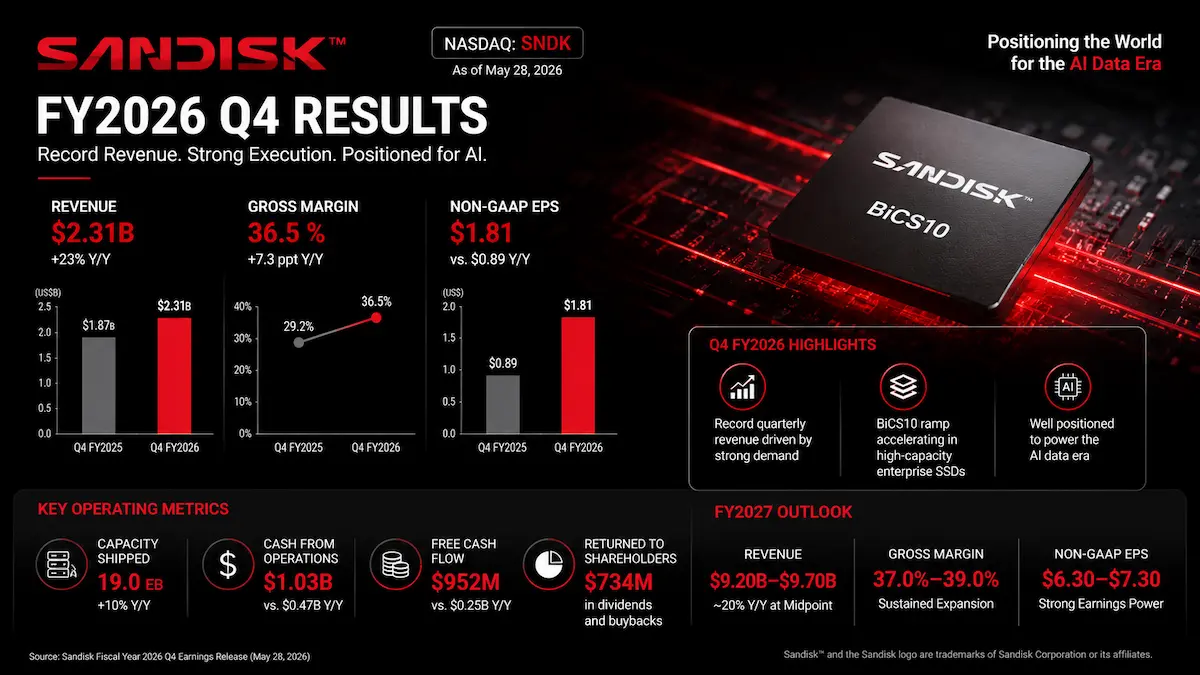
Fiscal 2026 revenue was $20.248 billion. Edge generated $12.160 billion, or about 60.1% of revenue; Datacenter generated $5.153 billion, or about 25.4%; and Consumer generated $2.935 billion, or about 14.5%. The mix is important because it shows that the company is not yet a pure AI-datacenter story. Edge remains the largest commercial engine, while Datacenter has become the highest-profile incremental growth vector. Fiscal 2026 Datacenter revenue increased 437% year over year, and in the fiscal fourth quarter alone Datacenter revenue reached $2.977 billion.
The Profit Formula: Price, Bits, Mix and Cost per Bit
The underlying profit equation is closer to semiconductor manufacturing than to branded electronics. Revenue is essentially a function of the number of bits shipped, the realized price for those bits and the product value captured by packaging them into higher-performance solutions. Gross profit then depends on manufacturing cost per bit, yields, utilization, controller and component costs, assembly and test efficiency, product mix and the speed at which new NAND generations ramp.
Fiscal fourth-quarter 2026 revenue increased 51% sequentially to $8.965 billion; Sandisk said roughly one-third of the sequential growth came from higher volume and two-thirds from higher pricing. That disclosure is a useful reminder that recent earnings power has been materially amplified by market pricing, not just by company-specific execution. Fiscal 2026 GAAP gross margin was 71.5%, while fiscal fourth-quarter gross margin reached 84.6%. Those figures demonstrate operating leverage in a favorable environment, but they should not automatically be interpreted as permanent structural margins. The key analytical question is how much of the margin can survive once pricing normalizes.
Flash Ventures: The Manufacturing Core
All of Sandisk’s flash-memory wafers are currently sourced through its joint ventures with Kioxia. Sandisk owns 49.9% of each of the three Flash Ventures entities, co-develops flash process technology and memory design with Kioxia, and generally has the right to purchase approximately half of Flash Ventures output. Kioxia owns the fabrication facilities and provides wafer-manufacturing services, while the joint ventures own or lease much of the relevant manufacturing equipment. Sandisk pays Flash Ventures the cost of the wafers plus a small markup.
This structure is economically significant because it gives Sandisk access to large-scale leading-edge NAND production without replicating every part of a wholly owned fab network. It also distributes technology-development and capacity investment across a long-standing partner structure. The trade-off is equally important: Sandisk must fund roughly half of required joint-venture capital investment when operating cash flow is insufficient, pays half of fixed costs regardless of the output it chooses to purchase, and is constrained in its ability to manufacture flash outside the venture framework. The arrangement is therefore both a cost advantage and a strategic dependency.
The New Business Model: Turning Capacity into Contracted Economics
The most consequential change in the Sandisk business model is the adoption of long-term customer agreements that the company calls New Business Models, or NBMs. These agreements generally commit Sandisk to deliver, and customers to purchase, stated product volumes over multi-year periods. Pricing includes fixed and variable components, while customer obligations can be supported by cash deposits, third-party collateral or other financial guarantees.
As of July 3, 2026, Sandisk reported $59.8 billion of transaction price allocated to remaining performance obligations, entirely related to NBMs, with approximately 19% expected to be recognized over the following twelve months. The company also had $1.242 billion of contract liabilities tied primarily to customer advances, $1.5 billion of refund liabilities that largely represented refundable security deposits, and $5.0 billion of collateral held or issued by third-party financial institutions that could become accessible to Sandisk upon specified customer defaults or breaches. The 2026 Form 10-K further disclosed two additional post-year-end NBMs with an aggregate transaction price of $31.3 billion.
At its August 2026 Investor Day, Sandisk said it had signed NBMs with eight customers covering approximately 50% of fiscal 2027 bits and approximately two-thirds of fiscal 2028 bits. Economically, this is an attempt to change the company from a seller that frequently discovers demand after capacity has already been built into one that can plan a meaningful portion of output against enforceable commitments. If it works as intended, better visibility can reduce inventory mistakes, improve utilization planning, support technology investment and dampen earnings volatility. The offset is that contracted supply can become an opportunity cost if spot pricing rises dramatically or customer requirements change faster than contract structures permit.
Platform Strategy: Full-Stack Flash Rather Than a Single Product
Sandisk’s platform strategy is not a software-platform model with third-party developers and classic network effects. It is a semiconductor stack. At the bottom are NAND cell architecture, process technology and manufacturing economics. Above that sit controllers, firmware, packaging and system engineering. Those capabilities are converted into enterprise SSDs, embedded storage, client solutions and consumer products, then connected to customers through global sales channels and increasingly long-duration supply frameworks.
This full-stack approach matters because the value of NAND increasingly depends on workload-specific optimization. In AI infrastructure, for example, storage economics are shaped not only by raw capacity but also by bandwidth, latency, power, endurance, form factor and the position of flash within the memory hierarchy. Sandisk’s strategy is therefore to use a common technology base across multiple markets while creating derivatives that match the performance and capital-efficiency needs of specific applications.
2. Deep Dive into Economic Moats
Cost Advantages: The Strongest Existing Moat
Under a Buffett-style moat framework, Sandisk’s most credible durable advantage is cost structure rather than brand visibility or revenue growth. Flash Ventures combines joint R&D, large-scale manufacturing, shared capital investment and cost-plus wafer purchases. Sandisk states that the arrangement helps lower product costs, improve quality control and accelerate delivery. The joint ventures now have terms scheduled through December 31, 2034, extending the time horizon over which this manufacturing architecture can operate.
The competitive replication cost is substantial. A rival cannot reproduce this position simply by buying NAND dies. It would need sustained process R&D, high-yield manufacturing at enormous scale, controller and firmware expertise, enterprise-grade qualification capabilities, advanced packaging and a customer base large enough to keep factories economically utilized. Existing giants such as Samsung, Micron, SK hynix and Kioxia can obviously compete on many of these dimensions; the moat is therefore strongest against subscale entrants and weaker against top-tier integrated NAND producers.
Sandisk’s newer CMOS directly Bonded to Array, or CBA, architecture could reinforce the cost moat if execution matches the roadmap. The company and Kioxia manufacture CMOS logic and the memory array separately before bonding the wafers. Sandisk argues that this enables a more flexible two-dimensional scaling strategy: a proven memory array can be paired with a newer CMOS wafer to create product derivatives without forcing every performance improvement to wait for an entirely new memory-array generation. The 9th-generation 2Tb QLC design announced in August 2026 pairs an advanced CMOS wafer with a proven array and targets higher performance with more capital-efficient scaling, while the 10th-generation QLC technology is designed to deliver up to 60% higher bit density than the 8th generation.
The durability test is whether those architectural gains translate into lower cost per useful bit after accounting for yield, bonding complexity and ramp expenses. Semiconductor roadmaps are not moats merely because a company announces them. The moat exists only if Sandisk can repeatedly convert process and architecture choices into lower unit economics or superior performance-per-watt before competitors erase the gap.
Switching Costs: Emerging Through Qualification and Contract Structure
Sandisk’s second-best moat is switching friction, especially in enterprise storage. Datacenter SSDs are not perfectly interchangeable commodities. Customers care about controller behavior, firmware, endurance, reliability, power, form factor, failure handling and application-level performance. Sandisk itself identifies market acceptance and customer qualification as critical steps in technology transitions. The need to qualify new generations raises the engineering and operational cost of replacing a proven supplier, particularly for mission-critical infrastructure.
NBMs add a contractual layer to those technical switching costs. Committed volumes, structured pricing and financial guarantees make the supplier relationship more durable than a sequence of quarterly purchase orders. A competitor trying to displace Sandisk may need to offer not only better price-performance but also equivalent supply assurance, successfully complete qualification and persuade the customer to reallocate future capacity commitments.
However, this moat should not be overstated. Large cloud and OEM customers have enormous bargaining power and typically prefer diversified supply. NAND remains an industry with multiple world-class producers. A customer that believes another supplier offers materially better economics can qualify an alternative over time. The most accurate description is moderate and potentially strengthening switching cost, not proprietary lock-in.
Intangible Assets: Valuable, but Not Sufficient Alone
Sandisk reported approximately 8,000 granted patents and 3,000 pending patent applications worldwide in its 2026 Form 10-K, alongside proprietary process know-how, controller expertise, firmware, systems engineering and a globally recognized consumer brand. These assets matter, but patent count should not be confused with moat width. The NAND industry relies heavily on cross-licensing, joint development and continuous node transitions. Sandisk itself cautions that patents alone cannot ensure future success.
The more defensible intangible asset is accumulated know-how: how to co-optimize NAND, controllers, firmware, packaging and manufacturing for specific workloads. That knowledge is embedded in engineering teams, qualification history and process experience rather than in a single legal right. It is difficult to copy quickly, but it can decay if execution slips for even one or two technology generations.
Network Effects: Weak Today, Potentially Strategic Around HBF
Sandisk does not have a classic network effect in its core business. One additional SSD customer does not directly make another customer’s SSD more valuable. The company’s consumer channels and brand can improve distribution efficiency, but that is not the same as a network effect.
High Bandwidth Flash, or HBF, is the closest thing to an ecosystem strategy. In August 2026, Sandisk and SK hynix released an HBF technical specification through the Open Compute Project, with participation from companies including Google and Tenstorrent. The goal is to establish a common framework for placing high-capacity flash closer to compute in AI inference systems. If HBF becomes a broadly adopted memory tier, early technical leadership could give Sandisk design influence and first-mover learning. Yet the specification is deliberately open, which can accelerate market formation while limiting proprietary lock-in. HBF should therefore be treated as a potential market-expansion mechanism, not a proven network-effect moat.
Can These Moats Support Long-Term Excess Returns?
Possibly, but the answer depends on whether Sandisk can reduce the cyclicality discount attached to NAND. Cost leadership and qualification-driven switching costs can protect share and improve through-cycle profitability, but they do not eliminate supply-and-demand economics. When industry bit supply grows faster than demand, even efficient producers can see severe pricing pressure. Sandisk’s most important strategic experiment is therefore not a single memory node; it is the combination of cost-efficient manufacturing with multi-year customer economics. If NBMs materially stabilize utilization and pricing while the technology roadmap preserves cost per bit, the company could achieve a structurally better return profile than a traditional merchant memory model. If not, recent margins will look more cyclical than moat-driven.
3. Business Inflection Points & Future Catalysts
The Critical Inflection Point: The 2025 Spin-Off, Followed by the 2026 Contracting Shift
Sandisk’s legacy reaches back to SunDisk, which adopted the SanDisk name in 1995 and later helped create the SD card standard with Panasonic and Toshiba. Western Digital acquired SanDisk in May 2016 to deepen its non-volatile memory expertise and vertically integrate into NAND. Western Digital then announced in October 2023 that it intended to separate its flash and hard-disk businesses. The separation became effective on February 21, 2025, and regular-way SNDK trading began on February 24, 2025.
The separation is the pivotal corporate event because it made flash economics, capital allocation, product priorities and customer contracting directly accountable to a standalone management team. The more consequential operating consequence arrived in fiscal 2026: Sandisk began shifting toward multi-year NBMs at the same time that Datacenter became a major growth pillar. The combination changes both sides of the model. The company is trying to sell more bits into higher-value AI and enterprise workloads while simultaneously making demand for those bits more contractually visible.
Catalyst 1: NBM Conversion Could Reduce the Cyclicality Discount
The transmission mechanism is straightforward. Multi-year committed volumes improve production planning; structured pricing can reduce exposure to abrupt market resets; advances and collateral improve financial protection; and higher visibility can support investment in technology transitions without relying solely on short-term demand forecasts. If those benefits persist through a weaker NAND pricing environment, investors may begin to view Sandisk as a more durable cash-flow compounder rather than a pure memory-cycle trade.
Observable indicators include the percentage of annual bits covered by NBMs, remaining performance obligations, contract liabilities, customer collateral, the percentage of contracted revenue recognized each year, inventory days, factory underutilization charges and the volatility of gross margin across pricing cycles. Sandisk’s stated coverage of roughly 50% of fiscal 2027 bits and roughly two-thirds of fiscal 2028 bits gives the market a concrete benchmark to track.
The failure case is equally clear. Sandisk may be unable to deliver required volumes or specifications; customers may breach purchase commitments; guarantees may not offset the full economic loss; or contracted pricing may prevent Sandisk from fully capturing a stronger market. The contracts can also constrain supply that might otherwise be sold into more attractive opportunities. NBM growth is therefore a catalyst only if contract quality proves more important than contract quantity.
Catalyst 2: Datacenter and AI Inference Can Upgrade the Revenue Mix
Datacenter revenue increased from $960 million in fiscal 2025 to $5.153 billion in fiscal 2026. The mechanism behind the catalyst is mix rather than merely end-market growth. Enterprise SSDs combine NAND with controller, firmware and systems expertise and are sold into workloads where reliability, performance, endurance and power efficiency matter. A sustained shift toward these products can increase the value captured per bit and make technical qualification more strategically important.
Investors should watch Datacenter revenue as a percentage of total sales, enterprise SSD shipment growth, qualification activity, product capacity and endurance mix, hyperscaler deployment timing and gross margin relative to Edge and Consumer. The most important test is whether Datacenter growth remains strong when industry pricing is less favorable. That would indicate share and product-mix gains rather than a purely cyclical uplift.
The risk is that AI infrastructure spending is not linear. Deployment timing can move by quarters, customers can optimize models to use less storage per unit of compute, and alternative memory architectures can change the economics of the stack. Sandisk also notes that enterprise SSDs often use DRAM, creating another component dependency. Strong AI demand is a tailwind, but it does not remove execution and architecture risk.
Catalyst 3: CBA, BiCS9, BiCS10 and HBF Could Expand Both Cost and Addressable Market
Sandisk’s two-dimensional CBA scaling strategy is designed to accelerate derivative development and improve capital efficiency by decoupling parts of the CMOS and memory-array roadmap. If BiCS9 and BiCS10 ramp at attractive yields, the result could be lower cost per bit, higher density, better power efficiency and faster response to customer-specific requirements. That would reinforce the company’s most credible economic moat: manufacturing and architecture-level cost advantage.
HBF adds a different pathway. Rather than competing only for traditional SSD capacity, Sandisk is attempting to place flash closer to AI compute as a higher-bandwidth, high-capacity tier that can coexist with HBM. The observable indicators are concrete: OCP ecosystem participation, accelerator or hyperscaler design engagements, published interface and packaging milestones, qualification progress, commercial product timing and eventually revenue contribution. Until those milestones appear, HBF should be valued as strategic optionality rather than established earnings power.
The principal risks are yield, qualification delays, manufacturing complexity, Kioxia roadmap alignment and competitive response. The CBA architecture must deliver real economics at scale, not just technical specifications. HBF must also prove that system-level total cost of ownership is compelling enough to earn a durable place in the AI memory hierarchy. Open standardization may accelerate adoption, but it may also make it easier for competitors to participate.
4. Key FAQs
How does Sandisk make money after the Western Digital spin-off?
Sandisk makes money primarily by selling NAND-based storage products: enterprise SSDs, client SSDs, embedded flash, consumer SSDs, memory cards, USB drives, wafers and components. Edge was about 60% of fiscal 2026 revenue, Datacenter about 25%, and Consumer about 15%. Profitability is driven by realized NAND pricing, bit shipments, product mix, cost per bit, yields and utilization. The company is now overlaying that hardware model with multi-year NBM contracts that commit customers to future volumes under structured pricing and financial guarantees.
What is Sandisk’s competitive advantage in NAND flash versus Samsung, Micron and SK hynix?
Sandisk’s strongest advantage is not simple scale or brand awareness. It is the combination of joint NAND development and cost-plus wafer sourcing through Flash Ventures with Kioxia, plus in-house controller, firmware and systems expertise. This gives the company an integrated path from NAND architecture to finished SSD. Against Samsung, Micron and SK hynix, however, the moat is relative rather than absolute because those companies also possess deep manufacturing scale and technical expertise. Sandisk’s differentiation becomes more defensible when enterprise qualification and long-term customer commitments are added to the manufacturing stack.
How could AI inference and Sandisk HBF technology affect the SNDK business model?
AI inference could increase the amount of flash required in datacenters because model serving, KV cache and data-intensive workflows place pressure on capacity, bandwidth and power efficiency. Sandisk is targeting that demand first through enterprise SSDs and potentially through HBF, which is designed to place high-capacity flash closer to compute. If HBF becomes a recognized memory tier, Sandisk could expand beyond traditional storage into a higher-value part of the AI memory hierarchy. The commercial impact is not yet proven; adoption should be judged by ecosystem participation, customer qualification and revenue-bearing deployments rather than by technical announcements alone.
5. Conclusion
The core Sandisk corporate gene is the industrialization of flash across the full stack. The company’s historical strength was never merely selling memory cards; it was combining flash architecture, controller intelligence, standards, manufacturing partnerships and product engineering to turn NAND into usable storage systems. The current version of that playbook moves the center of gravity from consumer removable media toward enterprise SSDs, AI infrastructure and capital-efficient NAND derivatives.
The clearest moat is cost and execution capability around Flash Ventures, CBA-based technology development and systems integration. Switching costs are meaningful but secondary, strengthened by qualification requirements and newly signed multi-year NBMs. Intangible assets support the model, while classic network effects remain weak. The company’s strategic ambition is to convert those assets into a less volatile commercial structure by contracting a larger percentage of future bit output before it is produced.
That transformation is plausible but not yet fully proven through a complete NAND downcycle. The decisive evidence over the next one to two years will be whether NBM commitments remain economically favorable, whether Datacenter mix holds up outside peak pricing, and whether BiCS9, BiCS10 and HBF translate technical claims into cost, qualification and revenue milestones. Sandisk’s enterprise gene is therefore best described as a semiconductor cost engine being rebuilt around long-duration customer economics—not a commodity business that has somehow escaped commodity risk.
Authoritative Sources
- Sandisk Corporation 2026 Form 10-K
- Sandisk Fiscal Fourth Quarter and Fiscal Year 2026 Results
- Sandisk 2026 Investor Day Growth Strategy and Long-Term Financial Model
- Kioxia and Sandisk 9th-Generation QLC 3D Flash Announcement
- Kioxia and Sandisk 10th-Generation QLC 3D Flash Announcement
- Sandisk and SK hynix HBF Open Compute Project Specification Announcement
- Sandisk Official History: The SD Card at 25
- Western Digital Fiscal 2016 Annual Report
- Sandisk 2025 Registration Statement: Separation and Distribution
Disclaimer: This article is intended solely for business logic discussion and corporate research purposes, and does not constitute investment advice of any kind.