



Key Takeaways
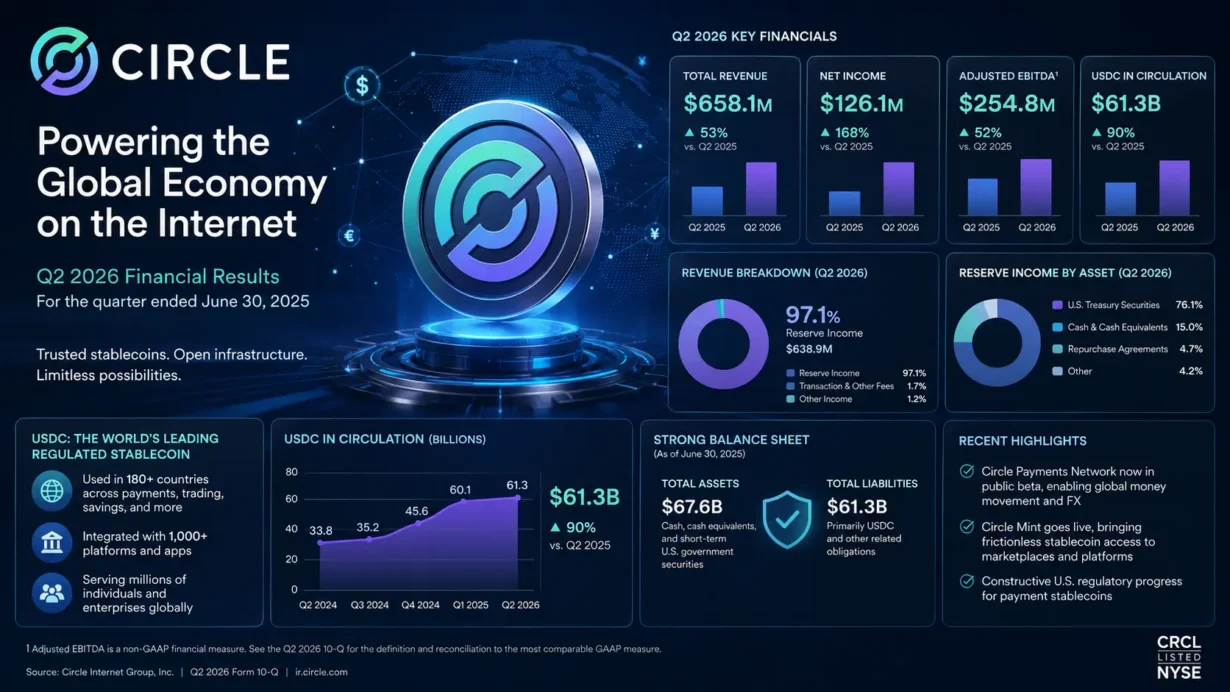
- Circle’s current earnings engine is still overwhelmingly reserve-driven. In Q2 2026, reserve income was $667.7 million, or 95.2% of total revenue and reserve income, making USDC circulation and short-term interest rates the two dominant variables in near-term revenue formation.
- The more important strategic question is not whether USDC grows, but who captures the economics of that growth. Circle paid $324.6 million of Q2 2026 distribution costs tied to Coinbase alone, while total distribution, transaction, and other costs reached $412.5 million. The company therefore needs to increase direct platform engagement and fee-based revenue, not merely expand token supply.
- Circle’s strongest moat is a combination of regulatory infrastructure and network liquidity rather than conventional customer lock-in. Its licensing history, reserve architecture, federal and New York trust charters, institutional counterparties, and broad multichain distribution are expensive and time-consuming to replicate, but they do not make USDC immune to competition.
- The platform strategy is becoming vertically integrated: Circle Digital Assets and liquidity services provide the monetary layer; Circle Payments Network and related applications provide transaction utility; and Arc is designed to become the settlement and developer layer. If these pieces reinforce one another, Circle can diversify away from pure reserve spread economics.
- The principal risks are equally structural: declining interest rates, costly distribution partnerships, stronger regulated entrants after U.S. stablecoin legislation, competition from Tether and tokenized yield products, and execution risk around Arc and CPN. A larger stablecoin market does not automatically translate into better unit economics for Circle.
1. Business Model Breakdown
What Circle actually monetizes today
Circle Internet Group was founded in 2013 around the idea that value should move over the internet with the same ease as information. The business has changed materially since then, but its present economic core is straightforward: Circle issues fully reserved digital currencies, primarily USDC, invests the corresponding reserve assets in highly liquid cash and cash-equivalent instruments, and earns the interest and dividend income generated by those reserves.
This means the Circle business model is not best understood as a conventional software subscription model. It is closer to a regulated monetary network with a large reserve-income engine, layered with software, payments, liquidity, interoperability, and blockchain infrastructure. In Q2 2026, Circle generated $701.3 million of total revenue and reserve income. Reserve income contributed $667.7 million, or 95.2% of the total. Other revenue was $33.6 million, up 41% year over year, but still represented only 4.8% of the revenue base. According to Circle’s Q2 2026 Form 10-Q, other revenue includes subscription and services revenue, transaction revenue, fund-management fees, redemption fees, blockchain rewards, and infrastructure-related fees.
The reserve-income formula has two primary inputs: average stablecoins in circulation and the yield earned on the reserve portfolio. In Q2 2026, average USDC in circulation was $76.5 billion, up 25% year over year, while Circle’s reserve return rate fell to 3.5% from 4.1%. The resulting reserve income still grew 5% because balance growth outweighed the lower yield. This is the key sensitivity investors should understand: Circle can grow USDC circulation and still experience muted revenue growth if interest rates decline quickly enough.
The reserve structure is designed around liquidity and capital preservation rather than credit spread. Circle states that the majority of USDC reserves are held through the Circle Reserve Fund, an SEC-registered Rule 2a-7 government money market fund managed by BlackRock, with BNY serving as custodian, while the remaining cash is primarily held at large regulated banks. Circle also publishes weekly reserve information and monthly third-party assurance reports on its official transparency page. Economically, Circle is therefore monetizing the float created by a non-interest-bearing digital dollar while maintaining a one-for-one redemption promise.
The hidden variable: distribution economics
Gross reserve income materially overstates the economics Circle retains. USDC is distributed through exchanges, wallets, banks, fintechs, blockchains, and other ecosystem partners, and Circle frequently shares economics to encourage that distribution. Coinbase is the most important example. Under the collaboration framework disclosed in Circle’s filings, Coinbase receives economics based on USDC held on its platform and a share of broader ecosystem economics after specified deductions.
In Q2 2026, Circle incurred $324.6 million of distribution costs connected with Coinbase agreements, equivalent to roughly 46% of the quarter’s total revenue and reserve income. Total distribution, transaction, and other costs were $412.5 million. After these costs, Circle reported $289 million of revenue less distribution costs and a 41% RLDC margin. The analytical implication is critical: USDC growth can be economically attractive or economically expensive depending on where balances sit and how much Circle must pay to acquire or retain distribution.
This is why the rise in USDC held on Circle’s own platform matters more than it first appears. In Q2 2026, USDC on Circle’s platform reached $12.4 billion at quarter end, and the daily weighted-average percentage of USDC on Circle’s platform rose to 19.5% from 7.4% a year earlier. Because platform location affects Circle’s share of reserve economics under its Coinbase arrangement, direct platform adoption can improve monetization even if total USDC circulation grows at a similar rate.
From stablecoin issuer to full-stack financial platform
Circle now describes its business around three reinforcing pillars. The first is Circle Digital Assets and Services, including USDC, EURC, USYC, Circle Mint, xReserve, and related liquidity infrastructure. The second is Circle Applications, including Circle Payments Network, StableFX, and other products that turn digital assets into payment, treasury, and financial-market workflows. The third is Arc, Circle’s Layer-1 blockchain designed for stablecoin-centric financial applications.
The strategic logic is vertical integration without abandoning interoperability. USDC remains available across public blockchains rather than being locked to a proprietary chain; Circle’s current USDC page states that native USDC is supported across 37 blockchain networks. At the same time, Arc gives Circle the opportunity to own more of the execution environment, developer tooling, transaction economics, and institutional workflow surrounding its digital assets. CPN then provides an application-level network that can connect financial institutions and payment providers while abstracting much of the blockchain complexity.
That architecture creates a potential flywheel: more institutional distribution can increase USDC circulation; more USDC liquidity makes Circle’s applications more useful; more applications can generate fee revenue and additional working balances; and Arc can provide a purpose-built settlement venue for those applications. The strategy is economically important because it attempts to transform Circle from a company whose revenue is mostly a function of interest rates into a platform whose monetization can increasingly come from services, transactions, network activity, and infrastructure.
2. Deep Dive into Economic Moats
Moat #1: Intangible Assets — regulatory infrastructure, trust, and institutional credibility
Circle’s most defensible intangible asset is not the USDC brand by itself. The stronger asset is the regulatory and operational system behind the brand. Circle has spent more than a decade building licenses, compliance systems, banking relationships, reserve-management processes, and regulator familiarity across multiple jurisdictions. That accumulated institutional capital is difficult to reproduce quickly because a competitor cannot simply purchase a software stack and obtain the same regulatory history, banking access, audit processes, sanctions controls, and supervisory track record.
The regulatory stack has become deeper. Circle’s 2025 annual filing describes regulated operations in the European Union under MiCAR, a Major Payment Institution license in Singapore, and other jurisdictional authorizations. In July 2026, Circle received final OCC approval to establish Circle National Trust, a federally chartered national trust bank. Later that month, it received a New York limited purpose trust charter. These approvals can lower institutional adoption friction because regulated banks, asset managers, payment companies, and market infrastructures tend to care about legal status, custody standards, reserve governance, and counterparty controls as much as they care about blockchain performance.
Circle has also embedded itself with high-grade financial counterparties. Its 2025 Form 10-K states that BlackRock is the preferred partner for managing stablecoin reserves under a multi-year memorandum of understanding and that BlackRock agreed, subject to the arrangement’s terms, not to develop and launch a competing payment stablecoin. BNY custody of the Circle Reserve Fund further strengthens the institutional architecture. These relationships do not create an unassailable monopoly, but they raise the credibility threshold a new entrant must meet to compete for conservative institutional flows.
The durability test is whether this advantage survives regulatory normalization. The answer is mixed. Clearer U.S. stablecoin law can validate Circle’s long-standing compliance-first approach, but it can also reduce uncertainty for banks, payment networks, brokerages, and large technology firms that previously stayed outside the market. Circle’s own annual report warns that clearer regulation may attract new competitors with larger customer bases and financial infrastructure. Regulatory capital is therefore a real moat, but it is best viewed as a head start and execution advantage rather than a permanent legal barrier.
Moat #2: Network Effects — liquidity, integrations, and institutional distribution
Stablecoins exhibit network effects because users prefer a digital dollar that is liquid, widely accepted, easy to redeem, supported across exchanges and blockchains, and integrated into financial applications. Developers similarly prefer assets that already have deep liquidity and broad wallet, custody, and infrastructure support. Each additional venue or integration can make the asset more useful to the next participant.
Circle’s Q2 2026 data show meaningful scale: USDC ended the quarter at $73.3 billion in circulation, represented 27% of Circle’s defined addressable fiat-backed stablecoin market, and was held in 7.01 million “meaningful wallets,” defined by Circle as onchain wallets holding more than $10 of USDC. Current Circle materials say USDC is natively supported on 37 blockchains and integrated across a large partner ecosystem. CPN adds another potential network layer. At the end of Q2 2026, Circle reported 175 financial institutions enrolled in CPN and $14.7 billion of annualized transaction volume based on the trailing 30 days, up 76% quarter over quarter.
The cost for a competitor to catch up is not merely minting another fully reserved token. It must build sufficient exchange liquidity, market-maker support, fiat on- and off-ramps, blockchain integrations, custody support, compliance tooling, institutional acceptance, and developer mindshare so that the new token becomes convenient enough to use across many contexts. That coordination problem is expensive and slow.
However, the network effect is not winner-take-all. Circle itself identifies Tether as its primary stablecoin competitor, and USDC’s market share was 27% at Q2 2026 compared with 28% a year earlier. Moreover, interoperability cuts both ways: the same open architecture that helps USDC spread also makes it easier for applications to support multiple stablecoins. End-users can often switch between stablecoins at low direct cost. The moat is strongest where liquidity, compliance, and institutional integration matter simultaneously, and weaker where users simply choose whichever dollar token has the highest liquidity or best economics on a given venue.
Switching Costs and Cost Advantages: useful, but not the primary moat
Circle has some switching costs at the institutional layer. Banks and enterprises that complete compliance reviews, integrate Circle Mint APIs, configure treasury operations, implement CPN workflows, and build reconciliation systems do incur real migration costs. Those costs can become meaningful once stablecoins are embedded in payment or treasury processes. Yet they are not comparable with deeply proprietary enterprise software because customers can often maintain multiple stablecoin and payment relationships in parallel.
Cost advantage is even less convincing as a current moat. Circle’s blockchain-based infrastructure can reduce settlement time and working-capital requirements for customers, but Circle itself pays substantial distribution incentives. Q2 2026 distribution, transaction, and other costs consumed 59% of total revenue and reserve income. That expense profile is evidence that distribution scale is valuable, but also evidence that Circle has not yet converted network scale into a structurally low-cost acquisition model.
Arc could eventually improve economics by giving Circle a native settlement network with predictable dollar-denominated fees and integrated financial applications, but that is an unproven future advantage rather than an established cost moat. For now, the strongest investment-grade moat case rests on regulatory-intangible assets plus network liquidity and integration depth.
3. Business Inflection Points & Future Catalysts
The decisive strategic inflection point: the 2019 retreat from broad crypto services
Circle’s most consequential strategic turn occurred in 2019. The company had spent the prior period building a broad crypto-finance portfolio that included Circle Pay, institutional trading, and the Poloniex exchange, which it acquired in February 2018. USDC launched in September 2018 through the Centre framework, but at that time it was one product within a much broader strategy.
By late 2019, Circle reversed course. Poloniex was spun out, Circle Trade was sold to Kraken, and the standalone Circle Pay application was wound down. In its December 2019 announcement, Circle explicitly stated that it was organizing around a stablecoin platform focus. This was more than portfolio cleanup. It changed the corporate identity from a diversified crypto operator into infrastructure centered on regulated digital dollars.
That focus subsequently enabled a clearer sequence of platform investments: bringing USDC governance in-house after the 2023 restructuring of Centre, expanding regulated issuance internationally, launching CPN in 2025, announcing Arc, and building a broader stack around payments, tokenized assets, foreign exchange, developer services, and agentic commerce. In strategic terms, 2019 is where Circle chose the protocol-and-infrastructure path instead of remaining an exchange-led crypto conglomerate.
Catalyst 1: Arc public mainnet could expand Circle’s monetization surface
Circle has scheduled Arc’s public mainnet launch for September 16, 2026. The announced founding validator cohort includes BlackRock, DTCC, ICE, Mastercard, Visa, Standard Chartered, Global Payments, MoneyGram, SBI Group, Sumitomo Corporation, and Galaxy, alongside Circle. Circle also disclosed more than 100 ecosystem and institutional builders ahead of public launch.
The transmission mechanism is potentially powerful. Arc can provide a native environment where USDC functions as a dollar-denominated settlement asset, while Circle applications such as StableFX and CPN can operate closer to the base infrastructure. If third-party institutions deploy tokenized funds, collateral, payments, foreign exchange, or capital-market workflows on Arc, Circle could gain network service fees, developer-service revenue, higher USDC utility, and more direct platform activity. This would improve revenue quality if fee-based income grows faster than reserve income.
Observable indicators should include mainnet transaction volume, active transacting wallets, USDC and USYC balances on Arc, the number of production—not merely pilot—deployments by announced institutions, network fee revenue, StableFX volume, and the percentage of Circle revenue coming from non-reserve sources. Testnet scale is not enough; the commercial proof will be sustained economic activity after launch.
The execution risks are substantial. Institutional validators do not guarantee institutional transaction flow. Arc competes with established Layer-1 and Layer-2 networks that already have developers, liquidity, and applications. Security failures, insufficient decentralization, weak third-party developer adoption, or regulatory complexity around a future ARC token could slow adoption. Circle’s Q2 filing also states that the transition to a proof-of-stake model and creation or broader distribution of ARC tokens remain subject to legal, regulatory, technical, and market considerations.
Catalyst 2: CPN can turn USDC distribution into a payments revenue network
Circle Payments Network is the clearest attempt to move up the value chain from digital-dollar issuance into payment orchestration. CPN connects eligible financial institutions for stablecoin-powered settlement, while CPN Managed Payments, launched in April 2026, allows payment providers, fintechs, banks, and enterprises to use stablecoin settlement while Circle manages the digital-asset lifecycle and partners can remain largely fiat-facing.
The transmission mechanism has two layers. First, CPN can generate transaction and service revenue directly. Second, payments routed through the network can create additional demand for USDC balances, increasing the reserve base. This combination is strategically superior to pure stablecoin issuance because the same transaction can potentially support both fee income and reserve income.
The key metrics are CPN transaction volume, active versus enrolled institutions, payment corridors, payout coverage, repeat transaction rates, disclosed fee revenue, and the rate at which CPN customers adopt additional Circle services. Circle reported $14.7 billion of annualized CPN transaction volume based on the trailing 30 days at Q2 2026 and 175 enrolled financial institutions. Those figures establish early traction, but the relevant question is whether volume compounds without proportionate incentive spending.
Execution risk comes from local banking and liquidity constraints, regulatory fragmentation, pricing pressure, and the strength of incumbent cross-border payment networks. A large enrollment count can overstate economic activity if institutions remain in testing or route only small volumes. CPN must prove that it can become a repeat-use network, not just an integration directory.
Catalyst 3: federal and state trust infrastructure can deepen institutional adoption
Circle’s July 2026 OCC approval for a national trust bank and its New York trust charter could materially strengthen the institutional proposition. Circle National Trust is authorized for federally regulated digital-asset custody, with reserve management described as a future capability. Bringing more custody and potentially reserve-management functions inside a federally supervised Circle entity could reduce dependency on fragmented external structures and improve confidence among regulated counterparties.
The transmission mechanism is primarily institutional trust and operating integration. Banks, asset managers, clearing organizations, and corporate treasurers may be more willing to use USDC when custody and fiduciary services sit inside a federal trust framework. Over time, Circle may also gain more control over the economics and operational design of reserve infrastructure.
Investors should monitor the activation of Circle National Trust services, custody assets, whether USDC reserve-management functions migrate to the trust bank, growth in institutional minting and redemption, and the pace of adoption under the U.S. GENIUS Act framework. Circle’s latest filings state that increased regulatory clarity is expected to support adoption, but also acknowledge that the same clarity can attract banks and other well-capitalized competitors.
The main risk is therefore paradoxical: the regulation that validates Circle can also commoditize regulatory legitimacy. If major banks issue competing stablecoins or tokenized deposits with embedded customer distribution, Circle’s regulatory lead may narrow. The competitive outcome will depend on whether Circle converts its head start into liquidity, integrations, and developer adoption before regulation lowers barriers for incumbents.
Catalyst 4: mix shift toward direct platform economics could matter more than headline USDC growth
One of the most underappreciated catalysts is simply better monetization of the existing network. Q2 2026 other revenue grew 41% year over year, USDC on Circle’s platform more than doubled to $12.4 billion at quarter end, and RLDC margin improved to 41% from 38%. Those are early signs that Circle may be retaining more economics from its ecosystem even while reserve yields decline.
The transmission mechanism is straightforward: fee-based products reduce interest-rate sensitivity, while more USDC held directly on Circle’s platform improves Circle’s share of reserve economics under its distribution arrangements. If CPN, tokenized funds, wallets, developer services, StableFX, and Arc increase direct customer activity, Circle can potentially grow revenue per unit of USDC without relying solely on higher rates or larger circulation.
The metrics that matter are other revenue as a percentage of total revenue, subscription and transaction growth, USDC on-platform percentage, distribution costs as a percentage of reserve income, RLDC margin, and adjusted operating-expense growth. The principal risk is that platform expansion may require continued heavy spending while distributor bargaining power remains high. In addition, USDC circulation fell from $77.0 billion at the end of Q1 2026 to $73.3 billion at the end of Q2, showing that the reserve base can contract sequentially even within a longer-term growth trend.
4. Key FAQs
What percentage of Circle’s revenue comes from USDC reserve income in 2026?
In Q2 2026, reserve income was $667.7 million, equal to 95.2% of Circle’s $701.3 million in total revenue and reserve income. This makes the company highly sensitive to both USDC balances and short-term interest rates. The diversification story is improving—other revenue grew 41% year over year—but at $33.6 million it remained only 4.8% of the total. For fundamental analysis, reserve income is still the dominant earnings engine, while payments and software are the strategic option value.
How does Circle make money from USDC if USDC is redeemable 1:1 for the U.S. dollar?
Circle receives dollars when eligible customers mint USDC and holds corresponding reserve assets for the benefit of stablecoin holders. Those reserves are invested primarily in highly liquid cash, short-dated U.S. government instruments, overnight Treasury-backed repurchase agreements, and the Circle Reserve Fund. Circle earns the interest and dividends generated by those assets while maintaining the one-for-one redemption liability. It then shares a significant portion of the economics with distribution partners such as Coinbase and incurs blockchain transaction and operating costs. The net business economics therefore depend on reserve yield, average USDC circulation, where USDC is held, and the cost of distribution.
Does Circle have a durable moat against Tether, banks, and other stablecoin issuers?
Circle has a credible moat, but not an absolute one. Its strongest defenses are regulatory infrastructure, reserve transparency, institutional partnerships, liquidity, broad blockchain support, and an increasingly integrated payments and developer ecosystem. Those advantages take time and capital to reproduce. However, stablecoins have relatively low end-user switching costs, applications can support multiple tokens, Tether remains a larger competitor by circulation, and clearer regulation may invite banks and payment companies into the market. Circle’s moat will become more durable only if it converts its regulatory head start and USDC liquidity into recurring application, transaction, and infrastructure revenue that competitors cannot easily displace.
5. Conclusion
Circle’s corporate DNA is best described as regulation-first monetary infrastructure combined with open-network distribution. The 2019 decision to abandon a broad crypto conglomerate strategy and concentrate on stablecoins created the strategic coherence visible today. USDC became the anchor asset; reserve management and compliance became trust infrastructure; multichain integrations created distribution; and CPN, StableFX, developer services, tokenized assets, and Arc are now being built around that anchor.
The economic tension is equally clear. Circle already has substantial scale, but scale does not automatically equal a moat or superior economics. The company still gives up a large share of reserve income through distribution arrangements, remains heavily exposed to interest rates, and competes in an open architecture where customers can support multiple stablecoins. Its strongest competitive advantages are therefore not token issuance alone, but the combined difficulty of replicating its regulatory history, institutional counterparties, liquidity footprint, multichain integrations, and production-grade compliance infrastructure.
Over the next one to two years, the central question is whether Circle can turn USDC from a highly successful reserve-income product into the monetary layer of a broader fee-generating platform. Arc, CPN, trust-bank infrastructure, and rising direct platform balances provide plausible pathways. The proof will be visible in non-reserve revenue mix, RLDC margin, direct USDC balances, production institutional activity, CPN payment volume, and Arc economic usage. If those indicators compound, Circle’s moat can widen from “trusted stablecoin issuer” to “embedded financial network.” If they do not, the company may remain a strong stablecoin franchise whose earnings are still disproportionately determined by rates and distributor economics.
Authoritative Sources
- U.S. SEC — Circle Internet Group Form 10-Q for the quarter ended June 30, 2026
- Circle Investor Relations — Q2 2026 Results
- U.S. SEC — Circle Internet Group 2025 Form 10-K
- U.S. SEC — Circle Internet Group 2025 Form S-1
- Circle — USDC Reserve Transparency and Stability
- Circle — USDC Product and Network Information
- Circle — 2018 Introduction of USD Coin
- Circle — 2019 Strategic Refocus on Stablecoins
- Circle — Arc Founding Validators and September 2026 Mainnet Plan
- Circle Investor Relations — CPN Managed Payments Launch
- Circle — Final OCC Approval for Circle National Trust
- Circle — New York Department of Financial Services Trust Charter
- Circle — Acquisition of IBM Blockchain Patent Portfolio
Disclaimer: This article is intended solely for business logic discussion and corporate research purposes, and does not constitute investment advice of any kind.