


Key Takeaways
- BitMine Immersion Technologies has undergone a structural business-model reset: the company moved from a small, capital-intensive Bitcoin mining and equipment operation into an Ethereum treasury and staking platform whose accounting revenue is now dominated by validator rewards.
- The most important economic engine is not mining. It is the combination of large-scale ETH ownership, staking yield, and unusually deep access to public capital markets. For the nine months ended May 31, 2026, BitMine raised roughly $11.87 billion through its at-the-market equity program and used approximately $11.69 billion of cash to purchase ETH.
- The strongest emerging moat is a cost-and-distribution advantage created by captive scale: BitMine can use its own multi-million-ETH treasury as an anchor customer for MAVAN, absorb fixed validator, security, compliance, and custody costs across a very large asset base, and then attempt to commercialize the same infrastructure for third-party institutions.
- The moat is not yet fully proven. Ethereum’s network effects belong to Ethereum, not to BitMine; staking yields are protocol-driven rather than proprietary; institutional clients can switch providers; and capital-market access can deteriorate rapidly if BMNR loses valuation support or trades at a discount to underlying asset value.
- The next phase of the story depends on per-share economics, not headline ETH ownership. The critical tests are whether ETH per diluted share can rise after financing activity, whether MAVAN can add third-party staking assets and fee revenue, and whether staking cash generation can outgrow custody, corporate, and preferred-dividend obligations.
BitMine Immersion Technologies, Inc. (NYSE: BMNR) is best understood as a capital-markets vehicle that has been converted into an Ethereum operating platform, rather than as a conventional crypto miner. That distinction is central to analyzing the BitMine Immersion Technologies business model. From 2021 through mid-2025, the company operated immersion-cooled Bitcoin mining sites, sold and leased mining equipment, provided hosting and consulting services, and generated relatively modest revenue from self-mining. Beginning in the third calendar quarter of 2025, management deliberately shifted the center of gravity toward ETH treasury accumulation, asset-light digital-asset services, and ultimately Ethereum staking and validator infrastructure.
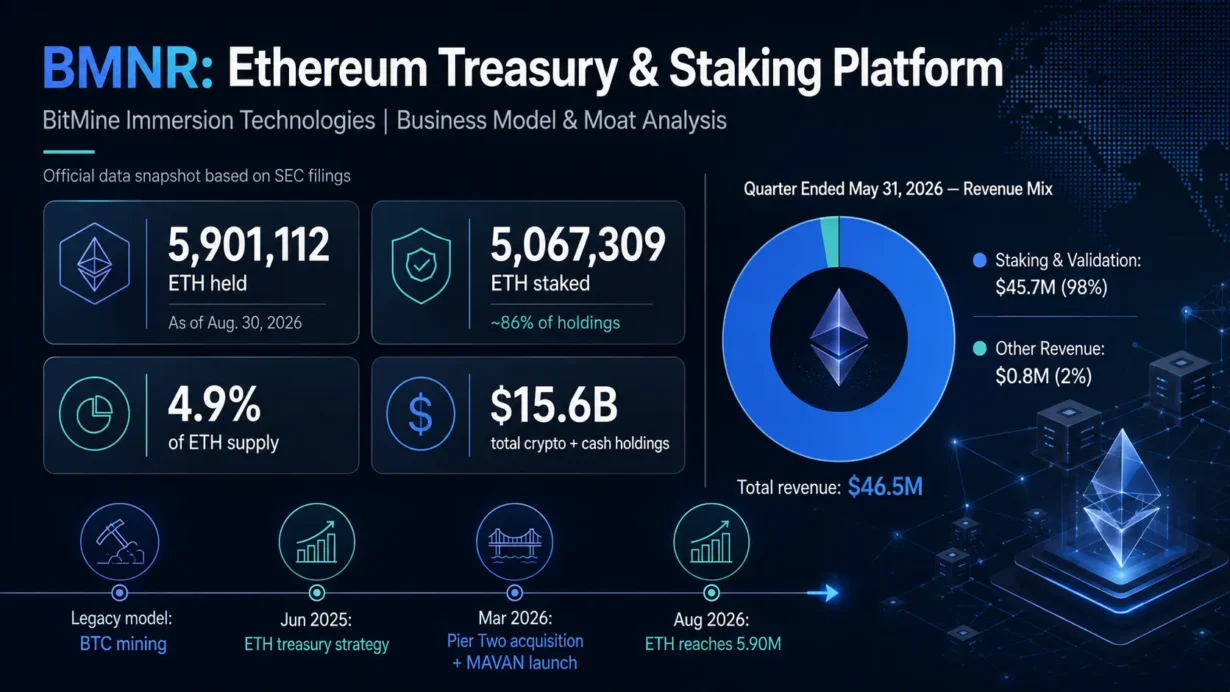
The strategic break occurred around June 30, 2025, when BitMine announced a $250 million private placement to launch an Ethereum treasury strategy and appointed Thomas J. Lee as chairman. That move followed the company’s June 2025 uplisting and public offering, and it opened a much larger capital-formation channel than the legacy mining business could support. The transformation accelerated in November 2025 when native staking began, and again in March 2026 when BitMine acquired Pier Two Holdings and launched MAVAN, the Made in America Validator Network, as an institutional-grade staking platform.
As of the company’s August 30, 2026 operational update, BitMine reported 5,901,112 ETH, equal to approximately 4.9% of the 120.7 million ETH supply cited in that filing. It also reported 5,067,309 ETH staked, or about 86% of its ETH holdings. The same update placed total crypto, cash, marketable securities, and strategic “moonshot” holdings at $15.6 billion. These are company-reported point-in-time figures furnished in an SEC filing, not a substitute for quarter-end audited financial statements. The latest full financial statements used in this analysis are the Form 10-Q for the period ended May 31, 2026.
1. Business Model Breakdown
From mining economics to treasury economics
The original BitMine model was straightforward but structurally constrained. It spent capital on miners, power, hosting, site infrastructure, and immersion-cooling systems, then monetized those assets through self-mining, equipment sales, leasing, hosting, and consulting. Fiscal 2025 revenue totaled only about $6.1 million, including $3.1 million from self-mining, $1.9 million from leasing, $846,000 from equipment sales, and $235,000 from consulting. The legacy model exposed the company to hardware obsolescence, electricity costs, Bitcoin halving economics, site utilization, and recurring capital expenditures.
The new model is economically different. BitMine now treats ETH as its primary strategic reserve asset and uses staking to convert part of that balance-sheet exposure into recurring protocol-level revenue. Instead of earning most of its revenue by running energy-intensive Bitcoin mining hardware, the company earns digital assets by validating blockchain activity. Management has also moved toward a lower-capex architecture in which security, custody, validator operations, treasury management, and compliance matter more than physical mining expansion.
Revenue source #1: staking and validation
Staking is now the core accounting revenue stream. For the three months ended May 31, 2026, BitMine reported $45.7 million of staking and validation revenue out of total revenue of $46.5 million, meaning roughly 98% of quarterly revenue came from staking and validation. For the nine months ended May 31, 2026, staking and validation contributed $56.9 million of $59.9 million in total revenue, or approximately 95%.
The underlying mechanism is simple: BitMine stakes ETH and operates validator nodes, directly or through infrastructure providers acting at its direction. When validators successfully perform network duties, the Ethereum protocol pays rewards in digital assets. BitMine recognizes the full protocol reward as revenue when it acts as principal node operator, while relevant service-provider and delegator costs are recognized as cost of sales. The key variables are the quantity of ETH staked, the Ethereum staking yield, validator uptime, slashing performance, ETH’s U.S. dollar price, and the operating fees required to secure and manage the validators.
This creates a revenue stream that is capital-light relative to Bitcoin mining, but it is not equivalent to high-margin SaaS. The protocol sets much of the economic yield, competitors can access the same base staking mechanics, and U.S.-dollar revenue fluctuates with ETH prices. BitMine therefore cannot create a durable pricing monopoly simply by owning ETH. Its opportunity is to reduce the operating cost per staked ETH, maintain institutional-grade reliability, and monetize a third-party service layer on top of its own treasury.
Revenue source #2: MAVAN as a future third-party staking platform
MAVAN is the most strategically important attempt to turn BitMine from a balance-sheet vehicle into an operating platform. BitMine launched MAVAN in March 2026 in connection with its acquisition of Pier Two Holdings, an Australian provider of non-custodial staking infrastructure, validator operations, staking-as-a-service, and related blockchain infrastructure services. Pier Two brought technology, operating personnel, customer relationships, and multi-network capabilities into a platform that had initially been built to support BitMine’s own ETH treasury.
The platform strategy is effectively “captive demand first, external distribution second.” BitMine’s own ETH acts as the anchor asset base. That gives MAVAN immediate scale, a live operating environment, and an internal customer large enough to justify institutional security, monitoring, redundancy, compliance, and validator-management investment. The next strategic step is to sell the same infrastructure to custodians, institutional investors, and ecosystem partners. If successful, that would add service and fee revenue that is less dependent on BitMine purchasing more ETH for its own balance sheet.
This is the most important business-model upgrade to watch. A treasury company that only owns and stakes its own ETH remains primarily an asset-exposure vehicle. A treasury company that uses its asset scale to build a third-party staking network begins to look more like a financial-infrastructure operator. The difference is crucial because fee-based third-party assets can expand without requiring an equal amount of BitMine balance-sheet capital.
Revenue source #3: residual Bitcoin mining, consulting, and legacy activities
BitMine continues to maintain a small Bitcoin mining operation and has generated modest consulting and leasing revenue, but these businesses are no longer the center of the model. In the May 2026 quarter, self-mining revenue was only $624,000 and consulting revenue was $168,000. Leasing and mining-equipment sales contributed no revenue in that quarter. The company has explicitly described a strategy of winding down proprietary self-mining exposure and deferring new site buildouts.
That makes legacy mining strategically optional rather than defining. It can generate cash when mining economics are attractive, but the company’s valuation logic now depends much more heavily on the scale and productivity of the ETH treasury, the economics of staking, and the commercialization of MAVAN.
The non-revenue engine: capital formation
For BitMine, the most important source of economic fuel is not reported as revenue at all. It is capital formation. In the nine months ended May 31, 2026, the company sold 340,748,312 common shares through its ATM program and reported approximately $11.87 billion of gross proceeds. Over the same period, investing cash flow included roughly $11.69 billion used to purchase ETH. The company stated that its ATM program permitted up to $24.5 billion of common-stock sales from time to time.
This is the core treasury flywheel. Public-market demand for BMNR can be converted into equity capital; equity capital can be converted into ETH; ETH can then be staked to generate protocol rewards. If new capital is raised at a sufficiently attractive valuation relative to underlying net assets, the company may be able to increase ETH per share or net asset value per share even while issuing more shares. If capital is raised below economic asset value, however, the same mechanism becomes dilutive. The distinction between “more ETH” and “more ETH per share” is therefore the central analytical discipline for this company.
BitMine has also broadened its funding stack. In June 2026 it issued 3.5 million shares of 9.50% Series A Perpetual Preferred Stock at $80 per share, producing approximately $273.8 million of net proceeds. This creates another source of capital, but it also imposes a fixed dividend burden. Because the preferred dividend rate is materially above the company’s cited recent ETH staking yield, preferred financing cannot be justified by staking spread alone. It only creates value if the capital funded through that instrument earns an adequate total return through asset appreciation, strategic investment returns, or broader capital-allocation benefits after financing costs.
The result is a hybrid business model with three layers: an ETH asset base, a staking-and-validator operating layer, and a public-capital formation layer. The model can be powerful when all three reinforce one another. It can also become reflexive in the wrong direction if ETH falls, BMNR’s market valuation compresses, and the company loses the ability to raise accretive capital.
2. Deep Dive into Economic Moats
Intangible Assets: emerging institutional credibility, but limited proprietary protection
BitMine has developed intangible assets in the form of public-company governance, capital-markets visibility, institutional investor relationships, treasury-management processes, and the technology and customer relationships acquired with Pier Two. Its NYSE listing, ability to access large equity programs, and institutional staking positioning can reduce friction for counterparties that prefer to work with a public, reporting company.
However, those attributes should not be overstated. A stock-exchange listing is not proprietary intellectual property. ETH is not exclusive. Validator software can be replicated. Custody relationships can be obtained by competing institutions. The company has not disclosed a patent estate or unique protocol rights that would prevent other well-capitalized firms from building comparable infrastructure. Intangible assets therefore contribute to trust and distribution, but they are not yet a hard barrier to entry.
Switching Costs: potentially meaningful for institutions, but not yet proven at scale
Institutional staking can create moderate switching costs. A custodian or asset owner integrating with a staking provider must complete security reviews, legal and compliance diligence, validator configuration, reporting integration, service-level monitoring, and operating-risk approval. Once a provider has demonstrated high uptime, sound key-management procedures, resilient infrastructure, and reliable reporting, customers may be reluctant to switch solely for a small fee discount because migration introduces operational and slashing risk.
That said, BitMine has not yet demonstrated enough third-party customer scale to treat switching costs as a mature moat. The company’s own filings describe MAVAN’s expansion from an internally focused staking platform toward third-party institutional customers as a plan still carrying customer-acquisition, service-level, competitive, and regulatory risk. In other words, switching costs may eventually protect an installed base, but the installed base itself must first be built.
Network Effects: Ethereum has them; BMNR does not yet
Ethereum has powerful network effects because more developers, users, applications, liquidity, stablecoins, tokenized assets, validators, and infrastructure providers can increase the utility of the ecosystem. Those network effects are economically relevant to BitMine because the company owns ETH and earns staking rewards on Ethereum.
But Ethereum’s network effect should not be misclassified as BitMine’s moat. A new MAVAN customer does not automatically make MAVAN more useful to every other customer in the same way that an additional participant strengthens a marketplace or social network. More assets on MAVAN can improve operating scale, data, reputation, and cost absorption, but those are scale economies rather than a true demand-side network effect. At present, BMNR’s network-effect moat is weak.
Cost Advantages: the strongest emerging moat
The most defensible advantage is BitMine’s captive scale. As of August 30, 2026, the company reported 5.90 million ETH and about 5.07 million ETH staked. A validator platform supporting that quantity of owned assets starts with a level of utilization that a new standalone staking provider would need years of customer acquisition to replicate. That matters because institutional staking involves fixed and semi-fixed costs: engineering, validator monitoring, cyber defense, compliance, treasury controls, vendor oversight, redundant infrastructure, legal support, and reporting systems.
Spreading those costs over millions of ETH can lower the operating cost per staked unit. The same internal scale can also support stronger purchasing terms with hosting, cloud, custody, connectivity, and infrastructure providers. Pier Two’s technology and personnel may further improve that cost structure by bringing an established non-custodial staking stack into the organization.
Still, the cost advantage has limits. Ethereum’s staking reward rate is protocol-driven, so BitMine cannot command a structurally higher base yield merely because it is larger. Competitors with significant institutional assets can also reach scale. The advantage therefore depends on net economics: validator performance, slashing avoidance, vendor pricing, custody expense, compliance efficiency, and the ability to convert excess platform capacity into profitable third-party fee revenue.
Capital-market access: a powerful but reflexive advantage
BitMine’s capital-market access functions like an additional cost-of-capital advantage when BMNR securities trade at favorable prices. The company raised nearly $11.9 billion through common-stock ATM issuance in the nine months ended May 31, 2026, later added perpetual preferred capital, obtained a full NYSE listing, and was added to the Russell 1000 in June 2026. That combination gives management more financing tools than most standalone staking operators or private crypto infrastructure firms possess.
But this is not a permanent moat in the Buffett sense. It is conditional on investor demand. If BMNR trades materially above underlying economic value, equity issuance can become a low-friction funding source. If the stock trades below net asset value, issuing more common equity can transfer value away from existing shareholders. The company’s $4 billion repurchase authorization gives it a potential counter-cyclical tool, but repurchases themselves require liquidity and do not eliminate market risk.
For long-term excess returns, the relevant question is therefore not whether BitMine can raise capital, but whether it can repeatedly raise and deploy capital at a positive spread to per-share intrinsic value. That is a much higher bar.
Moat verdict
BitMine currently has an emerging rather than mature moat. Its two most credible barriers are captive staking scale and capital-market distribution. The first can produce real operating cost advantages; the second can accelerate asset accumulation and platform investment. Neither is yet sufficient by itself to guarantee durable excess returns.
The moat becomes materially stronger if three conditions are met simultaneously: MAVAN gains meaningful third-party institutional assets, staking and service gross profit comfortably exceed custody and corporate overhead, and ETH per diluted share or net asset value per diluted share rises over time despite financing activity. If those conditions are not met, BMNR remains primarily a leveraged public-market wrapper around ETH exposure rather than a differentiated infrastructure franchise.
3. Business Inflection Points & Future Catalysts
The decisive strategic inflection point: June 2025
The most important inflection point in BitMine’s history was not the launch of a new miner or data center. It was the June 2025 decision to use the public company as a large-scale Ethereum treasury vehicle. The company announced a $250 million private placement on June 30, 2025 to initiate the ETH strategy, while Thomas J. Lee became chairman. That changed the addressable capital base, changed the asset mix, changed the revenue opportunity, and ultimately changed the operating model.
The legacy mining company could only grow as fast as it could fund equipment, power, and hosting economics. The treasury model could grow as fast as public capital markets allowed management to raise capital and deploy it into ETH. Once the ETH balance became large enough, staking transformed those assets from passive exposure into a recurring protocol-reward stream. MAVAN then created a path to monetize the operating capabilities built around that treasury for external institutions.
Catalyst 1: higher staking penetration and MAVAN commercialization
The clearest near-term operating catalyst is increasing the productive utilization of BitMine’s ETH and turning MAVAN into a third-party platform. As of August 30, 2026, BitMine reported approximately 5.07 million ETH staked out of 5.90 million ETH held, or about 86%. The company estimated annualized staking revenue of approximately $340 million at then-current conditions and projected roughly $396 million if its ETH were fully staked at the cited 2.67% seven-day annualized yield.
The transmission mechanism is direct. More staked ETH increases the quantity of protocol rewards earned, assuming yield and validator performance remain stable. Third-party assets would add another revenue layer through staking service economics without requiring BitMine to fund every incremental ETH itself. That can improve capital efficiency because the platform earns from assets it does not own.
The most useful observable indicators are the percentage of BitMine ETH staked, total ETH or other assets validated through MAVAN, third-party assets as a share of MAVAN activity, validator uptime, slashing events, staking yield, staking cost of sales, gross profit, and disclosed customer or custodian additions. A particularly important milestone would be evidence that third-party fee revenue is becoming material relative to staking rewards on BitMine’s own balance sheet.
The execution risks are equally clear. Ethereum staking yields can compress as participation rises. Protocol changes can alter reward economics. Validator downtime or slashing can damage economics and reputation. MAVAN relies on third-party infrastructure providers and key personnel, including Ethereum Tower under a long-term management arrangement. Pier Two integration can fail to produce the expected technology, customer, or personnel benefits. Regulation can also impose new requirements as MAVAN moves from self-staking toward serving external institutions.
Catalyst 2: capital allocation that increases ETH per share rather than merely total ETH
BitMine is approaching its stated goal of holding 5% of ETH supply, but the economic importance of that target is frequently misunderstood. Owning 5% of ETH does not automatically create shareholder value. The value-creation mechanism depends on the price and structure of the financing used to acquire that ETH, the resulting change in ETH per diluted share, the yield earned on those assets, and the cost of financing.
The catalyst is therefore not simply “buy more ETH.” It is disciplined capital allocation. If BMNR can issue equity above economic net asset value, repurchase shares when they trade below value, and use preferred or other financing only when the expected total return on deployed capital exceeds the financing cost, the treasury can compound on a per-share basis. A liquid common stock, a large ATM authorization, the new preferred security, and a repurchase program give management multiple levers.
The observable metrics should include total ETH, ETH per basic and diluted share, cash and marketable securities, total debt and preferred obligations, common shares issued and repurchased, average financing prices, net asset value per share, staking revenue per share, and total corporate expenses per share. Investors should also monitor whether new capital is allocated primarily to ETH and productive infrastructure or increasingly to strategic minority investments that introduce unrelated valuation volatility.
The failure mode is dilution. During the nine months ended May 31, 2026, BitMine sold more than 340 million common shares through the ATM program. That financing created the balance sheet that allowed the ETH treasury to scale, but future issuance is only accretive if the company receives enough value per new share. A prolonged discount to NAV would weaken this flywheel and could force management to choose between slower ETH accumulation and economically dilutive issuance.
Catalyst 3: U.S. regulatory clarity and institutional Ethereum adoption
A broader regulatory shift could also improve BitMine’s opportunity set. The SEC’s Division of Corporation Finance stated in May 2025 that certain protocol staking activities, under the facts described in its statement, do not involve the offer and sale of securities. In August 2025, the Division issued a separate statement addressing certain liquid staking activities. These are staff views rather than binding Commission rules, but they reduced one category of uncertainty around staking structures that conform to the described facts.
The GENIUS Act, signed into law in July 2025, created a federal framework for payment stablecoins. To the extent stablecoins, tokenized securities, and other on-chain financial instruments expand on Ethereum or Ethereum-connected infrastructure, the result could increase institutional demand for ETH, custody, staking, and validator services. BitMine is exposed to that trend through both its treasury and MAVAN.
The transmission mechanism would run through several channels: greater institutional blockchain usage could support ETH demand, increase the strategic importance of compliant staking infrastructure, and expand the addressable customer base for MAVAN. Observable indicators include institutional staking mandates, regulated custodian integrations, third-party MAVAN assets, U.S. rulemaking and enforcement posture, and measurable growth in tokenization activity that settles on Ethereum or relies on Ethereum security.
The risk is that regulation becomes more restrictive, that institutional adoption favors competing chains or Layer 2 systems that capture more economics away from Ethereum mainnet, or that staking becomes commoditized and fee pressure offsets asset growth. Regulatory clarity is therefore an enabling condition, not a guarantee of BitMine-specific profits.
4. Key FAQs
How does BitMine Immersion Technologies make money now?
BitMine now makes most of its reported revenue from Ethereum staking and validation. In the quarter ended May 31, 2026, approximately 98% of revenue came from staking and validation. The company stakes ETH, operates or directs validator infrastructure, and earns protocol rewards when validation duties are performed successfully. Bitcoin mining and consulting still exist, but they are economically secondary. Separately, BitMine’s largest source of balance-sheet growth has been capital raising through common equity and other securities; that financing is not revenue, but it funds ETH purchases that can later generate staking income.
Is BMNR an Ethereum treasury company or a Bitcoin mining company?
BMNR should now be analyzed primarily as an Ethereum treasury and staking infrastructure company with residual Bitcoin mining exposure. The company’s 2025 annual filing explicitly described a shift away from the mining-centric model toward an ETH-anchored treasury and capital-light ecosystem services. By May 2026, staking and validation had become the dominant revenue source, and by August 2026 the company reported 5.90 million ETH versus only 211 Bitcoin. The legacy miner remains part of the corporate history, but it no longer explains the economics of the business.
What is MAVAN and why does it matter to the BitMine business model?
MAVAN is BitMine’s institutional staking and validator platform, launched in March 2026 alongside the acquisition of Pier Two. It matters because it gives BitMine a path from asset ownership to financial infrastructure. The company can use its own large ETH treasury as an anchor workload, spreading fixed operating and compliance costs across millions of ETH, then attempt to sell staking infrastructure to custodians and institutions. If third-party assets become material, MAVAN could diversify revenue away from pure ETH price exposure and improve capital efficiency. If it remains mostly an internal staking operation, BitMine will continue to behave primarily like a treasury vehicle rather than a platform business.
5. Conclusion
BitMine’s corporate DNA is now built around financial engineering, digital-asset balance-sheet scale, and validator infrastructure rather than mining hardware. The company used a public-listing and capital-markets platform to raise billions of dollars, converted a large portion of that capital into ETH, and then built staking operations to monetize the treasury. The March 2026 acquisition of Pier Two and launch of MAVAN added the missing operating layer: a potential institutional infrastructure business sitting on top of the treasury.
The company’s most credible competitive advantage is not that it owns a lot of ETH. Scale itself is not a moat. The stronger argument is that BitMine’s own ETH creates captive platform utilization, which can lower per-unit infrastructure costs, improve operating experience, and support a commercial staking product. Its capital-market access is another meaningful advantage, but it is reflexive and valuation-dependent rather than permanent. Ethereum’s network effects may benefit BitMine, yet those network effects belong to the protocol, not to BMNR shareholders.
The long-term quality test is therefore per-share compounding. A durable BitMine franchise would need to show that ETH per diluted share or NAV per diluted share can grow after financing activity, that staking revenue converts into sustainable cash economics after custody, overhead, and preferred dividends, and that MAVAN can attract third-party institutional assets. If those outcomes emerge, BitMine could evolve from an ETH treasury proxy into a scaled blockchain infrastructure company. If they do not, its economic identity will remain primarily that of a public-market wrapper around a highly volatile ETH balance sheet.
Primary Sources
- BitMine Immersion Technologies 2025 Form 10-K — U.S. Securities and Exchange Commission
- BitMine Immersion Technologies Form 10-Q for the period ended May 31, 2026 — U.S. Securities and Exchange Commission
- June 2025 Ethereum Treasury Strategy and Chairman Appointment Form 8-K — U.S. Securities and Exchange Commission
- March 2026 Pier Two Acquisition Form 8-K — U.S. Securities and Exchange Commission
- August 31, 2026 BitMine ETH Holdings and MAVAN Operational Update — SEC-filed company exhibit
- June 2026 Series A Perpetual Preferred Stock Offering Form 8-K — U.S. Securities and Exchange Commission
- SEC Division of Corporation Finance Statement on Certain Protocol Staking Activities
- SEC Division of Corporation Finance Statement on Certain Liquid Staking Activities
- White House Notice: GENIUS Act Signed into Law
- BitMine Immersion Technologies Investor Relations
Disclaimer: This article is intended solely for business logic discussion and corporate research purposes, and does not constitute investment advice of any kind.