

Key Takeaways
- IBM’s earnings engine is increasingly software-led. In 2025, Software generated $30.0 billion of revenue, roughly 44% of company sales, with an 83.5% gross margin and a 33.1% segment profit margin. The economic logic is straightforward: expand the share of recurring, high-margin software while using Consulting and Infrastructure to deepen enterprise adoption and distribution.
- IBM’s strongest moat is not brand recognition alone. It is the combination of high switching costs around mission-critical workloads and a broad control layer spanning Red Hat hybrid cloud, automation, data, security, transaction processing, and enterprise AI. Replacing one IBM product is possible; unwinding the architecture, operational processes, compliance controls, skills, and integrations around an IBM-centered stack can be materially harder.
- The platform strategy has become more coherent since the 2019 Red Hat acquisition and the 2021 Kyndryl separation. Red Hat provides the open hybrid-cloud substrate; HashiCorp extends infrastructure lifecycle automation; Confluent adds real-time data streaming; watsonx addresses AI development, data, governance, and orchestration; Consulting helps clients implement the stack across heterogeneous environments.
- The near-term upside case depends on mix, not simply top-line acceleration. Faster growth in Red Hat, Data, automation, and AI-related software can lift recurring revenue and cash conversion even if Consulting remains moderate and IBM Z follows its normal product-cycle volatility.
- The principal risks are visible rather than theoretical. IBM reduced its 2026 constant-currency revenue-growth expectation to 4%–5% after second-quarter softness, Transaction Processing declined 8% year over year in the quarter, IBM Z declined 42%, and large acquisitions have increased integration demands, intangible assets, and balance-sheet complexity.
IBM is one of the rare technology companies whose corporate history is also a history of changing computing architectures. Its roots date to the 1911 formation of Computing-Tabulating-Recording Company, renamed International Business Machines in 1924. The company later helped establish the mainframe era, most notably with System/360 in 1964, which standardized compatible computing across a family of machines. That architecture created an early version of a platform business: customers could add capacity and software without rebuilding the entire computing environment from scratch.
The more important corporate gene, however, is IBM’s repeated willingness to migrate the source of economic value when one technology layer commoditizes. In the 1990s, IBM survived the erosion of proprietary hardware economics by shifting toward integrated services and enterprise solutions. In 2019, it acquired Red Hat for approximately $34 billion to anchor an open hybrid-cloud strategy. In 2021, it separated Kyndryl, shedding a large managed-infrastructure-services business to sharpen IBM around software, consulting, hybrid cloud, AI, and mission-critical infrastructure. More recently, IBM has used acquisitions such as HashiCorp and Confluent to fill specific control points in infrastructure automation and real-time data.
1. Business Model Breakdown
The modern IBM business model is best understood as an enterprise technology stack with four monetization layers: Software, Consulting, Infrastructure, and Financing. These businesses have very different margin structures, but the strategic objective is to make them reinforce one another rather than operate as isolated product lines.
Software: The Primary Profit Pool
Software is the most economically important piece of IBM’s current portfolio. In 2025, Software revenue reached $29.96 billion, up 10.6% as reported, with an 83.5% gross margin and a 33.1% segment profit margin. That revenue base is organized into four categories: Hybrid Cloud, Automation, Data, and Transaction Processing.
Hybrid Cloud is essentially the Red Hat franchise, including Red Hat Enterprise Linux, OpenShift, Ansible, and Red Hat AI. Its role is larger than its direct revenue contribution. Red Hat gives IBM an enterprise-grade open-source foundation that can operate across public cloud, private cloud, on-premises infrastructure, and edge environments. This matters because IBM does not need to displace hyperscale clouds to win. Its strategy is to monetize the complexity created when enterprises use several clouds while retaining regulated, latency-sensitive, or mission-critical workloads on their own infrastructure.
Automation monetizes the operational complexity layered on top of that hybrid architecture. The portfolio includes infrastructure lifecycle management, observability, integration, FinOps, security functions, application operations, and HashiCorp products such as Terraform and Vault. The economic thesis is that more infrastructure choices, more applications, and more AI agents create more provisioning, governance, integration, and cost-management work. IBM attempts to turn that complexity into recurring software demand.
Data includes databases, data integration, governance, AI assistants, and related capabilities. The 2026 acquisition of Confluent materially expands this layer by adding real-time event streaming. In an AI environment, a model can be sophisticated but commercially weak if the data feeding it is stale, fragmented, or poorly governed. IBM’s strategic argument is that enterprise AI becomes more valuable when the company controls more of the data plane that connects operational systems to models and agents.
Transaction Processing contains some of IBM’s most mature but economically durable software. These products support mission-critical workloads, especially in environments linked to IBM Z. Growth can be uneven because capacity additions and software demand are partly tied to customer transaction volumes and mainframe cycles, but the franchise benefits from deeply embedded workloads and high operational risk around migration.
The important distinction is that IBM is not trying to become a pure SaaS company in the conventional sense. Its software portfolio mixes subscriptions, term licenses, consumption models, transaction-linked economics, and recurring support. What matters is that the portfolio produces a large base of high-margin, repeat revenue attached to enterprise systems that customers cannot casually interrupt.
Consulting: Distribution, Implementation, and Wallet Expansion
IBM Consulting generated $21.06 billion of revenue in 2025. Its gross margin was 28.1%, far below Software, which means Consulting should not be valued as if it were the company’s core profit pool. Its strategic importance is different: it reduces implementation friction and gives IBM a channel into complex enterprise transformations.
Consultants help clients design hybrid-cloud architectures, modernize applications, integrate data, deploy AI, and re-engineer workflows. That gives IBM two forms of economic leverage. First, Consulting can create demand for IBM software by embedding products into broader transformation programs. Second, IBM can remain commercially relevant even when a client chooses non-IBM infrastructure or software in parts of the stack. IBM’s official partner ecosystem includes companies such as AWS, Microsoft, Oracle, SAP, Adobe, Salesforce, and others, illustrating a deliberate strategy of participating in heterogeneous enterprise environments rather than demanding an all-IBM architecture.
The trade-off is that services revenue is more labor-intensive, more exposed to discretionary project timing, and structurally lower margin. Consulting therefore works best for IBM when it functions as a platform adoption accelerator rather than as an end in itself.
Infrastructure: Mission-Critical Compute with Cyclical Economics
Infrastructure generated $15.72 billion of revenue in 2025 and carried a 58.6% gross margin. The segment includes IBM Z, distributed infrastructure such as Power and Storage, infrastructure software, and support.
IBM Z is strategically important because it anchors some of the world’s most sensitive transaction-processing environments. The business can produce strong product-cycle surges when a new mainframe generation launches, followed by difficult comparisons as the cycle matures. The z17 drove strong growth in 2025, but second-quarter 2026 IBM Z revenue fell 42% year over year, demonstrating why investors should distinguish durable installed-base economics from cyclical hardware shipment growth.
Infrastructure also acts as a distribution surface for IBM software. The more relevant long-term question is not whether IBM can make hardware revenue grow smoothly every quarter; it is whether the company can maintain the installed base, attach software and support, and use new systems to preserve the economics of mission-critical computing.
Financing: A Supporting Function, Not the Strategic Core
Financing is small relative to the other segments. It facilitates client purchases and supports the broader IBM ecosystem, but it is not the central driver of IBM’s competitive positioning. Its economics should be assessed alongside credit quality, receivables, and IBM’s consolidated debt rather than treated as a standalone technology growth engine.
The Underlying Profit Formula
IBM’s business model can be summarized as a mix-shift formula: preserve high-value installed workloads, increase the proportion of software attached to those workloads, use open hybrid-cloud technology to stay relevant across non-IBM environments, and deploy Consulting to accelerate implementation and cross-sell. The model works when software grows faster than the corporate average, recurring revenue increases, Consulting improves software pull-through, and Infrastructure retains mission-critical incumbency without consuming excessive capital.
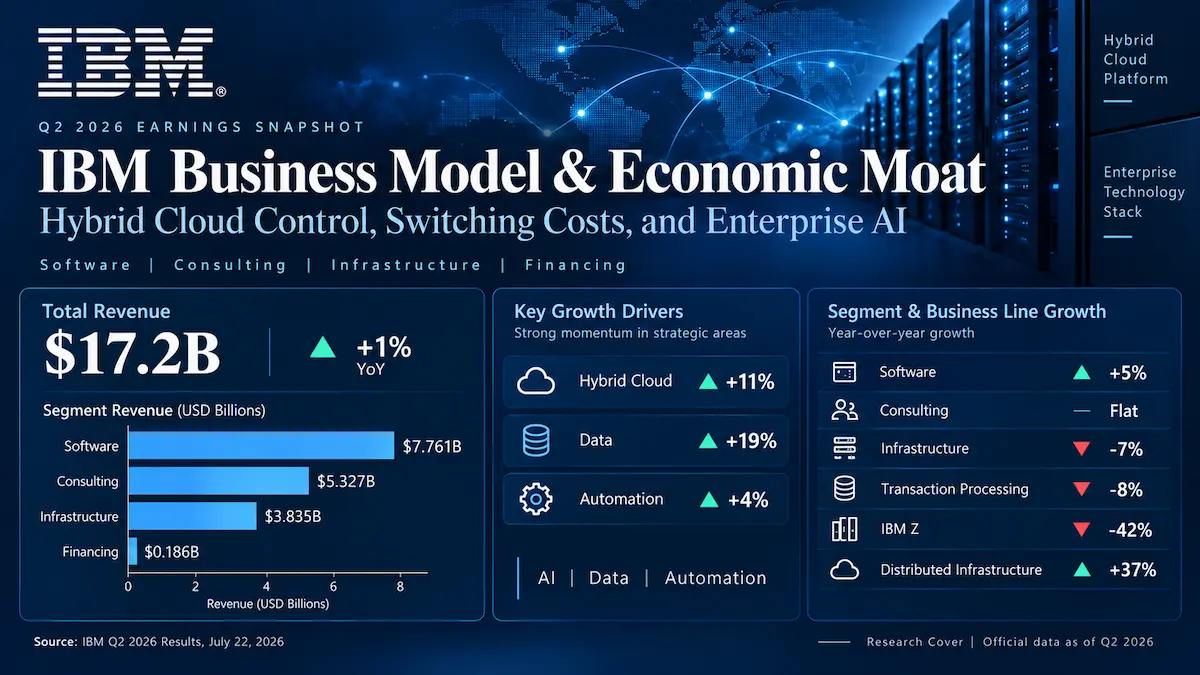
This is already visible in the financial mix. IBM generated $67.54 billion of revenue in 2025, while Software represented roughly 44% of sales and a disproportionately larger share of segment profit. In the second quarter of 2026, Software revenue was $7.76 billion and grew 5%, while Consulting was essentially flat and Infrastructure declined 7%. Within Software, however, the composition remained revealing: Hybrid Cloud grew 11% and Data grew 19%, while Transaction Processing declined 8%.
2. Deep Dive into Economic Moats
Under a Buffett-style moat framework, IBM does not deserve a high score simply because it is old, large, famous, or embedded in Fortune 500 IT budgets. A genuine moat must either protect pricing, lower customer acquisition cost, raise customer retention, reduce unit costs, or make competitive replication economically unattractive. On that basis, IBM’s two strongest defenses are switching costs and a form of intangible-asset advantage built around enterprise trust, software ecosystems, technical standards, and accumulated domain expertise. Network effects and cost advantages exist in narrower pockets, but they are less central.
Moat 1: Switching Costs Around Mission-Critical Workloads
IBM’s most defensible advantage is the cost of changing systems once they become embedded in core enterprise operations. This is especially important in mainframe, transaction processing, regulated-industry workflows, middleware, identity, automation, and large hybrid-cloud environments.
The switching cost is not merely a software license cancellation fee. It can include application rewrites, database migration, testing, security recertification, regulatory validation, workforce retraining, process redesign, downtime risk, vendor coordination, and the possibility of operational failure. For a bank, insurer, government agency, telecom operator, or healthcare institution, the expected cost of a failed migration can be larger than the direct technology savings from switching vendors.
This is why legacy should not automatically be interpreted as weakness. Legacy becomes a moat when the workload remains economically essential, the installed technology continues to receive modernization investment, and the vendor provides a credible bridge to newer architectures. IBM’s hybrid-cloud strategy is designed to extend rather than destroy this incumbency: OpenShift, APIs, automation, data integration, and AI tooling can make older systems participate in modern application architectures without requiring clients to replace everything at once.
A competitor can offer a cheaper database, cloud service, AI model, or infrastructure platform. To displace IBM at the account level, however, it may need to absorb years of migration work, prove equivalent resilience and security, recreate integrations, win approval from risk functions, and overcome the organizational inertia of systems that already work. That is a materially higher hurdle than competing feature-for-feature.
The limitation is that switching costs can become a melting iceberg if customers gradually modernize away from the incumbent. IBM therefore has to keep converting historical lock-in into contemporary relevance. If clients increasingly move workloads to cloud-native alternatives without IBM software attached, the moat weakens over time even if the old systems remain profitable for years.
Moat 2: Open Hybrid-Cloud Control Layer and Enterprise Intangibles
IBM’s second major advantage is not a traditional consumer brand moat. It is a bundle of enterprise intangibles: Red Hat’s open-source position, technical credibility, long-standing customer relationships, enterprise support capabilities, security and governance know-how, patents and research, and deep experience operating in regulated or mission-critical environments.
Red Hat is particularly important because it changes the strategic posture of IBM. A proprietary vendor usually strengthens itself by locking customers into its own infrastructure. Red Hat instead gives IBM a way to monetize openness. RHEL and OpenShift can run across competing clouds and on-premises systems. Ansible can automate heterogeneous environments. HashiCorp can provision and secure infrastructure across multiple providers. Confluent can move data across distributed systems. watsonx can govern and orchestrate AI across model and infrastructure choices.
This creates an unusual competitive position: IBM can benefit from enterprise heterogeneity rather than needing to eliminate it. The more fragmented an enterprise’s architecture becomes, the more valuable control, automation, governance, integration, and observability can become. IBM’s platform strategy is therefore less about owning every compute cycle and more about owning selected control points across a fragmented stack.
Replication is expensive because a rival would need more than a single successful product. It would need credible open-source assets, enterprise-grade support, a global sales and services organization, security and compliance expertise, developer adoption, integration across old and new systems, and the patience to build trust in workloads where outages are unacceptable. Hyperscalers can match or exceed IBM in individual technical categories, and specialist software firms may be stronger in particular niches, but recreating IBM’s breadth while remaining neutral across multiple clouds is a more complex undertaking.
Why Network Effects Are Secondary
IBM benefits from ecosystems, open-source communities, partner integrations, and developer familiarity, but it does not possess a classic winner-take-most network effect comparable with a social network, marketplace, or payment network. A new IBM customer does not automatically make IBM products dramatically more valuable to every existing customer.
Red Hat and open-source ecosystems can produce community-driven innovation and compatibility benefits, while Confluent’s Kafka heritage gives IBM exposure to a widely adopted data-streaming standard. Those dynamics are strategically useful, but the more defensible economics still come from customer embeddedness, integration depth, and operational switching costs.
Why Cost Advantage Is Also Secondary
IBM has global scale, procurement leverage, large R&D budgets, and a broad installed base, but it is not primarily a low-cost producer. Its model depends more on delivering high-value enterprise outcomes than on being the cheapest vendor. In public-cloud infrastructure, for example, hyperscalers have structural scale advantages that IBM does not need to replicate if IBM can monetize software and control layers across those clouds.
Can These Moats Support Long-Term Excess Returns?
Potentially, but only if IBM keeps moving the moat upward in the technology stack. Historical switching costs can defend cash flows; they do not automatically create growth. The long-term quality of the moat depends on whether IBM can attach Red Hat, automation, data, governance, security, and AI to the same mission-critical environments that once depended mainly on IBM hardware and transaction-processing software.
The evidence is encouraging but not conclusive. Software has become the largest and highest-margin segment, Red Hat continues to post double-digit growth, and Data accelerated sharply in the second quarter of 2026. At the same time, overall second-quarter revenue growth slowed to 1%, IBM reduced full-year constant-currency revenue guidance to 4%–5%, and some mature software and infrastructure categories weakened. The moat is therefore best described as durable but requiring continuous reinvestment rather than self-perpetuating.
3. Business Inflection Points & Future Catalysts
The Strategic Inflection Point: Red Hat Reframed IBM from Proprietary Stack to Open Control Layer
The most important modern inflection point was IBM’s 2019 acquisition of Red Hat for approximately $34 billion. The transaction was not simply a large software acquisition. It changed the logic of how IBM could remain relevant as public cloud expanded.
Before Red Hat, IBM faced a strategic problem: hyperscale cloud providers were becoming the default destination for new workloads, while IBM’s strongest installed assets remained concentrated in enterprise data centers and legacy architectures. Red Hat gave IBM a neutral operating layer based on Linux, containers, Kubernetes, and open-source infrastructure. Instead of forcing customers to choose IBM infrastructure, IBM could help clients operate across AWS, Microsoft Azure, other clouds, and their own data centers.
The 2021 separation of Kyndryl reinforced that shift by removing a large, lower-growth managed-infrastructure-services business. The combination transformed IBM’s portfolio from a broad IT conglomerate toward a more focused hybrid-cloud, software, consulting, and mission-critical infrastructure model.
The subsequent acquisitions of HashiCorp and Confluent should be viewed through the same strategic lens. They are attempts to extend IBM’s control layer from application portability into infrastructure provisioning, security, integration, and real-time data. The success test is not whether the acquired products continue to exist; it is whether IBM can increase cross-sell, raise customer lifetime value, and create a more unified enterprise platform without damaging the openness that made those assets attractive in the first place.
Catalyst 1: Red Hat, HashiCorp, and Confluent Create a Larger Software Control Plane
The transmission mechanism is cross-platform monetization. Red Hat gives IBM a standardized application and operating environment; Terraform and Vault manage infrastructure provisioning and secrets; Confluent streams real-time data; IBM automation and integration products manage application and operational complexity; watsonx adds AI and governance. If IBM can sell these capabilities as complementary layers rather than disconnected products, software revenue per enterprise account can increase without requiring IBM to own the underlying public cloud.
Observable indicators include Hybrid Cloud and Automation growth, Data growth after the Confluent acquisition, software gross margin, recurring revenue trends, cross-sell commentary, and evidence that acquired products sustain their pre-acquisition developer and customer momentum. In second-quarter 2026, Hybrid Cloud grew 11% and Data grew 19%, while Automation grew 4%, indicating that the portfolio is not moving uniformly.
The execution risk is platform overreach. IBM has acquired multiple assets with strong identities and ecosystems. Excessive bundling, sales complexity, pricing changes, or perceived loss of vendor neutrality could weaken product-level franchises. Integration must create more customer value than organizational friction.
Catalyst 2: Enterprise AI Moves from Model Experimentation to Governed Production Workflows
IBM is unlikely to win the AI market by owning the most popular frontier model. Its stronger opportunity is the enterprise operating layer around models: data preparation, governance, orchestration, security, hybrid deployment, workflow integration, and consulting-led implementation.
The transmission mechanism is workload proliferation. As enterprises deploy more AI models and agents, they create additional infrastructure, data, identity, integration, observability, and governance requirements. That can expand demand for Red Hat, watsonx, automation, Confluent, security, and Consulting simultaneously. IBM’s value proposition improves if customers prefer model choice and data control rather than a single vertically integrated AI vendor.
Observable indicators include software growth in Data and Hybrid Cloud, AI-related software contract value, Consulting backlog conversion, adoption of watsonx governance and orchestration capabilities, customer references that progress from pilot to production, and evidence that AI demand generates pull-through into automation or Red Hat rather than remaining a stand-alone consulting project.
The main risk is commoditization. Foundation models are becoming more numerous, open-source alternatives continue to improve, and hyperscalers are building competing governance and orchestration layers. If enterprise AI standardizes around cloud-native tooling controlled by a small number of hyperscalers, IBM’s multi-vendor control-plane thesis becomes less differentiated.
Catalyst 3: Software Mix and Productivity Expand Profit Faster Than Revenue
The third catalyst is financial rather than purely technological. IBM’s Software segment has substantially higher gross margins than Consulting, and the company has been using automation and portfolio actions to raise productivity. If Software continues to outgrow the corporate average, consolidated margins and free cash flow can improve even with moderate company-wide revenue growth.
The transmission mechanism is mix plus operating leverage. A greater share of high-margin software increases gross profit dollars; productivity programs can reduce the expense required to support each dollar of revenue; recurring revenue can improve visibility and cash generation. IBM generated $14.7 billion of free cash flow in 2025 and has stated that it expects 2026 free cash flow to increase by about $1 billion year over year.
Observable indicators include consolidated and Software gross margin, operating pre-tax margin, free cash flow, software mix, expense growth versus revenue growth, and acquisition-related amortization or stock-based compensation. Investors should also watch the difference between organic margin improvement and benefits that depend heavily on restructuring or non-GAAP adjustments.
The risk is that acquired growth proves expensive. IBM invested $10.5 billion in acquisitions during the first half of 2026 and ended the second quarter with $62.0 billion of total debt, including IBM Financing debt. Confluent alone was acquired for approximately $11 billion of enterprise value. If integration costs, compensation, interest expense, amortization, or slower-than-planned cross-sell offset the acquired revenue, the mix shift can look better operationally than economically.
Catalyst 4: Mainframe and Distributed Infrastructure Monetize AI Without Becoming the Core AI Thesis
IBM can also benefit from AI through infrastructure demand, but this should be treated as a secondary catalyst. The z17 cycle showed that new mainframe capabilities can stimulate a large upgrade wave, while Power and Storage produced strong second-quarter 2026 growth and IBM reported a nearly $500 million backlog in distributed infrastructure.
The transmission mechanism is workload modernization rather than generic server demand. Financial institutions and other enterprises can add capacity for transaction processing, encryption, fraud analytics, AI inference, and hybrid integration while keeping sensitive data close to existing systems.
Observable indicators include IBM Z cycle performance, distributed-infrastructure backlog, Infrastructure gross margin, capacity additions, and attach rates for software and support.
The risk is cyclicality. IBM Z revenue fell 42% year over year in the second quarter of 2026 after the strong launch cycle. A high-quality installed base does not eliminate hardware timing effects. Infrastructure should therefore be judged over full product cycles and on its ability to support software economics, not on a single quarter’s shipment growth.
What Could Break the Catalyst Stack?
The most important downside scenario is not one isolated product failure. It is a breakdown in the integrated platform thesis. If Red Hat growth slows materially, acquired automation and data assets fail to cross-sell, Consulting does not convert AI demand into durable software usage, or hyperscalers absorb more of the governance and integration layer, IBM could remain cash generative while reverting to a lower-growth profile.
The second-quarter 2026 results offer a useful reality check. Revenue grew only 1% as reported, Software growth slowed to 5%, and IBM cut its full-year constant-currency revenue expectation to 4%–5%. These figures do not invalidate the strategy, but they raise the burden of proof. Future upside increasingly depends on demonstrating that the software platform can produce sustained organic growth after adjusting for acquisition contributions and product-cycle effects.
4. Key FAQs
How does IBM make money from hybrid cloud and AI?
IBM monetizes hybrid cloud and AI across several layers rather than through one product. Red Hat generates software revenue from enterprise operating systems, containers, and automation; IBM Automation monetizes infrastructure and application complexity; Data products monetize databases, integration, governance, streaming, and AI tooling; watsonx monetizes enterprise AI development and governance; Consulting earns fees for implementation and workflow transformation; Infrastructure supports mission-critical deployment environments. The commercial logic is to earn recurring software revenue wherever the customer runs workloads, including non-IBM public clouds.
What is IBM’s strongest economic moat in 2026?
IBM’s strongest moat is high switching costs around mission-critical enterprise workloads, reinforced by a broad hybrid-cloud control layer. Customers can replace individual IBM products, but replacing an embedded architecture can require application migration, operational retraining, regulatory recertification, security redesign, integration work, and substantial execution risk. Red Hat, automation, data, and AI tools strengthen the moat when they make legacy and modern systems work together rather than forcing clients into disruptive rip-and-replace programs.
Why did IBM acquire Red Hat, HashiCorp, and Confluent?
The three acquisitions target different control points in the same enterprise architecture. Red Hat provides the open hybrid-cloud application and operating platform; HashiCorp adds infrastructure provisioning and security lifecycle management; Confluent adds real-time data streaming. Combined with IBM’s automation, data, security, watsonx, Consulting, and mission-critical infrastructure, the acquisitions are intended to make IBM a control and orchestration layer across heterogeneous enterprise IT. The strategic payoff depends on cross-sell and platform integration while preserving the openness and developer ecosystems that made the acquired assets valuable.
5. Conclusion
IBM’s corporate gene is not simply longevity. It is architectural persistence combined with selective reinvention. The company built one of the earliest durable computing platforms, survived the commoditization of proprietary hardware by becoming more services-oriented, then repositioned again around open hybrid cloud and software. The Red Hat acquisition was the modern pivot: IBM stopped needing to win by owning every layer of infrastructure and instead sought to monetize the control points that connect heterogeneous environments.
The economic moat is strongest where IBM combines mission-critical incumbency with modern software. High switching costs protect core workloads, while Red Hat, automation, data, security, and watsonx give IBM a path to remain relevant as those workloads are modernized. Consulting broadens distribution and implementation capacity; Infrastructure keeps IBM anchored in environments where reliability, security, and transaction intensity matter more than commodity compute economics.
The central research question for the next one to two years is whether IBM can convert its expanded software portfolio into sustained organic growth and higher free cash flow after accounting for acquisition costs and normal infrastructure cycles. Red Hat and Data remain important proof points, while slower Transaction Processing, the 2026 IBM Z decline, reduced revenue guidance, and the scale of recent acquisitions are equally important counterweights. IBM’s competitive position appears structurally stronger than a simple “legacy technology company” label suggests, but the durability of excess returns will depend on execution at the integration layer rather than on the installed base alone.
Primary and Official Sources
- IBM 2025 Form 10-K — U.S. Securities and Exchange Commission
- IBM 2025 Annual Report — IBM Investor Relations
- IBM Second-Quarter 2026 Results — IBM Newsroom
- IBM Investor Events and Reporting Calendar — IBM Investor Relations
- IBM Completes Acquisition of Confluent — IBM Newsroom
- IBM Completes Acquisition of HashiCorp — IBM Newsroom
- IBM and Red Hat: Better Together — IBM Investor Relations
- IBM Completes Separation of Kyndryl — IBM Investor Relations
- The IBM System/360 — IBM History
- The Origins of IBM — IBM History
Disclaimer: This article is intended solely for business logic discussion and corporate research purposes, and does not constitute investment advice of any kind.