

Key Takeaways
- Western Digital is no longer a diversified HDD-and-flash storage conglomerate. Following the February 2025 separation of Sandisk, WDC is economically a focused hard-disk-drive infrastructure company whose earnings power is increasingly tied to cloud and hyperscale capacity demand.
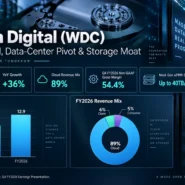
- The Western Digital business model is driven by selling ever more exabytes at attractive economics rather than by subscriptions or advertising. In fiscal 2026, Cloud generated $11.49 billion, or 89% of total revenue, while higher-capacity products, improved pricing and a better cost structure lifted GAAP gross margin to 48.9%.
- WDC’s most defensible moat is a cost-and-qualification system rather than brand alone: vertically integrated recording heads and media, areal-density engineering, UltraSMR software, a common hardware platform, precision manufacturing, and lengthy hyperscaler qualification cycles can jointly reduce cost per terabyte and customer transition risk.
- The next major value-creation tests are the 40TB ePMR ramp, the 2027 HAMR production transition, and the planned intelligent platform layer. Each can expand capacity economics or customer reach, but each also carries meaningful qualification, manufacturing-yield, software-execution and customer-concentration risk.
- The central risk is that a concentrated hyperscale customer base has substantial bargaining power. WDC’s top 10 customers represented 73% of fiscal 2026 revenue, meaning stronger strategic partnerships improve demand visibility but can also magnify pricing, execution and account-loss risk.
1. Business Model Breakdown
The cleanest way to understand Western Digital after the Sandisk spin-off is to stop thinking of it as a broad consumer-storage company and start thinking of it as an infrastructure manufacturer monetizing data growth through cost-efficient magnetic capacity. The company was founded in 1970, built a major HDD position over decades, materially deepened its enterprise-drive capabilities through the 2012 acquisition of HGST, acquired SanDisk in 2016 to add NAND flash exposure, and then reversed that diversification in February 2025 by separating the Flash business into an independent Sandisk. That final step changed the economic identity of WDC: the continuing company is now centered on HDD technology, cloud capacity and the manufacturing economics of cost per terabyte.
Revenue is overwhelmingly hardware-based. Western Digital sells high-capacity enterprise HDDs to hyperscalers, cloud service providers, enterprise customers and OEMs; client HDDs for desktop and notebook use; and branded external storage products through retail and channel partners. There is no material advertising model and no disclosed high-margin SaaS subscription engine at the core of current results. This distinction matters because the company’s operating leverage comes primarily from product mix, pricing, factory utilization, areal-density gains and manufacturing yield rather than from recurring software gross margins.
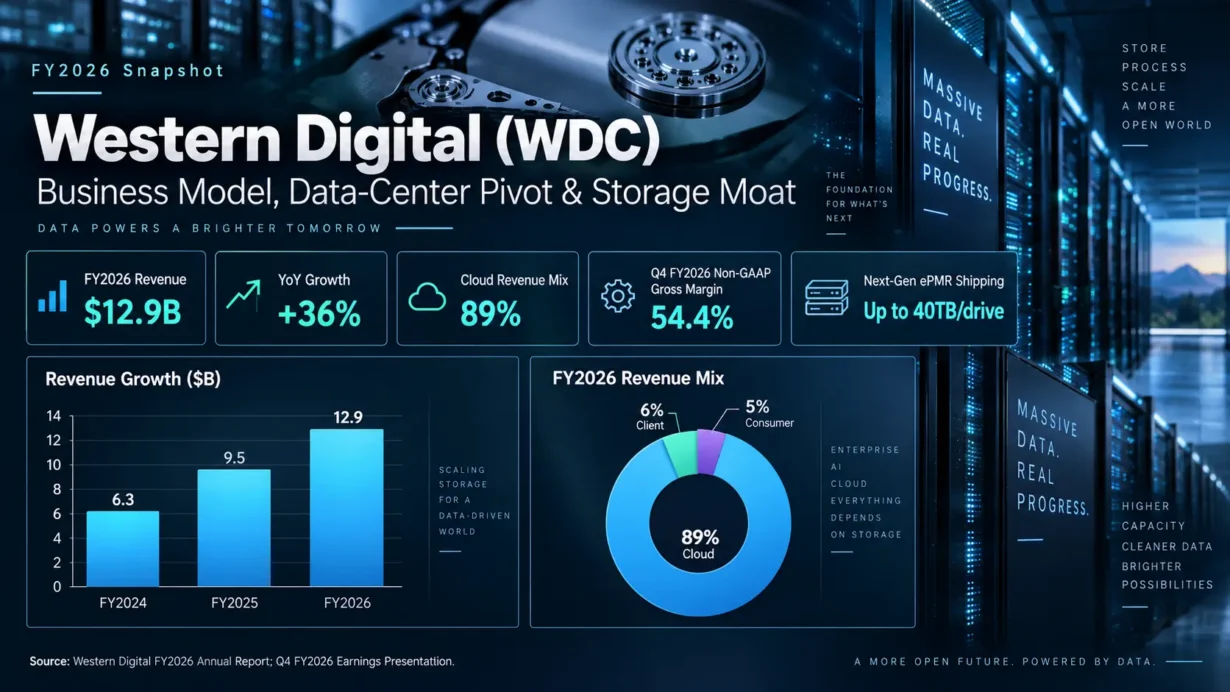
Fiscal 2026 makes the revenue architecture unusually clear. Western Digital reported $12.919 billion of net revenue, up 36% year over year. Cloud contributed $11.490 billion, or 89% of revenue; Client contributed $726 million, or 6%; and Consumer contributed $703 million, or 5%. Cloud revenue rose 38%, driven by a 27% increase in exabytes sold and an 8% increase in average selling price per exabyte. At the company level, exabytes sold increased 25% and ASP per exabyte increased 8%. This is the essential monetization formula: more stored exabytes multiplied by the price captured per exabyte, minus the cost required to manufacture and deliver that capacity.
The profit model is even more important than the revenue mix. Western Digital’s GAAP gross margin rose from 38.8% in fiscal 2025 to 48.9% in fiscal 2026. Management attributed the improvement to higher shipment volume, better cost structure on newer-generation products, a mix shift toward higher-capacity drives and improved pricing. In the fiscal fourth quarter, GAAP gross margin reached 54.1%, while free cash flow was $1.28 billion on $3.75 billion of revenue. For fiscal 2026 as a whole, free cash flow was $3.51 billion. Those numbers show why capacity leadership is economically consequential: if a new drive generation stores materially more terabytes without a proportional increase in bill-of-materials cost, power draw, rack footprint or manufacturing cost, WDC can create value for the customer while also improving its own gross profit per unit of production.
Western Digital’s commercial model is also moving toward longer-duration customer relationships. The fiscal 2026 Form 10-K says certain customer agreements commit both WDC and its customers to substantial volumes over multi-quarter or multi-year periods, often at predetermined or formula-based prices. This can smooth demand visibility and support capacity planning, especially because high-capacity drives have long production lead times. But it is not automatically a margin advantage: these contracts can also limit WDC’s ability to capture spot-market upside if industry pricing tightens. In other words, long-term agreements reduce one form of volatility while introducing opportunity-cost and execution risk.
The platform strategy: hardware commonality first, software abstraction second
WDC’s platform strategy operates at two layers. The first is already embedded in the manufacturing model. The company uses common platforms across product families, sharing components where possible. That reduces inventory complexity, creates purchasing economies and allows customers to leverage prior qualification work when adopting successive drive models. This is strategically important in hyperscale storage, where qualifying a new drive is not a trivial procurement decision but a reliability, firmware, systems-integration and fleet-management exercise.
The second layer is newer and potentially more strategic. At Innovation Day 2026, Western Digital outlined an intelligent platform architecture combining SSDs, HDDs and a software-defined abstraction layer through an open API, with a planned 2027 launch aimed at customers operating at 200-plus-petabyte scale. The stated objective is to reduce qualification complexity and extend hyperscale-like storage economics to customers that lack hyperscalers’ internal engineering resources. The commercial opportunity is real, but investors should not confuse roadmap optionality with an established software business. As of the latest public disclosures, WDC’s earnings remain predominantly driven by hardware. The platform layer should therefore be judged by customer adoption, attach economics and reduced time-to-production rather than by assuming a SaaS-style valuation premium in advance.
2. Deep Dive into Economic Moats
A Buffett-style moat analysis requires separating durable structural advantage from temporary growth, favorable pricing or simple scale. Western Digital’s current strength is not best described as a classic consumer brand moat, and it does not possess a meaningful network effect. The strongest defenses are instead a cost advantage built from vertically integrated storage engineering and a moderate switching-cost advantage created by customer qualification, reliability requirements and common-platform continuity.
Cost Advantages: the core moat
Western Digital designs and manufactures substantially all of the recording heads and magnetic media used in its HDD products. That vertical integration matters because HDD economics are determined by a tightly coupled system of heads, media, mechanics, firmware, controllers, servo systems, manufacturing tolerances and yield. The company also invests in magnetics, photonics, nano-feature fabrication, precision manufacturing and global test infrastructure. A rival does not close this gap merely by spending on a new factory; it must develop the underlying physics, process control, firmware, reliability data and manufacturing yield at commercial scale.
The moat becomes more visible when expressed as cost per terabyte rather than drive count. WDC’s UltraSMR architecture is designed to add roughly 20% capacity through software and works with both ePMR and HAMR. In August 2026, the company said it had started shipping its next-generation ePMR products at capacities up to 40TB per drive. Higher capacity per drive can reduce the number of drives, racks, cables, controllers and power resources needed to store a given amount of data. If Western Digital can preserve reliability while raising areal density and capacity faster than its cost base rises, it can simultaneously improve customer total cost of ownership and its own gross-margin structure.
This is a genuine competitive advantage, but it is a dynamic moat rather than a permanent franchise. Seagate and Toshiba remain capable HDD competitors, and each technology transition resets part of the race. HAMR, ePMR, advanced actuators and software-enhanced recording all require successful qualification and manufacturing yields. Western Digital itself warns that technology transitions can pressure gross margin if yields disappoint or if customers delay adoption. The moat therefore depends on repeated engineering execution, not on a one-time invention.
Switching Costs: meaningful, but not absolute
Hyperscale HDD switching costs arise from qualification and operational risk rather than contractual lock-in alone. A cloud operator buying millions of drives cares about failure behavior, vibration, firmware, power profiles, rebuild characteristics, rack density, workload fit and long-term fleet predictability. Western Digital notes that customer qualification can be lengthy and uncertain. Its common-platform approach is therefore economically valuable because customers can carry qualification knowledge forward to later product generations instead of treating every capacity transition as a completely new architecture.
Long-term purchase arrangements can deepen this relationship by aligning WDC’s manufacturing plans with customer capacity roadmaps. The benefit is earlier visibility into demand and potentially better factory planning. The limitation is customer bargaining power. Fiscal 2026’s three largest customers represented 16%, 15% and 13% of revenue, and the top 10 represented 73%. That level of concentration means switching costs run both ways: a customer may face technical friction in changing suppliers, but WDC also faces substantial revenue risk if a major account changes architecture, reduces orders or forces price concessions.
Intangible Assets: supportive, not the primary moat
Western Digital reported approximately 4,700 active patents worldwide in its fiscal 2026 10-K, covering data-storage technologies, magnetic recording and related building blocks. The intellectual-property base supports the engineering moat, but patent count by itself should not be treated as evidence of durable excess returns. Storage markets have long histories of cross-licensing, alternative engineering approaches and rapid technology transitions. The more economically relevant intangible asset is accumulated know-how: how to turn laboratory recording advances into reliable high-volume drives with competitive yields.
Network Effects: essentially absent
Western Digital does not become more valuable to each customer simply because more customers buy its drives. That means the classic network-effect moat is weak. The future intelligent platform layer could create ecosystem benefits if APIs, integrations and operational tooling become widely adopted, but there is not yet enough evidence to classify WDC as a network-effect business. The more disciplined conclusion is that Western Digital’s moat is primarily a manufacturing-cost and qualification moat, with IP acting as reinforcement rather than as the standalone source of defensibility.
Can these advantages support long-term excess returns? Potentially, but only if WDC sustains an attractive cost-per-terabyte trajectory through successive recording transitions. The fiscal 2026 margin expansion is encouraging because it coincided with higher-capacity mix and improved product cost, but one strong cycle does not prove permanent economics. The critical test is whether Western Digital can keep delivering capacity gains that customers value while protecting yields, pricing discipline and capital efficiency through the HAMR era.
3. Business Inflection Points & Future Catalysts
The strategic inflection point: the 2025 Sandisk separation
Western Digital’s most important recent strategic turning point was the February 2025 separation of Sandisk, not because flash ceased to matter, but because the transaction clarified which economic system WDC would optimize. The 2012 HGST acquisition had strengthened enterprise HDD technology and scale. The 2016 SanDisk acquisition then transformed Western Digital into a broader HDD-plus-NAND storage company. By 2023, management concluded after a strategic review that separate HDD and Flash companies could pursue different technology roadmaps, capital structures and operating priorities. The separation was completed on February 21, 2025.
The result is a more legible corporate gene. WDC can now allocate R&D, manufacturing capital, commercial incentives and management attention around HDD areal density, hyperscale qualifications and cost-per-terabyte leadership. It also monetized the retained Sandisk stake to reduce debt and repurchase WDC shares; by July 3, 2026, the company no longer held Sandisk common stock. The separation therefore did more than simplify financial reporting. It removed an internal portfolio-management conflict between two storage technologies with different capital intensity, cycle dynamics and competitive structures.
Catalyst 1: 40TB ePMR and UltraSMR mix shift
The first near-term catalyst is the commercial ramp of next-generation ePMR drives at capacities up to 40TB. Western Digital reported in its fiscal fourth-quarter 2026 earnings presentation that it had started shipping these products. The transmission mechanism is straightforward: higher terabytes per drive can reduce customer infrastructure cost per petabyte while improving WDC’s product mix and cost per exabyte. If customers accept the new drives at scale, revenue can rise through higher exabyte shipments while gross margin benefits from a richer high-capacity mix and newer-generation cost structure.
Observable indicators include Cloud exabyte growth, ASP per exabyte, gross margin, commentary on qualification and production volume, and the mix of high-capacity nearline products. A particularly important signal is whether margin improvement persists as 40TB volumes increase rather than only during tight supply conditions. The main risks are slower customer qualifications, weaker hyperscaler capex, yield shortfalls, a competitor reaching better capacity economics, or long-term contract pricing that limits WDC’s ability to monetize scarcity.
Catalyst 2: HAMR production ramp beginning in 2027
The second catalyst is HAMR. Western Digital has said its HAMR drives are under qualification with hyperscale customers, with ramp production planned for 2027, and its public roadmap targets 60TB and eventually 100TB-class drives. The important strategic feature is not HAMR alone but the dual-path architecture: WDC intends to extend ePMR while ramping HAMR on a common architectural foundation. That can reduce the cost of forcing customers through an abrupt technology migration and can give WDC more flexibility to optimize different capacity points for yield, reliability and economics.
The transmission mechanism is a continuation of areal-density economics. Successful HAMR can keep increasing terabytes per drive after conventional magnetic-recording techniques become harder to scale, supporting lower infrastructure cost per petabyte and potentially higher gross profit per manufacturing unit. Observable indicators include the number of qualified hyperscale customers, timing of commercial volume shipments, yield and cost commentary, capacity milestones, and whether WDC can keep capital expenditure within its targeted capital-efficient framework while scaling the technology.
The failure modes are equally important. HAMR requires new recording-head and media capabilities and can suffer from reliability or yield issues that only become economically visible at volume. Customers may delay qualification, alternative recording roadmaps may prove more economical, or competitors may ramp equivalent capacity sooner. A delayed HAMR transition would not necessarily break the WDC thesis because ePMR remains part of the roadmap, but it could weaken the company’s relative cost curve and compress valuation expectations attached to technology leadership.
Catalyst 3: intelligent platform expansion in 2027
The third catalyst is the planned intelligent platform layer expected in 2027. Western Digital is targeting customers at 200-plus-petabyte scale that need hyperscale economics but do not have hyperscalers’ internal storage-engineering resources. An open-API software abstraction spanning HDD and flash tiers could reduce deployment complexity, shorten qualification cycles and improve the attach opportunity around WDC’s storage hardware.
The transmission mechanism is less about creating a pure recurring-software business and more about making advanced storage easier to adopt. If the platform reduces time-to-production, WDC may accelerate product qualification, broaden its customer base beyond a few hyperscalers and potentially capture more value per deployment. Observable indicators should include the actual 2027 launch, named customer wins, deployments above the 200PB threshold, evidence that qualification times decline, and any disclosure separating platform or systems revenue from drive revenue.
The main risk is execution outside WDC’s historic center of gravity. Software abstraction, systems integration and ecosystem go-to-market require different capabilities from precision HDD manufacturing. Large customers may prefer their own orchestration layers, while smaller enterprises may prefer incumbent storage-system vendors. Until there is measurable adoption, the platform should be treated as strategic optionality rather than as an established moat.
Catalyst 4: longer customer commitments and sustained pricing discipline
A subtler catalyst is the industry’s shift toward earlier and longer customer commitments. WDC says rising demand for high-capacity drives, longer lead times and greater manufacturing complexity are causing customers to engage earlier and extend commercial arrangements. Better demand visibility can improve factory loading, working-capital planning and capital efficiency. When paired with disciplined supply, that can reduce the destructive boom-bust behavior historically associated with hardware markets.
Investors should watch backlog-like visibility disclosures, duration of customer agreements, ASP per exabyte, inventory levels and gross-margin stability. The risk is that long-term pricing formulas protect volume but cap upside, or that a customer fails to meet commitments. The same contracts that stabilize demand can become a liability if costs rise unexpectedly or if WDC is locked into lower pricing during a tight market.
4. Key FAQs
How does Western Digital make money after the Sandisk spin-off?
Western Digital now makes most of its money by selling HDD-based storage capacity, especially high-capacity enterprise drives for cloud and hyperscale data centers. In fiscal 2026, Cloud represented 89% of total revenue. The key earnings variables are exabytes shipped, ASP per exabyte, high-capacity product mix, manufacturing cost per exabyte, factory utilization and yield. WDC is not currently a software-subscription company; its planned software-defined platform is an expansion of the storage infrastructure model rather than the existing core profit engine.
What is Western Digital’s economic moat in cloud hard drives?
The strongest moat is cost advantage reinforced by switching friction. WDC vertically integrates critical recording heads and magnetic media, invests heavily in areal-density and firmware technologies, and uses common platforms that can lower component costs and ease customer qualification across generations. Hyperscalers face meaningful validation and fleet-management work when changing drive architectures, which gives qualified suppliers some stickiness. However, the moat is not absolute because Seagate and Toshiba remain credible competitors and WDC’s concentrated customers retain significant purchasing power.
Will HAMR and AI storage growth materially change the Western Digital business model?
HAMR is more likely to strengthen the economics of the existing business model than to replace it. AI creates more data that must be retained, while HAMR is intended to increase the amount of data stored per drive. If WDC executes well, the combination can raise exabyte shipments, improve cost per terabyte and support better margins. The business model becomes meaningfully broader only if the 2027 intelligent platform gains traction and allows WDC to capture value beyond the physical drive through software-defined deployment and systems integration.
5. Conclusion
Western Digital’s corporate gene is now unusually concentrated: convert advances in magnetic recording, firmware and precision manufacturing into lower-cost, higher-capacity storage for customers whose data sets keep compounding. The 2025 Sandisk separation stripped away much of the conglomerate complexity and exposed the core economic engine. Fiscal 2026 showed what that engine can look like in a favorable environment: 89% Cloud revenue, strong exabyte growth, higher ASP per exabyte, a 48.9% GAAP gross margin and substantial free cash flow.
The durable advantage is not simply that WDC is large or well known. It is the interaction of vertically integrated heads and media, areal-density engineering, UltraSMR software, common platform architecture, global manufacturing and hyperscale qualification. Together, those capabilities can lower cost per terabyte and reduce customer transition friction. That combination is difficult to replicate quickly because a competitor must match both laboratory technology and high-volume reliability economics.
The next 12 to 24 months will test whether that moat is widening. The 40TB ePMR ramp must translate into durable mix and margin improvement; HAMR qualification must convert into commercially efficient 2027 production; and the intelligent platform strategy must prove that WDC can reduce deployment complexity without drifting into a software business where it lacks demonstrated advantage. At the same time, customer concentration, long-term pricing commitments, supply-chain dependencies and technology-transition risk remain material constraints on the quality of the economics.
The most useful analytical frame is therefore not “HDD versus flash” in the abstract. It is whether Western Digital can keep reducing the fully loaded cost of storing each incremental terabyte faster than competing architectures while maintaining reliability, qualification continuity and capital discipline. If it can, the company’s role in AI infrastructure can remain economically important even as the rest of the compute stack changes rapidly.
Primary and Official Sources
- Western Digital FY2026 Form 10-K — U.S. Securities and Exchange Commission
- WD Reports Fiscal Fourth Quarter and Fiscal Year 2026 Financial Results
- Western Digital Q4 FY2026 Earnings Presentation
- Western Digital August 2026 Investor Presentation
- Western Digital Innovation Day 2026 — AI Storage Roadmap and Platform Expansion
- Western Digital Completes Planned Company Separation
- Western Digital Completes Acquisition of HGST
- Western Digital FY2016 Annual Report — SanDisk Acquisition
Disclaimer: This article is intended solely for business logic discussion and corporate research purposes, and does not constitute investment advice of any kind.