

Key Takeaways
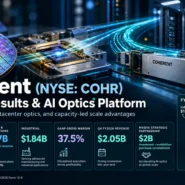
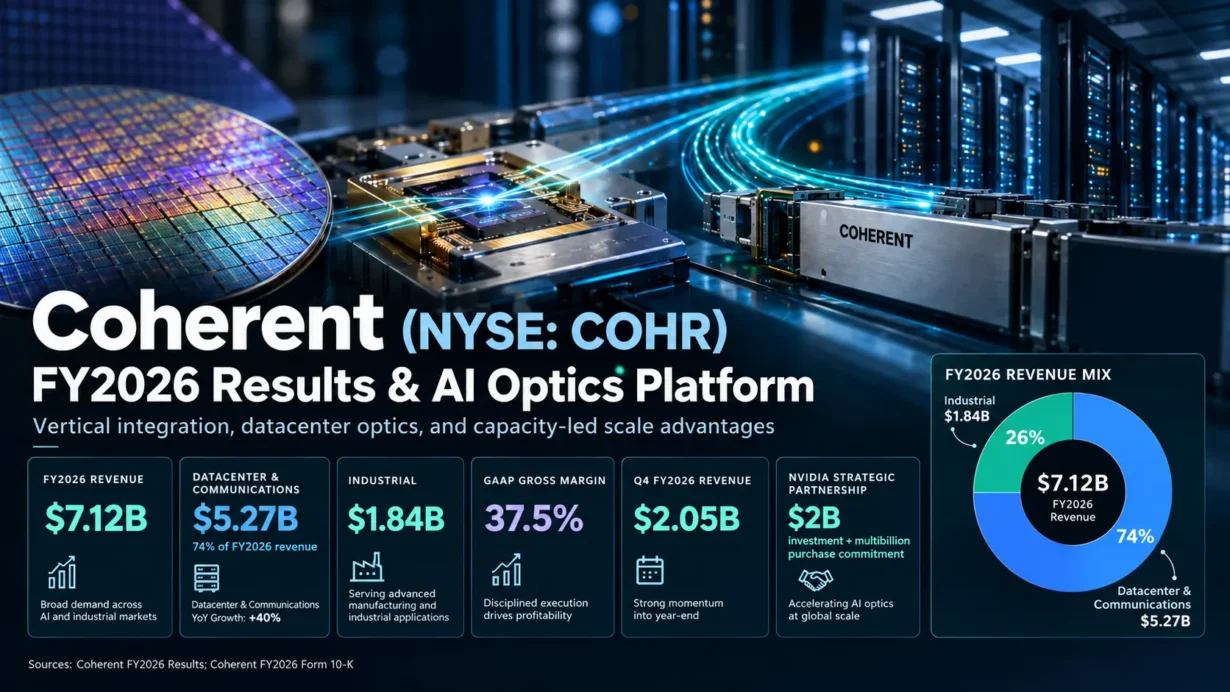
- Coherent Corp. (NYSE: COHR) is no longer best understood as a diversified laser company. Its economic center of gravity has moved decisively toward datacenter and communications photonics: fiscal 2026 Datacenter & Communications revenue reached approximately $5.27 billion, about 74% of total company revenue, and grew 40% year over year.
- The core Coherent business model is hardware-centric, but the strategic value lies in controlling more of the optical stack than a typical component vendor: compound-semiconductor materials, lasers, detectors, integrated circuits, passive optics, thermals, photonic integrated circuits, transceivers, co-packaged optics, optical circuit switches, transport subsystems and industrial laser systems.
- The strongest moat is the combination of intangible manufacturing know-how and scale-based cost advantages in difficult photonic processes, especially 6-inch InP and GaAs platforms. Customer qualification requirements create an additional switching-cost layer, although they do not make Coherent immune to design losses or technology transitions.
- The March 2026 NVIDIA agreement materially changes Coherent’s strategic position. The non-exclusive arrangement includes a multibillion-dollar purchase commitment, future capacity rights and a $2 billion NVIDIA equity investment to support R&D, capacity and operations. It improves demand visibility, but also raises customer-concentration and capital-execution risk.
- The next test is whether Coherent can convert capacity expansion and technology breadth into sustained margin gains. Fiscal 2026 GAAP gross margin improved to 37.5%, yet operating cash flow fell to $80 million as inventory expanded to support growth. The moat therefore has to be proven through yield, working-capital discipline and return on new capacity, not just revenue growth.
1. Business Model Breakdown
From engineered materials to a full-stack photonics platform
Coherent’s corporate DNA is unusual because today’s company is the product of several technology layers being assembled over decades. The legal lineage begins with II-VI Incorporated, founded in Pennsylvania in 1971 around engineered optical materials. The company expanded through internal development and acquisitions into compound semiconductors, optical communications and photonic components. A major step came in September 2019, when II-VI completed its acquisition of Finisar, adding a large optical-transceiver franchise, InP optoelectronics and communications manufacturing scale. The defining transformation followed on July 1, 2022, when II-VI acquired the former Coherent, Inc., combining II-VI’s materials and networking capabilities with Coherent’s laser systems. In September 2022, the parent company adopted the Coherent name and the COHR ticker.
That sequence matters because it explains why Coherent is structurally different from a conventional optical-module assembler. The company can participate at multiple layers of the value chain: engineered materials, semiconductor devices, optical components, modules, subsystems and complete laser or networking systems. The 2022 transaction did not merely add revenue; it created the possibility of using internally manufactured photonic building blocks across several end products. The economic thesis is that more internal control can improve product differentiation, supply assurance, cycle time, yield learning and gross-margin capture when the underlying technologies are difficult to manufacture.
The next phase began after Jim Anderson became CEO in June 2024. By fiscal 2026, Coherent had simplified its external reporting into two segments: Datacenter & Communications and Industrial. It also divested selected businesses, including its aerospace and defense operation and a Munich business. That portfolio pruning is strategically important because fiscal 2026 Industrial revenue declined 10% largely because of divestitures, while Industrial segment profit still increased 4%. In other words, management has been willing to reduce reported revenue in areas where portfolio quality and return characteristics can be improved.
Where the revenue comes from
Coherent generated $7.12 billion of fiscal 2026 revenue. Datacenter & Communications contributed about $5.27 billion, or roughly 74% of the total, while Industrial contributed about $1.84 billion. In the fourth quarter of fiscal 2026, Datacenter & Communications represented approximately 79% of consolidated revenue. This mix shift is the most important fact for understanding the modern Coherent business model: AI datacenter connectivity and communications optics increasingly determine the company’s growth rate, capital requirements and valuation narrative.
Datacenter & Communications sells transceivers, semiconductor lasers, detectors, optical and electronic components, photonic integrated circuits, co-packaged-optics technologies, optical circuit switches and communications subsystems. The company describes its datacenter transceiver portfolio as protocol-agnostic across Ethernet, InfiniBand, NVIDIA NVLink and other AI networking architectures. This reduces dependence on a single network protocol and allows Coherent to monetize the same underlying photonics competencies across multiple system designs.
Industrial remains strategically relevant rather than merely residual. It sells excimer, solid-state and CO2 lasers; high-power laser systems; precision optics; engineered materials; thermoelectric products; and semiconductor-related materials and devices. These products serve semiconductor and display capital equipment, precision manufacturing, scientific instrumentation, life sciences and other industrial applications. The segment provides a second earnings engine and preserves technical competencies in lasers, optics and materials that can feed back into the broader photonics platform.
How Coherent actually makes money
The company is primarily a seller of physical technology, not a SaaS, advertising or transaction-fee business. Revenue economics therefore depend on shipment volume, product mix, average selling prices, manufacturing yield, capacity utilization and the ability to move customers to higher-speed or more integrated optical products. Coherent markets through direct sales as well as distributors and agents, and it targets long-term relationships and sales agreements with major customers where possible.
This matters because the apparent “recurring” element of the model is not subscription revenue. It comes from repeated design cycles, qualification, capacity allocation and the ongoing replacement of one bandwidth generation with another. A hyperscale or networking customer that qualifies Coherent’s 800G transceiver, 1.6T module, high-power InP laser or other optical component may purchase at scale for a product cycle, but Coherent must still win the next architecture. The model can therefore produce attractive multi-year revenue visibility without being contractually recurring in the software sense.
The profitability engine is manufacturing leverage. Fiscal 2026 revenue increased 23% to $7.12 billion, while GAAP gross margin expanded to 37.5% from 35.2%. Coherent attributed the improvement primarily to lower product input costs, faster manufacturing cycle times, better yields, pricing optimization and lower intangible-asset amortization. Datacenter & Communications segment profit increased 47% on 40% revenue growth, demonstrating that volume growth can generate operating leverage when factories, product mix and yields move in the right direction.
However, the same model can consume substantial capital and working capital. Fiscal 2026 operating cash flow fell to $80 million from $634 million in fiscal 2025, primarily because inventory increased to support higher expected revenue. Coherent also sharply increased investment spending as it expanded capacity. That is the essential tension in the business model: strong demand can increase reported earnings while temporarily absorbing cash through wafers, components, work-in-process, cleanroom capacity and customer-specific ramps. Investors therefore need to track cash conversion alongside revenue and gross margin.
The platform strategy: architecture breadth rather than a single optical bet
Coherent’s current platform strategy is best described as technological optionality built on common manufacturing infrastructure. In datacenter optics, the company is developing products across silicon photonics, InP and VCSEL technologies rather than betting on a single optical architecture. At OFC 2026, it demonstrated multiple 1.6T transceiver implementations using different photonic technologies and DSP partners, along with work targeting 3.2T and higher-speed architectures. It also demonstrated several co-packaged-optics approaches, including silicon-photonics CPO with an external laser source using Coherent’s own high-power InP continuous-wave lasers, a VCSEL-based CPO approach and an InP modulator-on-silicon path.
This is commercially significant because the industry has not converged on one permanent architecture for every AI networking layer. Pluggable transceivers, CPO, near-packaged optics, scale-up, scale-out and scale-across fabrics can coexist for different distances, power envelopes and deployment cycles. A supplier with credible technology across several of these paths has a better chance of preserving content even when customers change architectures.
Coherent has also announced PhotonLink, a new integrated-optics platform intended to span the signal chain from light generation and beam shaping through transmission, detection and electrical conversion for the xPU or switch. As of September 16, 2026, PhotonLink had been announced but had not yet been publicly unveiled; Coherent scheduled the unveiling for September 21, 2026 at ECOC. Consequently, PhotonLink should be treated as a potentially important platform catalyst, not as a commercially proven product franchise yet.
2. Deep Dive into Economic Moats
Intangible Assets: the strongest moat component
Coherent’s most defensible advantage sits in process knowledge, device design, materials science and manufacturing intellectual property. As of June 30, 2026, the company reported approximately 3,160 issued patents and 1,280 pending patent applications worldwide. The patent count matters less than the underlying nature of the know-how: Coherent itself notes that the designs, processes and specialized equipment used in engineered materials, advanced components and subsystems are complex and difficult to duplicate.
In photonics, this kind of know-how compounds across layers. Producing a high-performance InP laser is not simply a matter of owning a recipe. The supplier must control epitaxy, wafer fabrication, device design, packaging, optical coupling, thermal behavior, reliability screening and high-volume process stability. Yield data and failure analysis accumulated over years can be as important as formal patents. A competitor therefore has to spend not only on R&D, but also on cleanroom infrastructure, process engineering, test capability, customer qualification and enough production volume to climb the yield curve.
This is particularly relevant to Coherent’s 6-inch InP platform. The company is expanding 6-inch InP manufacturing in the United States and Europe and has positioned InP as a foundational technology for next-generation AI interconnects. Coherent also operates multiple 6-inch GaAs VCSEL manufacturing facilities. Large-diameter compound-semiconductor manufacturing is difficult because scaling wafer size while maintaining uniformity, yield and reliability creates technical and economic hurdles that are not solved by capital alone.
The limitation is technological obsolescence. Patents and process knowledge only generate excess returns if the company stays relevant as customers move from one lane speed, modulation scheme, packaging architecture or material system to another. This is why Coherent spent $723 million on R&D in fiscal 2026, up from $582 million the prior year. The moat is therefore dynamic: it must be renewed continuously.
Cost Advantages: meaningful, but earned through yield and scale
The second major moat is cost advantage derived from vertical integration, manufacturing scale and accumulated yield learning. Coherent designs and manufactures many critical transceiver inputs internally, including lasers, detectors, ICs, passive optics, thermal solutions and photonic integrated circuits. This can lower dependence on external component suppliers, reduce duplicated supplier margins and allow faster co-optimization across device and module layers.
The key distinction is that “being large” is not itself a moat. The defensible element is whether scale reduces unit cost or improves supply reliability in a way that smaller competitors struggle to match. Fiscal 2025 and fiscal 2026 results provide some evidence: Coherent reported manufacturing-cost reductions, improved yields and cycle-time efficiencies as contributors to gross-margin expansion. The Datacenter & Communications segment generated about $1.33 billion of segment profit on $5.27 billion of revenue in fiscal 2026, while Industrial generated about $423 million on $1.84 billion. Those economics suggest that both segments can earn healthy segment-level profit when mix and execution are favorable.
The Sherman, Texas InP expansion is the clearest forward test. Coherent said in June 2026 that the project is expected to double manufacturing production space and quadruple wafer production capacity. If the added volume improves fab utilization and yield while serving committed demand, the capacity can deepen cost advantage. If demand is overestimated or qualification slips, the same fixed-cost structure can become a liability through underutilization and excess inventory.
Switching Costs: real at the qualification level, but not absolute
Switching costs are a supporting moat rather than the primary one. Coherent’s 10-K states that customers can require qualification or requalification of manufacturing lines before accepting volume shipments, including when suppliers establish new lines, relocate production or introduce new products. That requirement creates friction because replacing a supplier can involve engineering validation, reliability testing, system qualification, supply-chain review and time-to-market risk.
This is economically valuable in high-volume AI infrastructure, where a failed optical component can disrupt expensive systems and where availability itself can be strategic. Long-standing relationships and jointly planned capacity can further increase the cost of switching. The NVIDIA relationship illustrates this dynamic: the 2026 agreement includes future access and capacity rights in addition to a purchase commitment, suggesting that secure supply is part of the economic value proposition.
Still, switching costs should not be overstated. Optical customers routinely dual-source, redesign around new standards and qualify alternative vendors. Each new bandwidth generation can reopen competition. Coherent must therefore maintain performance, cost and delivery leadership; qualification friction slows substitution but does not prevent it.
Network Effects: not a meaningful moat today
Coherent does not exhibit a classic network effect in which each additional user makes the product more valuable to every other user. Industry standards and interoperability can expand the total market, but those benefits accrue to the ecosystem rather than uniquely to Coherent. The company participates in multi-vendor standards and interoperability efforts, yet this should be viewed as market access, not a proprietary network effect.
For long-term excess returns, the moat thesis therefore rests mainly on intangible manufacturing assets plus cost advantages, reinforced by qualification-related switching friction. The durability of that moat depends on staying ahead of bandwidth transitions and converting scale into yields, margins and reliable supply. If competitors match device performance and manufacturing economics, or if customers vertically integrate key photonics functions, Coherent’s breadth alone will not guarantee superior returns.
3. Business Inflection Points & Future Catalysts
The strategic inflection point: the 2022 acquisition of Coherent
The most consequential strategic turning point was the July 2022 acquisition of the former Coherent, Inc. by II-VI. Finisar had already expanded II-VI’s communications and transceiver capabilities in 2019, but the Coherent deal connected materials and optical networking with a major laser-system franchise. The resulting company was explicitly designed to span materials, components, subsystems, systems and service.
That structure is what makes the current AI-optics strategy possible. A company that only assembles transceivers would have less control over high-power lasers, InP devices, detectors, passive optics and thermal components. A company focused only on compound-semiconductor wafers would capture less value from modules and systems. The 2022 combination created a broad photonics stack; the post-2024 management agenda has been about converting that breadth into a more focused set of high-return platforms.
Catalyst 1: 1.6T, 3.2T and the accelerating optical content of AI datacenters
The transmission mechanism is straightforward: larger AI clusters require more bandwidth among accelerators, switches and racks, while copper reaches practical distance and power limits at higher data rates. As architectures add optical links and move to faster lane speeds, the addressable content for lasers, detectors, transceivers and integrated optical engines can rise even if price per bit continues to fall.
Coherent is positioned across 800G and 1.6T pluggables today while developing 3.2T and higher-speed technologies, including 400G-per-lane building blocks. The breadth matters because the company can potentially monetize either the complete module or critical internal components when customers choose different system architectures. In August 2026, management guided fiscal first-quarter 2027 revenue to $2.2 billion to $2.4 billion and non-GAAP gross margin to 39.5% to 41.5%, indicating that near-term demand remained strong entering the new fiscal year.
Observable indicators include Datacenter & Communications revenue growth, the mix of 1.6T versus earlier generations, disclosures on 3.2T and CPO customer qualification, gross-margin progression, R&D intensity and whether component growth accompanies module growth. The main risks are faster-than-expected average-selling-price erosion, a slower AI infrastructure buildout, customer insourcing, a standards shift that favors competitors, or an architecture transition that reduces Coherent’s content per link.
Catalyst 2: NVIDIA-backed capacity expansion can turn scarcity into scale economics
The March 2, 2026 NVIDIA agreement is unusually important because it links demand, capacity and capital. The non-exclusive agreement includes a multibillion-dollar NVIDIA purchase commitment and future access and capacity rights for advanced laser and optical networking products. NVIDIA also invested $2 billion in Coherent through a private placement, with proceeds intended to support R&D, future capacity and operations.
Coherent is using that backdrop to expand InP capacity in Sherman, Texas. In June 2026, the company announced a letter of intent for up to $50 million of direct CHIPS Act funding for the project, which it expects to double production space and quadruple wafer-production capacity. The commercial mechanism is powerful if executed well: committed demand supports capacity investment; larger wafer output spreads fixed costs; better utilization and yield can lower unit economics; and secure supply can make Coherent more strategically valuable to large AI customers.
Observable indicators include customer qualification of new lines, wafer output, utilization, manufacturing yield, gross margin, inventory growth, operating cash flow and capital intensity. Investors should also monitor customer concentration. Coherent disclosed that one customer represented 20% of fiscal 2026 revenue and a second represented 12%, with both concentrations primarily tied to Datacenter & Communications. The 10-K does not identify those customers, so it would be inappropriate to attribute those percentages to NVIDIA or any other named company without additional disclosure.
The risk is that capacity can arrive before economically attractive demand. Coherent itself warns that the NVIDIA arrangement may create material future cash requirements and affect revenue concentration, gross margin and capital expenditures as volumes ramp. Customer qualification delays can postpone shipments, while an AI spending slowdown could leave the company with underutilized fabs or excess inventory. Fiscal 2026 operating cash flow already showed how growth can absorb cash when inventory rises ahead of shipments.
Catalyst 3: PhotonLink could shift Coherent from component breadth to platform economics
PhotonLink is potentially the most strategically interesting product-platform development because it attempts to organize Coherent’s disparate photonics assets into an integrated signal-chain proposition. The announced scope runs from light generation and beam shaping through optical transmission, detection and electrical conversion, with support for CPO, near-packaged optics and other integrated architectures.
If customers adopt the platform, the mechanism could expand Coherent’s addressable content per system and deepen engineering engagement. Instead of competing for a single laser or transceiver socket, Coherent could provide multiple coordinated building blocks optimized around power, bandwidth, packaging and manufacturability. That would make the company’s historical acquisition strategy economically coherent: materials knowledge would feed device design, devices would feed modules, and modules would feed higher-value integrated systems.
The key observable indicators are customer design wins, qualification announcements, production shipments, revenue contribution from higher-value systems such as OCS and multi-rail products, and evidence that platform adoption improves gross margin rather than simply increasing complexity. The main execution risk is that PhotonLink was still an announced, pre-unveiling platform as of September 16, 2026. Its commercial traction, customer breadth and margin profile were not yet established. Investors should distinguish a technically broad roadmap from proven platform economics.
Catalyst 4: portfolio simplification and manufacturing discipline can expand margins even without peak top-line growth
The less visible catalyst is internal. Fiscal 2026 GAAP gross margin expanded by 233 basis points, while Industrial segment profit rose even as revenue fell because of divestitures. Management has been consolidating sites, exiting selected businesses and prioritizing higher-return R&D. If this continues, Coherent can create earnings growth from mix, utilization and operating discipline rather than relying solely on AI datacenter volume.
Observable indicators include GAAP gross margin, SG&A as a percentage of sales, segment profit growth, restructuring charges, site-consolidation progress and free-cash-flow conversion. The risk is that aggressive portfolio optimization can disrupt supply, trigger requalification requirements or remove businesses that once provided diversification. A narrower portfolio can improve returns but also increase exposure to the AI infrastructure cycle.
4. Key FAQs
How does Coherent (COHR) make money from AI data centers?
Coherent makes money primarily by selling optical hardware and photonic components used to move data inside and between AI datacenters. Its product set includes 800G and 1.6T transceivers, InP and VCSEL lasers, detectors, silicon-photonics devices, passive optics, thermal components, optical circuit switches, datacenter-interconnect products and emerging CPO solutions. The business logic is that AI clusters require rapidly rising bandwidth, which increases the number and performance requirements of optical links. Coherent can monetize either complete transceiver modules or individual high-value components, depending on the customer architecture.
What is Coherent’s competitive advantage in optical transceivers and InP photonics?
The advantage is not simply that Coherent sells many products. It is the combination of vertically integrated device manufacturing, process IP, 6-inch compound-semiconductor capacity, customer-qualified production lines and the ability to combine internally produced lasers, detectors, optics, thermals and PICs into higher-level modules. Competitors can replicate individual products, but matching the full manufacturing stack requires capital, specialized engineering talent, qualification time and enough production volume to achieve competitive yields. That advantage remains conditional on Coherent continuing to win each new speed and architecture transition.
Is Coherent a pure-play AI optics company or a diversified photonics supplier?
Coherent is still a diversified photonics supplier, but its earnings profile is becoming increasingly AI-optics-centric. Datacenter & Communications produced about 74% of fiscal 2026 revenue and nearly 79% of fourth-quarter revenue, making it the dominant growth engine. Industrial remains material, with lasers, optics and engineered materials serving semiconductor equipment, precision manufacturing, display, scientific and life-science applications. This diversification can reduce dependence on a single end market, but rising datacenter concentration means COHR’s growth and capital allocation are increasingly tied to AI infrastructure spending.
5. Conclusion
Coherent’s corporate gene is best described as vertically integrated photonics manufacturing rather than a single-product laser or transceiver story. The company’s history—from II-VI’s engineered-materials roots, through the Finisar acquisition, to the 2022 combination with Coherent—assembled a technology stack that spans materials, devices, modules and systems. That breadth became much more economically relevant once AI datacenters created an urgent need for higher-bandwidth, lower-power optical connectivity.
The durable part of the moat is the intersection of intangible process know-how and manufacturing economics. Coherent controls difficult compound-semiconductor technologies, possesses thousands of patents and substantial proprietary know-how, and operates qualified high-volume manufacturing platforms that customers cannot replace instantly. Scale can reinforce the advantage through utilization and yield, while qualification creates switching friction. Network effects, by contrast, are not a meaningful source of competitive protection.
The next one to two years will determine whether that technological breadth becomes a superior economic model. The NVIDIA-backed capacity build, 1.6T-to-3.2T transition, CPO development and PhotonLink platform can increase revenue, content per system and gross margin. But each catalyst has a mirror-image risk: customer concentration, capital intensity, qualification delays, inventory build, price erosion and architecture uncertainty. The central research question is therefore not whether optical demand is growing; it is whether Coherent can translate optical demand into sustained returns on capital and cash flow after funding the factories required to serve it.
That distinction is what separates a cyclical beneficiary from a durable platform company. Coherent has assembled the technical assets to compete as the latter. The evidence investors should demand now is consistent margin expansion, disciplined working capital, successful qualification of new capacity, multi-customer adoption of next-generation platforms and cash generation that catches up with reported earnings.
Primary Sources
- U.S. SEC — Coherent Corp. Form 10-K for fiscal year ended June 30, 2026
- Coherent Investor Relations — Fourth Quarter and Full Year Fiscal 2026 Results
- Coherent — NVIDIA and Coherent Strategic Partnership, March 2, 2026
- Coherent Investor Relations — Sherman InP Expansion and CHIPS Letter of Intent, June 16, 2026
- Coherent Investor Relations — Next-Generation Pluggable Transceiver Technologies at OFC 2026
- Coherent Investor Relations — Multiple Co-Packaged Optics Technologies at OFC 2026
- Coherent Investor Relations — PhotonLink Platform Announcement, August 25, 2026
- Coherent — II-VI Completes Acquisition of Coherent, July 1, 2022
- U.S. SEC — II-VI Form 8-K on Completion of Finisar Acquisition, September 24, 2019
- Coherent — Jim Anderson Appointed Chief Executive Officer, June 3, 2024
Disclaimer: This article is intended solely for business logic discussion and corporate research purposes, and does not constitute investment advice of any kind.