

Key Takeaways
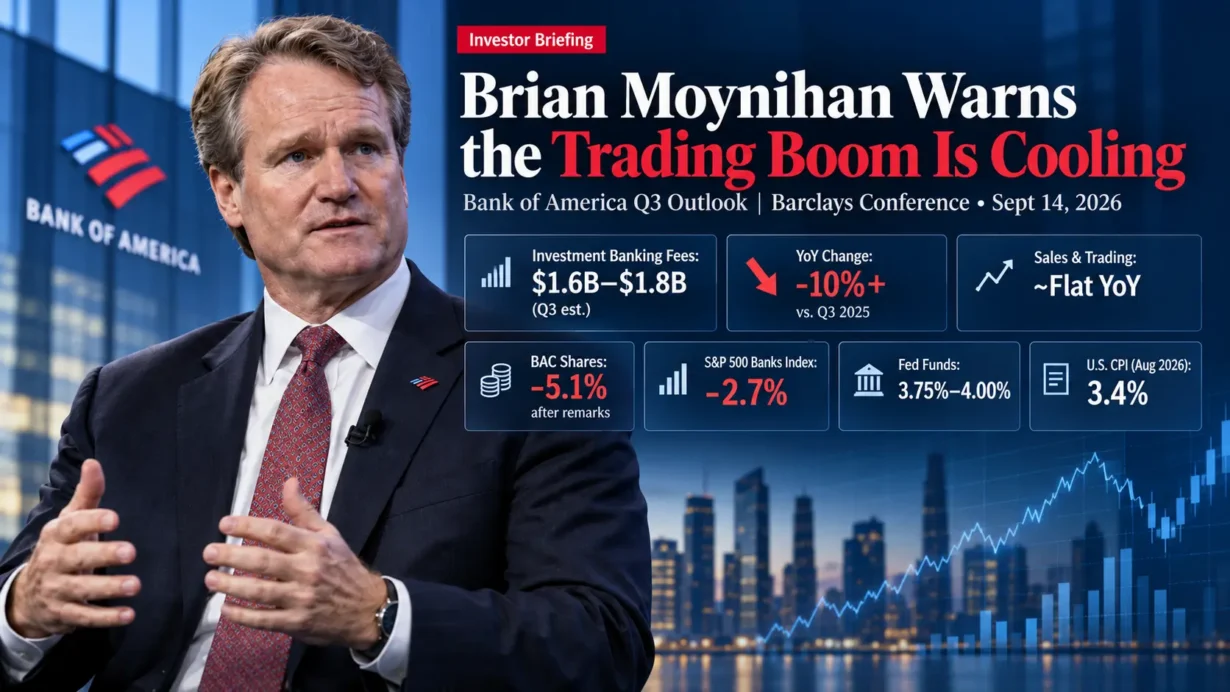
- Bank of America expects third-quarter investment-banking fees of roughly $1.6 billion to $1.8 billion, implying a decline of at least 10% from the prior-year quarter.
- Sales and trading revenue is expected to be roughly flat year over year, a sharp deceleration from the first-half surge and a potential end to Bank of America’s long streak of annual trading growth.
- Moynihan still sees a resilient U.S. economy: consumer spending remained broad-based, commercial loan demand was healthy and credit quality stayed near historically strong levels.
- Higher interest rates are a two-sided catalyst for banks: they can support net interest income, but they can also slow financing activity, mortgage demand and leveraged transactions.
- AI remains a structural investment theme for Bank of America, but management is emphasizing controlled deployment, human accountability and measurable productivity rather than unchecked automation.
1. Core Viewpoints Restored
Investment-banking fees are resetting lower: roughly $1.6B-$1.8B for Q3
The most important signal was not that dealmaking is collapsing, but that fee capture is becoming more uneven. Moynihan indicated that the broader investment-banking market had softened and that Bank of America was not as well positioned in some of the most active pockets of business. That matters because investors often extrapolate a strong M&A and underwriting tape across the entire sector. The latest guidance argues for greater selectivity: headline deal activity can remain healthy while economics concentrate in a smaller number of mega-deals, larger equity offerings and top-tier advisory franchises.
The commercial logic is straightforward. When the fee pool narrows, market share matters more than industry growth. A bank that misses the specific products, geographies or sponsor channels driving activity can underperform even in an apparently constructive capital-markets environment. For investors, this shifts the earnings debate away from “Is Wall Street busy?” toward “Which platform is actually monetizing the busiest lanes?”
Sales and trading revenue is expected to be roughly flat year over year
This is the cleanest warning that the first-half trading boom should not be annualized. Extraordinary volatility, large equity offerings, AI-linked positioning and strong client risk activity boosted markets revenue earlier in 2026. Moynihan’s update suggests that some of those tailwinds are normalizing, particularly in financing and prime-brokerage-related activity.
The deeper implication is that operating leverage can reverse quickly in capital-markets businesses. Trading desks have high fixed-cost platforms, so a slowdown in revenue growth can compress incremental margins even if absolute revenue remains historically strong. This is why a “flat” trading quarter can still disappoint a stock when the valuation already discounts continued double-digit growth.
The U.S. consumer remains resilient, but affordability is the pressure point
Moynihan’s consumer read was notably more constructive than the stock-price reaction implied. Bank of America’s internal data showed broad-based spending growth, including restaurants, entertainment and travel-related categories, while wage growth and credit quality remained supportive. Commercial customers were also using lines of credit more actively, a sign that business investment has not rolled over.
The key risk is affordability rather than an immediate credit break. Higher gasoline costs, elevated borrowing rates and persistent inflation can erode real disposable income even when nominal wages continue to rise. That distinction matters for investors: a resilient consumer can keep transaction volumes and credit demand stable for longer, but margin pressure can appear first in discretionary spending mix, loan growth and delinquency normalization before a broader macro slowdown becomes visible.
Higher rates can keep Bank of America’s net interest income engine running
Moynihan remained constructive on net interest income, arguing that balance-sheet repricing, loan growth and deposit economics continue to create a multi-year compounding effect. That view gained relevance two days later when the Federal Reserve raised the federal funds target range by 25 basis points to 3.75%-4.00%, while the latest U.S. CPI data still showed headline inflation at 3.4% year over year in August.
For Bank of America, the rate backdrop is not simply “higher rates are good.” The positive side is asset repricing and stronger net interest yield. The negative side is weaker mortgage demand, more expensive corporate financing and potentially slower leveraged deal activity. The investable question is whether incremental NII can offset softer fee pools without causing a material deterioration in credit quality or loan demand.
AI spending is rising, but Bank of America is prioritizing controlled deployment
Moynihan said the bank has deployed AI tools broadly across its workforce and expects the AI expense budget to increase, while stressing that employees remain accountable for outputs and that autonomous agents are not being left to operate without oversight. This is an important contrast with the market’s tendency to treat AI spending as a pure headcount-reduction story.
The business logic is closer to operating leverage through workflow redesign. The highest-value use cases are likely to be faster document production, better data retrieval, improved client service, coding productivity, fraud detection and process automation. For a regulated bank, however, the economic value of AI depends on auditability, security and error control. Productivity gains that introduce legal, model or cybersecurity risk can destroy more value than they create.
2. Industry Chain and Sector Impact
Potential pressure: Bank of America (NYSE: BAC) and capital-markets-sensitive bank earnings
The near-term pressure point for BAC is earnings-expectation risk. The market had been rewarding banks for strong trading, underwriting and advisory momentum; Moynihan’s updated range forces analysts to reconsider how much of that momentum is repeatable in the third quarter. The stock’s post-comment decline shows that the earnings bar—not just absolute fundamentals—was the immediate issue.
That said, the fundamental picture is more balanced than the price reaction alone suggests. Bank of America still has a large low-cost deposit franchise, improving net interest income, healthy commercial loan demand and growing wealth-management fees. The bear case is therefore less about balance-sheet stress and more about multiple compression if fee growth slows while expenses continue to rise for technology, compensation and infrastructure.
Potential relative beneficiary: JPMorgan Chase (NYSE: JPM), if its stronger fee outlook holds
The most important cross-check came one day later. JPMorgan Co-President Doug Petno said the bank expected both investment-banking fees and markets revenue to grow in the mid-to-high teens percentage range in the third quarter. That contrast suggests the current environment may be rewarding scale, client breadth and market-share concentration rather than lifting every large bank equally.
For investors, the read-through is not simply “JPM good, BAC bad.” It is that dispersion inside financials is rising. When industry activity becomes concentrated in fewer large transactions, the firms with the deepest sponsor relationships, strongest prime-brokerage platforms and broadest global distribution can take a disproportionate share of the fee pool. Relative earnings revisions may therefore matter more than the direction of sector revenue alone.
3. Practical Investor Strategy
1) Trade the earnings revision cycle, not the headline narrative
A “healthy economy” does not automatically translate into upside for every bank stock. The more useful framework is to track whether consensus estimates are moving up or down for investment-banking fees, trading revenue, net interest income and expenses. BAC’s September 14 reaction is a reminder that a stock can fall sharply even when management remains constructive on the economy if forward earnings assumptions were simply too aggressive.
2) Separate rate beneficiaries from rate casualties inside the same bank
Following the Federal Reserve’s September 16 rate increase, investors should monitor both sides of the income statement. Positive indicators include higher net interest yield, stable deposit costs and continued commercial loan growth. Defensive warning signs include weakening mortgage activity, slower leveraged-finance volumes, rising deposit competition and deterioration in consumer credit. A higher-rate environment can expand spreads and destroy loan demand at the same time.
3) Use the October 14 earnings release as the next validation point
Bank of America’s next quarterly earnings release is scheduled for October 14, 2026. The highest-value checks will be whether investment-banking fees land inside the $1.6 billion-$1.8 billion range, whether trading is truly flat year over year, whether NII remains on its upper-single-digit growth trajectory, and whether expense growth stays controlled enough to preserve operating leverage.
For risk management, investors should avoid treating the September selloff as sufficient evidence that the bad news is fully priced in. The more robust approach is to compare the post-guidance valuation with the direction of estimate revisions and the quality of revenue mix. If fee estimates continue falling while the multiple remains elevated, downside risk persists. If NII, wealth-management fees and credit metrics offset the capital-markets slowdown, the earnings bridge becomes more durable.
4. Frequently Asked Questions FAQ
Why did Bank of America stock fall after Brian Moynihan’s September 2026 Barclays conference comments?
Bank of America shares fell more than 5% after Moynihan guided third-quarter investment-banking fees to roughly $1.6 billion-$1.8 billion and said sales and trading revenue would be approximately flat year over year. The update was weaker than investors had expected after a very strong first half, creating an immediate downward reset in near-term earnings expectations.
What does Brian Moynihan’s latest outlook mean for BAC stock investors?
The message is mixed rather than uniformly bearish. Capital-markets revenue is slowing, but Bank of America still sees resilient consumer spending, healthy credit, commercial loan growth and supportive net interest income. Investors should focus on whether those recurring banking revenues can offset weaker trading and investment-banking fees while expenses remain disciplined.
Which bank stocks could benefit if Wall Street deal activity becomes more concentrated?
Large platforms with strong market share in advisory, underwriting, prime brokerage and global markets may be better positioned when the fee pool concentrates around fewer large transactions. JPMorgan’s management, for example, gave a materially stronger third-quarter outlook for investment-banking and markets revenue than Bank of America. That divergence makes relative market share and earnings revisions especially important.
Sources: Bank of America Investor Relations — Brian Moynihan at the Barclays Global Financial Services Conference, September 14, 2026; Reuters on Bank of America guidance and the market reaction; Reuters on JPMorgan’s contrasting Q3 outlook; Federal Reserve September 16, 2026 FOMC statement; and U.S. Bureau of Labor Statistics August 2026 CPI release.
Disclaimer: This article is for informational purposes only and does not constitute investment advice.