


Key Takeaways
- Fabrinet monetizes outsourced precision manufacturing rather than proprietary end products. Its economic engine spans process engineering, new product introduction, supply-chain management, optical and electronic assembly, advanced packaging, testing, and selected vertically integrated optics.
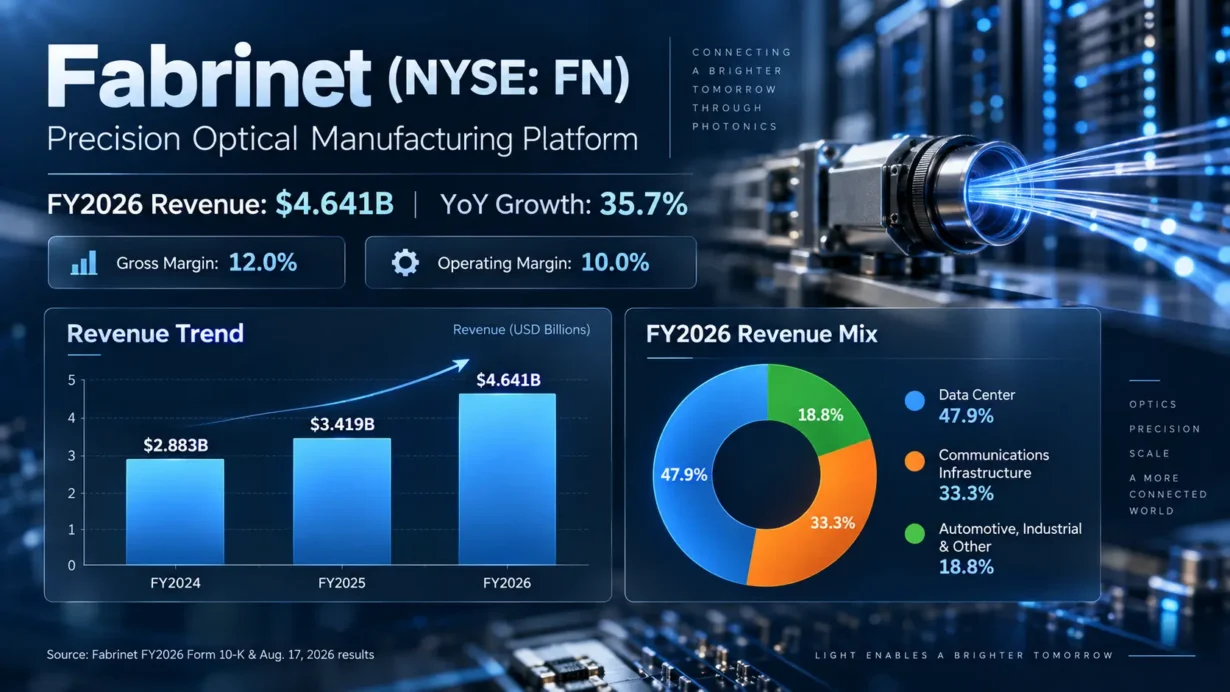
- Fiscal 2026 revenue reached $4.64 billion, up 35.7% year over year. Data center products represented 47.9% of revenue, communications infrastructure 33.3%, and automotive, industrial and other markets 18.8%. GAAP gross margin was 12.0%, while operating margin reached 10.0% as SG&A fell to only 2.0% of sales.
- The most defensible moat is switching cost, not brand. Optical programs can require three to six months or longer to qualify, and customers often rely on dedicated production cells, process recipes, tooling, test systems, yield data, and factory audits that make supplier migration costly and operationally risky.
- The second moat is a system-level cost advantage: customer-proximate NPI centers feed qualified programs into a large Thailand manufacturing base, while customized optics, proprietary manufacturing software, supply-chain tools, and factory-within-a-factory operations deepen process integration.
- The principal counterweight is concentration risk. Cisco, NVIDIA, Nokia, and Amazon represented 57.4% of fiscal 2026 revenue, while customer commitments are largely short term. Capacity expansion and inventory growth therefore create meaningful downside if customer ramps are delayed or demand normalizes.
1. Business Model Breakdown
The Fabrinet business model is best understood as a specialized manufacturing platform for products that are difficult to build, difficult to qualify, and expensive to get wrong. The company does not primarily compete by owning the end-product architecture. Instead, it sits inside the manufacturing stack of optical networking, data-center, industrial, automotive, medical, and sensing customers and converts their designs into repeatable, high-yield production.
This distinction matters. Fabrinet is not a conventional electronics manufacturer that merely assembles standardized boards at low labor cost. Its core value proposition is the ability to take complex optical, electro-mechanical, and electronic products from process design and prototype through qualification, volume manufacturing, final assembly, and test. In many cases, Fabrinet also provides supply-chain procurement, materials management, advanced optical packaging, customized test strategies, and continuous yield optimization. That breadth allows it to monetize more of the manufacturing workflow while making the customer relationship progressively harder to unwind.
Where Revenue Actually Comes From
Fabrinet reorganized its end-market disclosure in fiscal 2026 to reflect the way the business has evolved. Data center revenue reached $2.23 billion, or 47.9% of total revenue, and grew 40.8% year over year. Communications infrastructure generated $1.55 billion, or 33.3% of revenue, up 47.4%. Automotive, industrial, medical, sensors, and other applications generated $869.6 million, or 18.8% of revenue, up 10.1%.
The data-center bucket is increasingly important because it includes data-center interconnect, high-performance-computing applications, and other data-center-specific products. Fabrinet’s latest investor materials also identify transceivers, silicon photonics, co-packaged optics, and complex high-performance-computing PCBAs as addressable product areas. The company therefore participates in AI infrastructure primarily through the physical connectivity and manufacturing layer surrounding accelerated computing, rather than through ownership of the processors themselves.
Communications infrastructure remains another large profit pool. Fabrinet manufactures products used in telecom and enterprise networks, including network systems, line cards, ROADMs, optical components, and related assemblies. These programs benefit from the same precision-manufacturing competencies required in data centers, allowing the company to reuse engineering knowledge across adjacent optical markets rather than build entirely separate operating systems for each vertical.
The Profit Formula: Low Gross Margin, High Process Density
Fabrinet’s reported margins reveal the underlying economics. Fiscal 2026 gross margin was 12.0%, which looks modest compared with software, semiconductor design, or branded hardware companies. But this is partly a function of a manufacturing model in which materials and components flow through cost of revenue. The more important indicator is how much corporate overhead is required to support that revenue base. SG&A declined to 2.0% of revenue in fiscal 2026 from 2.6% in fiscal 2025, allowing GAAP operating margin to reach 10.0% despite only a 12.0% gross margin.
That spread is the core operating logic: Fabrinet earns relatively thin gross economics on a very large volume of material-intensive revenue, but its specialized manufacturing infrastructure, customer concentration, and centralized operating model allow significant gross profit to drop through to operating income. The company is therefore a utilization-and-execution business. Yield, factory loading, material availability, labor efficiency, and product mix matter more than conventional software metrics such as annual recurring revenue or customer acquisition cost.
The model is also less contractually recurring than the customer stickiness might suggest. Fabrinet typically enters supply agreements with initial terms of up to three years, but these agreements generally contain no minimum purchase commitment. Actual production is driven by customer forecasts and purchase orders, many of which are short term and subject to revision or cancellation. Economically, this creates an unusual combination: low contractual visibility, but potentially high operational retention once a program has been qualified and embedded in a dedicated manufacturing process.
The Platform Strategy: NPI Near the Customer, Scale in Thailand
Fabrinet’s platform strategy is a funnel rather than a marketplace. Its NPI centers in California and Israel sit close to customer engineering teams and help with design for manufacturability, prototyping, test development, and early process qualification. Those NPI sites use production equipment designed to mirror the company’s lower-cost volume-manufacturing environment. Once a program is qualified, Fabrinet can transfer it to Thailand with fewer process variables and less rework.
This creates a repeatable strategic loop: enter early in the product lifecycle, become part of the customer’s manufacturing process, qualify the line, transfer volume to a lower-cost campus, then improve yields and material costs over time. Customized optics and glass add another layer of vertical integration by internalizing selected components that would otherwise come from third-party suppliers. Fabrinet’s proprietary manufacturing and inventory software, combined with real-time production data, further embeds the company in the customer’s operational workflow.
The result is not a digital platform with network effects. It is a manufacturing platform whose value compounds through process knowledge, qualified lines, engineering repetition, supplier relationships, customer-specific data, and physical scale.
2. Deep Dive into Economic Moats
Intangible Assets: Useful, but Not the Primary Moat
Fabrinet owns meaningful process know-how, manufacturing recipes, engineering methods, testing capabilities, software tools, and institutional knowledge in optical packaging. It also holds a broad set of quality and industry certifications spanning telecom, automotive, medical, aerospace, laboratory testing, information security, business continuity, and energy management. These assets matter because they reduce the time and execution risk required to qualify new programs.
However, it would be a mistake to classify Fabrinet’s moat primarily as proprietary intellectual property. Much of the product IP belongs to customers and is licensed to Fabrinet only for manufacturing purposes. The company itself emphasizes a “never compete” philosophy and customer IP protection. Its intangible advantage is therefore procedural rather than patent-centric: customers trust Fabrinet with sensitive designs because the company has built systems to manufacture them without becoming a competing product vendor.
That is a real advantage, but it is a supporting moat. Competitors can invest in certifications, clean rooms, and engineering teams. What is harder to replicate is the accumulated operating history that proves those systems can deliver acceptable yields, security, quality, and ramp speed across successive generations of optical products.
Switching Costs: The Strongest Barrier
Switching costs are Fabrinet’s most defensible economic moat. Optical-device production is characterized by qualification cycles that can take three to six months or longer. A customer may need to qualify Fabrinet’s production process, factory environment, test flow, and finished output; in some cases, the customer’s own downstream customers must also approve the product. New suppliers therefore do not simply quote a lower price and win volume overnight.
The switching cost becomes larger after production starts. Fabrinet may operate dedicated engineering teams and segregated factory areas, use customer-specific tooling and consigned equipment, maintain customized test fixtures and software, track yield histories, and optimize materials and process steps over time. Replacing that system can require duplicated equipment, transfer engineering, requalification, new yield learning, inventory buffers, and the acceptance of potential delivery disruption.
This is why the moat should be measured in operational risk rather than in contract length. Fabrinet’s contracts do not guarantee long-duration volume, but a qualified high-complexity manufacturing process can still be sticky because the buyer must weigh a supplier’s lower quoted price against months of qualification work and the cost of a failed transition. The company’s fiscal 2026 customer list—Cisco, NVIDIA, Nokia, and Amazon among the customers individually exceeding 10% of revenue—illustrates that leading OEMs and hyperscalers are willing to place substantial programs on the platform.
The limitation is equally important: switching costs protect retention better than pricing power. Large customers know the business is concentrated and can negotiate aggressively. Fabrinet itself states that it expects product prices to decline over time and seeks to preserve economics by improving cycle time, yield, quality, product complexity, and material costs. That is the profile of a moat that defends the relationship while forcing the supplier to earn its economics through continuous execution.
Network Effects: Minimal
Fabrinet does not possess a meaningful classic network effect. A new customer does not make the service dramatically more valuable to another customer in the way additional users strengthen a payments network, marketplace, or social platform. In fact, the company’s factory-within-a-factory model intentionally segregates customers to protect intellectual property.
There are scale spillovers—more customers support deeper supplier relationships, more process learning, broader engineering experience, and better utilization—but these are economies of scope and learning rather than network effects. Treating them as network effects would overstate the durability of the moat.
Cost Advantages: The Second Core Moat
Cost advantage is Fabrinet’s second most important barrier, but the defensible element is not simply “Thailand is cheap.” Many global EMS companies can operate in lower-cost regions. Fabrinet’s edge comes from combining a lower-cost manufacturing base with optical specialization, customer-specific factories, engineering depth, customized software, supplier relationships, and the ability to move programs from customer-proximate NPI locations into high-volume production without rebuilding the process from scratch.
As of fiscal 2026, Fabrinet reported approximately 3.875 million square feet of owned manufacturing, warehouse, and administrative space in Thailand, plus additional facilities elsewhere. The company acquired an additional Pathum Thani facility during fiscal 2026 and expects fiscal 2027 capital expenditures to increase as it expands Pathum Thani, adds equipment in Thailand, and purchases a new manufacturing building in California. Thailand also provides tax incentives for qualifying manufacturing investments, although those benefits are subject to conditions and are partially offset by the evolving global minimum-tax framework.
A competitor trying to match Fabrinet therefore faces a multidimensional cost. It would need comparable low-cost capacity, process engineers with optical expertise, qualified lines, customer trust, supply-chain infrastructure, NPI handoff capability, and enough volume to absorb fixed costs efficiently. Large rivals such as Jabil, Celestica, Sanmina, Benchmark, Venture, InnoLight, and Eoptolink have substantial resources, so Fabrinet’s cost moat is not unassailable. Its durability depends on maintaining a productivity gap inside specialized optical manufacturing rather than assuming geography alone creates permanent advantage.
Can the Moat Support Long-Term Excess Returns?
The combination of switching costs and specialized cost advantages is strong enough to support attractive operating economics if utilization remains high. Fiscal 2026 provides a useful illustration: revenue rose 35.7%, gross margin remained near 12%, but operating margin improved as SG&A scaled much more slowly than revenue. The model can therefore produce operating leverage without requiring gross-margin expansion.
But the moat should not be confused with unlimited pricing power. The four largest disclosed customers accounted for 57.4% of fiscal 2026 revenue. Those customers can exert purchasing leverage, and Fabrinet must continually reinvest in capacity, process engineering, inventory, and equipment. Fiscal 2026 operating cash flow fell to $256.7 million despite $473.0 million of net income, largely because inventories and receivables increased to support higher demand. Inventory alone rose to roughly $1.02 billion at year-end.
The implication is that Fabrinet’s moat is best described as a process-embedded manufacturing franchise: it can defend program positions and earn strong returns when demand and utilization are healthy, but the durability of excess returns depends on disciplined capital allocation, working-capital control, and the company’s ability to prevent customer purchasing power from absorbing too much of the productivity gains.
3. Business Inflection Points & Future Catalysts
The Strategic Inflection Point: From Contract Manufacturer to Optical Production Platform
Fabrinet was founded in 2000 as a low-volume, high-mix manufacturer of complex optical components. The most important strategic inflection came in 2005, when the transfer of JDS Uniphase manufacturing operations to Thailand accelerated Fabrinet’s focus on optical communications, industrial lasers, and sensors. Around this period the company formalized its factory-within-a-factory model, in which customers could provide production equipment while Fabrinet supplied labor, logistics, manufacturing operations, and supply-chain support inside secure, segregated environments.
That move changed the company’s economic identity. Instead of competing as a generic contract manufacturer, Fabrinet became a specialist that could absorb a customer’s complex optical production process and reproduce it in a lower-cost environment without forcing the customer to surrender IP control. The subsequent build-out of Silicon Valley and Israel NPI centers extended the model upstream, giving Fabrinet a way to enter programs earlier and then transfer them into Thailand for volume manufacturing.
This historical architecture explains the current AI opportunity better than a simple “AI beneficiary” label. Fabrinet did not create a new business model for AI. AI infrastructure increased the value of an operating system the company had spent more than two decades building.
Catalyst One: Higher Optical Content per AI Data-Center Deployment
The first catalyst is the rising amount of high-speed connectivity required inside and between AI data centers. As accelerated-compute clusters scale, networking bandwidth and interconnect density must rise with them. Fabrinet can monetize that trend through transceivers, data-center interconnect, silicon photonics, co-packaged-optics-related manufacturing, and high-performance-computing PCBAs.
The transmission mechanism is straightforward: more compute clusters and faster network fabrics increase the number and complexity of optical and electronic interconnect products that must be manufactured. If Fabrinet is qualified on those programs, higher unit volumes and richer product complexity can lift revenue and improve factory utilization. The fourth quarter of fiscal 2026 provided evidence of this mechanism, with data-center revenue reaching approximately $669 million, up 68% year over year and representing 51% of quarterly revenue.
The observable indicators are data-center revenue growth, data-center mix, sequential growth in high-performance-computing and DCI-related programs, and Fabrinet’s ability to meet its first-quarter fiscal 2027 revenue guidance of $1.375 billion to $1.425 billion. Margin behavior also matters: if growth is driven largely by lower-value material pass-through, revenue can accelerate without equivalent profit leverage.
The main risks are customer capital-spending digestion, architecture shifts, customer insourcing, pricing pressure, and qualification delays. Co-packaged optics and other next-generation architectures may expand Fabrinet’s addressable manufacturing opportunity, but they can also redistribute value across the optical stack. Participation is not the same as guaranteed share.
Catalyst Two: Communications Infrastructure and DCI Broadening the Growth Base
The second catalyst is that growth is no longer confined to one AI-linked customer or one product family. Communications infrastructure revenue grew 47.4% in fiscal 2026, faster than total company revenue, and reached approximately $413 million in the fourth quarter, up about 40% year over year. This category includes telecom and enterprise-network products outside data-center-specific applications, while DCI is classified inside data center.
The transmission mechanism is broader bandwidth investment across carrier, cloud, and enterprise networks. More traffic requires additional optical transport, routing, switching, line cards, ROADMs, and associated components. A broader mix of programs can improve capacity utilization and reduce dependence on any single product cycle even if customer concentration remains high.
The key indicators are communications-infrastructure growth, customer concentration trends, Cisco and Nokia exposure, DCI revenue, and whether the category can sustain growth as prior supply-chain and inventory distortions normalize. The principal risk is cyclicality in telecom and network capital expenditures. Carrier programs can be lumpy, inventory corrections can be prolonged, and a small number of customers can move Fabrinet’s quarterly results materially.
Catalyst Three: Capacity Expansion Converts Demand Into Revenue—If Utilization Arrives
The third catalyst is capacity. Fiscal 2026 capital expenditures rose to $298.9 million from $130.7 million in fiscal 2025. Fabrinet invested in new manufacturing buildings at Chonburi and Pathum Thani and in equipment supporting Thailand expansion. Management expects fiscal 2027 capital expenditures to rise again, driven by Pathum Thani, ongoing capacity equipment, and a new California manufacturing building.
The transmission mechanism is supply-side rather than demand-side: qualified customer programs cannot become revenue if clean-room space, equipment, engineering resources, or test capacity are constrained. New capacity therefore creates an option on future customer ramps. It also strengthens Fabrinet’s ability to win large programs from customers that require confidence in both technical capability and physical scale.
The most useful indicators are capital spending, property and equipment growth, headcount, inventory, manufacturing utilization, gross margin, operating margin, and the number of customers contributing more than 10% of revenue. A particularly important signal will be whether new customer programs broaden the revenue base rather than merely deepen exposure to existing large customers. Fabrinet stated in its third-quarter fiscal 2026 release that several new customer agreements, particularly in datacom, were expected to support growth into the fourth quarter and beyond.
The risk is overbuilding. Fabrinet’s customer forecasts are not binding, and orders are often short term. If customers postpone programs after capacity is installed, the company can be left with underutilized factories, excess labor, and inventory that depress returns. Fiscal 2026’s large increase in inventory illustrates the working-capital cost of preparing for rapid demand. Capacity is therefore a catalyst only when utilization and yield arrive on schedule.
What Could Break the Catalyst Stack?
The most important failure mode is not a single competitor. It is a mismatch between committed capital and non-committed customer demand. Fabrinet is expanding facilities and inventory while serving a concentrated customer base whose purchase orders can change quickly. A synchronized slowdown among one or two large customers could hit revenue, utilization, inventory, and margins at the same time.
Geographic concentration is another structural risk. The majority of Fabrinet’s assets and manufacturing operations are in Thailand. Political disruption, natural disasters, labor-cost inflation, logistics interruptions, tax changes, or energy costs can therefore affect a large part of the platform simultaneously. The 2011 Thailand flooding remains a concrete historical example of this exposure.
Finally, tax economics have changed. Fabrinet recognized $57.4 million of current income-tax expense in fiscal 2026 related to Pillar Two undertaxed-profits-rule legislation. The company’s manufacturing tax incentives remain economically relevant, but investors should not assume historical low-tax benefits will translate unchanged into future after-tax earnings.
4. Key FAQs
How does Fabrinet make money from AI data centers if it does not design GPUs?
Fabrinet makes money from the physical infrastructure required to connect and scale AI computing systems. Its data-center portfolio includes optical transceivers, data-center interconnect products, silicon-photonics manufacturing, co-packaged-optics-related capabilities, and complex high-performance-computing PCBAs. The company earns manufacturing revenue by sourcing materials, engineering production processes, assembling and packaging products, testing them, and delivering qualified finished units for OEM and cloud-related customers. Its economics are tied to manufacturing volume, product complexity, yield, and utilization—not to ownership of GPU intellectual property.
Why would an optical OEM choose Fabrinet instead of manufacturing internally or using a larger EMS company?
The decision is primarily about execution risk. Fabrinet combines specialized optical-process engineering, low-cost Thailand production, customer-specific factory segregation, stringent IP protection, supply-chain management, NPI services, and qualification experience. Moving a complex optical program can require months of line qualification and customer audits, while process changes can affect yield and reliability. Larger EMS competitors can match Fabrinet on financial resources or general electronics scale, but a customer may still prefer Fabrinet when the program requires unusually deep optical packaging, testing, alignment, and process-transfer expertise. The trade-off is that customers retain alternatives, including internal manufacturing, so Fabrinet must continuously prove cost, quality, and delivery performance.
Is the Fabrinet business model recurring or cyclical?
It is operationally sticky but contractually cyclical. Supply agreements can last multiple years, yet they generally do not contain minimum purchase commitments, and actual orders are often short term. Once a program is qualified, switching can be costly enough to keep Fabrinet embedded for a long product cycle, which creates recurrence-like behavior at the program level. However, end demand is exposed to data-center, telecom, automotive, and industrial capital cycles, and large customers can revise forecasts quickly. The correct mental model is therefore “high switching costs inside cyclical end markets,” not subscription-like recurring revenue.
5. Conclusion
Fabrinet’s corporate DNA is specialized operational execution. The company does not need to own the end product to capture value; it needs to own the manufacturing process well enough that leading customers prefer not to move it. Its most important capabilities—optical process engineering, qualification, secure customer-specific factories, NPI-to-volume transfer, supply-chain control, testing, and low-cost production—work together as one system rather than as independent services.
The core moat is therefore switching cost reinforced by a specialized cost structure. Qualification periods, copy-exact process transfers, tooling, test infrastructure, yield learning, production data, and IP controls raise the practical cost of replacing Fabrinet. Thailand scale and vertical integration amplify that advantage, but they are not sufficient by themselves; global EMS competitors can build factories, while the harder asset to duplicate is a qualified process platform that customers already trust.
The next phase will test whether Fabrinet can convert AI data-center demand, communications-infrastructure growth, and new capacity into durable earnings without overextending working capital or becoming even more dependent on a handful of customers. The company enters fiscal 2027 with unusually strong growth momentum and a larger manufacturing footprint, but the relevant long-term question is not simply how fast revenue grows. It is whether Fabrinet can keep utilization high, preserve yields and service economics, diversify customer exposure, and maintain enough process differentiation that productivity gains remain with Fabrinet rather than being fully negotiated away by its largest customers.
Official Sources
Fabrinet FY2026 Form 10-K — U.S. Securities and Exchange Commission
Fabrinet Fourth Quarter and Fiscal Year 2026 Financial Results
Fabrinet 4QFY2026 Investor Presentation
Fabrinet Official Company History
Fabrinet Third Quarter Fiscal 2026 Financial Results
Fabrinet Optical Communications Capabilities
Disclaimer: This article is intended solely for business logic discussion and corporate research purposes, and does not constitute investment advice of any kind.