
Key Takeaways
- Eli Lilly’s economic engine has shifted decisively toward patented cardiometabolic medicines. In 2025, Mounjaro and Zepbound generated $36.5 billion combined and represented 56% of company revenue; in Q2 2026 they represented roughly 65% of quarterly revenue.
- The strongest moat is not brand awareness. It is the combination of protected molecular assets, large clinical evidence packages, regulatory approvals, manufacturing know-how, and the capital required to reproduce Lilly’s supply footprint at commercial scale.
- Lilly is building an incretin platform rather than relying on a single blockbuster: tirzepatide anchors the injectable franchise, Foundayo adds a mass-market oral format, and retatrutide is designed to push efficacy and complication treatment further.
- LillyDirect and expanding payer access improve control over patient access and distribution economics, but they are strategic complements rather than classic network-effect moats.
- The central risk is concentration plus price compression. Recent growth has been overwhelmingly volume-led while realized prices have declined, so long-term value creation depends on maintaining innovation, access, supply reliability, and product mix faster than pricing pressure erodes economics.
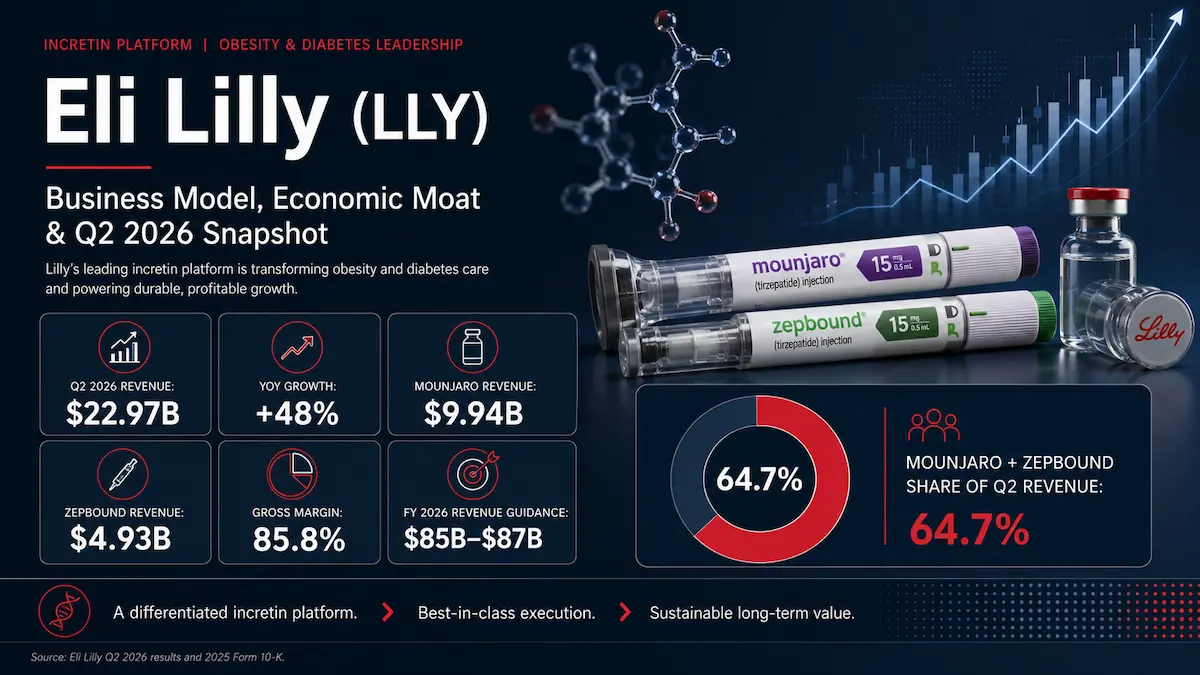
As of August 22, 2026, the latest reported quarter for Eli Lilly and Company (NYSE: LLY) is Q2 2026. The company reported $22.97 billion of quarterly revenue, up 48% year over year, with Mounjaro and Zepbound contributing $9.94 billion and $4.93 billion, respectively. Foundayo, the newly launched oral GLP-1 medicine, contributed $98 million in its first reported quarter. Lilly also raised full-year 2026 revenue guidance to $85 billion to $87 billion. Those numbers matter, but they are not the core investment-grade insight. The more important development is that Lilly has transformed its historical diabetes franchise into a vertically reinforced cardiometabolic platform spanning molecule design, clinical development, regulatory expansion, manufacturing, devices, payer access, and direct-to-patient distribution.
That platform architecture is the most useful way to understand the Eli Lilly business model today. Lilly is still a diversified pharmaceutical company with meaningful oncology, immunology, and neuroscience franchises, but its economic center of gravity has moved toward incretin medicines. The company’s future therefore depends less on simply defending one blockbuster and more on whether it can keep replacing each generation of therapy with a broader, more convenient, or more clinically differentiated successor before competitors compress price and share.
1. Business Model Breakdown
Eli Lilly is a human pharmaceutical company. It discovers or acquires drug candidates, funds preclinical and clinical development, secures regulatory approval, manufactures medicines at scale, and commercializes them through wholesalers, pharmacies, health systems, government programs, and direct-access channels. Unlike software, Lilly does not monetize recurring subscriptions in the conventional sense. Yet chronic medicines can produce economically recurring demand because patients may remain on therapy for long periods, provided efficacy, safety, reimbursement, adherence, and supply remain favorable.
The revenue model is overwhelmingly product-led. Lilly’s 2025 Form 10-K reported $65.18 billion of total revenue, including $60.96 billion of net product revenue and $4.22 billion of collaboration and other revenue. Collaboration revenue includes royalties, profit-sharing, milestones, and other payments from arrangements such as the company’s alliance with Boehringer Ingelheim. This makes Lilly fundamentally a proprietary-product business rather than a licensing company.
The mix has changed rapidly. Mounjaro, approved by the FDA in May 2022 for type 2 diabetes, generated $22.97 billion in 2025. Zepbound, approved for chronic weight management in November 2023 and later for moderate-to-severe obstructive sleep apnea in adults with obesity, generated $13.54 billion in 2025. Combined, the two tirzepatide brands accounted for 56% of annual company revenue. In Q2 2026, Mounjaro and Zepbound together generated $14.87 billion, or approximately 65% of total quarterly revenue.
This concentration reveals the underlying economics. Lilly’s most valuable products are protected innovations with high gross margins, substantial fixed research costs, and relatively low incremental manufacturing cost compared with the clinical value they can create. In 2025, company gross margin reached 83.0% of revenue. In Q2 2026, reported gross margin reached 85.8%. That is the hallmark of a successful innovative-pharma model: enormous upfront scientific and regulatory risk, followed by high contribution margins if a medicine wins approval, reimbursement, physician adoption, and durable demand.
However, high gross margin should not be confused with effortless pricing power. Lilly’s 2025 U.S. revenue growth was driven by a 53% volume increase while price reduced growth by 10 percentage points. In Q2 2026, worldwide revenue increased 48% as volume rose 60%, partially offset by a 13% decline in realized prices. In the United States, management said price would have declined by roughly 9% excluding certain rebate-estimate adjustments. The current profit engine is therefore volume expansion plus favorable product mix, not broad-based price increases.
The Incretin Platform Strategy
Lilly’s platform strategy is built around a ladder of therapies rather than a single formulation. Tirzepatide combines GIP and GLP-1 receptor agonism and is commercialized as Mounjaro for type 2 diabetes and Zepbound for obesity-related indications. Foundayo, the brand name for orforglipron, is a once-daily small-molecule oral GLP-1 medicine approved by the FDA on April 1, 2026 for chronic weight management. Retatrutide is an investigational once-weekly triple agonist targeting GIP, GLP-1, and glucagon receptors.
This creates three strategic layers. First, Lilly can segment by delivery preference: injectable versus oral. Second, it can segment by efficacy and disease severity: established dual agonism versus next-generation triple agonism. Third, it can expand the same cardiometabolic franchise across obesity-related complications and adjacent diseases. That is strategically superior to managing a single blockbuster because each new molecule can defend the installed franchise, widen the addressable population, and create a path to migrate patients without surrendering the category to a competitor.
The company is also adding a distribution layer. LillyDirect, launched in January 2024, connects patients to educational resources, independent telehealth providers, support services, and pharmacy fulfillment. In 2025, Lilly said more than one million patients accessed Lilly treatments through LillyDirect. Zepbound self-pay offerings use the platform to provide transparent cash pricing and reduce reliance on traditional third-party channel economics. In 2026, Lilly expanded access further through large pharmacy benefit managers and the Medicare GLP-1 Bridge.
LillyDirect should be viewed as a channel-control asset, not a software-style network effect. Its strategic value is that it can shorten the distance between manufacturer and patient, improve price transparency, reduce friction when insurance coverage is absent, help Lilly manage product launches, and create an owned access layer around medicines that otherwise move through fragmented intermediaries. In a category where reimbursement and fulfillment can determine market share almost as much as clinical efficacy, that control can matter materially.
How the Company Converts Science into Cash Flow
The cash conversion mechanism is straightforward in theory but difficult in execution. Lilly spends heavily on research and development, regulatory programs, commercial launches, manufacturing capacity, and acquired pipeline assets. If those investments produce differentiated therapies with broad labels, payer access, and protected exclusivity, revenue can scale much faster than central operating costs. In Q2 2026, revenue rose 48%, while research and development expense increased 14% and marketing, selling, and administrative expense increased 25%. That operating leverage helped Lilly lift its 2026 non-GAAP performance-margin guidance to 49.0% to 50.5%.
The trade-off is reinvestment intensity. Lilly is not harvesting the incretin cycle passively. It is spending aggressively to expand factories, acquire scientific platforms, and advance next-generation assets. In Q2 2026 alone, acquired in-process research and development charges were $2.8 billion, primarily associated with acquisitions. That spending can depress reported earnings in the short run, but strategically it reflects an attempt to use today’s cash flows to prevent tomorrow’s patent cliff from becoming a structural decline.
2. Deep Dive into Economic Moats
Using the classic Buffett framework, Lilly’s durable advantages are concentrated in intangible assets and an emerging cost-and-capacity advantage. Switching costs exist but are not especially strong, and network effects are weak in the strict economic sense. That distinction matters because pharmaceutical companies often appear more defensible than they actually are when analysts mistake revenue scale or brand familiarity for an enduring moat.
Intangible Assets: The Primary Moat
Lilly’s strongest moat is the bundle of intellectual property, regulatory exclusivity, proprietary know-how, clinical data, physician trust, and scientific capability attached to its medicines. The most tangible component is patent protection. Lilly’s 2025 Form 10-K lists estimated compound-patent expiry for Mounjaro/Zepbound in 2036 in the United States, 2037 in major European markets, and 2040 in Japan. Those dates do not guarantee exclusivity through the full period because patents can be challenged, invalidated, circumvented, or supplemented by other protections. Still, they provide a long runway for Lilly to monetize tirzepatide before direct generic competition becomes the primary economic threat.
The more durable portion of the intangible moat is not the legal patent alone. A competitor seeking to displace Lilly must reproduce a complete clinical and commercial system: a molecule with equal or better efficacy, tolerability and safety; large Phase 3 programs; outcome data in important populations; regulatory approvals; manufacturing at global scale; payer contracts; physician familiarity; and reliable supply. The capital and time required to build all of those pieces are the real barrier.
The clinical-development flywheel is increasingly important because Lilly is broadening molecules beyond their original labels. Zepbound became the first FDA-approved medication for moderate-to-severe obstructive sleep apnea in adults with obesity in December 2024. Foundayo won U.S. approval in April 2026 and was subsequently submitted for type 2 diabetes. Retatrutide has generated positive Phase 3 data in obesity and diabetes, and Lilly plans a U.S. regulatory submission in Q1 2027 for obesity, obstructive sleep apnea, and knee osteoarthritis pain. Each additional indication raises the cost for a challenger because a rival is no longer competing against one efficacy endpoint; it is competing against a growing evidence architecture.
There is an important caveat: some pipeline economics are shared. Orforglipron was licensed from Chugai Pharmaceutical, and Lilly’s 2025 Form 10-K states that Chugai is entitled to tiered royalties on future worldwide net sales ranging from the mid-single digits to the low teens. Foundayo can still be strategically valuable, but its unit economics are not identical to a wholly owned internally discovered asset.
Cost Advantages: More Accurately a Capacity and Process Advantage
Lilly’s second meaningful moat is manufacturing scale, although it should be described carefully. The company has committed more than $55 billion globally to manufacturing expansion since 2020, including more than $50 billion in the United States. In May 2026, Lilly announced an additional $4.5 billion across Indiana manufacturing sites, taking its Indiana capital commitments since 2020 above $21 billion. It has also announced a $3.5 billion Pennsylvania site intended to manufacture next-generation injectable medicines including retatrutide.
This is not automatically a cost moat. Spending more capital does not guarantee lower unit costs, and overcapacity can destroy returns. The strategic advantage comes from having qualified, regulated, validated capacity available when demand arrives. In high-growth injectable medicines, supply reliability can determine whether prescriptions convert into revenue. The barrier for a challenger is not only the cost of a plant; it is the time required to design it, validate processes, secure regulatory clearance, establish quality systems, source ingredients and devices, and ramp commercial output without supply disruption.
Foundayo adds an additional strategic dimension because it is a small-molecule oral drug rather than an injectable peptide. Lilly has not disclosed enough product-level cost data to prove that Foundayo will structurally carry higher margins than injectable incretins. Still, an oral small-molecule format can diversify the company away from exclusive dependence on injectable device capacity and potentially widen manufacturing flexibility over time. The key question is whether that flexibility translates into greater supply resilience and lower marginal capital intensity at commercial scale.
Switching Costs: Real but Not a Core Moat
Switching costs in obesity and diabetes therapy are moderate at best. Patients and physicians face titration schedules, side-effect management, insurance authorization, pharmacy coordination, and continuity-of-care considerations, so changing therapy is not frictionless. Yet these are not software-like switching costs. Payers can force formulary changes, physicians can change drugs when efficacy or tolerability disappoints, and patients can move when cash price or coverage changes.
Lilly can increase practical stickiness by offering multiple products across the same care journey. A patient who begins on Zepbound may later prefer an oral option such as Foundayo, or a physician may eventually consider retatrutide for a patient who needs a different efficacy profile. Keeping those transitions inside the Lilly portfolio is strategically valuable, but it is portfolio breadth rather than contractual lock-in.
Network Effects: Weak in the Buffett Sense
Lilly does not possess a meaningful classic network effect. One additional patient taking Zepbound does not directly make Zepbound more useful to every other patient. More prescribers and more real-world experience can increase familiarity and confidence, but that is closer to reputation, evidence accumulation, and distribution reach than a true network effect.
LillyDirect also should not be misclassified as a network-effect platform. More users may improve operating data and channel efficiency, but the service does not become exponentially more valuable because other users join. Its advantage is vertical integration around access, affordability, and fulfillment.
Can the Moat Support Long-Term Excess Returns?
Potentially, but only if Lilly keeps renewing the moat. Pharmaceutical excess returns are inherently finite because exclusivity expires and competitors innovate. Lilly’s current position is unusually strong because tirzepatide has long-dated compound patents and the company is already commercializing or advancing successor products before the core patent cliff becomes imminent. The crucial advantage is therefore not one patent; it is the organization’s demonstrated ability to convert a scientific franchise into sequential products and indications.
The moat would weaken materially if Lilly’s pipeline stalls, if safety issues alter prescribing behavior, if competing therapies offer meaningfully better efficacy or convenience, if payer pressure compresses net prices faster than volume grows, or if manufacturing investments fail to produce reliable capacity. The moat is durable only to the extent that Lilly can keep compounding scientific output into commercially differentiated products.
3. Business Inflection Points & Future Catalysts
The Strategic Inflection Point: Tirzepatide Turned Diabetes Expertise into a Platform
Lilly’s corporate history is unusually deep. The company was founded in Indianapolis in 1876. It commercialized one of the earliest insulin products in 1923 and introduced Humulin, the first recombinant DNA human healthcare product, in 1982. Those milestones established a long institutional competency in metabolic disease and biologic manufacturing.
The modern strategic inflection point, however, was the 2022 approval of Mounjaro. Tirzepatide changed Lilly from a diversified pharmaceutical company with a diabetes franchise into a company capable of dominating a much larger cardiometabolic profit pool. The key strategic step was recognizing that the same underlying biology could support multiple brands, indications, delivery formats, and successor molecules. Zepbound then converted tirzepatide into an obesity franchise, and LillyDirect, Foundayo, retatrutide, Medicare access, and enormous manufacturing expansion have since reinforced that platform.
Catalyst 1: Foundayo Scales the Addressable Market Beyond Injectables
Transmission mechanism: Foundayo can expand the population willing or able to use incretin therapy by offering a once-daily pill that can be taken without food or water restrictions. It also gives Lilly a second obesity modality at a time when payer coverage is broadening. The company reported $98 million of Foundayo revenue in Q2 2026 after its April launch, while all three of the largest U.S. pharmacy benefit managers were moving toward coverage of Lilly’s obesity portfolio.
Observable indicators: quarterly Foundayo revenue; prescription growth; refill and persistence data if disclosed; commercial formulary wins; Medicare GLP-1 Bridge utilization; international regulatory approvals; the FDA outcome for the type 2 diabetes application submitted in Q2 2026; and whether Foundayo growth is additive to Lilly’s franchise rather than merely cannibalizing Zepbound.
Main execution risks: oral convenience alone does not guarantee preference. Patients may value injectable efficacy, competitors may offer attractive oral alternatives, gastrointestinal tolerability may limit persistence, net pricing may be lower than expected, and payer management could narrow the eligible population. In addition, Lilly owes royalties to Chugai, which reduces the economic capture relative to a fully owned asset.
Catalyst 2: Retatrutide Extends Lilly’s Efficacy Frontier
Transmission mechanism: Retatrutide is designed to add glucagon receptor agonism to the GIP/GLP-1 framework. Lilly’s Phase 3 TRIUMPH-1 topline results reported average weight loss of up to 28.3% at 80 weeks at the 12 mg dose, while additional Phase 3 studies have reported meaningful improvements in obesity, type 2 diabetes, obstructive sleep apnea, and knee osteoarthritis pain. If regulators accept a broad label and the commercial launch is supported by sufficient capacity, retatrutide could reinforce premium clinical differentiation and reduce the risk that a competitor leapfrogs tirzepatide.
Observable indicators: filing of the planned U.S. BLA in Q1 2027; FDA acceptance and review timing; final published Phase 3 safety and discontinuation data; label scope; manufacturing readiness at planned U.S. sites; payer positioning; and evidence of whether physicians view retatrutide as a step-up therapy, a replacement for current injectables, or a distinct option for complex obesity-related disease.
Main execution risks: superior weight loss in a trial does not automatically translate into superior commercial economics. Regulatory review could take longer than expected, adverse events or tolerability could limit real-world use, the label could be narrower than investors expect, payer budgets could push back against premium pricing, and competitors could narrow the efficacy gap before or shortly after launch.
Catalyst 3: Manufacturing Capacity Converts Demand from a Constraint into Revenue
Transmission mechanism: historically, incretin demand has been high enough that capacity itself became strategically important. Lilly’s more than $55 billion of global manufacturing commitments are designed to increase active pharmaceutical ingredient production, injectable-device capacity, small-molecule capacity, and next-generation manufacturing capabilities. When new plants become operational and validated, the company can convert previously constrained demand into prescriptions, support global launches, and reduce the risk that shortages hand share to competitors.
Observable indicators: startup dates and regulatory clearance for new sites; company commentary on supply availability; days of inventory; international launch cadence; gross margin trends; capital expenditures; and whether incremental supply leads to higher unit volume without disproportionately lower net prices.
Main execution risks: pharmaceutical manufacturing ramps are complex. Construction delays, validation issues, quality deviations, device shortages, supplier failures, or demand forecasting errors can turn capacity expansion into a drag on returns. The business also faces the inverse risk: if competitive intensity or reimbursement changes reduce demand, very large fixed investments can lower capital efficiency.
Catalyst 4: Broader Reimbursement Expands the Treated Population, but at a Lower Net Price
Transmission mechanism: obesity treatment has historically been limited by coverage. The Medicare GLP-1 Bridge began on July 1, 2026 and gives eligible Medicare Part D beneficiaries access to covered GLP-1 medicines, including Foundayo and Zepbound KwikPen, for a $50 monthly copay through December 31, 2027. Lilly also announced broader commercial PBM coverage in 2026. Increased access can enlarge treated patient volumes substantially.
Observable indicators: Medicare Bridge enrollment and utilization; commercial covered lives; new-to-brand prescriptions; average realized price; rebate trends; gross-to-net deductions; and the mix between self-pay, commercial insurance, and government channels.
Main execution risks: broader coverage is economically valuable only if volume growth outweighs lower net pricing. Government and private payers have substantial bargaining power, and Lilly’s recent financial statements already show declining realized prices. The key KPI is therefore not prescription growth alone; it is revenue and gross profit per incremental treated patient.
What Could Invalidate the Bullish Catalyst Narrative?
The most important failure mode is a mismatch between clinical success and commercial economics. Lilly could continue reporting excellent trial data while seeing lower returns if prices decline faster than volume grows, payers impose restrictive utilization management, competitors gain comparable efficacy, or the company must spend more capital than expected to support supply. A second risk is concentration: the more Mounjaro and Zepbound dominate revenue, the more a single safety, reimbursement, supply, or competitive shock can move company-wide results. Lilly itself identifies dependence on relatively few products and product classes as a material risk.
A third risk is scientific succession. Today’s moat looks durable because Lilly has tirzepatide, Foundayo, and retatrutide at different points of the product cycle. That logic breaks if the next generation fails to improve outcomes, convenience, economics, or access. The true test of Lilly’s corporate gene is therefore not whether tirzepatide remains dominant forever; it is whether the company can repeatedly obsolete its own products before competitors do.
4. Key FAQs
How does Eli Lilly make money from Mounjaro and Zepbound?
Lilly earns product revenue when Mounjaro and Zepbound are sold through its pharmaceutical distribution channels, net of rebates, discounts, returns, and other gross-to-net adjustments. In 2025, Mounjaro generated $22.97 billion and Zepbound generated $13.54 billion. The economic attraction comes from high-value patented medicines with large chronic-disease populations and high gross margins, while the principal offsets are payer rebates, price concessions, marketing expense, R&D reinvestment, and manufacturing expansion. The model is therefore a volume-and-innovation engine rather than a simple list-price story.
What is Eli Lilly’s competitive advantage in the GLP-1 obesity market?
The strongest competitive advantage is a portfolio-and-infrastructure system: a protected dual agonist in tirzepatide, an approved oral GLP-1 in Foundayo, a late-stage triple agonist in retatrutide, expanding indication evidence, more than $55 billion of manufacturing commitments since 2020, broad payer access, and LillyDirect as a direct-access channel. The advantage is not invulnerable. Competitors can still win with better efficacy, safety, convenience, pricing, or reimbursement. But matching Lilly now requires competing across science, evidence, capacity, and access simultaneously.
Can Foundayo and retatrutide sustain Eli Lilly’s growth after Zepbound?
They can extend the growth runway, but they should not be treated as guaranteed replacements. Foundayo broadens the delivery format and could expand the addressable population among patients who prefer an oral therapy. Retatrutide could push efficacy and complication treatment further if Phase 3 results translate into broad regulatory approval and payer access. The most important evidence will be product-level revenue growth, persistence, net pricing, label breadth, manufacturing readiness, and whether the new products add patients to Lilly’s franchise rather than simply shifting existing patients from one Lilly medicine to another.
5. Conclusion
Eli Lilly’s corporate gene is best described as scientific renewal reinforced by industrial scale. The company’s history in diabetes created deep biological and manufacturing expertise, but the modern transformation began when tirzepatide converted that expertise into a multi-indication, high-growth cardiometabolic platform. Lilly is now using the cash flows from Mounjaro and Zepbound to build the next layers of that platform through Foundayo, retatrutide, direct patient access, payer expansion, and a manufacturing buildout that few competitors can quickly replicate.
The company’s moat is therefore strongest where intangible assets and manufacturing capability intersect. Patents protect the molecules, clinical evidence protects physician confidence and label breadth, manufacturing protects availability, and distribution strategy protects access. Switching costs and network effects are secondary. That distinction is important because Lilly’s long-term economics will not be defended by patient inertia alone; they will be defended by continuous innovation and the ability to industrialize that innovation faster than rivals.
The principal counterweight is that the franchise is becoming more concentrated just as realized prices are falling. Lilly must continue to grow volume, improve mix, broaden reimbursement, and launch successor medicines fast enough to offset price pressure and eventual exclusivity loss. If it does, the company can sustain a self-reinforcing pharmaceutical platform. If it does not, today’s exceptional growth could reveal the classic weakness of blockbuster economics: very high returns that remain dependent on a narrow set of protected assets.
Primary and Official Sources
- Eli Lilly 2025 Form 10-K — U.S. Securities and Exchange Commission
- Eli Lilly Q2 2026 Financial Results — Eli Lilly Investor Relations
- Eli Lilly Corporate History — Eli Lilly and Company
- Mounjaro Drug Trials Snapshot — U.S. Food and Drug Administration
- FDA Approval of Zepbound for Chronic Weight Management — U.S. Food and Drug Administration
- FDA Approval of Zepbound for Obstructive Sleep Apnea — U.S. Food and Drug Administration
- FDA Approval of Foundayo (orforglipron) — U.S. Food and Drug Administration
- Retatrutide Phase 3 Update — Eli Lilly Investor Relations
- Manufacturing and Quality — Eli Lilly and Company
- 2026 Indiana Manufacturing Expansion — Eli Lilly Investor Relations
- LillyDirect Launch — Eli Lilly Investor Relations
- Medicare GLP-1 Bridge — Centers for Medicare & Medicaid Services
- 2026 U.S. Coverage Expansion for Foundayo and Zepbound — Eli Lilly Investor Relations
Disclaimer: This article is intended solely for business logic discussion and corporate research purposes, and does not constitute investment advice of any kind.