

Key Takeaways
- Onto Innovation is fundamentally a semiconductor capital-equipment company, not a SaaS company. In fiscal 2025, systems and software represented 84% of revenue, while parts and services contributed the remaining 16%. The economic engine is therefore high-value tool placement followed by an installed-base stream of upgrades, spare parts, maintenance, and applications support.
- The company’s strongest moat is qualification-driven switching cost, reinforced by proprietary metrology, inspection, modeling, and yield-analysis know-how. Once a process-control tool is qualified inside a high-volume manufacturing flow, replacing it can require recipe redevelopment, correlation work, requalification, and acceptance of yield risk. That friction is economically meaningful even though it is not absolute.
- Onto’s platform strategy is becoming more important than any single instrument. Atlas G6, Dragonfly G5 and 3Di, EchoScan, Ai Diffract, Discover, the Semilab materials-analysis portfolio, and the Rigaku X-ray collaboration collectively broaden the number of process-control problems Onto can address across advanced logic, memory, HBM, 2.5D packaging, hybrid bonding, and specialty devices.
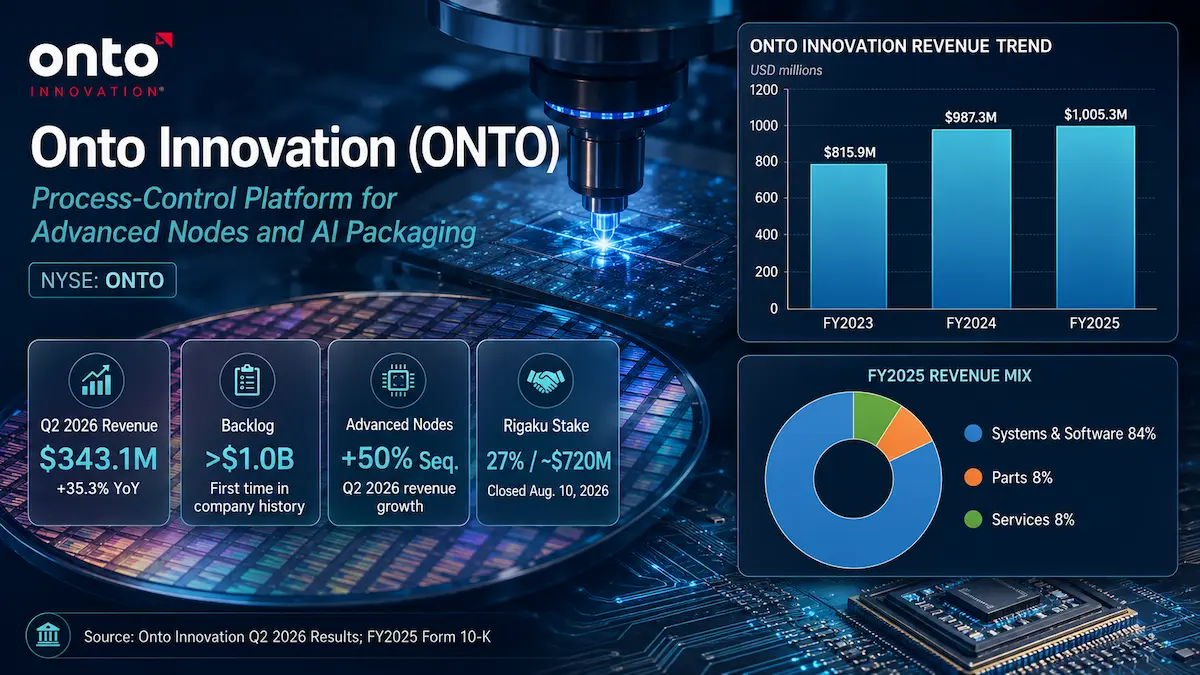
- The current growth setup is unusually strong but should not be mistaken for a permanent structural growth rate. Second-quarter 2026 revenue reached a record $343.1 million, advanced-nodes revenue rose 50% sequentially, advanced packaging and specialty-device revenue also hit a record, and backlog exceeded $1 billion. These figures support visibility, but semiconductor capital spending, customer qualifications, and AI infrastructure investment remain cyclical.
- The principal risks are customer concentration, intense competition, execution risk around newly acquired or partnered technologies, and capital-allocation risk. Onto’s top three customers represented 49% of fiscal 2025 revenue, while the $720 million minority investment in Rigaku deepens strategic alignment but does not provide operating control.
1. Business Model Breakdown
Onto Innovation makes money by selling the measurement, inspection, lithography, and analytical infrastructure that semiconductor manufacturers use to keep increasingly complex production processes inside acceptable yield windows. Its customers include silicon wafer producers, integrated device manufacturers, foundries, memory manufacturers, outsourced semiconductor assembly and test providers, and other advanced-device manufacturers. The company’s role is economically important because semiconductor manufacturing is a yield business: a small process excursion can destroy the value of an expensive wafer or package, while faster detection of defects and dimensional drift can shorten learning cycles and improve factory economics.
The revenue model is predominantly equipment-led. For the fiscal year ended January 3, 2026, Onto generated $1.005 billion of revenue. Systems and software contributed $847.8 million, or 84% of total revenue; parts contributed $84.2 million, or 8%; and services contributed $73.2 million, or 8%. This mix matters because it prevents a common analytical mistake: Onto owns meaningful software assets, but its financial profile should not be modeled like a recurring-revenue software vendor. Software licenses are primarily sold with systems and are generally recognized when made available, while licensing support and maintenance are recognized over the contract period. Services include maintenance contracts, labor, consulting, training, and installation; parts revenue includes replacement components and is complemented economically by system upgrades.
The underlying profit logic is a two-stage model. First, Onto wins a tool-of-record or qualified position at a critical process step. That initial sale can carry a high ticket value because the instrument is tied to yield, throughput, reliability, or time-to-solution. Second, every installed tool creates a long-duration commercial relationship involving spare parts, service, applications engineering, software support, upgrades, additional capacity tools, and opportunities to cross-sell adjacent process-control technologies. The recurring component is therefore real but installed-base driven rather than subscription driven.
The more powerful part of the model is that process complexity can expand Onto’s revenue opportunity faster than wafer volumes alone. Gate-all-around logic, high-bandwidth memory, 3D NAND, advanced 2.5D and 3D packaging, hybrid bonding, co-packaged optics, and new materials create additional control points. Each new structural layer, material interface, interconnect geometry, or packaging step can require another measurement, inspection, or analytical capability. In economic terms, Onto is monetizing the rising process-control intensity required to turn semiconductor complexity into manufacturable yield.
The Platform Strategy: From Point Tools to Connected Process Control
Onto’s platform strategy is best understood as a multi-modality process-control architecture rather than a conventional software platform. The company combines optical critical-dimension metrology, thin-film measurement, macro defect inspection, 2D and 3D metrology, opaque-film metrology, lithography, materials characterization, yield-management software, machine-learning analysis, and applications support. The strategic objective is to make these capabilities more valuable together than they are as isolated tools.
Atlas is central to advanced-node optical metrology. Dragonfly spans inspection and advanced-packaging metrology. Discover turns inspection data into defect classification and yield analysis. Ai Diffract converts optical signals into dimensional, thickness, and optical-property information using proprietary modeling, while SpectraProbe and AiGen X extend recipe development and computational capacity. The acquired Semilab technologies add surface-charge, contamination, wide-bandgap, infrared, and materials-analysis capabilities. The Rigaku collaboration adds X-ray measurement for structures where optical techniques alone may not provide enough information. The commercial thesis is straightforward: if Onto can correlate multiple measurement modalities and feed them into a common analytical workflow, it can capture more process steps per customer and make each installed platform harder to displace.
Recent results show how operating leverage can appear when product mix and demand align. In the second quarter of 2026, revenue rose 35.3% year over year to $343.1 million. GAAP gross margin reached 53.4%, while non-GAAP gross margin reached 57.0%; GAAP operating margin was 18.5% and non-GAAP operating margin was 30.0%. Management guided the third quarter of 2026 to revenue of $380 million to $400 million, GAAP gross margin of 57.3% to 57.8%, and non-GAAP operating margin of 31.5% to 32.5%. Those figures are company guidance rather than guaranteed outcomes, but they illustrate the earnings sensitivity to volume, mix, and execution.
2. Deep Dive into Economic Moats
Switching Costs: The Strongest Moat
The most defensible element of Onto’s competitive position is switching cost created by semiconductor qualification and process integration. Process-control tools do not operate as generic laboratory instruments. They are configured around specific customer structures, materials, recipes, tolerances, defect libraries, factory workflows, and statistical process-control requirements. A tool that has already been qualified in high-volume manufacturing becomes embedded in the customer’s operating process.
Replacing that tool can therefore require more than purchasing a competitor’s machine. The customer may need to rebuild recipes, correlate historical data, re-establish measurement matching across fleets, validate sensitivity and throughput, retrain engineering teams, integrate new software interfaces, and accept the risk that a change in process control could create yield excursions. When the measured structure is part of an expensive leading-edge wafer or advanced package, the cost of a false negative, nuisance defect, or unstable measurement can exceed the price difference between competing systems.
This moat is strongest after qualification and during capacity expansion. It is weaker when a customer is designing a new node, new package architecture, or new manufacturing line, because that is precisely when competing suppliers can challenge the incumbent. Onto must therefore keep winning the next qualification cycle. The moat protects installed positions; innovation determines whether the company earns the next generation of positions.
Intangible Assets: Process Know-How Matters More Than Patent Count
Onto’s second core moat is a bundle of intangible assets: proprietary optics, algorithms, signal processing, metrology models, inspection techniques, defect-classification methods, applications knowledge, software, and intellectual property accumulated across multiple generations of semiconductor manufacturing. As of January 3, 2026, the company reported 423 granted or exclusively licensed U.S. and foreign patents and 312 pending patent applications covering areas including metrology, defect detection and classification, materials characterization, lithography, automation, artificial intelligence, and machine learning.
The patent portfolio is evidence of sustained R&D, but patents by themselves are not the moat. The more durable advantage is the tacit engineering knowledge required to translate a physical signal into a production-worthy measurement at semiconductor-fab throughput and reliability. The customer does not merely need an instrument that can detect a feature in a controlled environment; it needs repeatable measurements, matching across tools, recipe portability, acceptable throughput, actionable analytics, service support, and stability inside high-volume manufacturing.
That accumulated know-how is expensive for competitors to replicate because it requires R&D spending, customer access, long qualification cycles, application engineering, field service, and real production feedback. Onto spent 13.1% of fiscal 2025 revenue on research and development, underscoring that its moat must be continuously renewed rather than harvested passively.
Network Effects: Limited, Not a Core Moat
Onto does not possess a classic network effect. One customer buying an Atlas or Dragonfly system does not automatically make the product more valuable to every other customer. Semiconductor manufacturing data is highly proprietary, and customers generally do not contribute a shared data pool in the way users strengthen a marketplace or social network.
There are smaller learning effects: a larger installed base can improve field knowledge, accelerate troubleshooting, expand application libraries, and create more engineering feedback. Those advantages can improve product development and support quality, but they are better classified as experience-curve and ecosystem benefits than true network effects.
Cost Advantages: Helpful but Secondary
Cost advantage is not the primary reason customers select Onto. In semiconductor process control, performance, sensitivity, precision, throughput, reliability, total cost of ownership, and support usually outweigh the lowest purchase price. Onto does outsource assemblies that it does not view as competitively differentiating and has been expanding in-region manufacturing in Asia, which can lower freight, tariff exposure, lead times, and logistics complexity. Those moves may support margins and responsiveness.
However, several competitors have greater financial, engineering, manufacturing, and marketing resources. Scale is therefore not an unambiguous structural advantage for Onto. The company’s more credible economic defense is to deliver enough yield value and process insight that customers care more about total manufacturing economics than equipment price.
Can These Moats Support Long-Term Excess Returns?
Potentially, but only if Onto continues to convert new semiconductor complexity into qualified process-control positions. The combination of switching costs and proprietary process knowledge can support attractive economics in specialized niches, particularly when a measurement becomes mission-critical and the customer has few production-proven alternatives. Yet the market is not protected from competition. Onto identifies KLA and Nova as principal competitors in thin-film and OCD metrology, KLA and Camtek in advanced-packaging inspection, Ushio and Canon in advanced-packaging lithography, PDF Solutions in software, and other specialists across materials and industrial applications.
The correct moat conclusion is therefore not that Onto is insulated from competition. It is that the company can earn durable value from qualification, workflow integration, and technical specialization if its R&D cadence stays ahead of the next process transition. The moat is dynamic, not static.
3. Business Inflection Points & Future Catalysts
The Strategic Inflection Point: The 2019 Merger of Nanometrics and Rudolph Technologies
The defining strategic turning point was the October 2019 merger of equals between Nanometrics and Rudolph Technologies that created modern Onto Innovation. Nanometrics brought a strong front-end metrology heritage, while Rudolph contributed inspection, lithography, process-control software, and advanced-packaging exposure. At announcement, the companies described an approximately $3 billion served-market opportunity and at least $20 million of expected annual cost synergies.
The deeper significance was not the cost synergy. The merger changed the company’s corporate architecture from a narrower collection of point products into a broader process-control supplier spanning wafer manufacturing, leading-edge fabrication, and advanced packaging. That breadth created three strategic options that still define Onto today: cross-selling adjacent technologies into the same customer base, reallocating R&D across complementary measurement modalities, and using software to connect data generated by different tools. The Semilab acquisition and Rigaku partnership are extensions of that original logic rather than unrelated diversification.
Catalyst 1: Advanced Packaging Process-Control Intensity
Transmission mechanism: AI accelerators increasingly rely on HBM, chiplets, 2.5D integration, 3D interconnects, hybrid bonding, and larger or more complex packages. These architectures create more bumps, bond interfaces, redistribution layers, planarization steps, and defect-sensitive surfaces. More process steps and tighter tolerances increase the amount of inspection and metrology required per package. Onto can monetize that complexity through Dragonfly G5 inspection, 3Di bump metrology, EchoScan void detection, Discover analytics, and related service and upgrade revenue.
The commercial evidence has become more concrete. Dragonfly 3Di was qualified by two major HBM customers in 2025, and orders were also secured for 2.5D logic applications. In March 2026, Onto said evaluations of the new Dragonfly G5 resulted in double-digit system order commitments and a similar number of 3Di orders, including displacement of a previously established tool of record. In April, the company said Dragonfly platforms were expected to grow more than 50% in 2026 versus 2025. By the second quarter of 2026, Specialty Devices and Advanced Packaging revenue had reached a company record.
Observable indicators: Dragonfly platform shipments, additional HBM and 2.5D qualifications, EchoScan adoption in hybrid bonding, advanced-packaging revenue growth, backlog conversion, and the ratio of service and upgrade revenue to the installed base. The most important qualitative indicator is whether Onto wins additional process layers rather than merely shipping more tools into the same step.
Execution risks: AI packaging investment can pause if accelerator demand, HBM capacity additions, or foundry packaging plans slow. Qualification schedules can slip. KLA and Camtek remain formidable competitors. A new package architecture can also change which inspection modality is most valuable. The catalyst fails if Onto’s sensitivity, throughput, cost of ownership, or applications support falls behind at the next transition.
Catalyst 2: Atlas G6 Plus Rigaku Creates a Multi-Modal Advanced-Node Offering
Transmission mechanism: leading-edge logic and memory are becoming harder to characterize optically as structures shrink, deepen, and incorporate more complex materials. Atlas G6 addresses optical critical-dimension and thin-film metrology for gate-all-around logic and HBM-related memory structures. Rigaku adds X-ray technologies that can provide complementary information on deeper or more complex structures. By integrating Onto’s Ai Diffract analysis with Rigaku CD-SAXS platforms, the companies aim to correlate the speed and positional information of optical metrology with the precision of X-ray measurements.
This matters economically because a successful multi-modal workflow can increase Onto’s share of the customer’s process-control budget without requiring the company to replace optical metrology. The opportunity is additive: optical tools can rapidly locate and monitor structures, X-ray can provide information that is difficult to obtain optically, and common modeling can tie the datasets together. That architecture could raise software attachment, increase the number of qualified process steps, and deepen switching costs.
The evidence is early but material. Atlas G6 secured multiple production orders following its 2025 launch and was selected by a second logic customer for gate-all-around metrology in the first quarter of 2026. Advanced-nodes revenue then increased 50% sequentially in the second quarter. The Onto-Rigaku X-ray offering had already been selected by two customers when the partnership was announced in April 2026. On August 10, 2026, Onto completed its approximately $720 million purchase of a 27% minority stake in Rigaku and gained the right to nominate a director.
Observable indicators: Atlas G6 customer wins, advanced-nodes revenue, the number of X-ray production selections, joint product launches, software attachment to X-ray systems, and evidence that correlated optical/X-ray workflows move from evaluation into high-volume manufacturing. The company’s Q3 2026 margin guidance is also relevant because premium product mix should eventually appear in gross and operating margins if the platform thesis is working.
Execution risks: X-ray qualifications can be lengthy, and the strategic investment is a minority position rather than a controlled acquisition. Onto must coordinate intellectual property, product roadmaps, sales incentives, service responsibilities, and customer ownership across two independent companies. The $720 million investment also raises the hurdle for capital returns, while fair-value accounting can introduce earnings volatility unrelated to core operating performance. The catalyst is only successful if joint technology wins convert into durable semiconductor revenue, not merely strategic alignment.
Catalyst 3: Semilab Integration Expands the Measurement Stack
Transmission mechanism: the Semilab transaction added FAaST, CnCV, and MBIR technologies spanning contamination monitoring, surface-charge metrology, wide-bandgap characterization, infrared OCD, and materials analysis. These capabilities extend Onto beyond geometry and visible-defect inspection into electrical and material properties that become more important as advanced devices use new materials and interfaces. The strategic value is highest when Semilab data can be combined with Onto’s OCD, acoustic, inspection, and modeling platforms to localize defects and accelerate yield learning.
At the November 2025 closing, management said the acquired product lines were expected to contribute approximately $120 million of revenue in 2026, weighted toward the second half. That figure should be treated as a benchmark disclosed at closing, not as guaranteed current guidance. The more important long-term question is whether Onto can create cross-platform revenue that would not have existed if Semilab remained standalone.
Observable indicators: materials-analysis revenue contribution, cross-selling into Onto’s existing logic, memory, packaging, and power-semiconductor accounts, gross-margin progression, new products that combine Semilab measurement with Ai Diffract or other Onto analytics, and customer evidence that multiple Onto modalities are being qualified together.
Execution risks: integration can disrupt engineering teams, customer relationships, supply chains, or product roadmaps. The acquired portfolio may also perform well on a standalone basis without generating the cross-selling synergies needed to justify the strategic premium. Investors should distinguish acquired revenue from genuine organic platform pull-through.
Near-Term Financial Checkpoints
The most useful near-term checkpoints are operational rather than valuation based. Second-quarter 2026 backlog exceeded $1 billion for the first time, but backlog should be treated as an indicator of demand visibility rather than guaranteed revenue. Management’s third-quarter 2026 guidance calls for $380 million to $400 million of revenue and a 57.3% to 57.8% GAAP gross margin. Sustained conversion at those levels would indicate that current strength is broadening beyond a single product or customer program. A sharp divergence would raise questions around capacity timing, product mix, customer concentration, or qualification conversion.
Customer concentration remains the most important structural counterweight to the growth narrative. Onto’s three largest customers accounted for 20%, 15%, and 14% of fiscal 2025 revenue, respectively. Taiwan and South Korea together represented 60% of annual revenue. That concentration can accelerate growth when a small number of leading customers ramp aggressively, but it can also amplify quarterly volatility when one customer delays capacity or changes a technology roadmap.
4. Key FAQs
How does Onto Innovation make money from semiconductor process control equipment?
Onto primarily earns revenue by selling semiconductor metrology, inspection, lithography, and related software systems, then monetizing the installed base through spare parts, service contracts, repairs, consulting, training, software support, and system upgrades. In fiscal 2025, 84% of revenue came from systems and software, with 8% from parts and 8% from services. The model is therefore capital-equipment led, with a recurring installed-base tail rather than a SaaS-style recurring-revenue structure.
What is Onto Innovation’s competitive advantage in HBM and advanced packaging metrology?
Its advantage is the ability to combine multiple process-control functions across the same advanced package. Dragonfly provides high-speed 2D inspection and 3Di bump metrology; EchoScan targets small subsurface voids in bonded structures; Discover analyzes defect data; and Onto can also address lithography and related metrology steps. This breadth can reduce the number of disconnected tools and datasets a customer must manage. The moat becomes strongest after Onto is qualified in high-volume manufacturing, because replacing a process-control flow can require recipe redevelopment, data correlation, requalification, and acceptance of yield risk.
How could the Rigaku partnership change the Onto Innovation business model through 2027?
If execution is successful, the Rigaku relationship could move Onto further from selling discrete optical tools toward selling correlated, multi-modal process-control solutions. Optical OCD can provide speed and location information, while X-ray can add precision for deeper and more complex structures. Integrating those datasets through Ai Diffract could increase software attachment, expand the number of process steps Onto can address, and deepen customer switching costs. The key risk is that Onto owns only a 27% minority stake, so technical and commercial coordination must be achieved without full operating control.
5. Conclusion
Onto Innovation’s corporate DNA is best described as an engineering-led process-control compounder built around semiconductor complexity. The company does not need to manufacture the chips that win the AI cycle; it needs the industry’s manufacturing architectures to become sufficiently complex that customers require more measurement, inspection, modeling, and yield-control steps. That is why advanced nodes and advanced packaging can reinforce each other economically even though they sit at different points in the semiconductor value chain.
The 2019 merger created the strategic template: combine complementary process-control technologies, use software and applications expertise to connect them, and expand into adjacent high-value measurement problems. Semilab and Rigaku extend that template into materials and X-ray. If Onto can make those technologies work as one process-control stack, the company can increase wallet share while making qualified positions more difficult to displace.
The durable moat is therefore not simply market growth, a large backlog, or a strong brand. It is the accumulated cost of qualifying, correlating, and operating mission-critical process-control technology in high-volume semiconductor manufacturing, reinforced by proprietary engineering and customer-specific workflow knowledge. The main analytical question for the next two years is whether Onto can convert its broader platform into repeatable multi-product wins without allowing customer concentration, integration complexity, or capital allocation to dilute the economics.
Primary Sources
- U.S. Securities and Exchange Commission — Onto Innovation 2025 Annual Report / Form 10-K
- Onto Innovation — 2019 Merger Completion Announcement
- Onto Innovation — 2026 Second Quarter Results
- Onto Innovation — Completion of Strategic Investment in Rigaku Holdings
- Onto Innovation — Rigaku X-Ray Strategic Partnership Announcement
- Onto Innovation — Semilab Materials Analysis Acquisition Completion
- Onto Innovation — Dragonfly G5 Inspection System Launch
- Onto Innovation — Atlas G6 OCD Metrology Platform Launch
- Onto Innovation — 3Di and EchoScan Advanced Packaging Process-Control Announcement
Disclaimer: This article is intended solely for business logic discussion and corporate research purposes, and does not constitute investment advice of any kind.