


Key Takeaways
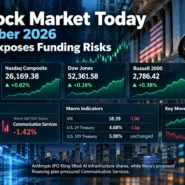
- The S&P 500 rose 0.86% to 7,656.98, the Nasdaq Composite gained 0.96% to 26,333.04, and the Dow Jones Industrial Average advanced 0.98% to 52,573.29, ending a four-session losing streak for the broad market.
- The rebound was broader than a mega-cap-only rally: nine of 11 S&P 500 sectors advanced and S&P 500 advancers outnumbered decliners by roughly 2.1-to-1, although total U.S. share volume of 14.0 billion remained below the 20-session average of 14.9 billion.
- August CPI rose 0.4% month over month and 3.4% year over year; core CPI increased 0.3% and 2.4%, respectively. The data kept near-term Federal Reserve tightening risk elevated even as equities rallied.
- The Treasury curve flattened: the official U.S. Treasury par yield was 4.63% on the 2-year, up 7 basis points, and 4.96% on the 10-year, up 1 basis point. Brent crude fell to $104.61, easing the immediate energy-inflation shock without removing it.
- AI infrastructure was the dominant single-stock theme. Dell Technologies closed up 11.98% and Hewlett Packard Enterprise rose 12.44% as investors repriced the durability of data-center and networking spending.
1. Market Capital Flows and Sector Rotation
Friday’s tape showed a meaningful rotation back toward growth-sensitive and cyclical exposure, but not a wholesale return to easy-money risk taking. Communication Services led the S&P 500 sectors at +1.35%, followed by Consumer Discretionary at +1.13%, Information Technology at +1.11%, Industrials at +1.07%, Real Estate at +0.88%, Financials at +0.62%, Consumer Staples at +0.56%, Materials at +0.50%, and Energy at +0.34%. Health Care fell 0.14% and Utilities declined 0.34%, making the two defensive groups the only sector laggards. The Russell 2000 gained 0.45% to 2,903.94, materially less than the S&P 500’s 0.86% advance, so large caps still outperformed small caps. Growth-leaning leadership was also clearer than value leadership: technology, communication services and discretionary shares outpaced value-heavy financials and energy, while defensive utilities and health care finished lower.
Market breadth improved materially. Advancing S&P 500 issues beat decliners by about 2.1-to-1, arguing against the view that the index gain was driven only by a handful of mega-cap stocks. The quality of the breadth was not flawless, however: Nasdaq new lows still exceeded new highs by 182 to 45, and U.S. exchange volume was below its recent average. That combination is consistent with a broad relief rally after de-risking rather than a definitive reset into a new high-conviction risk-on regime.
Institutional Flow Insight: The price action is consistent with selective re-risking after a difficult week, not with investors dismissing inflation or rates. U.S. equity funds recorded $32.27 billion of net redemptions in the week through September 9, according to LSEG Lipper data reported by Reuters, leaving positioning lighter into Friday’s rebound. At the same time, the 2-year Treasury yield rose sharply, so the market did not receive a conventional duration tailwind. A more plausible allocation logic is that lower oil prices reduced near-term inflation-tail risk, while the prior four-session equity decline and a forward S&P 500 multiple near 19 times earnings improved tactical entry points. The leadership pattern also suggests institutions may have preferred companies with visible AI-capex demand and operating leverage over bond-proxy defensives. That is an inference from prices and breadth, not confirmed daily fund-flow data.
2. Decoding the Biggest Market Movers
Dell Technologies (DELL)
Dell Technologies closed at $567.29, up 11.98% in the regular session. The immediate read-through came from renewed confidence in hyperscale and AI infrastructure spending after Oracle’s post-close earnings report, but Dell’s own latest official results provide the more important fundamental context. In its September 1 fiscal Q2 2027 release, Dell reported record revenue of $47.0 billion, up 58% year over year, diluted EPS of $6.34 and non-GAAP diluted EPS of $7.04. GAAP gross margin was 20.9%, while Infrastructure Solutions Group operating margin reached 15.0%. AI-optimized server revenue was $16.4 billion and quarterly AI server orders were $60.9 billion. Dell raised full-year fiscal 2027 revenue guidance to $192.0 billion, GAAP diluted EPS guidance to $24.37 and non-GAAP diluted EPS guidance to $25.50.
The official earnings-call transcript adds an important business-quality signal: management said customers were reallocating IT budgets toward infrastructure modernization and that Dell had booked more than $130 billion of AI server orders over the prior 12 months. Friday’s move therefore reflected more than a one-day sympathy trade; it repriced the probability that large-scale AI spending can remain an earnings and cash-generation driver for hardware vendors. The sector implication is constructive for server, storage and networking suppliers, but the magnitude of Dell’s one-day gain also raises near-term valuation and positioning risk if Treasury yields push decisively above 5% or hyperscaler capital-spending expectations soften.
Hewlett Packard Enterprise (HPE)
Hewlett Packard Enterprise closed at $62.09, up 12.44%. Its latest official fiscal Q3 2026 results, released September 2, showed record revenue of $12.2 billion, up 34% year over year. GAAP gross margin was 40.1% and non-GAAP gross margin was 40.4%; GAAP diluted EPS was $1.06 and non-GAAP diluted EPS was $1.11. Networking revenue was $2.9 billion and Cloud & AI revenue was $9.0 billion. HPE guided fiscal Q4 revenue to $13.9 billion-$14.8 billion, GAAP EPS to $1.12-$1.22 and non-GAAP EPS to $1.20-$1.30. For fiscal 2027, management raised its revenue-growth framework to 13%-17%, set a non-GAAP operating-margin framework of 14%-15%, and projected at least $5.0 billion of free cash flow.
The official call transcript makes the Oracle read-through unusually direct. HPE said Oracle would deploy HPE Juniper networking routers and switches across a major AI cloud infrastructure build-out. Management also reported networking orders up 36% on a normalized basis and quarterly Networks for AI orders of $700 million, while raising the year-end cumulative Networks for AI order target to $2.5 billion-$3.0 billion. The market therefore rewarded HPE not simply as an AI proxy but as a supplier with identifiable networking exposure to hyperscale build-outs. The broader valuation read-through is that investors are currently paying more for infrastructure vendors with visible order conversion and margin leverage, even while the capital-intensive cloud buyer itself can face more scrutiny over funding and free cash flow.
3. Macro Indicators and Market Outlook
The Cboe VIX finished the regular session at 15.84, down 11.21%. That decline was directionally consistent with the equity rebound and the pullback in crude oil, indicating that immediate demand for index downside protection eased. Still, the fall in spot volatility should not be interpreted as the disappearance of event risk: the Federal Reserve decision is only days away, oil remains above $100 per barrel, and the Treasury market is operating close to psychologically important yield levels.
The U.S. Treasury’s official par yield curve showed the 2-year at 4.63%, up 7 basis points from Thursday, and the 10-year at 4.96%, up 1 basis point. The 2s10s spread therefore narrowed to about 33 basis points from 39 basis points a day earlier. That flattening is consistent with stronger repricing of near-term policy risk than of longer-run growth and term-premium risk. August CPI rose 0.4% month over month and 3.4% year over year, while core CPI rose 0.3% and 2.4%. Fed-funds futures cited in Reuters’ close report implied a nearly 90% probability of a 25-basis-point rate increase at the September meeting, up from roughly 72% the previous day. That is market-implied pricing, not a guaranteed policy outcome.
Oil was the key cross-asset release valve. Brent crude settled at $104.61, down about 2.8% on Friday, while remaining sharply higher for the week after Middle East supply disruptions. The retreat helped reduce the immediate fear that another leg higher in energy would force an even more aggressive rates repricing. Energy stocks nevertheless lagged the broader market despite still-positive sector performance, which is consistent with investors rotating toward beneficiaries of lower input-cost and inflation risk rather than chasing the week’s oil winners.
Upcoming Economic Data & Catalysts:
- Advance Monthly Sales for Retail and Food Services, August 2026 (Release date: September 16, 2026): The Census Bureau will release August retail sales at 8:30 a.m. ET. Investors will focus on whether household demand remains resilient enough to support earnings without adding materially to inflation and rate pressure.
- Federal Open Market Committee decision and Summary of Economic Projections (Release date: September 16, 2026): The Fed statement is scheduled for 2:00 p.m. ET, followed by the press conference at 2:30 p.m. ET. The policy rate, updated projections and communication on inflation versus growth risks will be central to equity-duration and sector-rotation decisions.
Market Insights:
Friday’s advance was broad enough to qualify as a genuine risk-appetite rebound rather than a narrow mega-cap squeeze: nine sectors rose and S&P 500 breadth was positive by roughly two-to-one. However, the evidence does not yet justify treating the correction as fully repaired. Trading volume was below average, Nasdaq new lows remained elevated, the 2-year yield jumped, and the 10-year closed just below 5%. A renewed oil spike, a sustained 10-year break above 5%, weaker breadth, downward earnings revisions, a hawkish policy surprise or a VIX move back above recent stress levels could reverse the rotation quickly.
Trading & Investment Strategy:
Risk management should take priority over chasing Friday’s strongest names. For strategic investors, staggered deployment into companies with visible earnings, cash-flow support and durable end-demand is preferable to adding full positions after double-digit one-day rallies. Sector exposure can remain selective: AI infrastructure and high-quality cyclicals have stronger near-term momentum, while rate-sensitive defensives may need a clearer peak in yields before relative performance improves. Keep position sizes consistent with portfolio volatility budgets, define exit or stop-loss levels before entry, and reassess exposures if the 10-year Treasury yield holds above 5%, market breadth deteriorates, or earnings guidance weakens. Options hedges can be considered around the FOMC for portfolios with concentrated beta, but hedge cost and implied volatility should be weighed against the actual downside being protected.
4. Key FAQs About the US Stock Market Today
Why did the US stock market move on September 11, 2026?
U.S. stocks rebounded because lower oil prices reduced immediate inflation-tail risk, while August CPI came in firm but broadly in line with expectations and did not force a disorderly move in long-term Treasury yields. At the company level, renewed confidence in AI and data-center capital spending lifted infrastructure suppliers such as Dell and HPE. The combination allowed investors to add risk after four declining sessions even as the 2-year yield rose and Fed tightening expectations increased.
Which sectors performed best and worst in the US stock market on September 11, 2026?
Communication Services was the best-performing S&P 500 sector at +1.35%, followed by Consumer Discretionary at +1.13%, Information Technology at +1.11% and Industrials at +1.07%. Utilities was the weakest sector at -0.34%, while Health Care fell 0.14%. The pattern favored growth and cyclical exposure over classic defensive groups.
What should investors watch after the US stock market close on September 11, 2026?
The next major macro catalysts are August retail sales and the Federal Reserve decision on September 16. Between now and then, the most important market signals are whether the 10-year Treasury yield can remain below 5%, whether crude oil stabilizes after its weekly surge, and whether improving S&P 500 breadth can persist with stronger volume. In equities, investors should also watch whether AI-infrastructure leadership broadens without requiring further multiple expansion in the face of higher short-term yields.
Disclaimer: This article is intended solely for the exchange of investment ideas and does not constitute investment advice of any kind.