


Key Takeaways
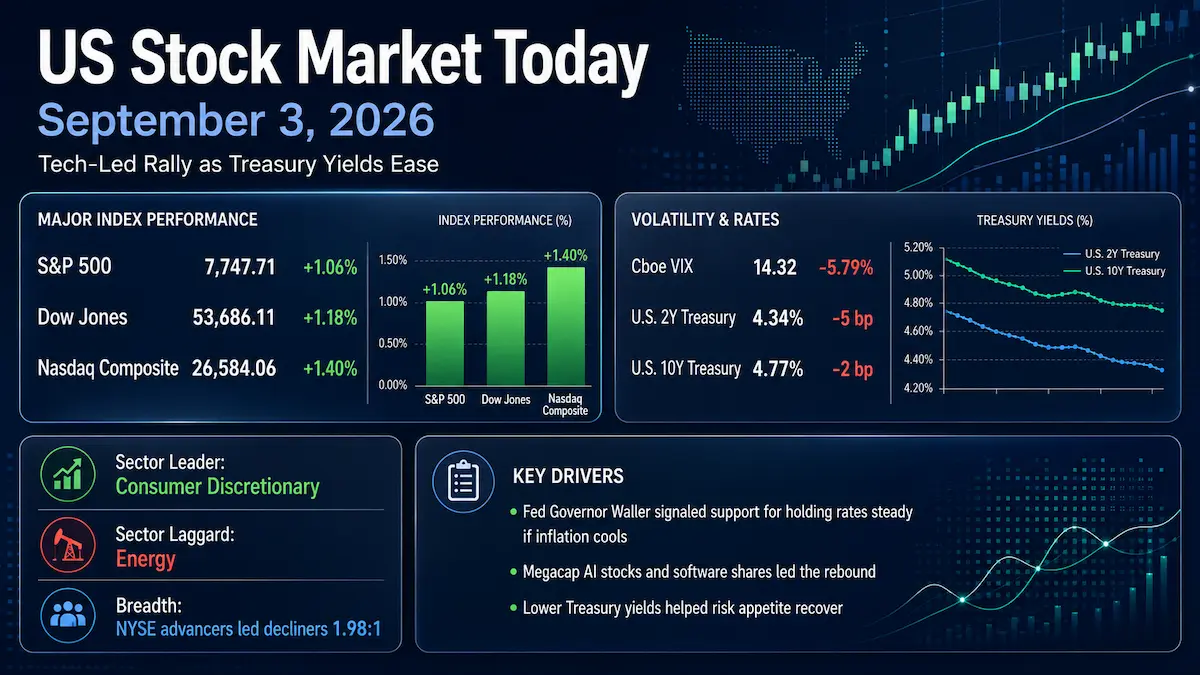
- The S&P 500 rose 1.06% to 7,747.71, the Nasdaq Composite gained 1.40% to 26,584.06, and the Dow advanced 1.18% to 53,686.11. The Russell 2000 added only 0.51% to 2,968.27, showing that the rally was broad but still tilted toward larger, growth-heavy stocks.
- Federal Reserve Governor Christopher Waller said he would be inclined to hold rates steady if incoming data confirms inflation is easing. Markets reduced the probability assigned to a September rate hike, while Treasury yields fell and equity duration risk was repriced higher.
- The macro mix was not uniformly dovish: initial jobless claims were a low 206,000, the August ISM Services PMI accelerated to 55.4, and the ISM Services Prices Index rose to 72.6, its highest reading since October 2022. The session therefore reflected relief from near-term tightening fears rather than confirmation that inflation risk has disappeared.
- Snowflake surged 16.55% after accelerating product-revenue growth and raising its official full-year outlook, while Broadcom fell 2.74% despite exceptional AI semiconductor growth. The divergence reinforced a key theme: investors are rewarding upward revisions and operating leverage, but the valuation hurdle remains unusually high across the AI complex.
1. Market Capital Flows and Sector Rotation
Thursday’s advance was broader than a simple megacap squeeze, but leadership remained concentrated in areas that benefit most when discount-rate pressure eases. Reuters/LSEG identified Consumer Discretionary as the strongest underlying S&P 500 sector and Energy as the weakest. Because the Reuters/LSEG closing report did not publish the raw sector-index percentage changes, the exact figures here use clearly labeled end-of-day Select Sector SPDR proxies rather than inventing index data: Consumer Discretionary rose 1.39%, Energy fell 0.74%, Technology gained 1.29%, Materials fell 0.62%, and Consumer Staples declined 0.32%. The pattern was consistent with a rotation toward growth, discretionary demand and rate-sensitive assets rather than a classic inflation/reflation trade.
Large caps clearly outperformed small caps: the Nasdaq gained 1.40% and the S&P 500 rose 1.06%, versus only 0.51% for the Russell 2000. That gap matters because small companies usually carry greater refinancing sensitivity and weaker balance-sheet resilience when policy rates and long yields are elevated. Defensive leadership was also limited. Consumer Staples declined, while rate-sensitive defensive groups such as Utilities and Real Estate benefited from lower yields. In other words, the tape combined growth leadership with selective cyclicality rather than producing a clean growth-versus-value binary.
Market breadth confirmed that participation extended beyond a handful of index heavyweights. Advancers outnumbered decliners by 1.98-to-1 on the NYSE and 1.67-to-1 on the Nasdaq. U.S. exchange volume reached 15.25 billion shares, slightly above the 20-session average of 15.09 billion. That combination makes the rally more credible than an index move driven solely by a few megacaps, although the Nasdaq’s outperformance and the Russell 2000’s lag still show where marginal risk appetite was strongest.
Institutional Flow Insight: The most plausible institutional interpretation is that falling front-end and long-end yields reduced the immediate penalty on long-duration earnings and allowed portfolios to rebuild exposure to high-quality growth after the recent global bond selloff. A lower VIX can also expand risk capacity for volatility-sensitive strategies, although public data cannot confirm that such systematic flows caused Thursday’s move. The first trading week of September may bring month-start cash deployment and benchmark rebalancing, but that should be treated as a possible amplifier rather than a verified catalyst. More important was the change in the rate narrative: investors were willing to pay for earnings visibility and positive revisions once the probability of an imminent Fed hike fell, while still penalizing businesses whose forward outlook did not clear an already demanding valuation bar.
2. Decoding the Biggest Market Movers
Snowflake (SNOW)
Snowflake closed at $356.47, up 16.55%. The move was supported by a genuine acceleration in the operating data rather than by a single headline. In its official Q2 FY2027 release, Snowflake reported revenue of $1.55 billion, up 35% year over year, and product revenue of $1.4919 billion, up 37%. GAAP diluted EPS was a loss of $0.55, while non-GAAP diluted EPS was $0.62. Non-GAAP product gross margin was 74.7%, and non-GAAP operating margin reached 15.3%.
The guidance revision was more important for the equity reaction. Snowflake raised full-year FY2027 product-revenue guidance to $6.07 billion, or 36% growth, from its prior $5.84 billion outlook, or 31% growth. It also raised full-year non-GAAP operating-margin guidance to 14.5% from 13.5%, while maintaining a 23.0% adjusted free-cash-flow margin target. For Q3, management guided product revenue to $1.588 billion-$1.593 billion, representing 37%-38% year-over-year growth, with a 15.5% non-GAAP operating margin.
The official earnings-call transcript adds an important margin-quality nuance. Management said Q2 marked a third consecutive quarter of product-revenue growth acceleration and attributed the improvement to both the core data platform and a meaningful step-up in AI revenue. CoCo surpassed 9,100 accounts and CoWork reached 5,800 accounts. At the same time, full-year non-GAAP product gross-margin guidance moved to 74.0% from the prior 75.0% outlook because faster-growing AI workloads currently carry lower contribution margins. Investors therefore rewarded the combination of faster consumption growth and stronger operating leverage even as AI mix created some gross-margin pressure.
The read-through extended beyond Snowflake. ServiceNow, Salesforce and Adobe also rose sharply, indicating that the market treated Snowflake’s results as evidence that enterprise AI spending can expand software consumption rather than merely shift budgets toward hardware. The investment implication is not that all software deserves a higher multiple; it is that companies able to convert AI adoption into observable usage, revenue acceleration and operating leverage can command a materially different valuation framework from vendors relying mainly on narrative.
Broadcom (AVGO)
Broadcom closed at $357.16, down 2.74%, despite reporting extraordinary absolute growth. Its official Q3 FY2026 release showed revenue of $29.591 billion, up 86% year over year, GAAP diluted EPS of $2.68 and non-GAAP diluted EPS of $3.32. Non-GAAP operating income was $20.095 billion, and free cash flow was $13.665 billion, equal to 46% of revenue. AI semiconductor revenue reached $16.7 billion, up 221% year over year and 54% sequentially. Broadcom’s IR site provides the official release, 8-K and earnings webcast but did not surface an official text transcript in the materials reviewed; accordingly, no transcript-only claims are used here.
For Q4, Broadcom guided total revenue to approximately $34.8 billion, up 93% year over year, and non-GAAP operating income to approximately 66% of projected revenue. Management also said it expects Q4 AI semiconductor revenue of $21.7 billion, up 236% year over year. Those are exceptionally strong figures, but the stock’s decline shows how much growth was already embedded in expectations. The market reaction is best read as a valuation and expectations-bar problem, not evidence that AI infrastructure demand collapsed.
The contrast with Snowflake is strategically important for the broader AI trade. Hardware remains the engine of AI capacity expansion, but the marginal equity reward is increasingly sensitive to whether a company’s next-quarter outlook provides fresh upside relative to a premium starting valuation. Software, by contrast, can attract incremental capital when AI adoption begins to translate into accelerating consumption and better operating leverage. That dispersion argues against treating “AI” as one homogeneous factor exposure.
3. Macro Indicators and Market Outlook
The Cboe VIX closed at 14.32, down 0.88 point or 5.79%. The decline was directionally consistent with the equity rally and indicated that demand for near-term index protection eased rather than diverged from the cash market. A VIX in the mid-teens does not eliminate event risk, however. With the August employment report due the next morning and CPI one week later, low implied volatility leaves less cushion if data forces a sharp repricing of the Fed path.
The U.S. Treasury’s official daily par yield curve marked the 2-year yield at 4.34% on September 3, down 5 basis points from 4.39% on September 2. The 10-year yield was 4.77%, down 2 basis points from 4.79%. The 2s10s spread therefore widened modestly to about 43 basis points from 40 basis points, a mild bull-steepening move because short yields fell more than long yields. That pattern is consistent with reduced concern about an immediate policy hike, while the still-elevated 10-year yield signals that investors continue to demand compensation for inflation, fiscal supply and geopolitical uncertainty. A one-day yield move should not be interpreted as a definitive signal of the Fed’s next action.
The day’s economic data explain why the bond rally was measured rather than euphoric. Initial jobless claims were 206,000 for the week ended August 29, up only 2,000 from the prior week’s revised level. The August ISM Services PMI rose to 55.4 from 54.1, while the Prices Index climbed to 72.6 from 70.3. That mix points to continued service-sector expansion alongside persistent input-price pressure. It strengthens the case for data dependence and makes the upcoming labor and inflation releases more important than extrapolating from a single Fed comment.
Cross-asset pricing also supported the rate-relief interpretation. The U.S. dollar index fell 0.69% to 98.91, while WTI crude settled at $91.30 and Brent at $95.52. Energy equities nevertheless lagged. That divergence suggests equity capital was rotating away from the recent inflation/geopolitical hedge and toward rate-sensitive growth exposures, although one session is not enough to establish a durable trend.
Upcoming Economic Data & Catalysts:
- Employment Situation for August 2026 (Release date: September 4, 2026): The Bureau of Labor Statistics will publish payroll employment, unemployment, labor-force and wage data at 8:30 a.m. ET. Investors should focus on whether labor-market cooling is orderly or deteriorating, because the distinction matters for both the policy path and earnings expectations.
- Consumer Price Index for August 2026 (Release date: September 11, 2026): The Bureau of Labor Statistics will publish CPI at 8:30 a.m. ET. Core inflation, services inflation and any energy pass-through will be central to the market’s assessment of real rates, long-duration equity multiples and the risk that the Fed remains restrictive for longer.
Market Insights:
The September 3 rally was broad enough to qualify as a genuine risk-on session, but its leadership remained large-cap and growth tilted. Positive NYSE and Nasdaq breadth, above-average exchange volume and gains across the three major indexes argue against calling it a purely megacap-driven move. At the same time, the Russell 2000’s 0.51% gain versus 1.40% for the Nasdaq shows that investors still preferred balance-sheet quality and earnings visibility over indiscriminate beta. The trend could reverse if the 10-year yield quickly retests recent highs, market breadth deteriorates, earnings revisions roll over, inflation data reopens the tightening debate, or the VIX breaks materially higher from its current low base.
Trading & Investment Strategy:
Risk management should take priority over chasing a one-day relief rally. Investors can stagger new positions rather than deploy capital at once, favor businesses with visible earnings or cash-flow revisions, and keep position sizes smaller ahead of binary macro releases. In growth and AI exposures, the Snowflake-Broadcom divergence argues for discriminating between companies with upward estimate momentum and those facing an extreme expectations bar. Stop-loss or thesis-invalidation levels should be defined before entry, and concentrated positions should be reduced if a renewed yield spike undermines the valuation case. For longer-horizon portfolios, a mix of high-quality growth, selective cyclicals and adequate liquidity offers better resilience than maximizing exposure to the day’s strongest momentum.
4. Key FAQs About the US Stock Market Today
Why did the US stock market move on 3 September 2026?
Stocks rallied because Fed Governor Christopher Waller signaled he could support holding rates steady if inflation continues to ease, reducing near-term rate-hike fears and pulling Treasury yields lower. The rally was reinforced by strong software earnings, especially Snowflake, while macro data showed resilient services activity and low jobless claims but still-elevated price pressure.
Which sectors performed best and worst in the US stock market on 3 September 2026?
Reuters/LSEG identified Consumer Discretionary as the strongest underlying S&P 500 sector and Energy as the weakest. The Consumer Discretionary Select Sector SPDR rose 1.39% and the Energy Select Sector SPDR fell 0.74% at the close. The rotation favored rate-sensitive growth and discretionary exposure, while Energy lost relative momentum despite crude oil remaining elevated.
What should investors watch after the US stock market close on 3 September 2026?
The immediate catalyst is the August Employment Situation on September 4, followed by August CPI on September 11. Investors should also watch whether the 2-year and 10-year Treasury yields continue to fall, whether the VIX remains contained near the mid-teens, and whether market breadth stays positive if megacap leadership cools. At the corporate level, follow-through in software after Snowflake’s guidance raise and continued valuation pressure in premium AI hardware names will help determine whether Thursday’s rotation has durability.
Selected Primary Sources
Disclaimer: This article is intended solely for the exchange of investment ideas and does not constitute investment advice of any kind.