


Key Takeaways
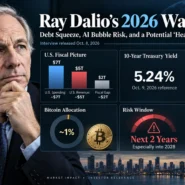
- Dalio sees a possible debt-driven credit squeeze within roughly two years, with the post-2026-midterm period through 2028 particularly vulnerable; this is his forecast, not a scheduled crisis.
- He argues that large federal deficits and AI infrastructure borrowing compete for a finite pool of savings, potentially maintaining upward pressure on long-term yields.
- By his own indicators, the market exhibits bubble characteristics: transformative AI technology can be real even when its most aggressively priced beneficiaries offer poor prospective returns.
- Dalio says he has been short debt, favors broad diversification, and considers a 5%–15% gold weight appropriate in a balanced portfolio; those are his views, not universal allocations.
- For investors, the immediate dashboard is Treasury yields, credit spreads, AI-related free cash flow, and upcoming bank and inflation releases—not a binary bet on an exact crash date.
1. Ray Dalio’s Core Views: What the October 2026 Interview Really Means
1.1 A Roughly $2 Trillion Fiscal Gap Is Colliding With an AI Capital-Spending Boom
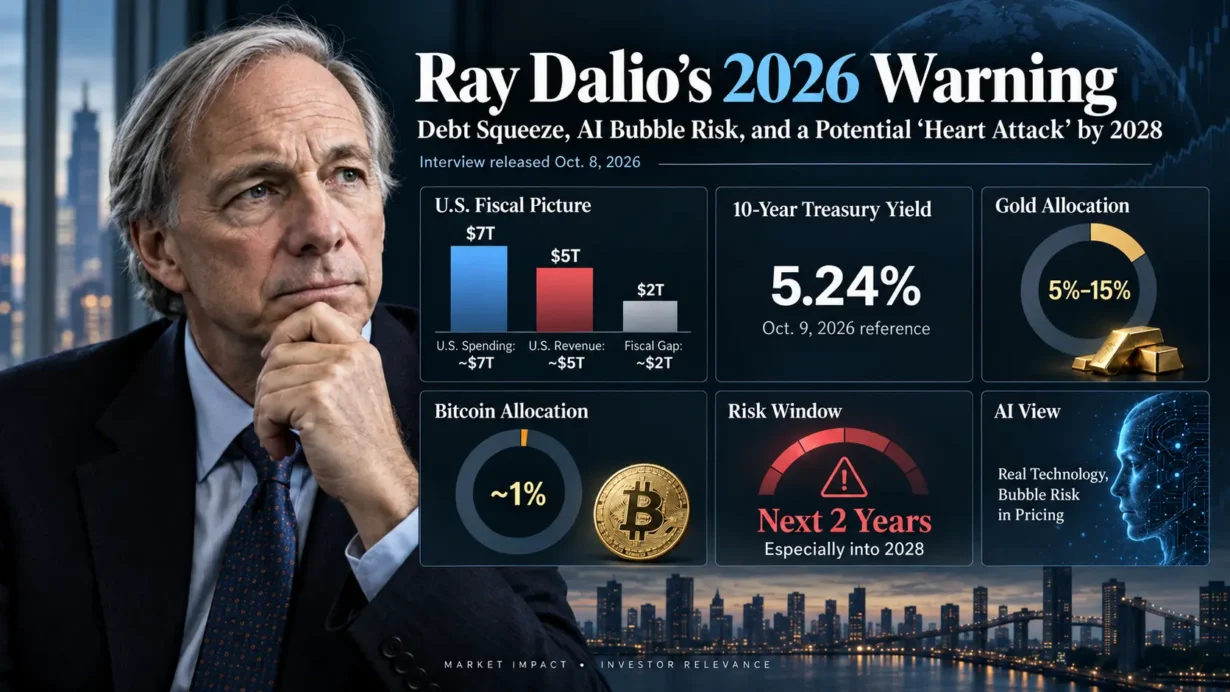
At approximately 9:38 in the interview, Dalio framed higher bond yields as a problem of supply versus demand. His illustrative federal figures were about $7 trillion in annual spending and $5 trillion in revenue—a roughly $2 trillion budget gap—alongside substantial debt refinancing. The distinction matters: the annual deficit is not the same thing as gross Treasury issuance, because maturing securities must also be rolled over. Meanwhile, hyperscalers and other AI infrastructure developers are seeking capital to fund power, data centers, networking, and advanced chips. When both sovereign and corporate borrowers compete for investors’ balance sheets, the clearing price of credit can rise. That means more expensive financing even without an immediate recession. Dalio also argued that foreign Treasury demand has weakened; that is his assessment of investor behavior, not a claim that every foreign holder is selling.
1.2 A Debt ‘Heart Attack’ Is a Credit-Rationing Scenario, Not a Guaranteed 2028 Crash
At approximately 13:09, Dalio described a sequence in which debt service consumes more cash flow, borrowing costs increase, and lenders become selective about whom they finance. He singled out mortgage borrowers and homeowners as groups that could feel the squeeze relatively early. Crucially, he said the vulnerable period might emerge within the next two years, especially after the 2026 U.S. midterm elections and into 2028; he did not identify a precise default date or promise a market collapse. The transmission channel is the investment story: higher yields can weaken housing affordability, restrict refinancing, compress corporate valuations, and eventually weigh on employment and spending. A less severe outcome is also possible if inflation subsides, fiscal financing becomes easier, or productivity gains strengthen cash flows faster than borrowing costs rise.
1.3 U.S. Stocks Are Losing Their Valuation Cushion Against Bonds
Dalio’s equity warning focuses on forward returns, not necessarily the next trading day’s direction. When share prices rise faster than underlying cash-flow expectations, prospective equity returns tend to fall; when Treasury yields rise at the same time, the incremental reward for holding stocks rather than bonds narrows. On October 9, 2026, the 10-year Treasury yield stood near 5.24%, according to Associated Press market reporting—a consequential hurdle for richly valued equities. A simple earnings-yield-minus-Treasury-yield comparison illustrates the pressure but is not a complete equity risk premium model: earnings are cyclical, growth differs by company, and risk premia are forward-looking. The practical implication is to demand a greater margin of safety from stocks whose valuations depend on distant, optimistic cash flows.
1.4 An AI Bubble Can Coexist With a Genuine Technological Revolution
At approximately 17:54, Dalio said his bubble indicators were signaling elevated risk. He compared the current enthusiasm with earlier periods when investors correctly recognized a technological revolution but overpaid for future winners. The mechanism is leverage meeting liquidity needs: a rising market capitalization creates paper wealth, but debt coupons, infrastructure construction, and operating costs must be met with cash. Selling assets to meet those obligations can deflate valuations before the technology’s long-run potential is exhausted. Importantly, Dalio distinguished expensive hyperscaler and headline AI bets from companies that could deploy AI to raise revenue or lower costs. That supports stock selection rather than the unsupported conclusion that all AI-linked businesses will fail.
1.5 His Portfolio Message: Less Debt Sensitivity, More Diversification, and Selective AI Adoption
At approximately 22:18, Dalio said he had been short debt, while emphasizing that most investors should start with diversification rather than speculative short positions. He described a 5%–15% gold allocation as a potential component of a balanced portfolio and said he personally holds only around 1% in Bitcoin. He also discussed inflation-indexed bonds, cash-generative AI adopters, and selected opportunities in capital-surplus economies such as Singapore and the United Arab Emirates. These exposures solve different problems: gold may diversify monetary and geopolitical risk, inflation-linked bonds address realized inflation, and productive businesses can generate operating cash flow. None is a perfect hedge. Gold can decline as real yields or the dollar rise; inflation-linked bonds remain sensitive to changes in real interest rates; and foreign-market investments introduce currency and regulatory risk.
2. Sector and Stock Implications: Where Capital May Flow
Potential Pressure: Debt-Funded AI Infrastructure, With Oracle (NYSE: ORCL) as a Case Study
Dalio did not issue an Oracle-specific trade recommendation in this interview. Oracle is an analytical example of the financing channel he described. Recent Reuters reporting has placed Oracle among firms pursuing major financing for AI-chip infrastructure, underscoring the capital intensity of the buildout. If bond yields and credit spreads rise together, the market may apply a steeper discount rate to future cloud profits while demanding clearer evidence that data-center utilization and contracted revenue can repay capital costs. Investors should distinguish booked or announced AI capacity from collected customer cash, and compare operating cash flow, capital expenditures, net borrowing, interest expense, and lease commitments across reporting periods. The counterargument is material: durable contract economics and higher utilization could validate the investment cycle even under elevated rates. Borrowing is a risk variable, not proof of impending failure.
Potential Beneficiary: Gold Diversification Through SPDR Gold Shares (NYSE Arca: GLD)
Dalio’s gold argument is primarily about portfolio resilience, rather than a short-term price target. A vehicle such as SPDR Gold Shares (GLD) offers exposure designed to track the price of gold bullion less trust expenses; it should not be confused with a gold-mining company, whose returns also depend on extraction costs and operational execution. If investors seek alternatives to long-duration nominal debt amid inflation, sovereign-credit concerns, or geopolitical stress, gold could attract incremental capital. Yet the trade is not one-way: higher real interest rates can increase the opportunity cost of holding a non-yielding asset, and a stronger dollar can create a headwind. GLD also carries ongoing expenses. A measured portfolio allocation and periodic rebalancing are more consistent with Dalio’s message than chasing an abrupt gold rally.
3. Practical Investor Strategy: Three Defenses Worth Testing
3.1 Stress-Test Interest-Rate Duration Before Adding More Yield
Start by measuring the sensitivity of bond funds, bond-like equities, and leveraged holdings to a further rise in yields. The iShares 20+ Year Treasury Bond ETF (TLT), for example, reported effective duration of approximately 14.7 years as of October 1, 2026. Under a simplified parallel-rate-shift assumption, a 1-percentage-point yield increase implies roughly a 14.7% decline in price before considering convexity, distributions, or portfolio changes; an equal-size yield decline works in the opposite direction. This is a risk illustration, not a forecast for TLT. Investors who need near-term liquidity may prefer to match bond maturities to expected cash requirements rather than rely on long-duration exposure as an automatic safe haven. Shorting Treasury securities, as Dalio described doing, introduces its own potentially substantial loss, financing, and timing risks.
3.2 Underwrite AI Exposure Using Free Cash Flow, Not Announced Spending
For every AI-linked equity, build two scenarios. In the base case, revenue recognition, customer retention, utilization, and margins eventually support the installed infrastructure; in the stress case, the revenue ramp slows while depreciation, energy costs, interest expense, and refinancing obligations continue. Monitor operating cash flow minus capital expenditure, net debt relative to sustainable earnings, and the timing of large customer contracts. As a practical review trigger—not a mechanical sell signal—reassess a position if capital spending keeps climbing for multiple quarters while free-cash-flow conversion and returns on invested capital fail to improve. For businesses that adopt rather than build AI infrastructure, demand demonstrated productivity or incremental sales rather than accepting vague efficiency promises.
3.3 Use Observable Catalysts and Write Down What Would Disprove the Bear Case
Use October 9’s roughly 5.24% 10-year Treasury yield as a dated reference point, not a permanent threshold. Watch whether yields climb alongside widening investment-grade and high-yield credit spreads, weaker loan demand, and softer corporate free cash flow. The next near-term checkpoints include JPMorgan Chase’s scheduled October 13, 2026 third-quarter earnings call—particularly commentary on credit quality, loan growth, and funding costs—and the U.S. September CPI release scheduled for October 14 at 8:30 a.m. Eastern Time. Equally important, write an invalidation case: easing inflation, stabilizing term premiums, strong debt auctions, resilient credit availability, and AI monetization catching up with capex would reduce the urgency of Dalio’s warning. Hedge sizing should reflect that uncertainty; an impressive macro thesis can still lose money if positioned too early.
4. Frequently Asked Questions (FAQ)
Is Ray Dalio predicting a U.S. stock market crash before 2028?
No definitive crash date was given. In the October 8, 2026 podcast, Dalio described a possible debt-induced credit squeeze in the next two years and highlighted vulnerability around the period after the 2026 midterms. A forecast of elevated credit and valuation risk is not the same as a guaranteed stock-market crash. Higher yields, wider credit spreads, and refinancing stress would strengthen his case; easing funding conditions would weaken it.
Which U.S. stocks could be hurt most if Ray Dalio’s AI bubble warning is correct?
Companies with large upfront AI infrastructure commitments, heavy external financing needs, and profits concentrated far into the future may be more sensitive to higher discount rates and tighter credit. Oracle (ORCL) is one company to analyze through that lens, although Dalio did not name it as a sell in the interview. Exposure must be judged company by company using cash flow, balance-sheet leverage, utilization, and contract quality—not an AI label alone.
Is buying GLD safer than buying TLT during a Ray Dalio-style debt crisis?
Neither asset is universally safer. GLD tracks bullion exposure, less expenses, and may diversify monetary or geopolitical stress but offers no coupon and can fall when real yields rise. TLT holds long-duration U.S. Treasury bonds, which can lose substantial value when yields rise but may benefit if a recession causes yields to fall. The relevant question is whether the main shock comes from inflation and debt supply, or from collapsing growth and a flight to Treasuries.
Source: The Julia La Roche Show, Episode 418 (released October 8, 2026), checked against the timestamped interview transcript, Reuters’ October 9 AI financing report, BlackRock’s TLT fund data, and the official Bureau of Labor Statistics calendar.
Disclaimer: This article is for informational purposes only and does not constitute investment advice. 免責聲明:本文僅供資訊分享,不構成投資建議。