

Key Takeaways
- Huang framed the AI agent as a personal assistant running on the computer, potentially shifting value from stand-alone apps toward persistent, task-completing workflows.
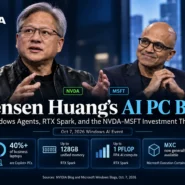
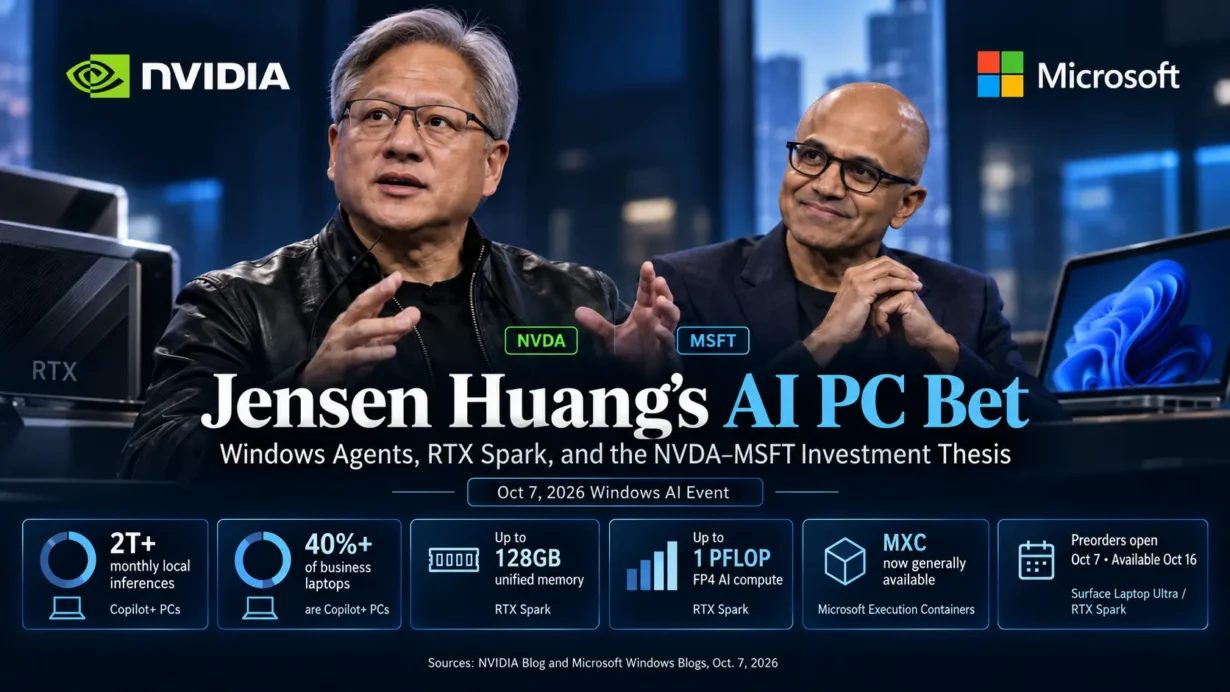
- Microsoft Execution Containers (MXC) became generally available on October 7. Huang identified secure agent execution as foundational to adoption, not a peripheral feature.
- RTX Spark-powered Windows PCs opened for preorder, with Surface Laptop Ultra shipments scheduled to begin October 16. NVIDIA is testing a new route to distribute its compute and CUDA ecosystem beyond the data center.
- Hybrid intelligence routes suitable work to local models while preserving cloud access for more demanding tasks. That can improve AI cost efficiency, but it also challenges simplistic forecasts that every additional agent means more cloud tokens.
- For investors, the decisive evidence will be commercial uptake, measurable unit economics and incremental gross profit—not model parameter counts or launch-day enthusiasm.
1. Reconstructing Jensen Huang’s Core Views
“It is now your personal assistant”: The PC Becomes an Agent Platform
Huang described an agent on a personal computer as a persistent assistant rather than another app to open and close. The underlying business shift is from selling access to software features toward owning the environment in which software performs work. If agents regularly draft, code, reconcile files and execute approved workflows, the operating system can become an orchestration and trust layer. That creates opportunities for higher-value devices and enterprise software, but it does not automatically prove that users will pay more; investors must distinguish impressive demonstrations from repeated, billable usage.
“MXC is going to revolutionize how agents are built and deployed”: Security as a Demand Unlock
Huang compared Microsoft’s Execution Containers with earlier Windows platform infrastructure because autonomous software needs enforceable limits on what it can read, change or transmit. Microsoft’s October 7 MXC technical release confirms that developers can define permitted files and network destinations and have those restrictions enforced outside the agent’s own control. The investment implication is a potential adoption bottleneck becoming more manageable: large companies are more likely to authorize persistent agents when identity, auditability and containment fit existing IT governance. Importantly, MXC supports multiple operating systems; Windows-specific integration is a possible competitive advantage, not evidence of an exclusive industry standard.
Hybrid Intelligence: Cloud Inference Becomes a Routing Decision
Microsoft’s companion briefing describes a system that sends appropriate tasks to local models and complex workloads to the cloud. This is an economic design choice, not a prediction that data centers will disappear. The local machine can absorb frequent, privacy-sensitive or latency-sensitive requests; the cloud still matters for frontier-scale models, centralized training and burst capacity. For enterprises, the relevant metric becomes cost per successfully completed, governed task—not gross token volume. For shareholders, lower token demand per workflow could pressure one revenue driver while enabling wider adoption, better product margins or increased subscription retention elsewhere in the stack.
RTX Spark and CUDA: Extending NVIDIA’s Platform to the Desk
The October event turned an earlier product announcement into an ordering and delivery timetable. NVIDIA said RTX Spark configurations support up to 128GB of unified memory and up to one petaflop of FP4 AI performance; these are specified peak capabilities, not independently verified throughput across ordinary business tasks. Surface Laptop Ultra preorders began October 7, with availability scheduled for October 16, while compact systems and higher-end DGX Station for Windows expand the range of possible deployment models. The strategic prize is software continuity: developers using NVIDIA tools at the desk may be more likely to use the same stack in larger systems. The counterargument is just as important: a premium hardware category with uncertain shipment volumes cannot yet be valued as a mass-market earnings engine.
2. Industry Chain and Sector Impact: Two Stocks That Matter
NVIDIA (NASDAQ: NVDA): A Potential Second Distribution Channel for AI Compute
The immediate beneficiary of broader adoption of RTX Spark devices would be NVIDIA’s hardware-and-software ecosystem. Windows OEMs can package NVIDIA compute into developer laptops, compact agent boxes and enterprise workstations, potentially extending the company’s addressable market beyond hyperscale data-center procurement. CUDA continuity creates a plausible distribution advantage: developers who prototype locally may face lower integration friction when scaling workloads. Yet the economics differ materially from rack-scale accelerators. Investors should monitor shipment volume, product mix, chip and system margins, and whether endpoint AI represents genuinely incremental compute spending rather than purchases displaced from cloud services. Premium component costs and competitive silicon are meaningful headwinds; OEM design wins alone do not establish pricing power.
Microsoft (NASDAQ: MSFT): A Windows Moat With an Azure Trade-Off
For Microsoft, a secure agent-ready Windows environment could increase the usefulness of Copilot, strengthen enterprise PC refresh demand and deepen the value of management and security integrations. Microsoft stated on October 7 that Copilot+ PCs run more than 2 trillion local inferences each month and that over 40% of laptops being built for business are Copilot+ PCs. These are company-reported adoption indicators, not proof of paid agent subscriptions, active autonomous workflows or incremental revenue. There is also a two-sided Azure effect: routing suitable inference to endpoints can reduce certain cloud-compute requests, while potentially improving customer economics and stimulating broader paid AI use. The metric to watch is consolidated profit from customers adopting hybrid AI—not cloud token usage in isolation.
Market structure matters. Reuters reported that the Surface Laptop Ultra starts at $2,599 and reaches $5,899 in a high-end configuration, reflecting a real affordability hurdle. It also described the push as an opportunity for NVIDIA to compete more directly in a PC market traditionally dominated by other chip vendors. This rollout should therefore be evaluated first as a professional and enterprise product cycle, not as an immediate replacement for the mainstream laptop market.
3. Practical Investor Strategy: Catalysts, Valuation Discipline and Risk Lines
Action Point 1: Follow the Deployment Calendar, Then Demand Proof of Monetization
Use October 16 device availability, later-2026 compact-device deployments and the planned experimental rollout of local-model routing in GitHub tooling as evidence checkpoints. Confirm actual shipment commentary, enterprise customer references, deployment frequency and management’s discussion of attach rates. Distinguish what is available today—such as MXC—from features Microsoft says will roll out over the coming months. A bull case becomes more credible when recurring usage creates measurable revenue or customer savings; an extended pilot phase with no disclosed commercial traction should keep earnings revisions conservative. Neither company supplied a new, quantified sales forecast for this opportunity at the October 7 fireside chat.
Action Point 2: Run a Break-Even Test Before Capitalizing the AI PC Story
A practical enterprise model compares avoided monthly cloud-inference spending and productivity benefits with the device’s incremental cost, power, maintenance, security administration and replacement cycle. For an illustrative $2,400 hardware premium amortized over 36 months, the added cost is roughly $67 per month before operating expenses. This is a sensitivity assumption—not a quoted NVIDIA or Microsoft device premium. If verified monthly savings fall below that hurdle, local inference needs a strong privacy, resilience or latency justification to earn its place. At the equity level, assess incremental gross-profit dollars rather than multiplying speculative device units by the highest retail selling price.
Action Point 3: Separate a Real Platform Shift From an Overpriced Entry
Consider staged exposure around earnings, product-sales disclosures and broader market pullbacks rather than treating a conference demonstration as an immediate buy signal. Establish an explicit thesis-invalidation condition—for example, delayed commercial deployment, poor endpoint economics or deteriorating segment margins—and size positions to the loss that would follow. As a purely illustrative risk budget, a position equal to 6% of a portfolio with a 12% adverse move creates approximately 0.72% portfolio downside before gaps or slippage; a stop order cannot guarantee that limit. The bull case is a durable expansion of the AI compute ecosystem; the bear case is strong technology adoption that fails to generate enough incremental profit to justify the stock’s valuation.
4. Frequently Asked Questions (FAQ)
What did Jensen Huang say about AI agents and Windows at the October 2026 Microsoft event?
At the October 7 fireside chat, Huang framed on-device agents as personal assistants and argued that Microsoft Execution Containers could change how agents are built and deployed. His point was about safe, persistent software execution and the platform that enables it—not a promise of a specified NVIDIA revenue increase.
Will NVIDIA RTX Spark AI PCs replace cloud data centers or reduce Azure revenue?
No such replacement was announced. Microsoft’s hybrid-intelligence architecture routes suitable tasks locally while preserving cloud inference for harder work. Some cloud token demand can migrate to devices, but more affordable inference could expand total usage. The net impact on Azure depends on workloads, pricing, customer adoption and the balance of recurring cloud and software revenue.
Is NVDA or MSFT the better AI agent stock after Jensen Huang’s October 7 remarks?
They represent different exposures. NVDA offers a more direct hardware-and-developer-platform thesis, with sensitivity to shipment mix and component economics. MSFT offers operating-system distribution, enterprise governance and software monetization, offset by a potential shift of some inference away from Azure. Neither case can be assessed without valuation, forecast revisions and evidence of paid adoption; the event alone does not establish a superior stock or a near-term price target.
Source and verification: NVIDIA’s official account of the Jensen Huang–Satya Nadella fireside chat (October 7, 2026); Microsoft’s product and deployment briefing (October 7, 2026); and Reuters’ event reporting and device pricing.
Disclaimer: This article is for informational purposes only and does not constitute investment advice.