



Key Takeaways
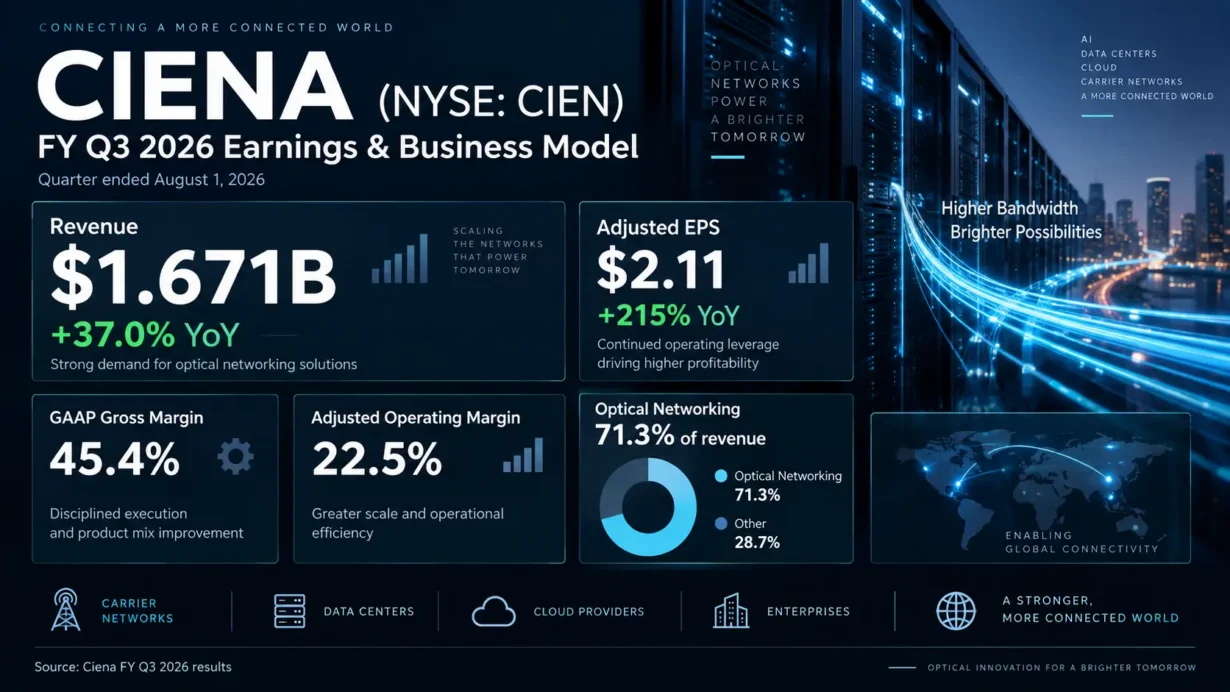
- Ciena remains a product-led networking company, not a SaaS business. In fiscal Q3 2026, Networking Platforms represented 81.1% of revenue, while Optical Networking alone represented 71.3%.
- The strongest economic moat is the combination of proprietary coherent-optics know-how and customer switching costs created by qualification cycles, installed photonic infrastructure, operational tooling and network reliability requirements.
- Ciena’s platform strategy is expanding from integrated optical systems into multiple consumption models: chassis-based transport, open photonic line systems, coherent pluggables, performance optics modules, routing, control software and newer data-center interconnect products.
- AI infrastructure is a meaningful growth vector, but it also increases customer concentration. Ciena disclosed that two individually significant cloud providers together accounted for roughly 42% of fiscal Q3 2026 revenue, while management classified cloud-provider revenue more broadly at 53% of the quarter.
- The main risks are technology-cycle execution, hyperscaler bargaining power, supply-chain commitments, backlog conversion, and the possibility that standardized pluggable optics reduce switching costs faster than Ciena can create differentiated value at the photonic and system layers.
1. Business Model Breakdown
At a high level, Ciena monetizes the rising cost of moving bits reliably over distance. Its customers include cloud providers, telecommunications carriers, cable operators, governments, research and education networks, and large enterprises. These customers buy Ciena technology when they need more capacity, lower power per bit, greater spectral efficiency, better network automation, or a cleaner way to scale optical and packet infrastructure without continually rebuilding the network from scratch.
The revenue model is still dominated by networking equipment. According to Ciena’s fiscal Q3 2026 Form 10-Q, the company generated $1.671 billion of quarterly revenue. Optical Networking contributed approximately $1.191 billion, or 71.3% of revenue, and Routing and Switching contributed $164 million, or 9.8%. Together, Networking Platforms represented 81.1% of the quarter. Platform Software and Services contributed 5.9%, Blue Planet contributed 1.4%, and Global Services contributed 11.6%.
Another useful lens is the consolidated product-versus-service split. Ciena reported approximately $1.390 billion of product revenue and $281 million of service revenue in the quarter. That means roughly five-sixths of revenue still came from products. Software, subscriptions, support and professional services improve revenue quality and customer stickiness, but they do not yet turn Ciena into a recurring-revenue software compounder. Any valuation framework that treats Ciena as a SaaS-like company would therefore misread the current economics.
The Core Monetization Engine: Optical Performance per Watt, per Fiber and per Rack
Ciena’s highest-value products are built around coherent optics. Coherent transmission uses sophisticated digital signal processing to encode, transmit and recover very high-capacity optical signals over fiber. Ciena’s proprietary WaveLogic technology is the central intellectual-property layer. The latest WaveLogic 6 family is offered in multiple form factors, including high-performance transponders and coherent pluggables. Ciena’s WaveLogic 6 Extreme supports up to 1.6 Tb/s on a single wavelength, while WaveLogic 6 Nano targets standardized pluggable use cases such as 800ZR and longer-reach 800G applications.
The business logic is straightforward: when a new modem generation carries more traffic over the same fiber, operators can defer additional fiber construction, reduce transceiver counts, lower power consumption and simplify network design. Ciena captures part of that customer economic benefit through equipment pricing, upgrade cycles and greater share of network capacity. The relevant competitive metric is therefore not the sticker price of a box. It is total cost per transported bit under real power, reach, space and reliability constraints.
A Platform Strategy Built Around Multiple Consumption Models
Ciena’s platform strategy is increasingly important because large cloud operators do not all want to buy networking technology in the same form. Some customers prefer an integrated optical transport system. Others want an open line system and choose their own transponders. Still others want standardized coherent pluggables for third-party routers, or performance optics modules that can be integrated into a hyperscaler’s own platform.
Ciena is trying to participate across those architectures without forcing customers into a single proprietary chassis. Its 6500 platform and Waveserver systems serve integrated transport use cases; its Reconfigurable Line System, or RLS, provides an open photonic foundation; WaveLogic pluggables extend the DSP franchise into third-party hosts; and newer module-level offerings let customers consume Ciena optics closer to their own system designs. This is strategically significant because network disaggregation can destroy the economics of a traditional equipment vendor if the vendor only monetizes the chassis. Ciena’s answer is to monetize the scarce optical intelligence across multiple form factors.
The RLS platform is particularly important to this architecture. A photonic line system can remain in place across multiple generations of coherent modems. If Ciena wins that layer, later modem upgrades can occur on top of an installed optical foundation that already has customer qualification, operational procedures and field support. That makes the line system both a revenue source and a strategic anchor.
Software and Services: Economically Useful, but Not the Primary Profit Identity
Ciena’s Navigator Network Control Suite provides network control, planning and automation, while Blue Planet addresses inventory, orchestration and multi-vendor operational workflows. These software layers matter because they increase the cost of operational change and help customers manage increasingly complex networks. However, Blue Planet is not currently the center of Ciena’s growth story. Fiscal Q3 2026 Blue Planet revenue declined year over year, while Platform Software and Services grew more modestly than Optical Networking.
Global Services includes implementation, maintenance, support, consulting and related services. In fiscal Q3 2026, services carried a 49.0% GAAP gross margin versus 44.7% for products. That is economically attractive, but services remain a minority of total revenue. The more important role of services is to deepen customer relationships, support complex deployments and reduce operational friction around Ciena’s installed base.
Why Outsourced Manufacturing Matters to the Model
Ciena relies extensively on contract manufacturers and external component suppliers rather than owning a vertically integrated manufacturing footprint. That structure keeps the strategic center of gravity in research, silicon, photonics, software architecture and customer engineering. It can improve capital efficiency, but it also creates a material supply-chain trade-off. As of August 1, 2026, Ciena disclosed approximately $3.3 billion of purchase-order commitments to contract manufacturers and component suppliers. In a demand upcycle, those commitments help secure capacity; if demand changes, they can create inventory and working-capital risk.
2. Deep Dive into Economic Moats
Under a Buffett-style moat framework, Ciena should not be awarded a competitive advantage merely because revenue is growing rapidly, because AI demand is strong, or because the company has a recognized brand in optical networking. Those conditions may improve earnings, but a moat requires an economic mechanism that makes customer defection or competitor catch-up persistently difficult. Ciena’s strongest defenses are intangible technological assets and switching costs. Network effects are weak, and cost advantage is secondary.
Intangible Assets: The Strongest Moat
Ciena’s most defensible intangible asset is not any single patent. It is the accumulated system-level know-how required to design coherent DSPs, high-speed optics, photonic line systems and the control software around them, then repeatedly move that stack to the next technology node while maintaining carrier-grade performance. The company’s fiscal 2025 Form 10-K disclosed roughly 2,400 issued patents and 800 pending patent applications as of December 2025, but the more important barrier is tacit engineering knowledge and the organizational capability to translate semiconductor advances into deployable network economics.
The cost of catching up is therefore measured in more than research dollars. A competitor needs advanced DSP architecture, photonics expertise, semiconductor design capability, systems integration, manufacturing qualification, field reliability data, software integration and credibility with customers whose networks carry mission-critical traffic. Ciena spent $848.3 million on research and development in fiscal 2025, equal to 17.8% of revenue, and R&D reached approximately $237 million in fiscal Q3 2026. That spending level does not prove a moat by itself, but it illustrates the continuous reinvestment required to maintain the technology franchise.
Recent product execution provides a more useful test. WaveLogic 6 Extreme moved coherent transmission to 1.6 Tb/s per wavelength, while Ciena and Telstra reported a production-network deployment carrying 1.6 Tb/s over approximately 1,100 kilometers between Melbourne and Sydney in September 2026. The significance is not the publicity value of a record. It is that next-generation coherent performance is being demonstrated under live-network constraints, which shortens the gap between laboratory capability and customer monetization.
This moat is durable only if it is renewed. Coherent optics is a technology race, not a static franchise. Nokia, Cisco and other competitors invest heavily, and data-center-oriented silicon vendors such as Broadcom, Marvell and Credo are increasingly relevant as Ciena moves closer to the data center. Ciena’s intangible-asset moat can support above-average economics, but only while the company continues to convert R&D into commercially relevant performance ahead of customer refresh cycles.
Switching Costs: Strong at the Network Layer, Lower in Standardized Pluggables
Ciena’s second major moat is switching cost. Optical transport infrastructure is not replaced casually. A carrier or hyperscaler must qualify optics, validate interoperability, retrain operations teams, update network-management workflows, redesign sparing strategies and accept the reliability risk of changing a critical transport layer. Once a photonic line system and operational toolchain are deployed at scale, the practical cost of replacing them can exceed the direct equipment price difference.
Those switching costs are strongest in the photonic infrastructure, integrated transport systems and operational software layers. They are weaker in standardized pluggable optics, where the entire purpose of industry standards is to improve interoperability and reduce proprietary lock-in. This creates an important strategic tension. Ciena benefits from open networking because open architectures expand the addressable market for WaveLogic pluggables and modules, but openness can also lower customer switching costs.
The company is responding by trying to own differentiated value above and below the standardized interface. Below it, RLS and photonic engineering can create a durable optical foundation. Above it, Navigator and services can become part of the customer’s operating model. At the module level, Ciena must keep performance, reach, power and density sufficiently differentiated that customers prefer its implementation even when the interface is standardized.
Network Effects: Not a Core Moat
Ciena does not have a classic network effect. One carrier buying a Ciena optical system does not directly make the product more valuable to another carrier in the way that an additional user can increase the value of a marketplace, payments network or social platform. A larger installed base can improve ecosystem familiarity, vendor credibility and interoperability experience, but those are scale and reputation benefits rather than a self-reinforcing network effect.
Blue Planet’s multi-vendor orchestration ambitions create some data and workflow advantages, but the business is currently too small to justify treating network effects as a central source of enterprise value. A disciplined moat analysis should therefore avoid using the term loosely.
Cost Advantages: Performance Economics, Not Lowest-Cost Manufacturing
Ciena can create customer cost advantages through fewer transceivers, higher spectral efficiency, better fiber utilization, lower power per bit and denser systems. Those savings can support pricing power because customers are buying improved total network economics. That is different from Ciena itself possessing a structural low-cost manufacturing advantage.
The company outsources manufacturing and competes against vendors with substantial scale and, in several cases, broader product portfolios and greater financial resources. Its economic edge is better described as performance economics: using intellectual property to reduce the customer’s cost per transported bit. That can be highly valuable, but it is contingent on technology leadership rather than on a permanently lower input-cost curve.
The resulting moat is real but renewable. Ciena’s best defense is the combination of proprietary coherent-optics capability and switching costs around installed photonic infrastructure and network operations. It is not a passive toll road. Long-term excess returns depend on repeating the innovation cycle, keeping products qualified at major customers and capturing enough of the customer’s performance benefit in price and mix.
3. Business Inflection Points & Future Catalysts
The Defining Strategic Inflection: The 2010 Nortel Metro Ethernet Networks Acquisition
Ciena was founded in 1992 and built its early identity around dense wavelength-division multiplexing. Its first commercial product, MultiWave 1600, entered the market in 1996 and helped establish Ciena as an optical-networking specialist. The most consequential strategic inflection, however, came in 2010 with the acquisition of Nortel’s Metro Ethernet Networks business.
The transaction, documented in Ciena’s 2010 SEC Form 8-K, materially expanded Ciena’s global installed base, customer relationships and optical technology portfolio, including advanced 40G and 100G coherent transport capabilities. More important than the transaction size was what it changed in Ciena’s corporate DNA. The company evolved from a specialist optical disruptor into a scaled transport platform with deep coherent-DSP capability, carrier relationships and a larger R&D engine.
That strategic inheritance is still visible. WaveLogic, the 6500 platform, Ciena’s Ottawa engineering depth and its large-service-provider footprint all sit downstream of the broader technical and customer base assembled in that era. Later moves, including the 2015 Cyan acquisition that brought Blue Planet and the 2025 Nubis acquisition that expanded Ciena’s data-center interconnect capability, are better understood as extensions of the platform created by the 2010 transformation.
Catalyst 1: WaveLogic 6 Monetization Across Systems, Pluggables and Customer-Owned Platforms
The first catalyst is not simply a new modem cycle. It is the ability to monetize the same coherent intellectual property through more customer consumption models. WaveLogic 6 Extreme supports high-performance 1.6T transport, while WaveLogic 6 Nano extends Ciena into standardized 800G-class pluggables. Ciena is also supplying performance-optics modules that can be incorporated into customer-designed platforms.
The transmission mechanism is broader wallet capture. If a hyperscaler wants a complete transport system, Ciena can sell systems. If it wants an open line system, Ciena can sell photonics. If it wants optics inside a router or proprietary host, Ciena can sell pluggables or modules. This architecture reduces the risk that network disaggregation automatically strips Ciena out of the bill of materials.
Observable indicators include Optical Networking growth, RLS and Waveserver demand, coherent-pluggable shipments, the mix of direct cloud-provider revenue, product gross margin, and disclosures about module-level wins. In the fiscal Q3 2026 earnings presentation, Ciena said RLS and Waveserver revenue each grew more than 55% year over year, pluggable revenue more than doubled, and WaveLogic 6 Nano 800ZR shipments more than doubled sequentially.
The principal risk is that standardized optics become commoditized. If competitors reach similar performance at acceptable power and reach, hyperscalers can use their purchasing scale to compress margins. The other risk is timing: a technology lead has economic value only if customers qualify and deploy the product before the next competitive generation narrows the gap.
Catalyst 2: RLS Hyper-Rail and the Scale-Across Bottleneck in AI Infrastructure
AI clusters are creating a new type of optical problem. Training and inference capacity is increasingly distributed across large campuses and multiple data-center buildings. As these systems scale, the number of high-capacity optical links and fiber pairs rises sharply. The bottleneck moves from individual transceivers toward how efficiently operators can aggregate, amplify, route and manage massive amounts of optical capacity across the campus.
Ciena’s answer is an extension of its RLS architecture called Hyper-Rail, designed for dense multi-rail optical connectivity in hyperscale AI environments. The strategic logic is attractive because the photonic line layer can be more durable than any single transceiver generation. If Ciena becomes part of the underlying scale-across architecture, future capacity upgrades can pull through additional optics and services on top of an installed photonic foundation.
Management said on its fiscal Q3 2026 earnings call that it expects initial Hyper-Rail standardization work by the end of calendar 2026 and meaningful revenue contribution during 2027. Because that timing is forward-looking, investors should treat it as an execution benchmark rather than an established result.
Useful indicators are the number of disclosed multi-rail design wins, RLS order growth, customer standardization milestones, backlog conversion and supply capacity for the relevant photonic components. Risks include changes in AI data-center architecture, slower hyperscaler capital spending, alternative approaches to campus interconnect, and the possibility that customers place orders earlier than deployment schedules require, causing backlog to overstate near-term consumption.
Catalyst 3: Nubis and the Move from Between Data Centers to Inside the Data Center
Ciena historically monetized connectivity between network nodes and data centers. The acquisition of Nubis Communications, completed in October 2025, is an attempt to move deeper inside the data center, where scale-up and scale-out fabrics connect accelerators, switches and racks at extremely high bandwidth density.
Ciena announced the transaction as a way to add compact, low-power optical and electrical interconnect technology to its portfolio. Nubis brings expertise in co-packaged and near-packaged optical architectures, active electrical cables and high-density optical engines. In February 2026, Ciena introduced the Vesta 200, a 6.4T class pluggable optical engine aimed at high-density AI connectivity. The strategic transmission mechanism is addressable-market expansion: Ciena can potentially sell optical technology not only for long-haul, metro and data-center interconnect, but also for connections within AI infrastructure.
Observable indicators include customer sample activity converting into production orders, qualification of Vesta and other Nubis-derived products, disclosures about revenue generated in and around the data center, and evidence that new products achieve acceptable gross margins. Management has said it expects initial CPX-related revenue in 2027 with a larger ramp in 2028, making this a medium-term option rather than a fully proven earnings engine today.
The execution risk is substantial. Inside-the-data-center connectivity is contested by semiconductor and connectivity specialists including Broadcom, Marvell and Credo, as well as multiple optical-component vendors. Product cycles can be shorter, hyperscalers may prefer multi-sourcing, and co-packaged optics adoption has repeatedly shifted in timing across the industry. Nubis expands Ciena’s opportunity set, but it also takes the company into a market with a different competitive structure from traditional optical transport.
Catalyst 4: Backlog Conversion and Operating Leverage
Ciena’s fiscal Q3 2026 results showed how powerful operating leverage can become when optical demand, product mix and supply availability align. Revenue increased 37% year over year to $1.671 billion, GAAP gross margin reached 45.4%, and adjusted operating margin reached 22.5%. Management disclosed approximately $8.5 billion of backlog at quarter end and said it expected to exit fiscal 2026 with backlog above $10 billion.
The mechanism is straightforward: if secured supply allows Ciena to convert backlog into shipments while operating expenses grow more slowly than revenue, gross profit and operating income can expand faster than sales. Ciena’s early fiscal 2027 outlook, issued on September 3, 2026, called for at least 30% revenue growth and a 25% to 27% adjusted operating margin. Those figures are management guidance, not guaranteed outcomes, but they establish a measurable operating benchmark.
The most important indicators are book-to-bill, backlog growth and conversion, inventory, cash flow, gross margin, operating margin and purchase commitments. The primary risk is backlog quality. Ciena’s filings note that customer arrangements generally do not guarantee minimum purchases and that purchase orders may be modified or cancelled in certain circumstances. At the same time, the company has made large supplier commitments to secure capacity. If demand shifts, that mismatch can pressure inventory and cash conversion.
The Risk That Matters Most: Concentrated Demand
AI-related growth improves Ciena’s opportunity but also changes its customer economics. Ciena’s fiscal Q3 2026 presentation classified cloud providers as 53% of quarterly revenue. Its Form 10-Q separately disclosed two significant cloud providers that together represented roughly 41.7% of quarterly revenue. This concentration can accelerate growth when hyperscaler capex is rising, but it also gives a small group of customers substantial negotiating leverage and increases exposure to program timing.
That concentration should be monitored alongside the company’s expanding backlog. A large backlog is valuable when it reflects diversified, non-cancellable demand and constrained supply. It is less valuable if it reflects a small number of customers reserving capacity far in advance. The key analytical question is therefore not just how large the backlog becomes, but how reliably it converts to revenue, margin and cash.
4. Key FAQs
How does Ciena make money from AI data center growth?
Ciena monetizes AI growth by selling the optical infrastructure required to move data among data centers, across large AI campuses and increasingly within data-center fabrics. Today, the largest revenue contribution comes from optical transport products such as RLS, Waveserver, coherent modems and pluggables. Over the next several years, Nubis-derived products could add scale-up and scale-out interconnect revenue inside the data center. The commercial opportunity grows when AI clusters require more bandwidth per site, more inter-building links and higher power efficiency, but Ciena still has to convert technical performance into qualified production deployments.
What is Ciena’s economic moat versus Nokia and Cisco?
Ciena’s moat is concentrated rather than broad. Its strongest defenses are proprietary coherent-optics engineering, a long record of qualification in mission-critical optical networks, installed photonic infrastructure and the operational switching costs around those deployments. Nokia and Cisco have broader portfolios and substantial resources, so Ciena does not possess an uncontested scale advantage. The investment question is whether focused optical R&D lets Ciena sustain superior performance per watt, per fiber and per rack long enough to preserve pricing and customer relevance. That is a technology-execution moat, not a permanent structural monopoly.
Is Ciena a hardware company or a software and services business?
Ciena is primarily a networking hardware and systems company with strategically important software and services attached. In fiscal Q3 2026, Networking Platforms generated 81.1% of total revenue, while Platform Software and Services plus Blue Planet together generated 7.3%, and Global Services generated 11.6%. Software and services improve customer retention, operational integration and margin quality, but the revenue and earnings cycle is still driven mainly by optical and routing product demand.
5. Conclusion
Ciena’s corporate DNA is best understood as an optics-first research platform built to monetize the physical constraints of moving data. Its competitive advantage is not simply that internet traffic grows. The more durable source of value is the company’s ability to repeatedly turn advanced DSP, photonics and systems engineering into better bandwidth economics for customers, then embed that technology inside infrastructure that is costly and risky to replace.
The platform strategy is becoming more flexible. Ciena is no longer dependent on selling only integrated optical boxes. It can monetize coherent intelligence through transport systems, open line systems, pluggables, modules, routing, software and services. That architectural optionality is strategically important as hyperscalers disaggregate networks and increasingly design their own systems. The acquisition of Nubis pushes the same logic further, from wide-area and data-center interconnect toward the high-density links inside AI infrastructure.
The trade-off is that Ciena’s moat must be continuously renewed. Standardization lowers some switching costs, hyperscalers are powerful buyers, competitors have deep engineering budgets, and supply commitments can amplify downside if demand expectations change. The next phase of the Ciena business model will therefore be judged less by headline AI exposure than by four operating outcomes: sustained WaveLogic 6 adoption, successful RLS Hyper-Rail commercialization, credible Nubis production ramps, and backlog conversion into margin and cash rather than merely future revenue promises.
Primary Sources and Official References
- Ciena Fiscal Third Quarter 2026 Financial Results
- Ciena Fiscal Q3 2026 Form 10-Q — U.S. Securities and Exchange Commission
- Ciena Fiscal Q3 2026 Earnings Presentation
- Ciena Fiscal Q3 2026 Financial Results Call Transcript
- Ciena Fiscal 2025 Form 10-K — U.S. Securities and Exchange Commission
- Ciena WaveLogic 6 Extreme Product Page
- Ciena WaveLogic 6 Nano Product Page
- Ciena Reconfigurable Line System Product Page
- Ciena Announcement of the Nubis Communications Acquisition
- Ciena Vesta 200 Announcement
- Ciena: The Founding of Ciena
- Ciena 2010 Form 8-K on the Nortel Metro Ethernet Networks Acquisition — U.S. Securities and Exchange Commission
Disclaimer: This article is intended solely for business logic discussion and corporate research purposes, and does not constitute investment advice of any kind.