


Key Takeaways
- NetApp sells a combination of storage systems, ONTAP-based software, long-lived support contracts and public-cloud services. Fiscal 2026 revenue reached $6.925 billion, of which $2.636 billion came from support alone.
- Customer switching costs are the primary moat: replacing embedded storage infrastructure can entail application testing, data migration, disaster-recovery redesign and operational retraining. ONTAP’s intellectual property and first-party hyperscaler integrations reinforce that advantage.
- Support generated a 92.5% fiscal 2026 segment gross margin, but the company is not a pure-play SaaS business. Hardware component inflation, product mix and cloud-partner economics remain material to consolidated profitability.
- All-flash refreshes, cloud migration and AI-focused infrastructure create potential growth pathways. Their credibility should be tested against normalized revenue growth, product margins, public-cloud consumption and paid AI deployments—not announcements alone.
- NetApp’s September 25, 2026 announcement concerning PEAK:AIO is an intention to acquire, not a completed transaction; any associated revenue or performance benefits remain prospective.
1. Business Model Breakdown
The NetApp business model monetizes enterprise data at three points in its lifecycle: initial infrastructure deployment, continuing management and protection, and migration or expansion into the public cloud. ONTAP—the software foundation that originated with NetApp’s first network-attached storage appliance in 1992—links those activities. The resulting commercial model is better understood as a software-centered infrastructure franchise than as either a commodity hardware manufacturer or a conventional subscription-software vendor. NetApp’s official company history documents the development of ONTAP and the company’s early storage architecture.
Four revenue streams with different economic characteristics
NetApp’s fiscal 2026 Form 10-K reports $6.925 billion in net revenue for the year ended April 24, 2026. The Hybrid Cloud segment generated $6.237 billion, comprising $3.194 billion of product revenue, $2.636 billion of support revenue and $407 million of professional and other services. The Public Cloud segment contributed another $688 million. These are accounting categories, not interchangeable measures of recurring revenue.
Product revenue is driven by sales of storage platforms and associated software, including all-flash systems. Its fiscal 2026 segment gross margin was 56.3%, leaving earnings exposed to component costs, product configuration and pricing discipline. Support contracts cover hardware and software maintenance, upgrades and related services. Their 92.5% segment gross margin illustrates why a large installed base can produce attractive incremental economics even when new-system demand fluctuates. Professional and other services include the consumption-oriented Keystone Storage-as-a-Service offering; Keystone therefore belongs to Hybrid Cloud reporting rather than being counted automatically as Public Cloud. Public Cloud, whose fiscal 2026 segment gross margin was 83.6%, consists primarily of cloud storage and related data and operational services delivered as a service. Segment margins exclude certain unallocated corporate costs and must not be confused with consolidated operating margins.
The operating flywheel starts with a production storage deployment. As the customer adds applications, snapshots, replication, recovery policies and trained administrators, the installed estate creates opportunities for renewals, capacity expansions and technology refreshes. NetApp then seeks to preserve that relationship when the same customer moves eligible workloads into AWS, Azure or Google Cloud. The commercial distinction is important: a new cloud deployment can protect an existing customer relationship, create incremental usage, or replace an on-premises purchase. Only the first two are unambiguously additive to revenue.
One data architecture, multiple routes to market
NetApp’s ONTAP platform documentation describes deployment across engineered storage systems, software-defined environments and cloud implementations. Its reach is extended by three major first-party managed offerings: Azure NetApp Files, Amazon FSx for NetApp ONTAP and Google Cloud NetApp Volumes. Their significance lies less in brand association than in reducing the application and operational changes required for certain migrations. NetApp can participate in cloud consumption even where it does not directly sell the underlying compute or own the customer billing interface. The company does not separately disclose a standardized revenue-sharing rate for each hyperscaler; assuming a uniform take rate would be unwarranted.
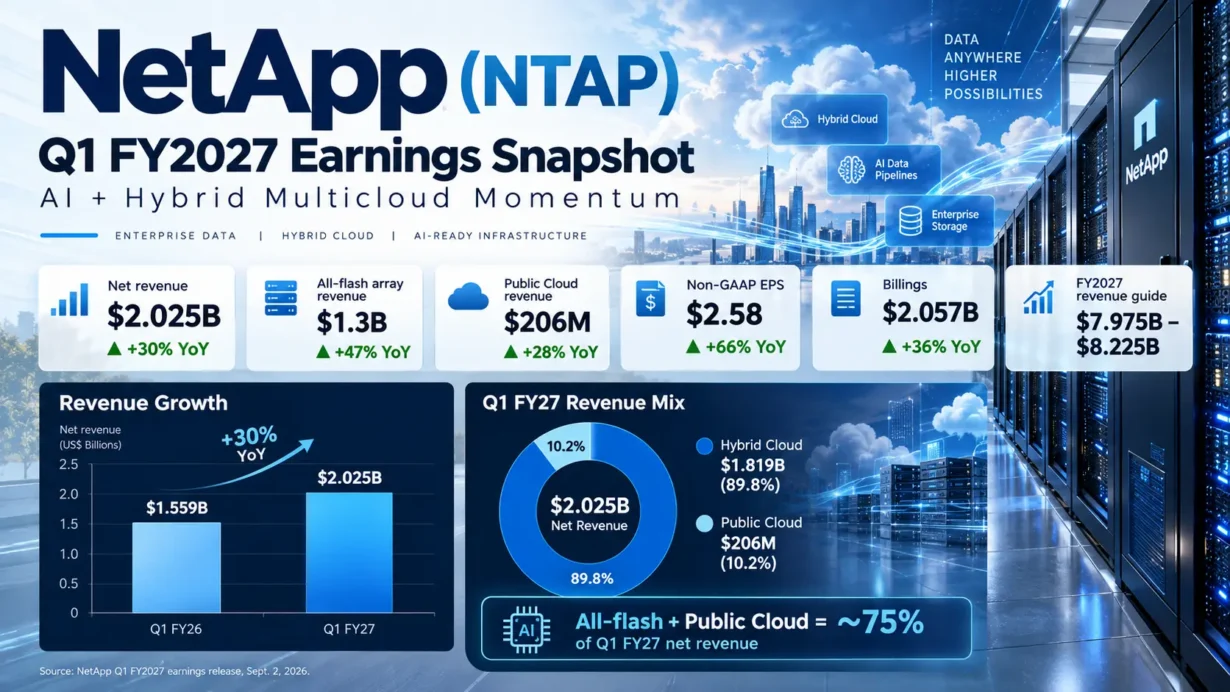
The most recent reported quarter supports the model’s growth potential but also illustrates the need for careful normalization. In the quarter ended July 31, 2026, revenue increased 30% to $2.025 billion, all-flash array revenue increased 47% to approximately $1.3 billion, and Public Cloud revenue increased 28% to $206 million, according to NetApp’s September 2, 2026 earnings release. However, fiscal 2027 has 53 weeks and its first quarter contained 14 weeks versus 13 a year earlier. The first-quarter Form 10-Q attributes approximately $65 million of incremental services revenue, including about $15 million in Public Cloud, to that extra week. It also states that all-flash growth benefited from price increases implemented in the prior fiscal year. Headline growth therefore should not be mistaken for an equivalent increase in underlying units or comparable-period consumption.
2. Deep Dive into Economic Moats
Under a Buffett-style economic-moat framework, NetApp’s relevant tests are switching costs, intangible assets, network effects and cost advantages. The defensible case rests principally on the first two. Neither sales scale nor a recognized corporate name independently establishes the ability to earn returns above the cost of capital.
Primary moat: switching costs embedded in mission-critical data
An enterprise does not replace a production storage environment as casually as it changes a procurement vendor. The expenditure is only part of the decision. Data movement consumes time and bandwidth; application compatibility and performance must be retested; backup, replication and recovery procedures must be revalidated; and administrators may need to learn a different operational stack. For databases, virtualized estates and other availability-sensitive workloads, migration risk can outweigh a lower competing equipment price. ONTAP features such as snapshots, cloning, multiprotocol access and SnapMirror replication can increase the operational scope of a platform decision.
The cloud strategy extends this switching-cost advantage rather than merely defending an aging appliance base. A customer with ONTAP-dependent workflows can use a familiar data-management model while pursuing an eligible migration to a first-party cloud service. That may make NetApp the path of least operational resistance at the point when the customer would otherwise reconsider its storage supplier. A competitor must do more than match throughput or price: it must demonstrate comparable migration execution, workload compatibility, resilience and support across the full deployment footprint. The moat is not absolute. Cloud-native redesign, open protocols, automated migration tools and credible alternatives from Dell, Everpure, hyperscalers and specialized AI-storage providers can reduce the economic penalty of switching.
Supporting moat: ONTAP intellectual property and cloud distribution rights
ONTAP’s accumulated data-management capabilities constitute the more economically relevant intangible asset than the NetApp name itself. Long-lived software development, production hardening, interoperability testing and enterprise support are difficult to reproduce quickly. Native placement inside all three major hyperscaler ecosystems strengthens distribution by meeting customers in cloud procurement and management workflows. Microsoft’s 2019 Azure NetApp Files launch, AWS’s 2021 FSx for ONTAP launch and Google’s 2023 NetApp Volumes launch establish that this distribution model exists across the major providers.
The qualification is that a first-party integration is not exclusivity. Hyperscalers control their marketplaces, service roadmaps and much of the customer experience; they also sell competing native storage products. Consequently, these relationships simultaneously widen NetApp’s addressable market and introduce partner bargaining power. Their long-term value depends on continuing technical differentiation, service economics and customer adoption—not on the mere existence of an integration.
Why network effects and structural cost advantages are weaker claims
NetApp does not exhibit a classic two-sided network effect in which each additional user inherently raises the value of the product for every other user. Its installed base supports product learning, service expertise and channel reach, but those are not equivalent to self-reinforcing network economics. Nor is a permanent cost advantage evident: storage hardware incorporates externally sourced components whose prices move with supply conditions. NetApp’s fiscal 2027 first-quarter filing says higher selling prices were offset by higher component costs, leaving Hybrid Cloud product gross margins relatively flat year over year.
The economic test is therefore whether embedded customers renew profitable support, adopt successive ONTAP-based platforms and expand into cloud services without requiring disproportionate customer-acquisition spending or price concessions. The fiscal 2026 support margin is evidence of attractive business-line economics, not, by itself, proof of sustained company-wide excess returns after research, sales, acquisitions and invested capital are considered.
3. Business Inflection Points & Future Catalysts
The strategic inflection: turning a storage operating system into a hybrid-cloud distribution layer
NetApp began in 1992 with a network file server and ONTAP, went public in 1995, and later broadened into unified storage, replication and all-flash systems, including the 2016 completion of its SolidFire acquisition. The more consequential strategic pivot for today’s business model was the decision to make ONTAP relevant inside hyperscaler-native services. Azure NetApp Files became generally available in May 2019, Amazon FSx for NetApp ONTAP in September 2021, and Google Cloud NetApp Volumes in August 2023. This was not a single acquisition or product launch but a multi-year shift in distribution economics: NetApp moved from supplying a customer’s data-center equipment toward also supplying technology embedded in the customer’s cloud operating environment.
That pivot changed the strategic question from how many storage arrays NetApp could ship to how much enterprise data could remain under an ONTAP-related management model as workloads moved between environments. It also created a new vulnerability: hyperscaler partnerships must be maintained with counterparties whose commercial incentives may not always align with NetApp’s.
Catalyst one: all-flash refreshes and pricing discipline through fiscal 2027–2028
The transmission mechanism is straightforward: replacing legacy or lower-performance storage with flash-based systems can lift product revenue and expand the future base of support contracts. NetApp reported approximately $1.3 billion in first-quarter fiscal 2027 all-flash array revenue, up 47% year over year. Its September 2026 outlook placed full-year fiscal 2027 revenue at $7.975 billion to $8.225 billion, with a projected GAAP operating margin of 24.3% to 25.3%; these are management estimates rather than realized results. Relevant indicators include quarterly all-flash revenue, the split between product and support growth, product gross margin, and evidence of sustained order activity after recent price increases.
The execution risk is that higher reported sales can reflect pricing or accelerated purchases ahead of additional price changes rather than durable volume expansion. Flash-media and other component inflation can absorb price gains, while customers may defer refreshes or favor alternative architectures. The first-quarter filing’s disclosure that increased selling prices were offset by higher component costs makes gross-margin conversion a more informative test than revenue growth alone.
Catalyst two: converting migration tooling into sustained public-cloud consumption
On September 3, 2026, AWS announced general availability of AWS Transform support for FSx for ONTAP as a migration destination. NetApp’s August 2026 JetStream acquisition similarly adds VMware disaster-recovery and migration capabilities. These tools may reduce the operational friction that has historically delayed cloud moves. The commercial sequence to monitor is migration starts, production cutovers, continuing storage consumption and ultimately Public Cloud revenue—not the number of integrations announced.
Public Cloud generated $206 million in the first quarter of fiscal 2027, up 28% on the reported comparison, but approximately $15 million of that quarter’s revenue was attributable to an extra reporting week. Excluding that timing contribution yields an illustrative comparable-period growth rate of roughly 19%, not a company-reported adjusted metric. Risks include workload repatriation, cloud-budget optimization, competing hyperscaler storage services, unfavorable partner terms and migrations that transfer spend from NetApp’s on-premises products rather than creating incremental demand.
Catalyst three: monetizing AI data preparation and parallel storage
AI infrastructure is a possible extension of the installed-base thesis, not evidence of an already-established new moat. NetApp’s fiscal 2026 earnings materials describe the launch of its AI Data Engine. In July 2026 it acquired DataPelago to add data-processing capabilities closer to the storage layer. On September 25, 2026, it announced an intention to acquire PEAK:AIO, whose parallel-file and metadata technology is intended to address highly concurrent AI workloads. That transaction remains subject to closing conditions and regulatory approval, and prospective capabilities are not yet delivered results.
The potential economic transmission is higher-value storage deployments and greater software or services attachment when customers need to discover, govern and serve large datasets without costly duplication. The observable milestones are acquisition closing, product integration, independently documented production deployments, conversion of pilot projects into paid contracts and evidence that AI-related demand contributes to gross profit rather than merely displacing existing systems. Major risks include integration delays, performance shortfalls at GPU-cluster scale, aggressive specialized competitors and enterprise AI projects that fail to progress from experimentation to production.
Across all three catalysts, cash conversion deserves its own check. Despite stronger earnings, first-quarter fiscal 2027 free cash flow was $401 million versus $620 million a year earlier, while the company reported higher inventories and capital expenditure. The filing also records $56 million in restructuring charges for the quarter. A credible margin-expansion narrative should eventually appear in cash generation and normalized operating results, not solely in non-GAAP earnings or one unusually long quarter.
4. Key FAQs
Is NetApp a SaaS company or a traditional enterprise storage hardware vendor?
Neither description captures the complete revenue model. In fiscal 2026, NetApp recorded $3.194 billion of product revenue, $2.636 billion of support, $407 million of professional and other services, and $688 million of Public Cloud revenue. It sells substantial hardware, but its economics depend heavily on the software, service contracts and data-management relationships attached to that hardware. High support margins should not be applied mechanically to the entire business, nor should all support revenue be labeled SaaS.
How does NetApp make money when customers use Amazon FSx for NetApp ONTAP or Azure NetApp Files?
These are hyperscaler-native services based on NetApp technology that allow enterprises to consume familiar storage capabilities inside their chosen cloud. NetApp participates in the economics of its Public Cloud offerings, which include cloud storage and related data services, while hyperscalers provide the managed-service distribution and customer-facing environment. The precise commercial terms vary by arrangement and are not broken out as a public per-gigabyte royalty schedule. For financial analysis, segment revenue and margins are more reliable than an assumed revenue share.
What would show that AI spending is becoming a durable NetApp revenue driver?
Look for repeatable paid deployments rather than benchmark claims or conference demonstrations. A stronger evidence set would include AI-related system purchases followed by software or services attachment, continued production use of AI Data Engine, measurable adoption of integrated DataPelago capabilities, and—if the proposed transaction closes—commercialization of PEAK:AIO technology. Rising all-flash sales alone cannot isolate AI demand from routine storage modernization or price increases.
5. Conclusion
NetApp’s corporate DNA is the commercialization of operational continuity. It started by simplifying networked file storage, then built a durable enterprise data-management layer around ONTAP. Today, its most relevant economic asset is the friction customers encounter when replacing the infrastructure, software procedures and protection policies that keep critical applications running. High-margin support captures part of that installed-base value; product refreshes and cloud services offer additional ways to monetize it.
The hybrid-cloud strategy is the defining evolution of that franchise. Native services inside AWS, Azure and Google Cloud give ONTAP a route into environments that could otherwise bypass traditional storage suppliers. Yet this distribution advantage is shared with powerful partners, and neither native integration nor AI positioning guarantees pricing power. Cloud competition, rising component costs and the risk of substituting cloud revenue for on-premises sales limit any simplistic moat narrative.
Over the next one to two years, the relevant test is whether NetApp can translate flash upgrades, easier migrations and AI-related product development into repeatable revenue growth, stable product margins, profitable cloud consumption and stronger cash conversion. That combination—not product announcements or headline growth distorted by reporting-calendar effects—would provide the clearest evidence that ONTAP’s switching-cost advantage is translating into enduring enterprise economics.
Primary Sources and Official Documentation
- U.S. SEC — NetApp fiscal 2026 Form 10-K (year ended April 24, 2026).
- U.S. SEC — NetApp fiscal 2027 first-quarter Form 10-Q (quarter ended July 31, 2026).
- NetApp Investor Relations — First-quarter fiscal 2027 results (September 2, 2026).
- NetApp Investor Relations — Fiscal 2026 full-year results (May 28, 2026).
- NetApp — Company history and milestones.
- NetApp documentation — ONTAP storage platforms.
- Microsoft Azure — Azure NetApp Files general availability (May 28, 2019).
- Amazon Web Services — Amazon FSx for NetApp ONTAP launch (September 2, 2021).
- Google Cloud — Google Cloud NetApp Volumes launch (August 24, 2023).
- Amazon Web Services — AWS Transform adds FSx for ONTAP (September 3, 2026).
- NetApp Investor Relations — DataPelago acquisition (July 16, 2026).
- NetApp Investor Relations — JetStream Software acquisition (August 6, 2026).
- NetApp Investor Relations — Proposed PEAK:AIO acquisition (September 25, 2026).
Disclaimer: This article is intended solely for business logic discussion and corporate research purposes, and does not constitute investment advice of any kind.