



Key Takeaways
- Arista makes most of its money from switching and routing platforms, not SaaS. Software is economically critical because EOS, NetDL, and CloudVision increase hardware differentiation, operational consistency, and customer retention, but recurring services remain a minority of reported revenue.
- The strongest moat is the combination of software-based intangible assets and operational switching costs. A customer that standardizes automation, telemetry, troubleshooting, change control, and engineering workflows around EOS and CloudVision can replace the hardware, but replacing the operating model is more disruptive.
- Classic network effects are limited, while cost advantages are useful but not exclusive. Merchant silicon and outsourced manufacturing improve capital efficiency, yet competitors can access similar silicon and Arista remains dependent on Broadcom for a large portion of its switching chips.
- AI Ethernet is the largest near-term expansion vector. Arista is extending Etherlink from scale-out networking toward scale-up and rack-scale systems with 1.6 Tbps platforms, creating a path to sell more networking content per AI cluster if open Ethernet architectures gain share.
- The largest counterweights are customer concentration, supply commitments, and mix pressure. Two customers represented 26% and 16% of 2025 revenue, and Arista had $9.7 billion of non-cancellable purchase commitments at June 30, 2026, increasing downside sensitivity if AI deployment plans are delayed or resized.
1. Business Model Breakdown
The revenue engine: high-performance networking hardware with software embedded in the value proposition
The Arista Networks business model is economically anchored in product sales. The company states that product revenue primarily comes from switching and routing products and related network applications, while service revenue is primarily derived from post-contract support, or PCS, purchased alongside products and renewed over time. This means the headline revenue model is closer to premium infrastructure than to a pure recurring software company.
That classification, however, understates the role of software. EOS is not an accessory layered on top of commodity boxes; it is the common operating system across Arista’s product architecture. EOS runs on standard Linux and uses a centralized state database with publish-subscribe access to system state. NetDL aggregates streamed device, telemetry, packet, flow, alert, sensor, and selected third-party data. CloudVision sits above that data model as the management, automation, observability, and AI-operations layer. The economic function of this software stack is to make hardware easier to operate at scale and to make each additional Arista deployment more compatible with the customer’s existing automation and operational procedures.
In other words, Arista monetizes the network twice without necessarily reporting two equally large revenue lines. First, it sells the physical switching and routing capacity required to move traffic. Second, its software architecture increases the probability that customers standardize more domains on Arista, renew support, add management subscriptions, and purchase future generations of hardware without redesigning the operating model from scratch.
Product revenue remains dominant
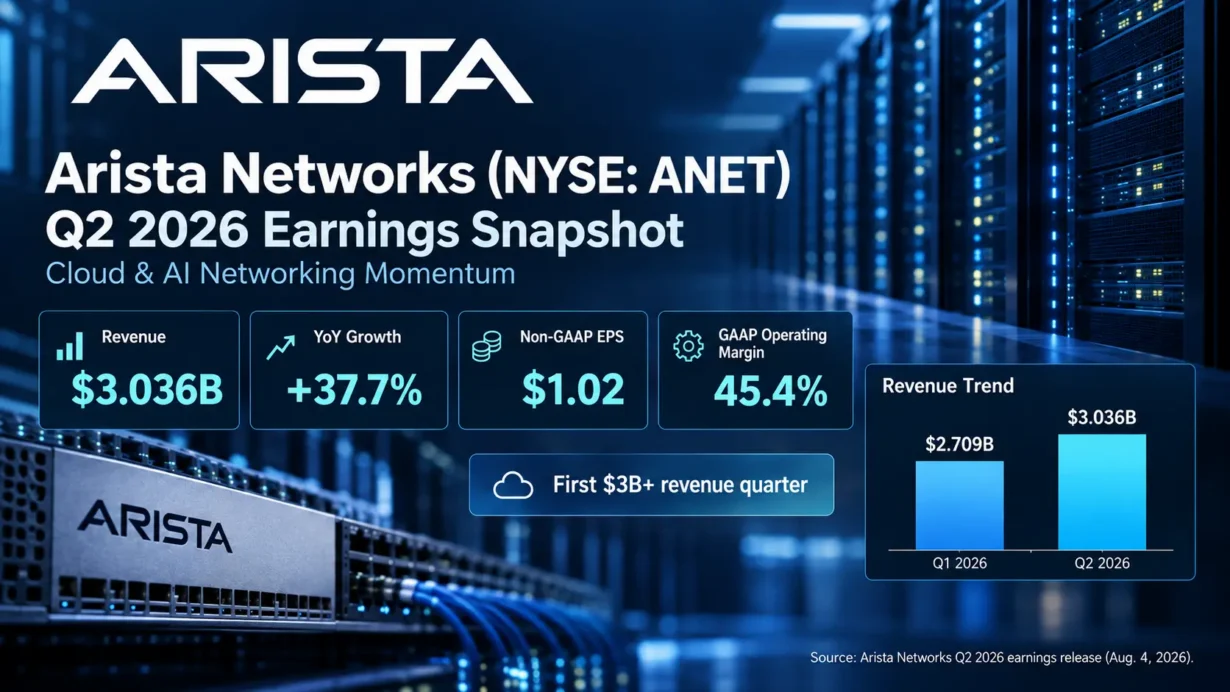
Fiscal 2025 product revenue was $7.577 billion, or about 84.1% of total revenue, while service revenue was $1.429 billion, or about 15.9%. In Q2 2026, product revenue was $2.605 billion and service revenue was $430.5 million, leaving the mix at approximately 85.8% product and 14.2% service. The practical implication is that investors and operators should not treat Arista as though its current economics are driven primarily by high-margin SaaS subscriptions. The recurring layer is strategically valuable, but the financial engine remains hardware-led.
The service line is nevertheless structurally attractive because it expands with the installed base. Arista reported that Q2 2026 service revenue grew 31.3% year over year as initial and renewal support contracts increased with the installed base. Support therefore acts as a recurring monetization tail attached to prior product shipments, improving lifetime customer economics even though it is not the majority of sales.
CloudVision adds subscription economics, but reported deferred revenue should not be mistaken for pure SaaS ARR
Arista offers CloudVision under term-based subscription licensing and CloudEOS under subscription or consumption models. This gives the company a path to expand software monetization without abandoning its hardware franchise. However, financial disclosures require careful interpretation. At June 30, 2026, deferred revenue was $6.866 billion and total remaining performance obligations were $8.4 billion, with approximately 91% expected to be recognized within two years. Those figures are substantial, but they are not equivalent to SaaS annual recurring revenue. Deferred revenue includes multi-year PCS contracts as well as product revenue deferred under customer acceptance clauses.
This distinction is commercially important. The growth in deferred revenue supports future revenue visibility, but it does not prove that the business has transformed into a software subscription model. The more precise conclusion is that Arista has built a growing base of contracted support and deferred product obligations around a hardware-led platform.
Capital allocation inside the operating model
Arista outsources most manufacturing to contract manufacturers and uses merchant silicon, allowing management to concentrate research and development resources on software, systems engineering, product architecture, signal integrity, thermals, optics, and quality. In 2025, R&D expense reached $1.237 billion, or 13.8% of revenue. This is the center of gravity of the model: externalize much of the semiconductor fabrication and assembly burden, then internalize the software and system-level engineering that determines reliability and operational value.
The model is capital efficient in fixed-asset terms, but it is not working-capital light. As AI demand accelerated, Arista increased non-cancellable purchase commitments to secure components and shorten lead times. At June 30, 2026, those commitments totaled $9.7 billion, with $9.4 billion expected within 12 months. That creates a powerful fulfillment advantage when forecasts are correct, but a meaningful inventory and margin risk if customer deployments are reduced or delayed.
2. Deep Dive into Economic Moats
Using a Buffett-style moat framework, Arista’s defensibility is strongest in intangible assets and switching costs. Network effects are weak in the classic sense, and cost advantages are supportive rather than decisive.
Intangible Assets: software architecture, engineering know-how, and operating credibility
The most defensible intangible asset is not the Arista brand by itself; it is the accumulated software architecture and engineering system behind EOS. EOS was designed around a modular, multi-process architecture with shared state, and Arista has carried that design across generations of merchant silicon and multiple networking domains. This gives the company an engineering flywheel: new silicon can be incorporated into a familiar operating system, new product families can inherit common telemetry and automation behaviors, and software improvements can propagate across a broader installed base.
The cost for a competitor to replicate this is not merely the expense of writing a network operating system. It would need to reproduce years of field-tested behavior, compatibility with large-scale automation, failure recovery, telemetry pipelines, operational tooling, customer-specific workflows, and the engineering discipline required to qualify new silicon without destabilizing production networks. Large incumbents have the resources to compete, but resource availability does not eliminate the time cost of rebuilding trust in mission-critical environments.
Arista’s customer engineering relationships are another intangible asset. The company explicitly describes deep engineering partnerships with customers as central to product development. This matters most in hyperscale and AI environments, where customers are not buying static feature lists; they are co-optimizing topology, optics, buffers, power, cooling, upgrade processes, load balancing, and telemetry. The resulting know-how is difficult to value on a balance sheet but can materially shorten product feedback loops.
Switching Costs: the operating model is stickier than the box
Arista deliberately supports open standards and merchant silicon, so its switching costs are not built primarily through proprietary lock-in. The stickiness comes from operations. Once an enterprise or cloud operator standardizes provisioning, telemetry, incident response, change management, testing, automation scripts, observability, and staff training around EOS and CloudVision, replacing Arista means more than swapping switches. It can require revalidating workflows, retraining personnel, rebuilding automation, changing troubleshooting processes, and accepting execution risk during migration.
CloudVision strengthens this effect because it extends a single operational model across data center, campus, routing, cloud, and increasingly WAN use cases. The more domains a customer manages through the same data and automation layer, the greater the organizational cost of fragmentation. This is an economically healthier form of switching cost than proprietary incompatibility because it is generated by operational efficiency rather than by making exit technically impossible.
That moat is not absolute. Large cloud customers have unusually strong engineering capabilities and can multi-source aggressively. They can also build internal software or use white-box systems. Arista’s 2025 concentration data demonstrates that bargaining power remains meaningful: two customers accounted for 42% of total revenue, and Q2 2026 gross margin fell partly because large end customers receive greater discounts. The switching-cost moat is therefore stronger in operational dependence than in pricing power against the largest buyers.
Network Effects: strategically useful, but not a classic moat
Arista does not possess a classic network effect comparable with a marketplace or payments network. One customer’s use of EOS does not directly make another customer’s network more valuable. The company does benefit from softer ecosystem effects: a larger installed base supports more integrations, more operator familiarity, more internal tooling, and more feedback for product development. NetDL and open APIs can also make third-party integrations more useful across deployments. These are real benefits, but they should not be overstated as a primary economic moat.
Cost Advantages: helpful architecture, limited exclusivity
Using merchant silicon and outsourced manufacturing can lower fixed capital requirements and lets Arista leverage the semiconductor R&D budgets and purchasing scale of suppliers and manufacturing partners. A common software stack also creates R&D leverage because software investments can be reused across multiple hardware families and networking domains.
But this advantage is not exclusive. Competitors can buy merchant silicon, outsource manufacturing, and pursue disaggregated architectures. Arista also identifies Broadcom as its predominant merchant silicon vendor for switching chips, which converts part of the cost advantage into supplier dependence. The cost structure is therefore an enabler of returns, not the deepest moat.
Can these moats support durable excess economics?
Potentially, but the mechanism is specific: Arista must continue converting software consistency into lower customer operating costs, faster qualification of new networking speeds, and broader share of each customer’s network. The moat weakens if hardware becomes sufficiently commoditized that customers accept greater operational complexity for lower unit prices, if vertically integrated AI systems capture the networking layer, or if competing platforms match Arista’s reliability and automation while bundling networking with compute, security, or broader enterprise infrastructure.
The key evidence is therefore not revenue growth alone. Durable moat evidence would include sustained support and software attach, continued gross-margin resilience despite customer concentration, successful reuse of EOS and CloudVision in campus and WAN, and the ability to preserve customer operating advantages as AI networking shifts from 800G to 1.6T and beyond.
3. Business Inflection Points & Future Catalysts
The critical strategic inflection: CloudVision turned EOS from a device operating system into a network-wide platform
Arista’s founding architecture was already differentiated: EOS launched in 2008, and the 7500 modular spine in 2010 demonstrated that the company could pair high-performance Ethernet with a common, programmable operating system. The more consequential strategic inflection came in 2015 with CloudVision.
CloudVision extended EOS concepts from an individual switch into a network-wide state, automation, and management layer. That move changed the strategic unit of competition. Instead of competing only on port density, latency, buffers, or price-performance, Arista could compete on how an entire network is operated. This created the architectural foundation for later expansion into campus, multi-cloud, observability, security, AI operations, and WAN.
The significance becomes clearer in hindsight. Arista’s 2025 10-K describes a single operating system, a single data lake, and a single management solution as the foundation of its client-to-cloud strategy. CloudVision was therefore not simply a management product launch; it was the point at which a strong switch franchise became a reusable platform strategy.
Catalyst 1: AI Ethernet expands from scale-out toward scale-up and rack-scale systems
The most important 12-to-24-month catalyst is the expansion of Ethernet’s role inside AI infrastructure. Arista already serves scale-out AI networks, where accelerators communicate across racks. Its next opportunity is to increase networking content within the rack and across distributed AI facilities as scale-up and scale-across architectures open to standards-based Ethernet.
In June 2026, Arista introduced the 7060XE7 family of 1.6 Tbps Etherlink platforms and explicitly described the launch as a transition from supplying high-performance switches toward comprehensive rack-scale systems. The portfolio targets scale-up and scale-out applications, including high-density and liquid-cooled environments. If open Ethernet wins more scale-up workloads that are currently served by proprietary interconnects, Arista’s addressable content per AI cluster could rise without requiring a proportional increase in customer count.
Transmission mechanism: more XPUs per cluster drive more east-west traffic; faster accelerator generations require higher link speeds and lower network-induced job delays; open Ethernet adoption gives customers a multi-vendor alternative to vertically integrated fabrics; Arista can monetize the transition through higher-speed platforms, optics-related architecture, EOS features, and observability.
Observable indicators: product revenue growth, management disclosures on AI networking deployments, conversion of 1.6T platforms from qualification into volume production, gross-margin behavior as large AI customers scale, and whether future product announcements show sustained participation in both scale-out and scale-up topologies.
Execution risks: Nvidia’s InfiniBand and NVLink ecosystems remain formidable; hyperscalers may build or disaggregate more of their own networking; supply constraints in memory, silicon, optics, or cooling infrastructure can delay deployments; and large AI customers can exert pricing pressure even while volumes rise. Arista’s own filings also warn that customers may overestimate AI demand and later cancel, delay, or reduce commitments.
Catalyst 2: Arista 2.0 broadens the platform from data center to campus, WAN, branch, and security
The second catalyst is enterprise wallet-share expansion. Arista’s historical strength in cloud and data-center networking created credibility in environments where reliability and automation matter most. The company is now attempting to export that operating model into the enterprise campus and WAN.
The VeloCloud acquisition, completed in June 2025 for $300 million, is strategically important because it fills a major architecture gap: WAN and branch connectivity. In July 2026, Arista added AI-driven Edge Threat Management to VeloCloud SD-WAN, combining SD-WAN and branch security functions in one edge platform. The commercial logic is cross-domain consolidation. A customer that already runs Arista in data centers and campuses can increasingly use the company for branch and WAN connectivity while preserving a more consistent management and security model.
Transmission mechanism: broader product coverage increases the number of budgets Arista can address inside one enterprise; CloudVision and related management tooling reduce the operating penalty of adding domains; a larger enterprise installed base supports more PCS renewals and software subscriptions; security and observability increase the strategic value of the management layer.
Observable indicators: sustained service revenue growth, evidence of enterprise deployments spanning multiple domains, increased CloudVision subscription adoption, VeloCloud product integration milestones, and management commentary showing that campus and WAN growth is becoming less dependent on isolated product wins.
Execution risks: Cisco and the combined HPE/Juniper portfolio have deep enterprise distribution and installed bases; bundling can matter more in enterprise procurement than best-of-breed performance; integrating acquired WAN software into Arista’s broader operating model takes time; and branch security adds competition from specialized security vendors as well as networking incumbents.
Catalyst 3: recurring software and support can improve revenue durability, but only if attach rates rise
Arista has a credible path to increase the recurring component of its model through CloudVision subscriptions, CloudEOS consumption models, AI operations, security software, and PCS renewals. The installed base already supports fast-growing service revenue, and deferred revenue plus remaining performance obligations provide a meaningful forward revenue base.
Transmission mechanism: every new hardware deployment increases the addressable base for support and management software; cross-domain deployments increase the value of centralized management; and subscription licensing can shift a greater share of customer lifetime value into repeatable software revenue.
Observable indicators: service revenue growth relative to product revenue, explicit software subscription disclosures, CloudVision licensing growth, renewal behavior, and the portion of future performance obligations attributable to support and software rather than product acceptance deferrals.
Execution risks: support growth may remain tightly coupled to hardware shipments rather than becoming an independent software engine; customers may resist incremental subscription fees; competitors may bundle management software; and investors can misread deferred revenue as SaaS-like backlog when a meaningful portion relates to product acceptance terms.
What can invalidate the catalyst stack?
The largest systemic risk is that Arista commits supply for an AI buildout cycle that later normalizes more sharply than expected. At June 30, 2026, the company had $9.7 billion of non-cancellable purchase commitments, while two customers had represented 42% of 2025 revenue. That combination amplifies forecast error: a small number of large customers can materially change deployment timing, while Arista may already have committed to components to protect lead times.
A second invalidation risk is architectural. If proprietary interconnects remain dominant in scale-up AI, Arista may continue growing strongly in scale-out networking but capture less incremental content than the rack-scale thesis implies. A third is competitive convergence: if Cisco, HPE/Juniper, Nvidia, or white-box ecosystems narrow the operational simplicity gap, the switching-cost moat becomes less valuable and price competition can intensify.
4. Key FAQs
How does Arista Networks make money from AI networking?
Arista makes money from AI networking primarily by selling high-speed Ethernet switching and routing platforms used to connect accelerators, storage, front-end networks, and distributed AI infrastructure. The company also monetizes support contracts and software such as CloudVision around those deployments. The growth opportunity comes from more networking bandwidth per accelerator generation, larger cluster sizes, and a potential shift toward Ethernet in AI scale-up as well as scale-out networks. The key limitation is that AI revenue is still hardware-intensive and concentrated among very large buyers, so unit growth can coexist with pricing pressure and lower gross margin.
Why is Arista EOS a competitive advantage over Cisco, Nvidia, and white-box networking?
EOS matters because Arista uses one software architecture across a broad hardware portfolio and combines it with real-time state, automation, telemetry, NetDL, and CloudVision. The advantage is not that competitors lack capable software; it is that Arista has spent years building a consistent operational model that customers can reuse across data center, AI, campus, and routing environments. Against white-box systems, EOS reduces the amount of software integration and lifecycle engineering customers must perform themselves. Against vertically integrated vendors, Arista offers a more open, merchant-silicon-based architecture. The trade-off is that Nvidia can bundle networking with GPUs and proprietary interconnects, while Cisco and HPE/Juniper can bundle networking with broader enterprise portfolios.
How exposed is Arista Networks to hyperscaler customer concentration and Broadcom supply risk?
The exposure is material. Two customers represented 26% and 16% of Arista’s 2025 revenue, meaning 42% of sales came from only two customers. Arista does not identify those two customers by name in its 2025 10-K, so assigning the concentration percentages to specific companies without additional verified disclosure would be inappropriate. On the supply side, Arista states that Broadcom is its predominant merchant silicon vendor for switching chips. This architecture helps Arista focus R&D on software and systems, but it creates dependency on Broadcom’s roadmap, availability, and commercial terms. The risk became more important as Arista raised non-cancellable purchase commitments to $9.7 billion by June 30, 2026 to support demand and navigate tighter memory and silicon supply.
5. Conclusion
Arista’s corporate gene is architectural reuse. The company takes merchant silicon, combines it with a common EOS software foundation, aggregates network state through NetDL, and increasingly manages multiple networking domains through CloudVision. That formula lets Arista enter adjacent markets without rebuilding the operating model for each one. The hardware changes from cloud spine to AI leaf to campus switch to WAN edge; the software and operational logic are designed to remain consistent.
The business therefore has a hybrid economic profile. Revenue is still dominated by hardware, but differentiation is increasingly created by software and the operational switching costs around that software. This is why Arista can show margins that look unusually strong for an infrastructure vendor while still facing hardware-specific risks such as customer concentration, supply commitments, merchant-silicon dependency, and product-cycle volatility.
The next test is whether the same platform logic can travel successfully into two much larger adjacencies: rack-scale AI networking and enterprise-wide client-to-cloud networking. If Arista can turn 1.6T Etherlink, scale-up Ethernet, campus, VeloCloud, CloudVision, and AI operations into one coherent operating architecture, its competitive position can deepen even without owning proprietary silicon. If those markets fragment, if vertically integrated systems dominate AI, or if large customers use their bargaining power to compress economics, the moat will prove narrower than the growth rate suggests.
Primary Sources
- U.S. SEC — Arista Networks 2025 Form 10-K
- U.S. SEC — Arista Networks Q2 2026 Form 10-Q
- Arista Networks Investor Relations — Q2 2026 Financial Results
- Arista Networks — Company Timeline and Quick Facts
- Arista Networks — 2010 Arista 7500 and EOS Architecture Announcement
- Arista Networks — 2015 CloudVision Launch
- Arista Networks — CloudVision Platform Overview
- Arista Networks — EOS, CloudVision, and CloudEOS Licensing
- Arista Networks — 2026 1.6 Tbps Etherlink AI Fabric Platforms
- Arista Networks — 2026 VeloCloud AI-Driven Zero Trust Branch
Disclaimer: This article is intended solely for business logic discussion and corporate research purposes, and does not constitute investment advice of any kind.