


Key Takeaways
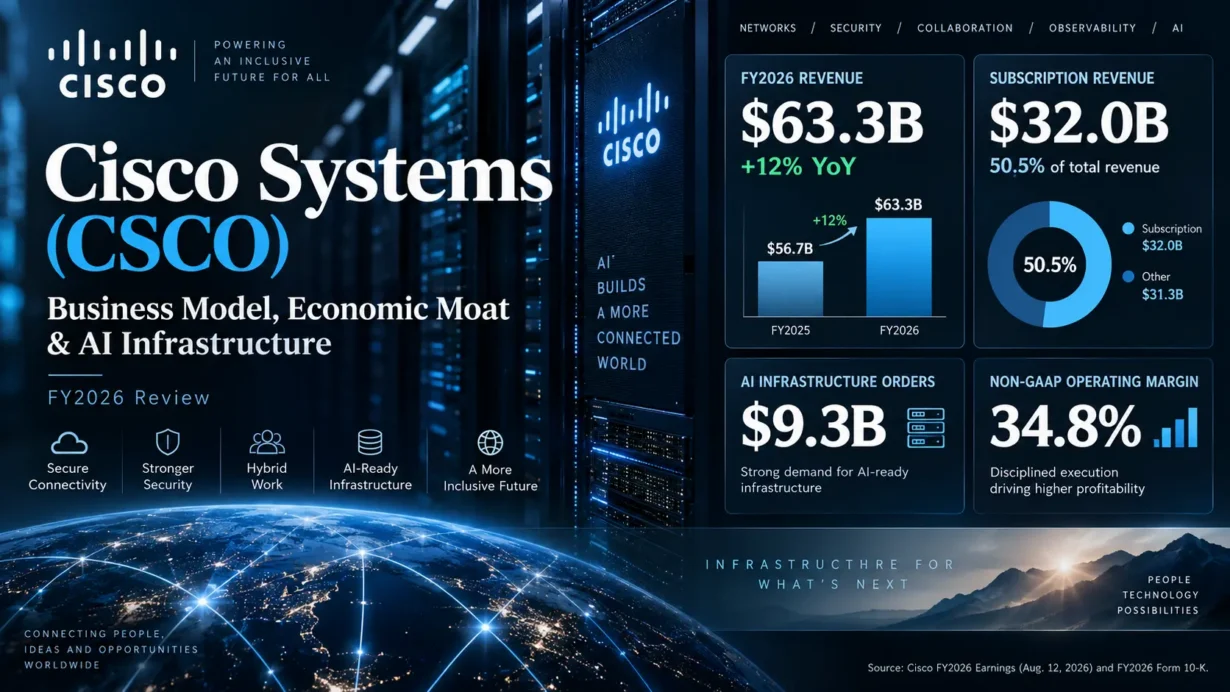
- Cisco’s economic engine is no longer a simple hardware replacement cycle. It monetizes mission-critical network infrastructure through an increasingly blended model of systems, software subscriptions, technical support, SaaS, security, observability, and lifecycle services.
- The company’s most defensible moat is switching cost: replacing a deeply embedded Cisco estate can require hardware migration, software reconfiguration, policy redesign, staff retraining, operational testing, and acceptance of downtime risk across business-critical networks.
- Cisco’s second major barrier is a proprietary technology stack spanning Silicon One, networking software, security, telemetry, and operational data. The strategic objective is to convert these assets into a unified control plane rather than compete as a collection of standalone products.
- AI infrastructure is now a material growth vector. Cisco reported $9.3 billion of FY2026 AI infrastructure orders from hyperscalers, approximately $4 billion of FY2026 AI infrastructure revenue, and said it expects about $7.5 billion of such revenue in FY2027.
- The core risk is that faster AI hardware growth does not automatically mean better economics. Product mix pressured FY2026 product gross margin, while best-of-breed competitors remain strong in AI networking, security, and observability. The platform thesis must therefore be proven through cross-sell, renewal, recurring revenue, and margin resilience.
1. Business Model Breakdown
The Core Revenue Engine: Infrastructure First, Recurring Economics Around It
Cisco makes money by selling the infrastructure required to connect, secure, observe, and operate digital environments, then layering recurring software and services around that installed base. In fiscal 2026, Cisco generated $63.3 billion of total revenue, up 12% year over year. Product revenue was $48.3 billion, or 76.3% of total revenue, while services contributed $15.0 billion, or 23.7%.
Within product revenue, networking remained the dominant economic engine. FY2026 networking product revenue reached $34.7 billion, up 22%, with Cisco attributing the increase primarily to AI infrastructure solutions based on Silicon One systems and optics. Security generated $8.2 billion of product revenue, collaboration $4.3 billion, and observability $1.1 billion. This mix makes one point clear: Cisco is still economically anchored in networking, but it is trying to increase the value captured around the network rather than depend only on periodic equipment replacement.
The company’s recurring layer is already substantial. Cisco reported $32.0 billion of FY2026 subscription revenue, equal to roughly 50.5% of total revenue. Importantly, this figure should not be mistaken for pure SaaS revenue. Cisco defines subscription revenue broadly to include term software licenses, security software licenses, SaaS, and associated service arrangements. The strategic significance is nevertheless real: a larger share of revenue is contractually recurring or recognized over time, which can reduce dependence on one-time hardware transactions and improve revenue visibility.
That visibility is reinforced by Cisco’s remaining performance obligations. RPO reached $46.7 billion at the end of FY2026, up 7% year over year, while deferred revenue reached $29.8 billion. Cisco expects roughly 49% of total RPO to be recognized over the following 12 months. These balances do not eliminate cyclicality, but they make the business less economically binary than a traditional equipment vendor whose revenue disappears when customers pause capital spending.
Where the Profit Pool Comes From
Cisco’s profitability depends on a mix of hardware economics, software attach, technical support, and operating leverage. FY2026 GAAP gross margin was 64.5%, with product gross margin at 63.2% and services gross margin at 68.8%. The higher services margin illustrates why support, maintenance, subscriptions, and lifecycle engagement matter commercially: they monetize installed infrastructure after the initial hardware sale and can increase customer lifetime value without requiring a full replacement transaction.
The company also spends heavily to maintain technological relevance. FY2026 research and development expense was $9.6 billion, or 15.1% of revenue, while sales and marketing expense was $11.6 billion, or 18.3% of revenue. Those costs are structurally important because Cisco competes across multiple layers simultaneously: silicon, systems, software, cloud management, security, observability, collaboration, and services. The company cannot sustain a platform model simply by bundling existing products; it must continuously fund engineering across the stack.
The Platform Strategy: Turn Installed Infrastructure Into a Control Plane
Cisco’s most important strategic shift is from selling products that interoperate to building a unified operating environment across them. Cisco Cloud Control, introduced in 2026, is intended to provide a single management plane spanning networking, security, compute, observability, and collaboration. Cisco says the platform is designed to let human operators and AI agents work from the same data layer and operational context while integrating with third-party systems such as AWS, Microsoft, Google Cloud, ServiceNow, Slack, and PagerDuty.
The commercial logic is straightforward. A standalone switch competes largely on performance, reliability, price, and support. A platform that combines networking, policy, security, observability, identity, automation, and AI-driven operations competes on workflow consolidation and operational dependency. If Cisco can make its products share telemetry, policy, context, and automation through one control plane, the value proposition shifts from “buy another Cisco device” to “standardize more of the operating model on Cisco.” That is a much stronger economic position because it expands share of wallet while raising the cost of fragmentation.
Splunk is central to this transition. Cisco completed the approximately $27 billion acquisition in March 2024, adding a large software, security, and observability asset to a company historically centered on network infrastructure. Strategically, Splunk gives Cisco a way to move higher in the stack: from transporting and securing traffic to interpreting machine data, detecting operational anomalies, analyzing incidents, and increasingly observing AI agents and models. The subsequent acquisitions of Galileo Technologies, Astrix Security, and WideField Security in 2026 show that Cisco is using Splunk as a platform for expanding into AI observability, non-human identity security, and agentic security operations.
2. Deep Dive into Economic Moats
Primary Moat: Switching Costs Embedded in Mission-Critical Infrastructure
Under a Buffett-style moat framework, Cisco’s strongest defense is switching cost rather than brand recognition. Enterprise networking is deeply operational. Large customers do not replace core switching, routing, wireless, security, and management systems as casually as they replace commodity endpoints. A migration can require network redesign, hardware deployment, software reconfiguration, access-policy changes, application testing, security validation, staff retraining, revised support processes, and carefully managed cutovers across systems where downtime can carry meaningful financial or operational consequences.
This becomes more powerful when multiple Cisco layers are deployed together. A customer using Cisco switches, wireless, routing, identity services, security tools, observability, support contracts, and cloud management is not locked in by one proprietary connector. It is locked in by accumulated operational knowledge, workflows, policies, certifications, troubleshooting procedures, and risk tolerance. Cisco’s training and certification ecosystem, including CCNA, CCNP, and CCIE tracks, reinforces this installed operational competence. The cost of changing vendors is therefore partly technical and partly organizational.
The moat is not absolute. Networking is standards-based, interoperability is necessary, and large enterprises increasingly run multi-vendor environments. Refresh cycles create natural windows for competitors to displace incumbent equipment. Cloud-managed networking and merchant-silicon architectures can also reduce dependence on vertically integrated vendors. Cisco’s switching-cost moat is therefore strongest when its products are integrated across operations and weakest when a customer evaluates an isolated device category at a clean replacement point.
Secondary Moat: Intangible Assets in Silicon, Software, Telemetry, and Operational Know-How
Cisco’s second durable advantage is a stack of intangible technological assets rather than a single patent portfolio. Silicon One is an important example. Cisco has built a unified, programmable networking silicon architecture designed to span hyperscale AI clusters, service provider networks, enterprise data centers, and campus environments. The advantage is not simply chip performance. A common architecture can reduce fragmentation across hardware roles, improve engineering reuse, support a unified software development model, and make it easier for Cisco to coordinate silicon, optics, systems, software, telemetry, and security.
This matters because competitors attempting to replicate Cisco’s full-stack position would need to match several capabilities at once: high-performance silicon, system design, networking software, operational tooling, security integration, field support, channel reach, and enterprise-grade lifecycle management. Cisco disclosed $9.6 billion of FY2026 R&D expense, illustrating the scale of sustained investment required to defend that stack.
Data is becoming another intangible asset. Cisco says its platforms connect roughly 39 million networking devices and one billion clients monthly, while observing more than 750 billion security events per day. Scale alone is not a moat; data only becomes defensible if it improves products in ways competitors cannot easily reproduce. Cisco is trying to do exactly that by using cross-domain telemetry and purpose-built models, including its Deep Network Model, to automate troubleshooting, security response, and infrastructure operations.
The strategic payoff would be significant if the data loop works. More deployed infrastructure produces more operational telemetry; more telemetry improves diagnostics, assurance, and automated response; better operations increase the value of standardizing on the platform; and broader platform adoption generates still more data. That is not a classic direct network effect, but it can create a data-and-workflow flywheel that reinforces switching costs.
Why Network Effects and Cost Advantage Are Not the Main Moats
Cisco does not have a classic consumer-style network effect in which each new user directly makes the product more valuable to every other user. A new enterprise buying a Catalyst switch does not materially improve another enterprise’s switch. Cisco does benefit from ecosystem scale, trained professionals, channel partners, developer integrations, and telemetry learning, but these are indirect reinforcement mechanisms rather than a pure network effect.
Cost advantage is also real but secondary. Cisco’s scale, supply-chain purchasing, reusable silicon architecture, and broad channel can improve unit economics. Yet the company competes against merchant-silicon systems, cloud-native architectures, lower-cost vendors, and hyperscalers capable of designing their own networking hardware and software. Cisco itself warns that some of its largest customers have the resources to build networking equipment, semiconductors, and software internally. That limits the durability of any pure manufacturing-cost moat.
The long-term excess-return case therefore rests mainly on whether switching costs and technological intangibles reinforce each other. If Cisco can make a customer’s network, security, observability, and AI operations work better as a unified system, the company can defend pricing and increase recurring monetization. If the portfolio remains a loose bundle of products, best-of-breed vendors can attack each category separately and erode the platform premium.
3. Business Inflection Points & Future Catalysts
The Strategic Inflection Point: From Router Vendor to Network Platform
The most important historical inflection point was Cisco’s move beyond routing into switching in the early 1990s. Cisco acquired Crescendo Communications in 1993 and entered the switching market; in 1994 it rolled out the Catalyst switch family, which Cisco’s own corporate history describes as its most profitable product line for the following two decades. This was more than product diversification. It established the strategic playbook that still defines Cisco: identify a critical transition in network architecture, acquire or build the missing technology, integrate it into a broader portfolio, and use the installed base to expand into adjacent control points.
The Splunk acquisition is the modern software-era expression of the same corporate gene. The object being controlled has changed. In the 1990s, Cisco expanded from moving packets between networks to controlling more of the physical and logical network fabric. In the 2020s, it is expanding from network control into the data, security, observability, and AI operations layers that determine how infrastructure is managed.
Catalyst 1: AI Infrastructure Revenue Conversion
The most immediate 12-to-24-month catalyst is the conversion of AI networking demand into recognized revenue. Cisco reported $9.3 billion of FY2026 AI infrastructure orders from hyperscalers, including $4.0 billion in Q4 alone. Management said it delivered approximately $4.0 billion of AI infrastructure revenue in FY2026 and expects approximately $7.5 billion in FY2027. At the same time, networking product orders grew 40% year over year in Q4 FY2026, marking an eighth consecutive quarter of double-digit growth.
The transmission mechanism is direct: hyperscalers, neoclouds, service providers, and enterprises are building larger AI clusters, which require high-bandwidth switching, routing, optics, and increasingly specialized congestion management. Cisco’s Silicon One G300 and related 8000 and N9000 systems target this bottleneck. If order conversion remains strong, AI infrastructure can lift product revenue and improve utilization of Cisco’s silicon, optics, and systems R&D base.
Observable indicators include AI infrastructure orders, AI infrastructure revenue, networking product growth, order growth excluding hyperscalers, backlog conversion, and product gross margin. The margin indicator is particularly important. In FY2026, Cisco’s product gross margin declined 0.5 percentage points to 63.2%, with product mix creating a 3.6-point headwind that was partly offset by productivity and other factors. Rapid AI hardware growth may therefore expand revenue faster than gross profit if the mix is structurally lower margin.
The major execution risks are customer concentration, pricing pressure, supply constraints, tariffs, and architecture substitution. Cisco explicitly notes that hyperscalers can design their own networking hardware, semiconductors, and software. It also competes with formidable vendors such as Arista, Broadcom, Nvidia, and others across the AI networking stack. The catalyst succeeds economically only if Cisco converts order momentum into durable revenue without sacrificing too much margin or becoming dependent on a small number of highly sophisticated buyers.
Catalyst 2: The Enterprise Networking Refresh Becomes a Platform Attach Cycle
A second catalyst is the large enterprise campus and data-center refresh cycle. Cisco has described a multi-year campus networking refresh underway, while its newer Smart Switches, Nexus One strategy, cloud management, and Cloud Control are designed to make upgrades more than a hardware replacement event. The opportunity is to attach recurring software, assurance, security, observability, and management to new infrastructure deployments.
The transmission mechanism is therefore two-stage. First, aging switching and wireless estates create a hardware refresh. Second, Cisco attempts to convert the refresh into a broader platform standardization decision. A customer that upgrades switches but also adopts unified management, embedded security, assurance, and subscription software generates higher lifetime value than a customer that simply buys a replacement chassis.
Observable indicators include product orders excluding hyperscalers, campus switching growth, subscription revenue, RPO growth, deferred revenue, and evidence that Cloud Control or unified networking subscriptions are being attached to new deployments. Cisco’s Q4 FY2026 product orders rose 35% year over year and were still up 25% excluding hyperscalers, suggesting that demand was not solely driven by a handful of AI customers.
The main risks are refresh deferrals, enterprise budget tightening, competitive cloud-managed architectures, and customer resistance to portfolio bundling. Cisco must also avoid creating integration complexity while claiming to remove it. A platform strategy is economically valuable only when customers experience lower operating burden, not merely when Cisco sells more SKUs under one commercial agreement.
Catalyst 3: Splunk Turns Network Telemetry Into Security and Observability Expansion
The third major catalyst is the monetization of Splunk as a cross-domain data and operations layer. Cisco’s latest acquisitions make the strategic direction increasingly explicit. Galileo adds AI observability and model-quality monitoring. Astrix adds non-human identity security. WideField adds identity, session, and activity telemetry intended to strengthen Splunk’s agentic security operations capabilities. Together, these assets target a new enterprise problem: AI agents act at machine speed across infrastructure, data, credentials, and applications, making traditional human-paced monitoring insufficient.
The latest evidence arrived on September 15, 2026. Cisco announced that Splunk AI capabilities can now run for self-managed and on-premises customers through Cisco AI POD for Splunk, built with NVIDIA accelerated computing. It also introduced Tokenomics capabilities in Splunk Agent Observability to track AI token spending and agent usage, expanded Agent Observability into Splunk Observability Cloud and Cisco Cloud Control, and formalized a multi-year Splunk-AWS agreement to co-develop security capabilities. Commercially, these moves matter because they broaden the addressable market beyond cloud-only AI workloads and connect AI governance, infrastructure, security, observability, and cost management inside the same operating stack.
The transmission mechanism is cross-sell and data unification. Cisco already sits inside the network, where it can observe traffic, identity, device, performance, and security signals. Splunk provides a platform for analyzing machine data and operational events. If Cisco can normalize and correlate those signals across networking, security, observability, and AI workloads, it can sell a higher-value control layer instead of isolated point products.
The key indicators are growth in security and observability, subscription revenue expansion, RPO growth, larger multi-product deals, renewal performance, and evidence that Splunk usage is expanding inside Cisco’s networking installed base. The current baseline leaves room for improvement: FY2026 security product revenue grew 2% and observability product revenue grew 4%, far below networking’s 22% growth. That means the strategic narrative is ahead of the financial proof.
The main risk is best-of-breed competition. Cisco competes against specialized security and observability vendors including CrowdStrike, Palo Alto Networks, Fortinet, Zscaler, Datadog, and Dynatrace, while large cloud platforms also control valuable telemetry and workflows. Splunk integration can create a powerful platform advantage, but only if Cisco improves product coherence and customer outcomes faster than specialist vendors innovate within their narrower domains.
4. Key FAQs
How does Cisco make money from hardware, software subscriptions, and services?
Cisco uses hardware as the infrastructure foundation and monetizes the installed base through software licenses, SaaS, technical support, security subscriptions, observability, and professional services. In FY2026, product revenue accounted for 76.3% of total revenue and services for 23.7%, while broadly defined subscription revenue reached approximately $32.0 billion, or about 50.5% of total revenue. The key business logic is that a network device can generate revenue more than once: at initial deployment, through attached software and support, through renewals, and through future platform expansion.
What is Cisco’s economic moat versus Arista, Nvidia, Palo Alto Networks, and other competitors?
Cisco’s main moat is not that it is larger than competitors. It is the cost and operational risk of replacing an integrated Cisco estate, reinforced by proprietary technology such as Silicon One, networking software, security, support, certifications, and cross-domain telemetry. Arista and Nvidia are formidable in high-performance and AI networking; Palo Alto Networks, CrowdStrike, Fortinet, and Zscaler are strong in security; Datadog and Dynatrace are strong in observability. Cisco’s differentiated proposition is breadth plus integration. Its moat strengthens when customers value a unified operating model and weakens when they prefer best-of-breed tools managed independently.
How could AI infrastructure and Splunk change the Cisco business model through FY2027?
AI infrastructure can raise Cisco’s hardware growth rate by increasing demand for high-speed switching, routing, optics, and data-center systems, while Splunk can increase recurring software and data-platform monetization around that infrastructure. Cisco expects approximately $7.5 billion of AI infrastructure revenue in FY2027, up from about $4.0 billion in FY2026, and has guided to FY2027 total revenue of $72.2 billion to $73.4 billion. The more important long-term question is whether Cisco can turn the AI buildout into durable software, security, observability, and operations revenue rather than capture only the first wave of hardware spending.
5. Conclusion
Cisco’s corporate gene is remarkably consistent: identify where infrastructure complexity creates a critical control point, establish a durable position in that layer, and then expand outward into adjacent functions. Multiprotocol routing solved connectivity fragmentation. Switching expanded control across the enterprise network. Security, cloud management, and collaboration broadened the portfolio. Splunk, Silicon One, Cloud Control, and AgenticOps are the current attempt to extend that same playbook into AI-era infrastructure and operations.
The strongest part of the Cisco business model is the interaction between installed infrastructure and recurring monetization. Hardware creates the footprint; software, services, support, security, observability, and management deepen the relationship. Switching costs protect the footprint, while proprietary silicon, software, telemetry, and operational know-how increase the value of staying inside the ecosystem. That combination is more durable than brand alone and more economically meaningful than raw market share.
The next phase will be judged by execution rather than narrative. AI infrastructure must convert order momentum into profitable revenue; enterprise refreshes must attach software and platform capabilities; and Splunk must accelerate security and observability economics. The most useful indicators are therefore AI infrastructure revenue, product gross margin, subscription revenue, RPO, security and observability growth, and evidence of cross-platform adoption. Those metrics will show whether Cisco is becoming a higher-value infrastructure platform or simply enjoying another strong networking cycle.
Official Sources
- U.S. Securities and Exchange Commission — Cisco Systems FY2026 Form 10-K
- Cisco Investor Relations — Q4 and Fiscal Year 2026 Earnings
- Cisco Newsroom — Cisco Cloud Control and AgenticOps Platform
- Cisco Newsroom — Silicon One G300 and AI Networking Systems
- Cisco — Silicon One Unified Networking Architecture
- Cisco — Corporate History Timeline
- Cisco Corporate Development — Acquisitions Strategy and History
- Cisco Blogs — WideField Security Acquisition Update
- Cisco — Enterprise Networking Certifications
- Cisco Investor Relations — September 15, 2026 Splunk AI and Agentic Security Advancements
- Cisco — Current Platform Scale and Portfolio Overview
Disclaimer: This article is intended solely for business logic discussion and corporate research purposes, and does not constitute investment advice of any kind.