


Key Takeaways
- Credo Technology Group Holding Ltd. (Nasdaq: CRDO) is fundamentally a product-led, fabless connectivity company built on proprietary SerDes and DSP intellectual property. Its current revenue engine is hardware, especially Active Electrical Cables, rather than a SaaS-style recurring subscription model.
- The most defensible elements of the Credo Technology business model are customer switching costs created by long qualification and design-win cycles, plus specialized mixed-signal SerDes/DSP know-how that can be reused across cables, retimers, optical DSPs, chiplets and system-level products.
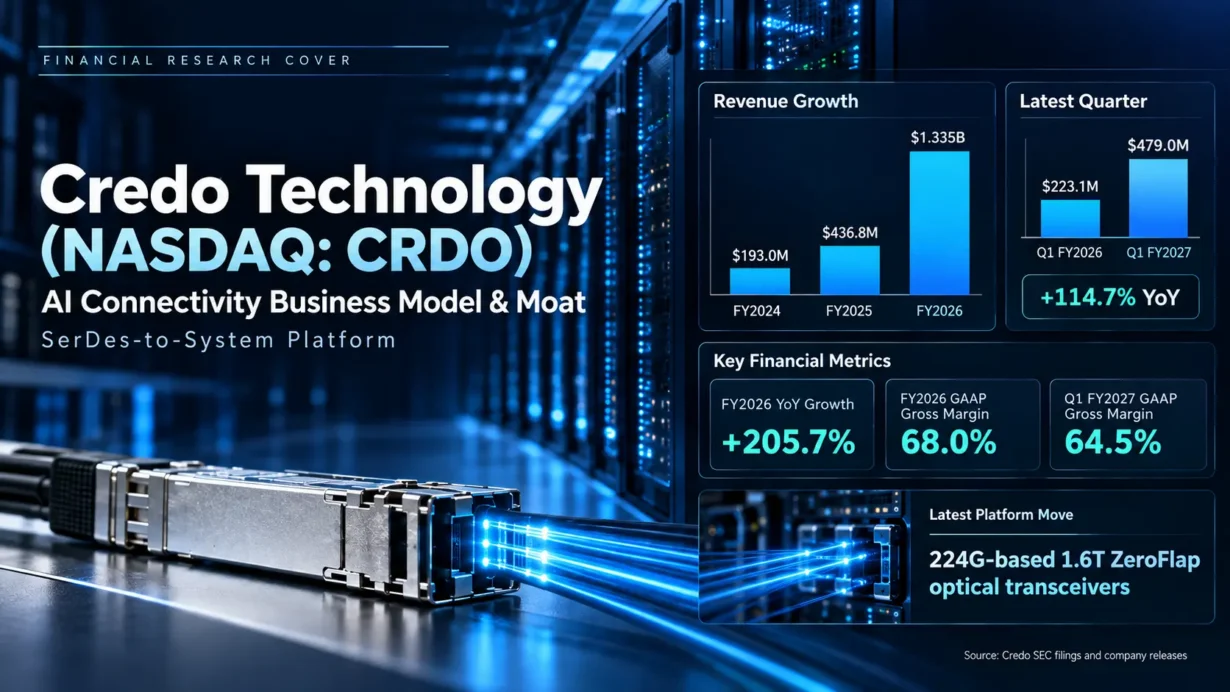
- The strategic breakthrough was the 2018 creation of the Active Electrical Cable category. That move changed Credo from primarily a component and IP supplier into a system-level connectivity vendor with direct exposure to hyperscaler architecture decisions. Fiscal 2026 validated that shift: revenue reached $1.335 billion, up 205.7%, with AEC volume responsible for more than 99% of the year-over-year revenue increase.
- Credo is now attempting a second transformation: from an AEC-led franchise into a vertically integrated copper-and-optics platform. The 2026 DustPhotonics acquisition, ZeroFlap optics, PILOT diagnostics, 1.6T products and OmniConnect broaden the amount of connectivity content Credo can address per AI cluster.
- The principal counterweight to the moat is concentration. In the first quarter of fiscal 2027, the two largest contracting customers represented 43% and 28% of revenue, while Credo’s end-customer disclosure showed four customers individually accounting for 33%, 28%, 13% and 10%. The business can compound rapidly when a hyperscaler architecture ramps, but it can also be exposed to abrupt design, sourcing and capital-spending changes.
1. Business Model Breakdown
The cleanest way to understand Credo is not as a cable company, an optical semiconductor company or an IP licensor in isolation. It is a connectivity architecture company whose core economic asset is high-speed SerDes and DSP design expertise, monetized through increasingly integrated products. Credo describes itself as a product-focused business with a strong foundation in IP, and its operating model is fabless: it designs the technology and system architecture while outsourcing wafer fabrication, assembly and testing to third parties. That keeps fixed manufacturing capital relatively light and pushes internal resources toward R&D, customer engineering and product qualification.
Credo’s revenue comes from several layers of the same technology stack. Product families include ZeroFlap Active Electrical Cables, optical transceivers, optical and copper DSPs, Ethernet and PCIe retimers, SerDes chiplets and newer OmniConnect memory-connectivity products. The company also licenses SerDes IP and sells software-enabled connectivity solutions through the PILOT diagnostic and analytics platform. Importantly, however, Credo does not currently disclose a material standalone SaaS subscription stream, and investors should not model PILOT as a conventional high-margin recurring software business without additional disclosure. The financial engine remains overwhelmingly tied to product shipments and design ramps.
The evidence is unusually direct. In fiscal 2026, Credo generated $1.335 billion of revenue versus $436.8 million in fiscal 2025, a 205.7% increase. Management stated in the fiscal 2026 Form 10-K that the ramp of AEC solutions at hyperscale data-center customers contributed more than 99% of the increase. In the first quarter of fiscal 2027, revenue reached $479.0 million, up 114.7% year over year, and AEC shipment growth contributed more than 90% of the increase. The business therefore has multiple products, but the current earnings machine is still highly concentrated around AEC adoption.
The underlying monetization logic is attractive when a design reaches volume. Credo typically engages both the end user and the end user’s suppliers. By working directly with hyperscalers, NeoClouds and other infrastructure operators, Credo can help define the connectivity requirement at the architectural level. Once an end customer specifies a Credo solution, OEMs, ODMs, cable assemblers or optical-module partners may then be required to incorporate that solution. This two-pronged go-to-market model gives Credo a path to influence the system specification upstream while still shipping through a broader hardware supply chain downstream.
This matters because data-center connectivity is not purchased solely on unit price. A failed or unstable high-speed link can strand expensive compute resources. Credo’s commercial proposition is therefore built around total system economics: lower power, signal integrity, reach, reliability, diagnostics and faster cluster bring-up. The company is trying to convert connectivity from a commodity component decision into an uptime and utilization decision. If successful, that changes the customer’s comparison from “which cable or DSP is cheapest?” to “which link architecture minimizes the risk that costly accelerators sit idle?”
The margin structure reflects this architecture-led model. Fiscal 2026 GAAP gross margin was 68.0%, up from 64.8% in fiscal 2025 as volume scaled. In fiscal Q1 2027, GAAP gross margin was 64.5%, with acquisition-related intangible amortization weighing on the reported figure; non-GAAP gross margin was 68.0%. These levels are consistent with a semiconductor and system design company that captures significant intellectual-property value while outsourcing capital-intensive manufacturing. But the model is not risk-free: Credo must commit to foundry and manufacturing capacity before end demand is fully certain, while most customer product sales are still made through purchase orders rather than firm long-term minimum commitments.
The platform strategy is the most important evolution in the Credo Technology business model. Its internal logic can be summarized as a ladder. SerDes is the foundational signal-processing technology. DSP and retimer architectures turn that SerDes into chips. AECs and optical modules turn the chips into complete interconnect systems. PILOT adds telemetry and diagnostics across those systems. DustPhotonics adds silicon photonics into the optical stack. OmniConnect takes the same high-speed SerDes competence into memory and chip-to-chip connectivity. The strategic objective is to reuse one deep technical competency across more layers of AI infrastructure while increasing the amount of Credo content attached to each customer architecture.
2. Deep Dive into Economic Moats
Switching Costs: The Strongest Current Moat
Credo’s clearest economic moat is not brand awareness or sheer scale. It is the switching cost created after a connectivity product wins a design and completes qualification. The company’s own risk disclosures make the mechanism explicit: customer evaluation and qualification can take months or more than a year; the design cycle from initial engagement to volume shipment is typically two to three years; and once a product is adopted inside an interdependent system, customers are unlikely to change suppliers until the next technology generation.
That creates a meaningful asymmetry. Before a design win, Credo must spend heavily on engineering, samples, testing and customer support with no assurance of revenue. After a design is qualified and enters volume production, however, replacing the supplier can force the customer to repeat validation, signal-integrity work, firmware integration, reliability testing and supply-chain qualification. For a hyperscale AI cluster, the operational cost of a poorly qualified link can be far larger than the component savings from switching to a marginally cheaper alternative.
The moat is therefore strongest inside a product generation, not necessarily forever. A competitor does not have to displace Credo every quarter; it can wait for the next 800G, 1.6T, PCIe or scale-up architecture transition and compete for the reset. Credo’s long-term excess-return potential depends on converting today’s installed design wins into follow-on wins across successive generations. This distinction is essential. Semiconductor switching costs can be powerful, but they expire when the architecture changes.
Intangible Assets: SerDes/DSP Know-How and System-Level Architecture
The second major moat is proprietary technical know-how, particularly mixed-signal SerDes and DSP architecture. Credo spent the 2008-2012 period developing a low-power mixed-signal SerDes architecture, commercialized the technology from 2013, and has since reused that foundation across line-card PHYs, chiplets, AECs, optical DSPs, retimers and memory connectivity. The durable asset is not a single patent or single cable design; it is the engineering organization and accumulated knowledge required to move high-speed signals reliably at low power across increasingly difficult channels.
Credo also emphasizes an architectural ability to achieve competitive performance using relatively mature manufacturing nodes in parts of its portfolio, which can reduce die cost and improve capacity availability. This is best viewed as an architectural cost advantage rather than a permanent manufacturing cost moat. Credo still uses advanced processes where necessary, including 3nm for some 1.6T products, and competitors can improve their own architectures. The advantage must therefore be continuously re-earned through design efficiency.
The system-level layer potentially makes the intangible moat more valuable. A vendor that understands the SerDes, DSP, cable, optical engine, firmware, telemetry and failure modes of the complete link can optimize interactions that a point-component supplier may not control. The September 2026 launch of Credo’s 1.6T ZeroFlap optical transceivers illustrates this direction: the product combines a 224G-per-lane Credo optical DSP, a Kfir200 silicon-photonics PIC derived from the DustPhotonics capability, and PILOT diagnostics. That is strategically more important than adding another SKU because it demonstrates vertical co-optimization across electrical, photonic and software layers.
Network Effects: Potential, but Not Yet a Proven Moat
Credo does not currently possess a classic network effect comparable with a marketplace, payment network or software ecosystem whose value automatically rises with each new user. PILOT could create data and workflow stickiness if it becomes deeply embedded in fleet operations, but Credo has not disclosed enough evidence to conclude that telemetry volume itself creates a self-reinforcing proprietary network.
OmniConnect is more interesting. In August 2026, Credo said it intends to contribute its lightweight AXI framer specification to the Open Compute Project and build an open ecosystem around the interconnect. If multiple accelerator, chiplet and memory vendors adopt a common interface, interoperability could increase the value of the ecosystem. Yet an open standard can also reduce vendor lock-in. The economically relevant question is whether Credo becomes the preferred implementation supplier around the standard, not merely whether the standard gains adoption. Until third-party adoption and commercial design wins become visible, OmniConnect should be treated as an option on future ecosystem effects rather than an established network moat.
Cost Advantages: Useful Support, Not the Core Defense
Credo’s fabless structure, small-die SerDes architecture and use of mature nodes in portions of the portfolio can support lower unit cost and capital efficiency. Its AEC proposition can also reduce customer-level power and system cost versus optical links over short reaches. But cost advantage alone is unlikely to be the most durable defense. Large competitors such as Broadcom, Marvell and Astera Labs have substantial engineering and financial resources, while cable and optical suppliers can compete aggressively on price. In semiconductors, cost leadership that comes from one process or architecture generation can compress quickly.
The higher-quality moat is the combination of cost-efficient architecture with qualification lock-in and customer co-design. In other words, Credo’s defensibility comes less from being permanently cheaper and more from being difficult to replace once its technology is designed into a mission-critical link.
Can the Moat Support Long-Term Excess Returns?
Potentially, but only if Credo repeatedly renews the moat. Fiscal 2026 demonstrated that one successful category can create extraordinary operating leverage: revenue more than tripled while GAAP operating margin reached 33.3%. Yet the same concentration that creates upside also limits certainty. Two customers represented 49% and 32% of fiscal 2026 revenue. In Q1 fiscal 2027, the two largest contracting customers represented 43% and 28% of revenue. These are not diversified recurring cash flows; they are large architecture wins with meaningful bargaining power on the other side of the table.
The long-term test is therefore not whether AEC remains strong. It is whether Credo can transform its installed hyperscaler relationships and SerDes know-how into multiple independent revenue engines: AEC, optical DSP, silicon photonics, ZeroFlap optical modules, PCIe and scale-up retimers, OmniConnect, chiplets and potentially future microLED interconnect. A broader portfolio can deepen customer integration and reduce dependence on any single product cycle. It can also create execution complexity and channel conflict. The moat expands only if integration increases customer value faster than it increases organizational complexity.
3. Business Inflection Points & Future Catalysts
The Strategic Inflection Point: Inventing the AEC Category in 2018
The most important turning point in Credo’s development was the 2018 creation of Active Electrical Cables as a new data-center system-product category. Before that, Credo’s history was primarily about building SerDes technology, selling PHY products, licensing IP and developing chiplets. AEC changed the level at which the company competed.
Instead of selling only a semiconductor that another vendor would integrate, Credo began packaging signal-processing intelligence into a complete cable system that solved reach, density, power and signal-integrity problems at the rack level. That move did three things. It increased the dollar content Credo could capture per link. It put the company closer to hyperscaler architecture teams. And it created a product whose value was measured at the system level rather than only by chip specifications.
The fiscal 2026 numbers show why this was transformational. AEC volume drove virtually all incremental revenue for the year and remained the dominant contributor to Q1 fiscal 2027 growth. The strategic lesson is that Credo’s enterprise gene is not merely “good SerDes.” It is the ability to take a deep physical-layer competency and package it into a new system architecture before the broader market treats that architecture as an established category.
Catalyst 1: 1.6T AEC and Higher-Speed Copper Content
The first catalyst is the continued bandwidth transition from 400G and 800G toward 1.6T, combined with larger AI clusters and denser rack architectures. The transmission mechanism is straightforward: higher port speeds increase signal-integrity difficulty, which raises the value of active retiming and intelligent cables over passive copper at challenging reaches. If Credo preserves design wins as customers migrate to next-generation fabrics, it can carry its installed position into a larger content opportunity.
Observable indicators include AEC unit-shipment growth, management commentary on 1.6T qualifications, the proportion of revenue growth still attributable to AEC, and evidence that new hyperscaler or NeoCloud customers are moving into volume production. Customer concentration should also be watched as a quality-of-growth indicator: rapid revenue growth supported by a broader base would be economically stronger than growth tied to one architecture.
The main risks are architectural substitution and customer bargaining power. Optical links can move closer to the compute package as speeds and distances rise, hyperscalers can redesign network topology, competitors can price aggressively, and customers can vertically integrate. Because Credo’s design wins are generation-specific, success at 800G does not guarantee success at 1.6T.
Catalyst 2: Optical Vertical Integration After DustPhotonics
The second catalyst is the conversion of Credo’s optical strategy from component participation into a vertically integrated platform. The May 2026 acquisition of DustPhotonics added silicon-photonics PIC technology to Credo’s existing SerDes and DSP capabilities. By September 2026, Credo had announced a 1.6T ZeroFlap transceiver that combines its 224G optical DSP, Kfir200 SiPho PIC and PILOT diagnostics. This is the first visible proof that the acquisition is being integrated into a unified product architecture rather than remaining a standalone technology asset.
The economic transmission mechanism is potentially powerful. If Credo can supply more of the optical bill of materials and co-optimize the electrical and photonic domains, it can expand revenue per port, reduce dependence on external component suppliers, shorten development cycles and potentially improve cost at scale. A successful ZeroFlap optical franchise would also reduce the strategic risk that optical substitution erodes the copper AEC opportunity, because Credo could participate on both sides of the transition.
Key indicators include optical design wins, production ramps at 800G and 1.6T, customer adoption of ZeroFlap telemetry, progress in silicon-photonics products at 1.6T and 3.2T, and gross-margin behavior as acquired technology moves into volume. Investors should distinguish product announcements from revenue conversion; Credo’s own disclosures emphasize that qualification cycles are long and design wins do not guarantee shipments.
The risks are equally concrete. Credo paid approximately $1.25 billion of total purchase consideration for DustPhotonics under the Q1 fiscal 2027 purchase accounting, creating substantial goodwill and intangible assets. Integration must therefore produce real commercial synergies to justify the capital deployed. Optical modules also place Credo closer to businesses served by existing module customers and suppliers, creating potential channel tension. Finally, optical technology is evolving rapidly toward linear optics, near-packaged optics and co-packaged optics, so the winning architecture remains unsettled.
Catalyst 3: OmniConnect and the AI Inference Memory Wall
The third catalyst is strategically different because it expands Credo beyond network links into memory connectivity. OmniConnect Weaver uses 112G VSR SerDes and a lightweight AXI-based framing approach to connect compute engines with large pools of lower-cost memory. Credo’s thesis is that AI inference is increasingly constrained by memory bandwidth and capacity rather than raw compute, making memory disaggregation and chiplet connectivity a new market for its SerDes expertise.
The transmission mechanism is a new content pool. If accelerator vendors adopt OmniConnect, Credo could monetize SerDes IP, chiplets or gearbox silicon around the compute-memory interface, diversifying the company away from AEC. The August 2026 decision to contribute the interconnect specification through an Open Compute Project workstream could improve interoperability and increase the probability of ecosystem adoption.
The observable indicators are commercial design-ins, third-party participation in the OCP workstream, production availability of Weaver, named accelerator or system partners, and eventually disclosed revenue contribution. The major risk is that the market chooses a different solution: HBM economics may improve, accelerator vendors may prefer proprietary links, or competing standards such as CXL- or chiplet-based approaches may capture the relevant workloads. OmniConnect is therefore a potentially large adjacency, but today it is a catalyst under validation rather than a proven earnings engine.
What Could Invalidate the Catalyst Stack?
The single biggest invalidation risk is that Credo’s platform breadth fails to translate into diversified commercial scale. The company is investing simultaneously across AEC, optics, SiPho, PCIe, scale-up retimers, memory connectivity and emerging interconnect technologies. That breadth can create cross-product leverage, but it also increases R&D load and execution risk. Q1 fiscal 2027 R&D expense rose 118.4% year over year to $114.5 million, partly reflecting headcount, design activity and new-product development.
A second risk is hyperscaler concentration. Large customers can change network architecture, postpone deployments, dual-source components or negotiate pricing. Credo’s purchase-order-based model offers limited contractual insulation if demand changes. A third risk is technology-cycle reset: a competitor that misses the current generation can still compete aggressively at the next one. Finally, foundry and assembly concentration remains material because Credo outsources all IC manufacturing to TSMC and relies on third-party assembly, test and AEC manufacturing partners.
4. Key FAQs
How does Credo Technology make money from AI data centers?
Credo makes money primarily by selling high-speed connectivity products used inside AI and hyperscale infrastructure. The largest current revenue driver is Active Electrical Cables, with additional revenue from optical and copper DSPs, retimers, optical transceivers, chiplets and SerDes IP licensing. Credo also provides PILOT diagnostic and analytics software as part of its connectivity platform, but the company does not currently disclose a significant standalone SaaS subscription revenue stream. The business model is therefore best understood as high-value hardware and semiconductor content monetized through design wins, not recurring software subscriptions.
What is Credo Technology’s competitive advantage in active electrical cables?
Credo’s advantage is the combination of proprietary low-power SerDes/DSP technology, system-level cable architecture, hyperscaler co-design and difficult qualification requirements. AECs solve a specific gap between short passive copper and higher-cost optical links by extending reach while keeping power and cost attractive for in-rack and short rack-to-rack connections. Once qualified, switching can be costly because the replacement must be revalidated across signal integrity, firmware, reliability and manufacturing. The advantage is real but not permanent: each bandwidth generation creates a new design-win contest.
Is Credo Technology’s growth dependent on hyperscaler customers?
Yes, materially. Credo sells to hyperscalers, NeoClouds, OEMs, ODMs and optical-module manufacturers, but revenue remains highly concentrated. In Q1 fiscal 2027, the two largest contracting customers represented 43% and 28% of total revenue. On an end-customer basis, four customers individually represented 33%, 28%, 13% and 10%. Hyperscaler adoption can create very fast scaling because one architecture can deploy across a large fleet, but it also means customer-specific design changes, sourcing decisions or capex timing can materially affect results. The most important evidence of business-model maturation would be sustained growth from multiple product families across a broader customer base.
5. Conclusion
Credo’s enterprise gene is best described as “SerDes-to-system translation.” The company spent its early years building mixed-signal connectivity IP, but its economic breakthrough came when it learned to convert that IP into complete system products such as AECs. That shift moved Credo closer to hyperscaler architecture decisions and created the switching costs that now form the strongest part of its moat. Fiscal 2026 and Q1 fiscal 2027 show the power of that model when a design ramps at scale.
The next phase is more ambitious. Credo is building a vertically integrated connectivity stack spanning copper, optical DSP, silicon photonics, optical modules, retimers, chiplets, memory interconnect and telemetry. DustPhotonics and the September 2026 1.6T ZeroFlap launch show that this is no longer merely a portfolio narrative: the company is beginning to combine acquired photonics with internal DSP and PILOT software in the same commercial product. If that integration produces multiple volume businesses, Credo can evolve from an AEC-centric growth company into a broader AI data-movement platform.
The critical qualification is that the moat must be renewed every generation. Credo competes in markets where standards change quickly, customers are concentrated, design cycles are long and large competitors have substantial resources. The durable advantage is therefore not any single 800G or 1.6T product. It is the organizational capability to identify the next connectivity bottleneck, solve it at the system level, earn a design win and then reuse the underlying SerDes/DSP technology across adjacent products before competitors close the gap.
Official Sources
U.S. SEC — Credo Technology Group Holding Ltd. Form 10-K for the fiscal year ended May 2, 2026. Primary source for fiscal 2026 revenue, margins, business model, customer concentration, competition, design-win cycles, manufacturing structure and risk factors.
U.S. SEC — Credo Technology Group Holding Ltd. Form 10-Q for the quarter ended August 1, 2026. Primary source for Q1 fiscal 2027 revenue, margins, AEC growth contribution, customer concentration and DustPhotonics purchase accounting.
U.S. SEC — Credo Q1 Fiscal 2027 earnings release, filed September 1, 2026. Primary source for quarterly financial highlights and Q2 fiscal 2027 guidance.
U.S. SEC — Credo fiscal 2022 Form 10-K. Primary source for the company’s development milestones from 2008 through the creation of AECs in 2018 and later product architecture work.
Credo — About Credo. First-party source for founding history, corporate technology methodology and stated product milestones.
Credo — PILOT Diagnostic and Analytics Platform. First-party source for PILOT telemetry, diagnostics and system-level functionality.
Credo Investor Relations — Completion of DustPhotonics acquisition, May 28, 2026. First-party source for the silicon-photonics acquisition and vertical-integration rationale.
Credo Investor Relations — OmniConnect contribution to the Open Compute Project, August 10, 2026. First-party source for the OmniConnect ecosystem and standardization strategy.
Credo Investor Relations — 1.6T ZeroFlap optical transceivers, September 15, 2026. First-party source for the latest 224G DSP, Kfir200 silicon-photonics and PILOT-integrated optical platform.
Disclaimer: This article is intended solely for business logic discussion and corporate research purposes, and does not constitute investment advice of any kind.