

Key Takeaways
- Broadcom makes money by controlling scarce infrastructure bottlenecks. In fiscal 2025, semiconductor solutions generated 58% of revenue and infrastructure software 42%; in Q2 fiscal 2026, the semiconductor mix rose to 68% as AI demand accelerated.
- The company’s strongest economic moats are switching costs and technical intangible assets, not classic network effects. Multi-year semiconductor design wins, deep system-level know-how, a large IP estate, and mission-critical software deployments make replacement expensive even when customers are large and sophisticated.
- VMware was the decisive strategic inflection point. It transformed software from an adjacent diversification effort into a second infrastructure platform with high incremental economics, while giving Broadcom a private-cloud control plane that can increasingly be positioned for enterprise AI workloads.
- The near-term growth engine is custom AI accelerators plus Ethernet networking. Q2 fiscal 2026 AI semiconductor revenue reached $10.8 billion, and management guided to approximately $16.0 billion for Q3, which would equal roughly 54% of the company’s total Q3 revenue guidance if delivered.
- The same model that produces high returns also creates concentrated risks: Broadcom estimated its top five end customers represented about 45% of Q2 fiscal 2026 revenue, approximately 95% of wafers manufactured by contract manufacturers in fiscal 2025 came from TSMC, and total debt principal stood at $66.72 billion as of May 3, 2026.
1. Business Model Breakdown
Broadcom monetizes infrastructure bottlenecks, not a single product category
The central logic of the Broadcom business model is to sell high-value components and software into systems where performance, reliability, compatibility, and time-to-market matter more than the lowest possible unit price. That distinction is important. A commodity supplier competes primarily on cost. Broadcom tries to operate where the customer’s cost of being late, unstable, underpowered, or forced into a redesign is materially larger than the price of the component or software license itself.
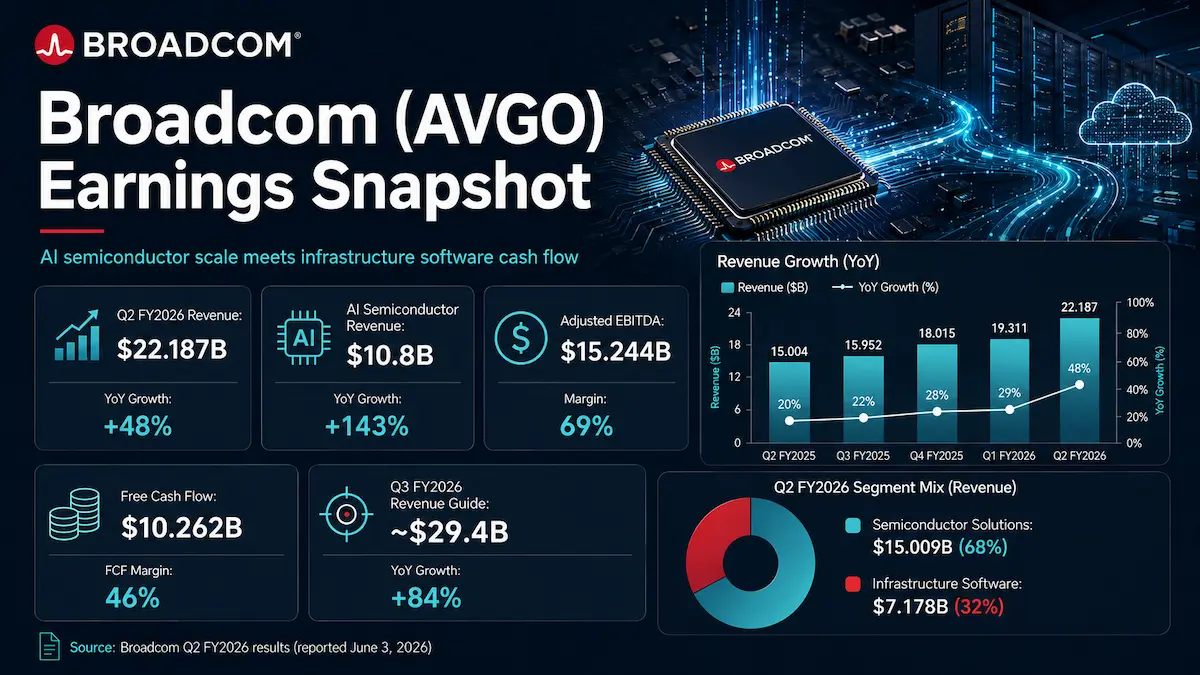
Fiscal 2025 revenue was $63.9 billion, split 58% semiconductor solutions and 42% infrastructure software. By Q2 fiscal 2026, quarterly revenue had reached $22.2 billion, up 48% year over year. Semiconductor solutions contributed $15.0 billion, or 68% of the quarter, while infrastructure software contributed $7.18 billion, or 32%. The mix change was driven primarily by custom AI accelerators and AI networking, not by deterioration in software: infrastructure software revenue still grew 9% year over year.
The most economically important shift is inside the semiconductor segment. Broadcom reported $10.8 billion of AI semiconductor revenue in Q2 fiscal 2026, up 143% year over year. That means AI alone represented roughly 72% of semiconductor segment revenue and almost half of companywide revenue for the quarter. Broadcom is therefore no longer simply exposed to AI as one growth vertical among many; AI infrastructure has become the dominant marginal driver of the company’s revenue trajectory.
Semiconductor solutions: custom compute plus the data-movement layer
Broadcom’s AI semiconductor economics are broader than custom accelerators. The company supplies custom XPUs, Ethernet switching and routing silicon, network interface products, PHYs, optical components, PCIe connectivity, SerDes technology, and increasingly rack- and system-level building blocks. This matters because AI clusters do not monetize only through compute. As cluster size rises, the value of moving data between accelerators, racks, and data-center sites rises as well. Broadcom can therefore capture content on both sides of the architecture: the accelerator and the network that keeps accelerators productively utilized.
The custom-ASIC model also changes competitive dynamics. A hyperscaler that co-designs a processor with Broadcom is not buying an interchangeable catalog chip. It is committing engineering teams, software assumptions, packaging choices, networking architecture, validation cycles, and production schedules to a multi-year program. Broadcom earns its position by helping translate a customer’s workload requirements into manufacturable silicon and then supporting the surrounding connectivity stack. The commercial relationship is narrower than a mass-market GPU ecosystem, but it can be extremely deep.
Outside AI, semiconductor revenue remains diversified across broadband, wireless, server and storage connectivity, industrial applications, and conventional networking. These franchises matter because they provide engineering reuse, customer access, cash generation, and exposure to infrastructure categories that do not move in perfect synchronization with AI capital spending.
Infrastructure software: high-value licenses, subscriptions, support, and mission-critical operating layers
Broadcom’s infrastructure software segment includes private cloud, mainframe software, cybersecurity, enterprise software, and Fibre Channel storage-area-network management. VMware Cloud Foundation, or VCF, is now the strategic center of the private-cloud portfolio. VCF integrates compute, networking, storage, management, and security and is designed to support virtual machines, containers, and increasingly private AI workloads under one operating model.
One accounting detail is especially important for investors analyzing the Broadcom business model. Broadcom reported Q2 fiscal 2026 product revenue of $16.9 billion and subscriptions and services revenue of $5.30 billion, but the product line is not equivalent to hardware. It included $1.96 billion of upfront software license revenue. A superficial hardware-versus-subscription split therefore understates the economic importance of software and can mischaracterize the company’s margin structure.
The software segment carries unusually high operating economics. In Q2 fiscal 2026, infrastructure software generated $5.65 billion of segment operating income on $7.18 billion of revenue, implying a segment operating margin of roughly 79% before corporate unallocated expenses. Semiconductor solutions generated approximately 62% on the same segment basis. These figures should not be confused with consolidated operating margin, but they illustrate why the VMware integration materially changed Broadcom’s profit architecture.
The platform strategy: own the control points at both ends of enterprise compute
Broadcom’s platform strategy is not a consumer-style ecosystem strategy. It is a control-point strategy. In hyperscale AI, the company aims to sit inside the custom compute, Ethernet, optical, and connectivity layers that determine cluster economics. In enterprise infrastructure, it aims to sit inside the virtualization, private-cloud, mainframe, security, and operations layers that determine how mission-critical workloads are run.
This creates a distinctive two-sided exposure to computing investment. When hyperscalers spend aggressively, Broadcom can monetize custom silicon and networking. When enterprises optimize infrastructure, repatriate selected workloads, modernize private cloud, or secure legacy systems, Broadcom can monetize software. The two businesses are not perfectly countercyclical, but their cash-flow profiles and customer use cases are sufficiently different to reduce dependence on any one traditional semiconductor end market.
The capital-allocation engine is part of the business model
Broadcom’s corporate history shows a repeatable operating pattern: acquire a strategically valuable infrastructure franchise, remove lower-priority activities, concentrate R&D and go-to-market resources on the most valuable customer relationships, increase monetization discipline, and recycle the resulting cash flow into R&D, debt service, shareholder returns, and future acquisitions. The 2016 combination of Avago and Broadcom created the modern semiconductor portfolio. CA Technologies in 2018 and Symantec’s Enterprise Security business in 2019 established the infrastructure-software playbook. VMware, completed in 2023, scaled that playbook dramatically. Broadcom’s subsequent sale of VMware’s end-user computing business for $3.5 billion in 2024 is consistent with the same tendency to prune assets that are not central to the control-point thesis.
The manufacturing model reinforces cash conversion. Broadcom outsources most leading-edge wafer production rather than funding a full advanced-node fab network itself, helping keep direct capital expenditure low relative to revenue. Q2 fiscal 2026 free cash flow was $10.26 billion, or 46% of revenue. The trade-off is that capital efficiency is partly purchased with supply-chain concentration: approximately 95% of wafers manufactured by Broadcom’s contract manufacturers in fiscal 2025 were produced by TSMC.
2. Deep Dive into Economic Moats
A Buffett-style moat analysis should distinguish durable economic friction from simple size, growth, or brand recognition. Broadcom has all three of those visible attributes, but none is sufficient by itself. The more defensible question is: what makes a rational customer continue using Broadcom even when a credible alternative exists?
Intangible Assets: strong, but the moat is know-how rather than patent count alone
Broadcom reported approximately 19,000 issued U.S. and international patents as of November 2, 2025, plus more than 2,000 pending applications. That IP estate matters, but patents alone are not the core moat. Broadcom itself states that it is not substantially dependent on any single patent or related group of patents. The more important intangible asset is accumulated engineering knowledge across high-speed SerDes, Ethernet switching, optical connectivity, RF, storage, ASIC implementation, packaging, firmware, and system integration.
That knowledge becomes more valuable when combined with customer-specific system insight. Broadcom’s engineers work with hyperscalers and OEMs on workloads, power envelopes, networking topologies, memory movement, and production constraints before a chip reaches volume manufacturing. A competitor trying to displace Broadcom therefore needs more than equivalent transistor performance. It must prove design competence, hit a customer’s schedule, qualify through the production chain, provide enough engineering capacity, and demonstrate that the surrounding networking and connectivity stack will work at scale.
The OpenAI collaboration is a recent illustration of this capability rather than independent proof of an unassailable moat. OpenAI and Broadcom announced in June 2026 that their first jointly developed inference processor, Jalapeño, moved from initial design to manufacturing tape-out in nine months, with initial deployment targeted by the end of 2026. OpenAI said early testing indicated materially better performance per watt than the current state of the art, although final performance was still being measured and had not yet been independently established. The more important competitive signal is the development cadence and the ability to industrialize a custom architecture alongside networking and rack partners.
Switching Costs: Broadcom’s strongest moat across both silicon and software
Switching costs are the clearest common denominator across Broadcom’s portfolio. In semiconductors, the switching cost is created during the design-win process. Once a custom accelerator, switch ASIC, RF component, or storage controller is embedded in a product or cluster architecture, replacing it can trigger redesign, validation, firmware changes, board or rack changes, qualification testing, inventory adjustments, and schedule risk. The cost is not merely engineering expense; it is the opportunity cost of delaying a product launch or an AI cluster deployment.
In software, the mechanism is different but equally economic. VMware, mainframe, security, and enterprise operations software often sits inside mission-critical production environments. Replacing a virtualization or infrastructure management layer can require application testing, migration tooling, retraining, security revalidation, operational redesign, and tolerance for service interruption. That creates genuine switching friction even when customers dislike a pricing or packaging change.
However, switching costs are not a license to over-monetize indefinitely. The SEC explicitly identifies customer acceptance of Broadcom’s software, services, and business strategy as a risk. If customers perceive the economic burden of staying as greater than the migration cost, switching costs can become a temporary profit pool rather than a durable moat. The sustainability test is therefore whether Broadcom continues to increase the customer’s total infrastructure value faster than it increases the customer’s economic dependence.
Network Effects: limited and frequently overstated
Broadcom does not possess a classic network effect comparable with a marketplace, social platform, or developer ecosystem whose value rises mechanically with user count. Ethernet benefits from a large standards-based ecosystem, and VMware has a broad installed base of operators, partners, and compatible infrastructure, but Broadcom does not exclusively own those networks. In fact, the openness of Ethernet is part of its appeal to hyperscale customers.
That distinction matters because Broadcom’s defensibility does not depend on locking the industry into a proprietary standard. It depends on repeatedly being one of the best suppliers inside open standards. This can produce excellent economics, but it requires continuous technical leadership rather than passive ecosystem rent extraction.
Cost Advantages: supportive, not the primary moat
Broadcom benefits from scale in R&D, purchasing, product reuse, and customer support, and its outsourced manufacturing model limits direct fab capital intensity. The software portfolio also has high incremental margins once core engineering and support infrastructure are in place. Yet these are supporting advantages rather than an impenetrable cost moat. Several competitors use the same leading foundries, and Broadcom’s dependence on TSMC means it does not control the most capital-intensive manufacturing bottleneck.
The more durable advantage is economic density: Broadcom can spread expensive engineering capability across a small number of very large design wins and infrastructure franchises where the value per engagement is high. That can generate superior returns without requiring Broadcom to be the industry’s lowest-cost producer in a commodity sense.
Moat verdict
Broadcom’s moat is strongest where switching costs intersect with scarce technical know-how. This combination is capable of supporting long-duration excess returns because a challenger must pay twice: first to recreate the engineering capability, and then to persuade a risk-sensitive customer to incur the cost of switching. The limitation is customer power. Hyperscalers are technically sophisticated, financially powerful, and increasingly willing to design their own silicon. Broadcom’s moat therefore protects a role in the value chain, but it does not eliminate pricing negotiation, insourcing risk, or the need to win each new generation.
3. Business Inflection Points & Future Catalysts
The decisive inflection point: VMware turned diversification into a second platform
Broadcom had already entered infrastructure software through CA Technologies and Symantec Enterprise Security, but VMware was the transaction that changed the company’s identity. The acquisition closed on November 22, 2023. Infrastructure software revenue was $7.64 billion in fiscal 2023; by fiscal 2025, it was $27.0 billion and represented 42% of total revenue. The comparison is not organic growth, because VMware was acquired, but it shows the scale of the strategic reset.
More importantly, VMware gave Broadcom a software platform rather than a collection of adjacent products. VCF can combine compute virtualization, software-defined networking, storage, security, automation, application services, and private AI under one operating layer. That creates a strategic symmetry with Broadcom’s semiconductor business: the company can monetize the physical data-movement layer of hyperscale AI while also monetizing the software control layer of enterprise compute.
The integration has also demonstrated the financial logic of Broadcom’s acquisition model. Fiscal 2025 gross margin rose to 68% from 63% in fiscal 2024, with Broadcom attributing part of the improvement to higher infrastructure software gross margin, increased license revenue, and lower software labor costs following the VMware integration. The risk is that margin extraction can run ahead of customer value creation; management therefore has to preserve product quality, ecosystem compatibility, and customer trust while maintaining the economics that justified the acquisition.
Catalyst 1: custom AI accelerators move from rapid growth to platform-scale deployment
The immediate catalyst is straightforward: more custom accelerators entering volume production, attached to more Broadcom networking and connectivity content. Q2 fiscal 2026 AI semiconductor revenue was $10.8 billion, up 143% year over year. Management guided Q3 AI semiconductor revenue to approximately $16.0 billion, more than 200% year-over-year growth. At the company level, Broadcom guided to approximately $29.4 billion of Q3 revenue. If both numbers are achieved, AI semiconductors alone would represent roughly 54% of total quarterly revenue.
The transmission mechanism is more powerful than unit growth alone. A successful custom-XPU program can pull Broadcom content into Ethernet scale-up and scale-out switching, optical interconnect, PCIe, NICs, PHYs, and rack-level systems. The October 2025 OpenAI partnership adds a visible multi-year deployment path: OpenAI and Broadcom announced plans to deploy 10 gigawatts of custom accelerators and Broadcom Ethernet systems, with deployments targeted to begin in the second half of 2026 and continue through 2029. Jalapeño is the first disclosed processor in that multi-generation program.
Observable indicators include reported AI semiconductor revenue, actual Q3 performance versus the $16.0 billion guide, the pace of OpenAI deployment milestones, new custom-ASIC design wins, Ethernet and optical product ramps, and inventory conversion into shipments. Broadcom’s inventory rose from $2.27 billion at fiscal year-end 2025 to $4.33 billion by May 3, 2026, primarily to support higher expected custom-AI-accelerator shipments, making execution on that inventory build particularly relevant.
The principal failure modes are customer delay or cancellation, hyperscalers shifting more design or implementation in-house, competitive wins by other ASIC or GPU suppliers, data-center power and construction constraints, product-yield problems, and foundry capacity limitations. Broadcom estimated its top five end customers accounted for approximately 45% of Q2 fiscal 2026 revenue. That concentration can make upside arrive quickly, but it can make a single program slip economically visible as well.
Catalyst 2: Ethernet captures a larger share of AI cluster value
Broadcom’s AI opportunity is stronger if Ethernet becomes a larger share of the scale-up as well as scale-out fabric. The commercial mechanism is simple: as accelerator counts rise, the network increasingly determines how much expensive compute capacity is actually utilized. Higher bandwidth, lower latency, better congestion control, more efficient optics, and power-aware system design can therefore increase networking content per cluster even when accelerator pricing becomes more competitive.
Broadcom’s latest portfolio includes Tomahawk and Jericho switching silicon, optical and physical-layer components, NICs, SerDes, and related connectivity. The OpenAI collaboration explicitly calls for Broadcom Ethernet solutions in both scale-up and scale-out. If that architecture performs well at gigawatt scale, it can serve as a reference point for other hyperscalers considering alternatives to more vertically integrated networking stacks.
Observable indicators include AI networking revenue growth, adoption of new Tomahawk and Jericho generations, optical-content growth, customer disclosures around Ethernet-based accelerator fabrics, and evidence that networking revenue grows with or faster than accelerator deployments. Execution risks include proprietary interconnect technologies, customer-specific architectures that reduce merchant networking content, optical supply constraints, and a failure to meet the power-efficiency or latency requirements of ever-larger clusters.
Catalyst 3: VMware Cloud Foundation converts installed-base switching costs into durable platform growth
The software catalyst is not simply higher VMware pricing. The higher-quality outcome would be broader adoption of VCF as a standardized private-cloud operating layer for both conventional applications and production AI. Broadcom released VCF 9.1 in May 2026 with additional production-AI, security, operations, and infrastructure capabilities. If customers consolidate more private-cloud functions onto VCF, Broadcom can increase software revenue per strategic account while preserving high incremental margins.
The transmission mechanism runs through platform consolidation. A customer that uses VCF for compute, networking, storage, automation, resilience, and private AI can reduce tool fragmentation but also becomes more deeply integrated with the platform. That can raise renewal durability, support larger enterprise agreements, and create cross-sell opportunities across security and operations products.
Observable indicators include infrastructure software revenue growth above the Q2 fiscal 2026 rate of 9%, VCF adoption and renewal commentary, segment operating income, customer migration from point products toward the integrated VCF stack, and evidence that private-AI functionality drives incremental deployments rather than merely protecting the existing virtualization base.
The principal risk is that Broadcom mistakes contractual leverage for product-market strength. Customers can respond to unfavorable economics or portfolio simplification by accelerating migrations to public cloud, alternative virtualization stacks, open-source platforms, or competing private-cloud architectures. Broadcom’s own SEC filings identify demand for data-center virtualization and customer acceptance of its software strategy as material risks. The catalyst works only if the economic value of VCF remains greater than the cost of leaving it.
Balance-sheet and valuation quality: cash generation can de-risk the acquisition model, but debt remains material
Broadcom’s cash engine gives management considerable flexibility. Q2 fiscal 2026 generated $10.49 billion of operating cash flow and $10.26 billion of free cash flow. At the same time, the company carried $66.72 billion of debt principal as of May 3, 2026. Stronger cash generation can reduce balance-sheet risk and increase strategic optionality, but continued large dividends, repurchases, or acquisitions compete with deleveraging for the same cash.
For investors, the quality of the next phase therefore matters as much as the headline growth rate. Revenue growth driven by a handful of highly concentrated AI programs deserves a different durability assessment from growth accompanied by broader customer diversification, rising networking content, stable software renewals, and continued free-cash-flow conversion.
4. Key FAQs
How does Broadcom make money from AI if it does not rely on selling a general-purpose GPU?
Broadcom monetizes AI primarily through custom accelerators and the networking and connectivity required to scale them. Its AI portfolio includes custom XPUs, Ethernet switching and routing silicon, NICs, PHYs, optical components, PCIe, SerDes, and system-level infrastructure. The economic thesis is therefore not that Broadcom must replace every general-purpose GPU. It can win by becoming the implementation and data-movement partner for hyperscalers that want workload-specific silicon and standards-based Ethernet at massive scale.
Why is VMware so important to the Broadcom business model after the acquisition?
VMware changed Broadcom’s revenue mix, margin structure, and strategic position. It gave Broadcom a large installed base in mission-critical virtualization and private cloud, created a software platform around VMware Cloud Foundation, and raised the share of high-margin infrastructure software in the consolidated business. It also introduced a new strategic challenge: Broadcom must monetize switching costs without pushing customers to conclude that migration is economically preferable. VMware is therefore both a moat amplifier and a test of capital-allocation discipline.
What is Broadcom’s strongest competitive moat versus Nvidia, other ASIC vendors, and hyperscalers’ in-house silicon?
Broadcom’s strongest moat is not a single processor architecture. It is the combination of custom-silicon implementation expertise, high-speed networking and connectivity IP, multi-year customer co-design relationships, and a track record of taking complex designs into volume production. Nvidia has a different and formidable advantage centered on a broad accelerated-computing software and hardware ecosystem, while hyperscalers can design more of their own silicon. Broadcom’s defendable niche is strongest when a customer wants customized compute but still needs an experienced implementation partner and a complete Ethernet connectivity stack. That moat can produce attractive economics, but it must be re-won with every new generation.
5. Conclusion
Broadcom’s corporate gene is unusually consistent: acquire or build scarce infrastructure franchises, concentrate resources on the highest-value control points, integrate tightly with a small number of demanding customers, and convert technical indispensability into cash flow. The company does not seek to own every layer of computing. It seeks to own layers where replacement is expensive and where a performance shortfall can compromise the economics of the entire system.
The VMware acquisition made that logic visible across both hardware and software. On one side, Broadcom is becoming a critical custom-compute and Ethernet supplier to hyperscale AI infrastructure. On the other, it controls a private-cloud and enterprise-software base with substantial switching costs and high incremental margins. The strategic coherence is stronger than the surface-level description of a diversified semiconductor-and-software conglomerate suggests.
The central question for the next several years is whether Broadcom can keep converting control points into higher customer value without allowing concentration, supplier dependency, aggressive monetization, or technological substitution to erode those control points. If custom AI ramps, Ethernet captures more cluster value, and VCF remains economically compelling to enterprises, Broadcom’s moat can deepen. If customers insource more silicon, deployment schedules slip, alternative interconnects gain share, or VMware customers accelerate migration, the same concentration that amplifies returns can amplify downside. That tension is the defining feature of the Broadcom business model.
Primary Sources
- Broadcom — Second Quarter Fiscal Year 2026 Financial Results: latest reported revenue, AI semiconductor revenue, free cash flow, segment mix, and Q3 guidance.
- U.S. SEC — Broadcom Fiscal Q2 2026 Form 10-Q: segment revenue, customer concentration, debt, revenue recognition, TSMC exposure, inventory, and operating-income data.
- U.S. SEC — Broadcom Fiscal 2025 Form 10-K: business description, economic risks, IP portfolio, fiscal 2025 segment results, VMware integration, and supply-chain disclosures.
- Broadcom — Company History: corporate lineage and major acquisition milestones.
- Broadcom — Completion of VMware Acquisition: official confirmation of the November 22, 2023 transaction close.
- OpenAI — Strategic Collaboration with Broadcom for 10 Gigawatts of Custom AI Accelerators: deployment scope, Ethernet architecture, and targeted 2026-2029 rollout.
- OpenAI — Broadcom and OpenAI Jalapeño Inference Processor: June 2026 processor disclosure, development cadence, early testing status, and multi-generation roadmap. Performance claims remain preliminary until final technical results are published.
- Broadcom — VMware Cloud Foundation 9.1: official description of the latest VCF production-AI and private-cloud capabilities.
Disclaimer: This article is intended solely for business logic discussion and corporate research purposes, and does not constitute investment advice of any kind.